Education Furniture Comparison: A Strategic Guide for UK Schools (2025)
🎯 Key Takeaway
An effective education furniture comparison involves evaluating procurement strategies beyond initial price to include long-term value, compliance, and educational impact. For most UK schools, a Durability-Led Procurement strategy provides an effective balance, reducing total cost of ownership and ensuring safety. However, understanding Budget-First and Flexibility-Focused approaches allows you to make the optimal choice for your specific circumstances, Saving Time & Stress in the long run.
Choosing the right furniture is a critical decision for any school business manager or headteacher. For an education furniture comparison, the choice isn’t just between different tables and chairs; it’s about selecting a procurement strategy that aligns with your school’s budget, educational philosophy, and long-term financial health. As of July 2026, pressures on school budgets are immense, yet the demand for high-quality, inspiring learning environments has rarely been greater.
With over 35 years of experience supplying UK schools, we’ve seen firsthand how these strategic decisions impact day-to-day operations. This guide will compare three core procurement strategies: Budget-First, Durability-Led, and Flexibility-Focused. We’ll analyse them across key factors to help you make an informed, confident decision that delivers lasting value for your students and staff.
Written by: The Cost Cutters UK Team | Reviewed by: Editorial Team, 35+ Years Experience; Rated Excellent On Trustpilot
ℹ️ Transparency Disclosure: This article is written by the experts at Cost Cutters UK based on our 35+ years of industry experience, internal data, and public research. Our goal is to provide a balanced, authoritative guide to help you make an effective decision for your institution. We believe transparency is key to building trust.
Quick Verdict: Which Education Furniture Strategy is Best?
For most UK schools, a Durability-Led Procurement strategy offers an effective long-term value. It balances manageable initial costs with superior longevity, compliance, and reduced maintenance, representing the most responsible use of school funds over time. However, the effective choice depends on your primary goal.
- Best for Severe Budget Constraints: Budget-First Procurement – for when the lowest possible initial spend is the only priority.
- Best for Long-Term Value: Durability-Led Procurement – for demonstrating excellent ROI and minimising future costs.
- Best for Modern Pedagogy: Flexibility-Focused Procurement – for creating dynamic, collaborative, and inclusive learning spaces.
Strategic Education Furniture Comparison at a Glance
Making the right choice requires a clear view of how each strategy performs against critical metrics. The following table provides a direct Classroom Table Comparison and wider furniture strategy analysis, comparing our three core procurement approaches to help you identify an effective fit for your school’s specific needs and priorities.
| Dimension | Budget-First Procurement | Durability-Led Procurement | Flexibility-Focused Procurement |
|---|---|---|---|
| Initial Cost | Lowest | Medium-High | Highest |
| Long-Term Value (5-Year TCO) | Poor | Excellent | Good |
| Compliance & Safety (BS EN 1729) | Risky / Inconsistent | likely to support | likely to support |
| Educational Impact | Potentially Negative | Positive | Very Positive |
| Typical Product Choices | Basic, non-compliant items, short warranties | Certified chairs & tables, reliable materials | Modular tables, mobile units, soft seating |
| effective Use Case | Temporary classrooms, emergency replacements | Core curriculum spaces, new builds, whole-school refresh | Sixth forms, SEN provisions, innovation hubs |
| Procurement Complexity | Low | Medium | High |
Best for Budget-First Procurement
Best for: Schools with severe, immediate budget constraints or for short-term, temporary needs.
This strategy prioritises one thing above all else: the lowest possible upfront price. It involves sourcing the most basic, cheapest items available to fill a space, often from non-specialist suppliers. While it can seem like a solution during a funding crisis, our experience shows it frequently leads to higher costs and greater stress down the line.
Pros:
- Lowest Initial Outlay: Frees up capital for other urgent needs in the very short term.
- Fast Sourcing: Basic, mass-produced items are often available for next-day delivery.
- Simple Decision-Making: The choice is driven by a single variable: price.
Cons:
- High Total Cost of Ownership (TCO): Frequent repairs and replacements can make this the most expensive option over 3-5 years.
- Compliance Risks: Products may not meet crucial safety standards like BS EN 1729, creating potential liability. You can learn more about the current school furniture regulations UK to understand the risks.
- Negative Educational Impact: Uncomfortable or broken furniture can disrupt learning and negatively affect student behaviour.
- Poor Durability: Materials and construction are often substandard, leading to failures within a short period.
Best for Durability-Led Procurement
Best for: Schools prioritising long-term value, minimising replacement costs, and demonstrating Return on Investment (ROI) to governors.
This is the strategy we recommend for the majority of UK schools. It focuses on the total cost of ownership rather than just the initial price tag. By investing in products that are certified for strength and stability (like those meeting BS EN 1729 standards), you purchase items designed to withstand the rigours of school life for years. This is about calculating the long-term value of your investment.
Pros:
- Excellent Long-Term Value: Lower TCO due to minimal repair and replacement needs. A key part of any School Chair Evaluation.
- likely to support Compliance: Products are certified to meet safety and ergonomic standards, safeguarding students and the school.
- Longer Warranties: Reputable suppliers offer may help of 5, 10, or even 15 years on these items.
- Positive Learning Environment: Well-made, appropriate furniture contributes to a sense of order and value, which can improve student focus. We offer guides on choosing the correct classroom chairs by age.
Cons:
- Higher Initial Investment: The upfront cost is greater than the budget-first approach.
- Longer Lead Times: Quality, certified furniture may not typically be available for immediate dispatch, requiring better planning.
- Requires More Research: Differentiating between genuinely durable products requires more than a simple price check.
Case Study: A Strategic Shift to Durability
– Challenge: A multi-academy trust was spending over £80,000 annually on reactive furniture repairs and replacements across its primary schools. Furniture was failing mid-year, disrupting classes and creating safety concerns.
– Solution: We worked with the trust to implement a Durability-Led procurement strategy. They used their Bulk Buy Discounts to invest in a planned replacement programme using BS EN 1729-certified tables and chairs with 10-year may help.
– Results: Within three years, the trust’s reactive replacement spend dropped by 75% to just £20,000. No in-year failures were reported in the newly kitted-out classrooms, and staff feedback on classroom quality improved significantly.
– Insight: A planned, upfront investment in certified, durable furniture delivered substantial long-term savings and eliminated operational headaches.
Best for Flexibility-Focused Procurement
Best for: Schools adopting modern, collaborative teaching methods and catering to diverse student needs, including Special Educational Needs (SEN).
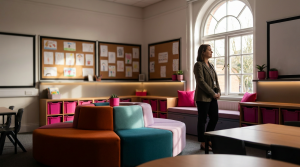
This forward-thinking approach views furniture as an active tool for learning. It involves purchasing modular, mobile, and varied items that allow teachers and students to reconfigure a space quickly for different activities – from individual deep work to group collaboration. This is the most expensive strategy upfront but can deliver a powerful educational impact when aligned with a school’s pedagogical vision. A proper Whiteboard & Display Board Selection is also crucial here.
Pros:
- Supports Modern Pedagogy: Enables active, student-led learning, project-based work, and collaborative tasks.
- Enhanced Inclusivity: Caters to diverse learning styles and physical needs, including those of SEN students.
- Future-Proofs Classrooms: Creates adaptable spaces that can evolve as teaching methods change.
- Boosts Student Engagement: A dynamic environment can increase student ownership and motivation.
Cons:
- Highest Initial Cost: These specialised items carry a premium price tag.
- Requires Teacher Training: To maximise the investment, staff need professional development on how to use the flexible space effectively.
- Potential for Misuse: Complex mechanisms on some items can be damaged if not used correctly.
- Can Create a “Messy” Look: Without clear routines, a flexible classroom can appear disorganised.
When to Choose Each Procurement Strategy
Selecting the right strategy comes down to aligning your procurement with your school’s immediate and long-term priorities. Use this guide to make a clear choice.
- Choose Budget-First if… you are outfitting a temporary classroom for a single term, dealing with an emergency replacement with no available funds, or purchasing items for very low-traffic areas. This should be a last resort, not a default strategy.
- Choose Durability-Led if… you are undertaking a whole-school refresh, managing a new build project, or needing to present a financially sound 5-10 year plan to governors. This is the default choice for core classroom, dining, and library spaces.
- Choose Flexibility-Focused if… your school is launching a new curriculum based on project-based learning, opening a specialised sixth form centre or innovation hub, or actively looking to improve provision for students with diverse learning needs.
If you’re still unsure, our advice is to start with a Durability-Led approach as your foundation and incorporate specific flexible elements where the curriculum demands it and the budget allows. This hybrid model often provides an effective of both worlds. For a comprehensive overview, review The Ultimate Furniture Buying Guides for UK Education, Office & Leisure.
Important Considerations
This guide provides a strategic framework, but every procurement project has unique variables. The cost and value figures presented are illustrative and based on industry averages; your specific costs will depend on supplier, volume, and product choice. We strongly recommend seeking detailed quotes and product specifications before making a final decision. Remember, you can often secure Bulk Buy Discounts for larger orders.
While this article focuses on three primary strategies, other models exist. Some schools explore furniture leasing to manage cash flow, or source second-hand items. Leasing can be effective but may have a higher total cost over time. Second-hand furniture can be a risk, often lacking warranties and a clear history of compliance, which research from sources like NFER (2023) suggests is a growing concern for school leaders.
For large-scale projects, new builds, or complex refurbishments, we recommend consulting with a specialist. An experienced partner can provide a complete “Design To Install We Do It All!” service, including space planning, product selection, and project management. This professional guidance is invaluable for navigating building regulations, optimising layouts, and ensuring the final result meets your educational objectives, ultimately Saving Time & Stress.
Frequently Asked Questions
What is the best approach for an education furniture comparison?
an effective approach for an education furniture comparison is a Durability-Led strategy for most schools. This method prioritises long-term value, safety compliance, and reduced lifetime costs over a low initial price. It represents the most fiscally responsible choice by minimising future repair and replacement budgets, ensuring you make a sustainable investment.
How important is BS EN 1729 compliance for UK schools?
It is critically important for UK schools to choose furniture compliant with BS EN 1729. This standard ensures that furniture has the correct dimensions for children’s ergonomics and has passed strength and stability tests. Non-compliant furniture can be a safety risk and may negatively impact students’ posture and ability to concentrate.
What is ‘Total Cost of Ownership’ for school furniture?
Total Cost of Ownership (TCO) is the complete cost of a piece of furniture throughout its life. It includes the initial purchase price plus the costs of repairs, maintenance, and eventual replacement. A cheap chair that needs replacing every two years has a much higher TCO than a more expensive, durable chair that lasts for ten years.
Should I mix and match furniture from different suppliers?
Mixing suppliers can be effective, but it requires careful management. Whilst it can help you find an effective price for individual items, it can lead to inconsistencies in quality, colour, and warranty terms. Using a single-source supplier like Cost Cutters UK simplifies procurement, ensures a cohesive look, and makes managing deliveries and warranties much easier.
What’s the difference between a static and a mobile whiteboard?
A static whiteboard is fixed to a wall, whereas a mobile whiteboard is on a wheeled stand. Static boards are great for dedicated teaching walls in a traditional classroom layout. Mobile whiteboards, often featured in catalogues from suppliers like YPO, offer flexibility, allowing them to be used as space dividers or for group work in different areas of the room.
Are ergonomic chairs worth the extra cost for schools?
Yes, ergonomic chairs that comply with BS EN 1729 are worth the investment. They are designed to support healthy posture and reduce fidgeting, which can improve student concentration and well-being. The “extra cost” is often minimal when viewed through the lens of TCO, as these chairs are typically more durable than their non-ergonomic counterparts.
How can I future-proof my classroom furniture investment?
Future-proof your investment by choosing durable, classic designs and incorporating some flexible elements. Opt for neutral colours for big-ticket items like tables and storage, using chairs for colour. Investing in a few mobile or modular pieces, as seen in collections from specialists like Kinnarps, allows you to adapt spaces without needing a complete refit as teaching styles evolve.
What are the most durable materials for school tables?
The most durable school tables typically feature a solid MDF core with a high-pressure laminate (HPL) top. This combination is highly resistant to scratching, heat, and impact. The frame should be fully welded steel with a tough epoxy coating. Some innovative options now include materials like recycled plastics, as highlighted by suppliers like British Recycled Plastic, for outdoor use.
How long should school chairs last?
A high-quality, certified school chair should last for at least 10-15 years. Many reputable suppliers, including Cost Cutters UK, offer may help of this length on their durable ranges. Cheaper, non-certified chairs may only last 1-3 years in a demanding school environment, making them a poor long-term investment.
How do I get help with planning my classroom layout?
Most specialist educational furniture suppliers offer a free space planning and design service. At Cost Cutters UK, our “Design To Install We Do It All!” service includes expert consultation to help you create a layout that is safe, efficient, and meets your educational goals. We use your room dimensions to create 2D and 3D plans for your approval.
Our Commitment to Value and Service
Ultimately, this education furniture comparison shows that the smartest choice is rarely the cheapest one upfront. A Durability-Led Procurement strategy is the most prudent path for most institutions, striking a crucial balance between initial cost and long-term value. It ensures compliance, minimises future expenditure, and creates a better learning environment. By focusing on longevity and total cost of ownership, you make a responsible investment in your school’s infrastructure.
When you’re ready to plan your next project, remember that you don’t have to do it alone. As a partner with over 35 years of experience, we’re here to help. We offer Bulk Buy Discounts and flexible payment options, including Credit Accounts Or Pay Flexibly, to make high-quality furniture accessible. From initial design to final installation, our team is committed to making the process smooth. Check out our full range of school furniture and let us help you build a better learning environment.
References
- BSI Group (2024). BS EN 1729 Parts 1 & 2: Furniture – Chairs and tables for educational institutions. This standard outlines the functional dimensions, safety requirements, and test methods for classroom furniture in the UK and Europe.
- Department for Education (DfE) (2023). Buying for schools guidance. Official UK government guidance encouraging schools to seek value for money, which includes considering the total cost of ownership, not just the initial price.
- National Foundation for Educational Research (NFER) (2023). School Leader Survey Report. This annual survey often highlights the financial pressures on schools and the challenges of balancing budgets with the need for quality resources.
- Kinnarps (2024). The Impact of Learning Environments on Educational Outcomes. A report based on case studies showing how flexible furniture can support different pedagogical approaches.
- YPO (2024). Annual School Supplies Catalogue. A procurement data source indicating product trends and price points for the UK education sector.
- UK Educational Furniture (2024). Blog and Product Descriptions. Analysis of their online materials provides insights into market positioning and common product specifications in the UK.
- British Recycled Plastic (2023). Product Sustainability Report. Data from their reports shows the lifecycle and durability benefits of using recycled materials for outdoor furniture, a principle applicable to TCO calculations.
Conclusion
Key Takeaways and Next Steps
In conclusion, this education furniture comparison reveals that while every school’s needs are unique, a Durability-Led Procurement strategy is the most prudent choice for the majority of UK schools. It strikes the crucial balance between a manageable initial cost and superior long-term value, ensuring full compliance with safety standards and minimising the recurring expenditure and disruption caused by repairs and replacements. By shifting the focus from the initial price tag to the total cost of ownership, school business managers can make a fiscally responsible investment that not only enhances the school’s physical infrastructure but also directly supports a better learning environment for students. This approach demonstrates foresight and a commitment to quality that resonates with governors, parents, and staff alike.
When you’re ready to plan your next project, consider a full-service partner to simplify the process and guarantee the best outcome. At Office Furniture Online, our expertise is rooted in helping schools navigate these exact decisions. We offer complimentary space planning services, detailed quotations that clarify total cost of ownership, and a vast range of furniture that meets the highest standards of durability and safety. Our team is committed to helping you implement a procurement strategy that aligns with your budget, pedagogical goals, and long-term vision. Let us help you build a resilient and inspiring learning space that will serve your community for years to come.