School Storage Solutions: A UK Guide to Maximising Space & Organisation
🎯 Key Takeaway
Effective school storage solutions involve strategically using durable, compliant, and flexible furniture to maximise space, improve organisation, and support learning outcomes in UK schools. This approach transforms storage from a mere necessity into a strategic asset for educational environments. Prioritise multi-functional and mobile units to create adaptable learning spaces that can change with curriculum needs. Select storage based on specific zones, such as classrooms, libraries, and SEN areas, ensuring it is age-appropriate and fit for purpose. Lastly, ensure all furniture complies with UK safety standards like BS EN 1729 to guarantee pupil safety and secure long-term value for money. This guide provides school business managers with a strategic framework for procuring storage that enhances operational efficiency and supports education.
A cluttered classroom with overflowing book corners and corridors blocked by bags is a familiar sight. This chaos does more than just look untidy; it actively hinders learning, increases stress for staff, and can even pose safety risks. Effective school storage solutions are the answer, but this means looking beyond just buying more cupboards. It’s about making a strategic investment in furniture that transforms your learning environment. The right approach to classroom organisation solutions can reclaim valuable floor space, improve lesson flow, and create a calmer, more productive atmosphere for pupils and teachers alike. As of July 2026, with space and budgets under constant pressure, making smart procurement decisions is more critical than ever. This guide will walk you through choosing the right units, meeting UK compliance, and adopting a full-service procurement process that saves you time and stress.
Written by: Costcutters UK Content Team | Reviewed by: Costcutters UK Editorial Team, 35+ Years in UK Education & Commercial Furniture Supply
Rated Excellent On Trustpilot
ℹ️ Transparency Disclosure: This article explores school storage solutions based on our 35+ years of industry experience, product analysis, and adherence to UK safety standards. Our goal is to provide authoritative, practical advice. Some links may connect to our services or product pages. All information is verified by our editorial team to ensure accuracy and relevance for UK school managers.
The Challenge: Maximising Space & Budgets in UK Schools
UK schools face a persistent dual challenge: operating within tight budgetary constraints while accommodating rising pupil numbers in buildings that aren’t getting any bigger. Data from the Department for Education (DfE) on school capital funding highlights the continuous pressure on resources, forcing school business managers to make every pound count. According to the Education Endowment Foundation’s (2021) research, while the impact can be modest, a well-organised physical environment is positively associated with better learning outcomes.

This is where strategic investment becomes crucial. Viewing high-quality, compliant storage not as an expense but as a long-term asset is a fundamental shift. Cheaper, non-specialist furniture may save money initially but often fails to withstand the rigours of a school environment, leading to higher replacement costs and potential safety issues. The Health and Safety Executive (HSE) guidance underscores that schools have a legal duty to provide a safe environment, which includes the provision of safe and stable furniture.
Therefore, the objective is to find solutions that deliver value over their entire lifecycle. Smart storage maximises the utility of every square metre, improves operational efficiency for teaching staff, and ensures a safe, organised space conducive to learning. It’s an investment in the school’s most valuable assets: its pupils and its staff.
What are the best storage solutions for each school zone?
The most effective approach is to select storage tailored to the specific function and user needs of each area within the school. A one-size-fits-all solution rarely works. Instead, by analysing the unique demands of classrooms, libraries, and specialist rooms, you can create a cohesive and highly functional environment. Our experience shows that this zonal approach maximises space and supports targeted educational activities.
Classroom Storage (EYFS, Primary & Secondary)
Classroom storage needs vary significantly with age. For the Early Years Foundation Stage (EYFS), where children learn through play, storage must be low-level, open, and easily accessible. Think brightly coloured tubs and shallow trays that allow young children to see and choose resources independently.
In primary schools, reliable tray units are a staple of classroom storage furniture uk. They provide excellent organisation for individual pupil work and shared resources. As pupils get older, the need for secure storage increases. Secondary classrooms often benefit from a mix of open shelving for books and taller, lockable cupboards for equipment and supplies. When planning, consider how storage interacts with other furniture; for example, the height of storage units should complement the size of your classroom chairs. For guidance on this, see our article on choosing classroom chairs by age.
SEN & Accessible Storage
For pupils with Special Educational Needs (SEN), which refers to learning difficulties or disabilities that require special educational provision, storage is a key tool for fostering independence. SEN classroom storage solutions should be thoughtfully designed. Using colour-coded trays, clear picture-based labels instead of text, and ensuring units are at an appropriate height can make a significant difference. Easy-to-use mechanisms are also vital. The goal is to create a predictable, easily navigated environment that empowers every pupil.
Library, Cloakroom & Corridor Storage
School library storage needs to be versatile. We recommend a combination of high-capacity static wall shelving for the main collection and mobile, double-sided bookcases to create flexible reading zones or quiet study areas. Don’t forget specialised storage for different media types.
In high-traffic cloakrooms and corridors, durability is paramount. Heavy-duty hook boards, benches with built-in compartments for bags, and reliable locker units keep these areas tidy and, more importantly, safe by preventing trip hazards.
Specialised Rooms (Science, Art, Music)
Specialised rooms have specialised needs. Science labs require cupboards made from chemical-resistant materials to comply with safety standards. Art rooms benefit from large plan chests for storing oversized paper and artwork flat. For music rooms, secure and properly sized instrument storage is essential to protect valuable equipment.
How do you choose the right school storage unit?
Choosing the right school storage units involves matching the furniture’s form and function to your specific needs, considering factors like flexibility, accessibility, and the types of materials being stored. The effective solution is often a blend of different types. For example, mobile units offer adaptability for dynamic learning spaces, while static cupboards provide high-density, secure storage for resources that aren’t used daily.
The material is also a key consideration. Melamine-faced chipboard (MFC) is a popular and cost-effective choice for general classroom use, offering good durability and a wide range of finishes. For environments demanding maximum toughness, such as workshops or science labs, fully welded steel units may be more appropriate.
To help you decide, we’ve compared the most common types of school storage below.
| Storage Type | Best For | Key Benefits | Considerations |
|---|---|---|---|
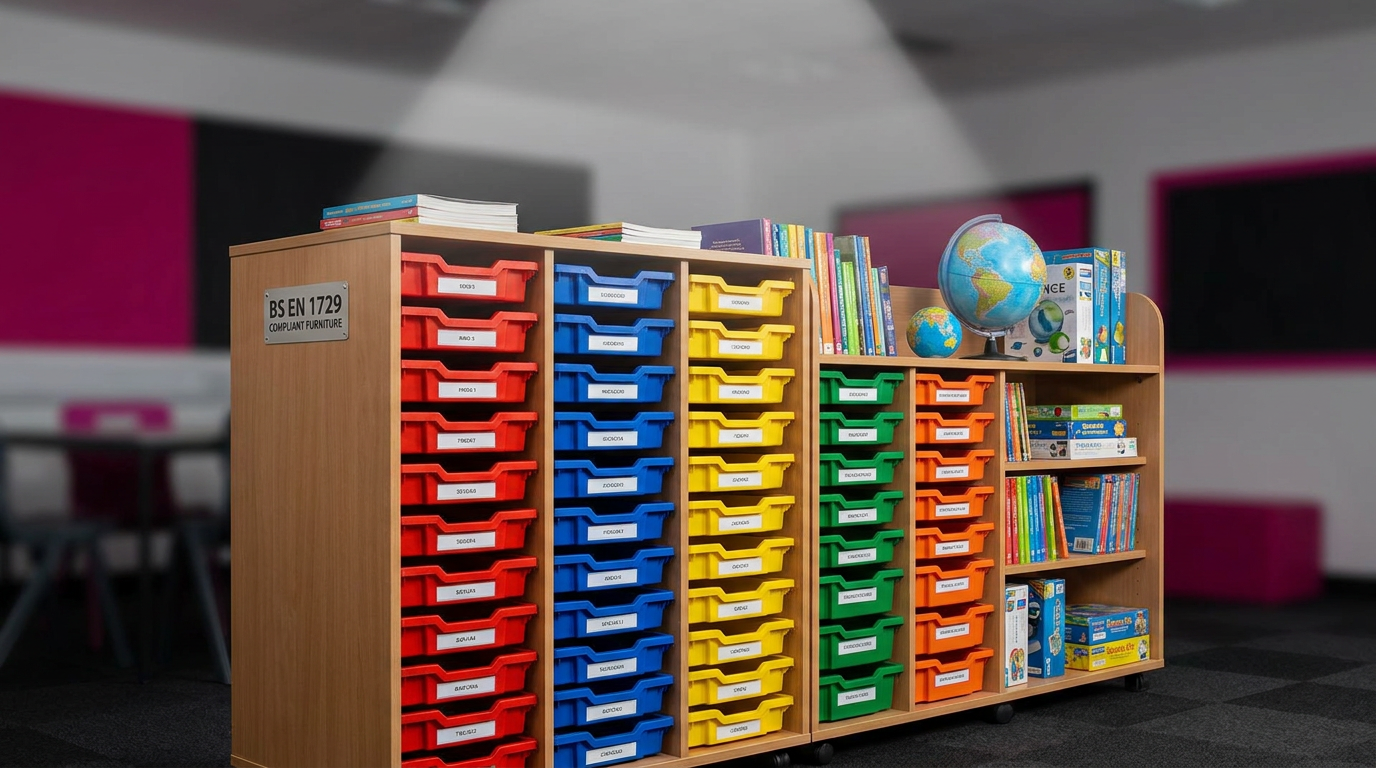
| Static Tray Units | Primary classrooms, resource rooms | High-density, organised storage for individual items; clear or coloured trays allow for easy content identification. | Fixed in place; less flexible for reconfiguring room layouts. |
| Mobile Tray Units | Dynamic learning spaces, EYFS, SEN classrooms | Excellent flexibility; resources can be moved to point of use. Lockable castors provide stability. | May have slightly lower capacity than static equivalents. Check castor quality for durability. |
| Stock Cupboards | Staff rooms, prep rooms, offices | Secure, high-capacity storage for bulk supplies, stationery, and equipment. Often feature adjustable shelves. | Can be bulky; less suitable for direct pupil access in a busy classroom. |
| Bookcases & Shelving | Libraries, reading corners, classrooms | Open access to books and learning materials, encouraging pupils to browse and select resources independently. | Can look untidy if not well-managed. Ensure units are stable and consider wall fixing. |
What do compliance and safety mean for school furniture?
Ensuring all furniture meets UK safety regulations is a non-negotiable aspect of procurement. The key standard for educational furniture is BS EN 1729. This British and European standard is not just a suggestion; it is a critical benchmark for pupil safety and a school’s duty of care. It specifies essential requirements for strength, stability, and durability, ensuring furniture can withstand the demands of a school environment without tipping, breaking, or collapsing.
BS EN 1729 is divided into two parts:
- Part 1: Focuses on functional dimensions, defining appropriate chair and table heights for different age groups to ensure good posture and ergonomic support.
- Part 2: Details safety requirements, including tests for stability (to prevent tipping), strength (to handle heavy loads), and durability (to withstand daily use and abuse).
Opting for compliant, durable school storage is a mark of responsible purchasing. While it may sometimes involve a higher initial outlay, it represents far better long-term value. Compliant furniture lasts longer, reduces the risk of accidents and potential liability, and demonstrates a clear commitment to pupil welfare. Typically ask for certification from your supplier and consult a comprehensive guide to school furniture regulations in the UK for detailed information.
Beyond the Catalogue: A Full-Service Approach to Procurement
Procuring furniture for a school involves much more than just picking items from a catalogue. For busy school business managers, the process of measuring spaces, selecting appropriate units, coordinating deliveries, and managing installation can be incredibly time-consuming. This is where a full-service approach offers significant advantages, “Saving Time & Stress”.
At Cost Cutters UK, our “Design To Install We Do It All!” philosophy covers every stage of the project. The process begins with a free consultation and site survey to understand your unique needs. From there, our team creates a professional 2D or 3D space plan, allowing you to visualise the layout and ensure it maximises your space before committing to an order. This planning stage is crucial for avoiding costly mistakes.
Once the plan is approved, we help you select the right school storage units and other furniture, often providing Bulk Buy Discounts for larger projects. We manage the entire delivery and installation process using our own vetted, DBS-checked teams, ensuring everything is built correctly and placed according to the plan. We can also arrange for the ethical removal and recycling of your old furniture. This comprehensive service,
Related Resources
streamlines the entire project from concept to completion, allowing school managers to focus on their core responsibilities.
Frequently Asked Questions About School Storage
What are school storage solutions?
School storage solutions are a strategic system of furniture designed to improve organisation, maximise space, and support educational activities within a school. This goes beyond simple cupboards, encompassing a range of units like mobile tray storage, static shelving, cloakroom benches, and specialised cabinets. The goal is to create an orderly and accessible environment. Choosing the right combination depends entirely on the specific needs of the space, the age of the pupils, and the curriculum.
What is the best storage for a primary school classroom?
The best storage for a primary school classroom is typically a combination of mobile, multi-functional units and accessible tray storage. Shallow tray systems, like those from Gratnells, are ideal for organising resources by subject or activity, giving teachers excellent control. Low-level units ensure pupils can safely access materials themselves, fostering independence. A mix of open shelving for easy access and cupboards for less frequently used items provides a balanced approach to classroom organisation.
How can I make classroom storage more accessible for SEN pupils?
To make storage more accessible for SEN pupils, focus on clear visual systems and appropriate physical design. Use colour-coded trays and large, clear picture labels instead of text-only ones to help pupils identify contents easily. Ensure units are at a suitable height for all children, including wheelchair users. Mobile units are particularly effective, as they allow resources to be brought directly to a pupil’s workspace, reducing movement and anxiety.
Are mobile storage for schools durable enough for daily use?
Yes, commercial-grade mobile storage for schools is specifically designed for the rigours of daily use. These units feature robust, fully-welded steel frames, heavy-duty castors (many with brakes for stability), and durable MFC panels with protective edging. Unlike domestic furniture, they are built to withstand constant movement and heavy loads. Always check the manufacturer’s warranty and weight capacity to ensure you are purchasing a truly durable product.
What regulations apply to school storage furniture in the UK?
The primary regulation for UK school furniture, including storage, is the British and European standard BS EN 1729. This standard specifies essential requirements for strength, stability, and safety to prevent accidents like tipping or collapse. It also provides ergonomic dimensions for furniture intended for children. Reputable suppliers must be able to provide certification that their products meet this standard, which is crucial for compliance and pupil safety.
How do I choose storage for a school library?
Choosing school library storage requires a mix of high-capacity static shelving and flexible mobile units. Static wall shelving is perfect for housing the main book collection efficiently. Double-sided mobile bookcases on castors are excellent for creating adaptable zones for group work or quiet reading. Remember to consider different shelf depths for picture books versus novels and to incorporate specific storage for digital media, magazines, or display purposes.
What are the benefits of using tray storage systems?
The main benefits of tray storage are superior organisation, flexibility, and resource management. The modular, colour-coded nature allows teachers to easily sort, store, and distribute materials for specific lessons, topics, or pupil groups. Because the trays are removable, they function as portable kits that can be taken to desks or different learning zones. This system is highly adaptable and can be reconfigured as curriculum needs change throughout the academic year.
How can I store pupil bags and coats efficiently?
The most efficient way to store bags and coats is with dedicated cloakroom furniture that keeps corridors clear and safe. This can include wall-mounted hook boards, benches with integrated compartments for shoes or bags, or individual lockers for older pupils. The key is to provide enough space for each pupil to prevent clutter and trip hazards. Given the high traffic in these areas, choosing durable school storage made from robust materials is essential.
Transforming Your School with Strategic Storage
In summary, school storage solutions are a foundational element in creating organised, efficient, and inspiring learning environments. By moving beyond simple tidiness and focusing on strategic choices – from mobile units and zone-specific furniture to ensuring BS EN 1729 compliance – school leaders can directly support teaching and learning while guaranteeing long-term value for their budget. A well-organised space is a prerequisite for a well-run school.
At Cost Cutters UK, we have spent over 35 years helping schools solve these challenges. Our end-to-end service, from design to installation, removes the stress from procurement. If you are ready to transform your space, book a free space planning consultation with our specialist team today.
References
- Health and Safety Executive (HSE) – School Safety Guidance – UK Government Guidance. Provides the legal framework and best practices for managing health and safety in UK schools, including the safe provision and maintenance of furniture and equipment.
- Department for Education (DfE) – School Capital Funding – Government Report. Details the allocation of capital funding to schools, which informs budgetary constraints and investment priorities for school business managers.
- British Standards Institution (BSI) – BS EN 1729 – Standards Body Publication. Defines the specific dimensions, strength, and stability requirements for furniture used in educational settings to ensure it is safe and ergonomic for pupils.
Specialised Rooms (Science, Art, Music)
For rooms with specific functions, storage must be equally specialised. Science labs require secure, chemical-resistant cupboards (like those made from Trespa) for safety. Art rooms benefit from large-format plan chests for paper and drying racks for artwork. In music rooms, bespoke shelving and lockable cabinets are needed to protect valuable and awkwardly shaped instruments, ensuring they remain organised and secure when not in use.
Choosing the Right Type of School Storage Unit
The most effective approach is to select a mix of storage types that cater to different needs for access, security, and flexibility. When choosing school storage units, consider how the space will be used. Mobile units are ideal for creating dynamic zones, while static