Open Plan vs Private Offices: A Data-Driven Guide for UK Workplaces
🎯 Key Takeaway
The debate over open plan vs private offices reveals that neither layout is universally superior; productivity is maximised by matching the workspace design to specific job functions and organisational needs. Open-plan offices can boost spontaneous collaboration but often lead to significant noise distractions and a documented decrease in productivity for focused tasks. Private offices excel at supporting deep work and confidentiality but may create communication silos and be less space-efficient or cost-effective. A hybrid office model, featuring zoned areas with acoustic furniture and bookable pods, offers a flexible and productive solution for most modern UK organisations.
The long-standing debate over open plan vs private offices has become more critical than ever for UK organisations. As of May 2026, businesses are still refining their work environments in the wake of major shifts in work culture. For years, the trend leaned heavily towards vast, open spaces, promising collaboration and cost savings. However, the reality has often been a trade-off with employee focus and well-being. The core issue is that a one-size-fits-all approach simply doesn’t work. This guide cuts through the noise, presenting a data-driven analysis to help you move beyond the binary choice. With our 35+ years of experience providing complete school and office furniture solutions, we’ve seen first-hand that the most effective workspaces are nuanced, flexible, and tailored to the people who use them.
Written by: The Cost Cutters UK Content Team | Reviewed by: Industry Specialists, 35+ Years Experience; Rated Excellent On Trustpilot
ℹ️ Transparency Disclosure: This article explores the debate between open plan and private office layouts based on industry research, academic studies, and our 35 years of experience in workspace design. Our goal is to provide authoritative, practical guidance. Some links may connect to our services, such as our breakout furniture and space planning consultations. All information is verified by our editorial team. Cost Cutters UK is a leading supplier of furniture to UK schools, public sector bodies, and businesses.
The Core Conflict: Defining Open-Plan and Private Office Layouts
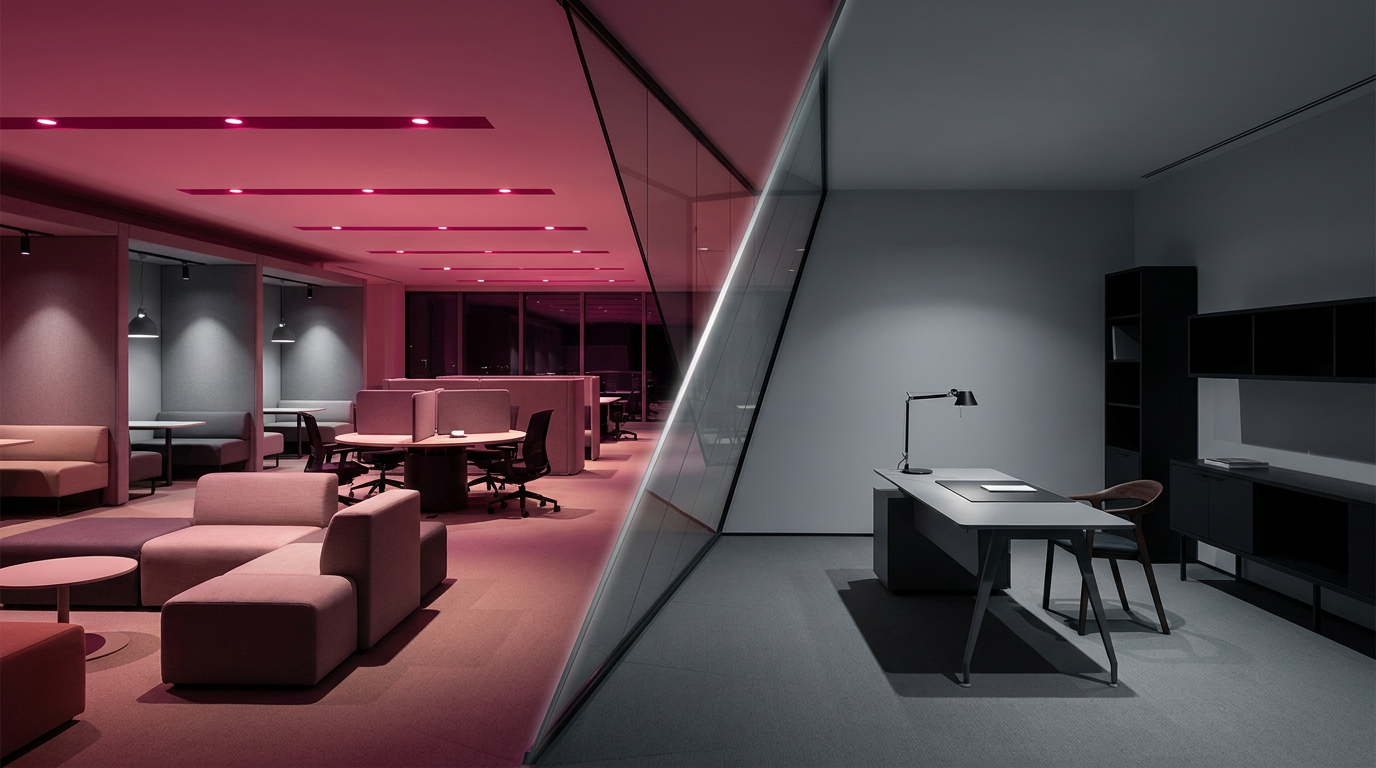
An open-plan office is a workspace with minimal or no physical barriers between employees, typically featuring large, shared desks or ‘hot-desking’ arrangements where staff don’t have a permanently assigned seat. The core philosophy is to foster collaboration, transparency, and a sense of egalitarian community. In contrast, a private office layout, often called a cellular office, is a workspace composed of individual, enclosed rooms for one or more employees. This design prioritises privacy, quiet, and the ability to concentrate without interruption, making it a traditional choice for executive suites and professions requiring confidentiality.
The historical shift from private to open-plan designs was driven largely by a desire to reduce real estate costs and break down hierarchical structures. However, as organisations measure the true cost of distraction, the conversation is shifting again. A modern office layout now frequently seeks to blend elements of both. According to an analysis by Servcorp UK (2023), the choice is not just about aesthetics but about aligning the physical environment with company culture and work processes. The most effective approach, as noted by workspace consultants at Cambraicourt (2023), involves a strategic assessment of how your teams actually work.
Open Plan vs Private Offices: A Head-to-Head Comparison
A direct comparison of open plan vs private offices highlights the fundamental trade-offs managers must make. While open plans appear cheaper and more collaborative on the surface, the hidden costs of lost productivity and employee dissatisfaction can be substantial. Private offices offer an environment for deep focus but can be less space-efficient and may inadvertently create communication silos if not managed correctly. There is no single winner; the optimal choice depends entirely on balancing these competing factors against your organisation’s specific goals.
This balance is the central challenge. According to a guide from Contract Interior Systems (2024), “an effective office layout is one that supports the tasks being performed within it.” This means a design agency and a law firm will have vastly different environmental needs. The table below breaks down the key attributes of each layout to help clarify these differences. It’s not just about cost per square foot, but about the cost of distraction versus the value of collaboration.
| Feature | Open-Plan Office | Private Office | Key Consideration |
|---|---|---|---|
| Collaboration | High potential for spontaneous interaction and quick communication. | Lower spontaneous interaction; communication is more structured and deliberate. | Does the work require constant, fluid collaboration or planned meetings? |
| Concentration & Focus | Low. Prone to high levels of noise and visual distractions. | High. Provides a quiet, controlled environment for deep work. | What percentage of your team’s tasks require uninterrupted focus? |
| Cost & Space Efficiency | High. Accommodates more employees per square metre, reducing real estate costs. | Low. Requires more space per employee and higher initial construction costs. | What is the budget for both initial fit-out and long-term operational costs? |
| Privacy & Confidentiality | Very Low. Unsuitable for sensitive conversations or confidential work. | Very High. Effective for HR, legal, finance, and management roles. | How much of your daily business requires acoustic and visual privacy? |
| Flexibility & Scalability | High. Easy to reconfigure desks and add or remove workstations as team sizes change. | Low. Changing the layout requires structural work, which is costly and disruptive. | How quickly does your organisation need to adapt its physical space? |
The Productivity Paradox of Open-Plan Offices
Open-plan offices are designed to boost collaboration, but extensive research suggests they often achieve the opposite while damaging productivity. The intended benefits – more energy, spontaneous teamwork, and lower costs – are frequently overshadowed by a set of powerful, well-documented open plan office disadvantages. The most significant issue is the constant barrage of auditory and visual distractions. This isn’t just an annoyance; it has measurable consequences for performance and well-being.

Research from Harvard Business Review (2018), in a foundational study, found that moving to open-plan layouts actually decreased face-to-face interactions by approximately 70%. Instead of talking more, employees retreated into their headphones and communicated more via email and instant messaging – precisely the behaviour the layout was meant to discourage. They were, in effect, creating digital walls because the physical ones had been removed. This creates a significant productivity problem.
Also, a report in The Independent (2024) highlights that the lack of privacy increases stress and leads to higher rates of sick leave. When employees feel they are constantly being watched or overheard, it can stifle creativity and honest conversation. The constant low-level noise typical of these environments has been shown to increase cognitive load, making it harder to perform complex tasks. These compounding factors demonstrate that while open plans may save money on rent, they can cost far more in lost efficiency and employee turnover, which is a major open plan office disadvantage.
Beyond the Binary: Why the Hybrid Office Model is the Future
The most effective solution for modern workplaces lies beyond the rigid choice between fully open or fully private. The hybrid office model, also known as a zoned office, offers a sophisticated third way that combines an effective elements of both. This approach provides a diverse ecosystem of spaces within a single office, empowering employees to choose the environment that best suits their task at any given moment. This philosophy is often referred to as Activity-Based Working (ABW), a work style where employees are not assigned a single desk but instead have access to various settings designed for different activities.
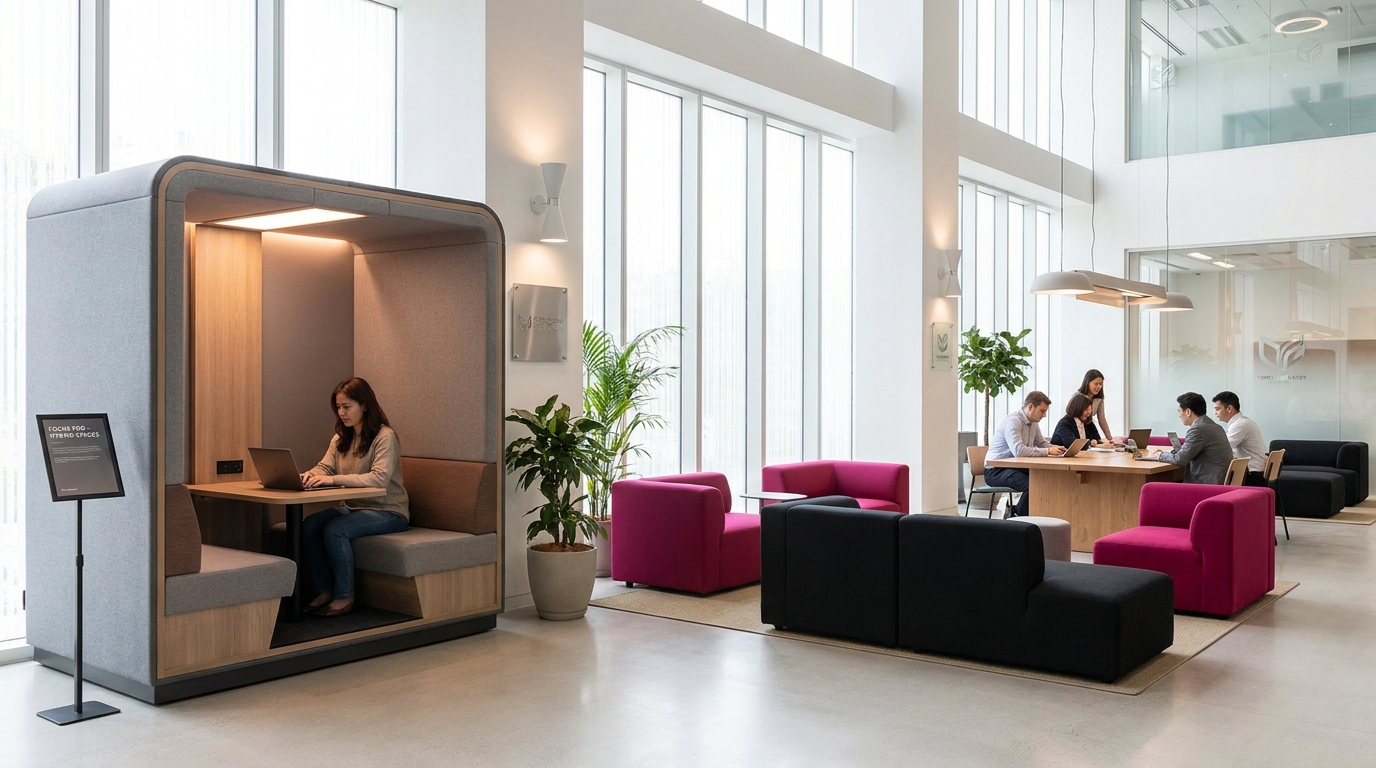
Imagine an office where one area is a vibrant, open hub with collaborative tables and whiteboards for brainstorming. A short walk away is a designated ‘quiet zone’ with library rules, where employees can perform deep-focus work without interruption. Dotted throughout are enclosed pods for private phone calls and video conferences, along with comfortable breakout areas for informal chats. This is the essence of the hybrid office model.
This approach directly addresses the primary failures of the one-size-fits-all model. It acknowledges that an employee’s needs change throughout the day; a team meeting in the morning, focused report-writing in the afternoon, and a confidential client call in between. By providing a purpose-built space for each activity, organisations can dramatically improve both productivity and employee satisfaction. This flexibility makes the hybrid office model the most resilient and effective modern office layout for the dynamic needs of today’s workforce.
Practical Office Productivity Solutions for a Hybrid Workspace
Creating a successful hybrid workspace doesn’t require a complete structural overhaul. In our experience, a furniture-led approach is often the most cost-effective and flexible way to implement these crucial zones. The key is to use smart furniture choices to define spaces and solve common problems like noise and lack of privacy. These are the practical office productivity solutions that make a hybrid model work.
The first and most critical element is managing sound. This is where acoustic office furniture becomes essential. Freestanding acoustic screens can be used to partition off quiet zones, while sound-absorbing desk dividers can give employees a greater sense of personal space in open areas. For walls and ceilings, acoustic panels and baffles can be installed to dampen ambient noise across the entire floor.
For privacy, office pods are a significant improvement. These self-contained, soundproofed units can be dropped into an open-plan space to provide private areas for phone calls, video conferences, or individual focused work without the cost and permanence of building traditional walls.
Finally, collaboration zones are brought to life with the right furniture. Instead of just rows of desks, think about using modular sofas, high-backed armchairs, and mobile whiteboards to create dynamic spaces. Our range of flexible breakout furniture is designed specifically for this purpose, encouraging interaction while remaining adaptable. By combining these elements, you can transform a standard open office into a high-functioning hybrid environment, “Saving Time & Stress” in the process.
#### Case Study: A Hypothetical UK Tech Start-Up
Challenge: A 60-person tech firm in an open-plan office faced complaints about noise and constant interruptions. Developers couldn’t focus, leading to project delays costing an estimated £15,000 per month in lost productivity.
Solution: Instead of a costly move, they adopted a furniture-led hybrid model. They invested in four two-person office pods for focused coding, used large acoustic screens to create a ‘deep work’ zone, and added modular breakout furniture to a corner for collaborative sessions.
Results: Within three months, self-reported focus levels increased by 40%, and project deadline adherence improved by 25%. The total furniture investment of £25,000 was recouped in less than two months of productivity gains.
Key Insight: You don’t need to change the building to change the behaviour. Strategic furniture investment can solve the core problems of an open-plan layout for a fraction of the cost of a full refit.
Budgeting for Your New Office Layout: A UK Manager’s Guide
Addressing your office layout is a significant investment, but it doesn’t have to be prohibitive. The key is to focus on long-term value rather than just the initial outlay. A full structural refit to build private offices is a major capital expense. In contrast, a furniture-led approach to creating a hybrid model is far more manageable and flexible, allowing you to adapt the space as your team evolves.
When budgeting, consider the total cost of ownership. This includes not only the purchase price but also the impact on productivity and employee retention. Investing in good Ergonomics, the science of designing efficient and safe workspaces, is crucial. Ergonomic chairs and height-adjustable desks reduce physical strain, leading to fewer sick days and higher concentration levels over the long term. This is an investment in your team’s well-being and performance.
At Cost Cutters UK, we understand the budget pressures faced by businesses and public sector organisations. That’s why we offer transparent pricing and several ways to make your investment manageable. Our Bulk Buy Discounts provide significant savings for larger projects. For public sector clients, our services are aligned with procurement standards, as shown by our official accreditations. Plus, with options to set up Credit Accounts Or Pay Flexibly, we make it easier to acquire the right furniture without straining your cash flow. We believe in providing value that goes beyond the price tag.
Frequently Asked Questions About Office Layouts and Productivity
What is the core difference in the open plan vs private offices debate?
The core difference in the open plan vs private offices debate lies in the trade-off between collaboration and concentration. Open plans remove physical barriers to encourage spontaneous communication, whilst private offices provide enclosed, quiet spaces for individual, focused work. An effective choice depends entirely on the primary nature of the tasks your employees perform and your company culture.
What are the main disadvantages of an open-plan office?
The primary open plan office disadvantages are high levels of noise and constant interruptions. These lead to reduced concentration, increased stress, and lower productivity for tasks requiring deep focus. A lack of privacy for confidential conversations and a higher rate of sickness transmission are also significant, well-documented drawbacks that organisations must consider carefully.
Why don’t open-plan offices work for everyone?
Open-plan offices fail when they don’t account for diverse job roles and personality types. A software developer who needs deep focus has different environmental needs than a sales team that thrives on collaborative energy. Introverted individuals can find the constant stimulation draining, impacting their well-being and performance. A one-size-fits-all approach rarely works in a diverse workforce.
What are the four main types of office layouts?
The four main office layouts are the cellular (private) office, the open-plan office, the hybrid/zoned office, and the co-working space. The cellular office consists of individual rooms. The open-plan features large shared spaces. The hybrid model strategically mixes both open and private elements. Co-working spaces are shared environments used by multiple companies or individuals.
Are open floor plans still popular in 2026?
Yes, but with significant modifications that address their classic flaws. As of 2026, purely open-plan layouts are less popular than the ‘hybrid’ or ‘zoned’ model. Companies are retaining the open feel but incorporating extensive private pods, quiet zones, and collaboration hubs to mitigate the documented disadvantages. The focus has shifted from purely open to strategically zoned.
How can you reduce noise in an open-plan office?
The most effective way is by using acoustic office furniture and creating designated quiet zones. This includes freestanding acoustic screens, desk dividers, sound-absorbing wall panels, and ceiling baffles. Installing enclosed office pods for calls and focused work is also a highly effective strategy that contains noise at the source, creating a more comfortable environment for everyone.
What is a hybrid office model?
A hybrid office model is a workspace design that includes a variety of different areas to support different tasks. It blends open-plan collaborative spaces with private offices, quiet zones for focused work, bookable meeting rooms, and informal breakout areas. This ‘Activity-Based Working’ approach allows employees to choose an effective environment for their specific task at any given moment.
Is a private office more expensive?
Initially, yes, a private office layout is typically more expensive per employee due to construction costs and lower space efficiency. However, organisations must weigh this against the potential hidden costs of lost productivity, higher employee turnover, and lower morale that can arise from a poorly designed open-plan space. The true cost is more than just the rent.
Which layout is better for creative collaboration?
A well-designed hybrid model is often best for creative collaboration. It provides open, flexible breakout areas with whiteboards and comfortable seating for energetic brainstorming sessions. Critically, it also provides adjacent quiet zones or pods where individuals can retreat to develop those creative ideas without distraction, offering an effective of both worlds for the creative process.
Which layout is better for tasks requiring deep focus?
Private offices are unequivocally better for tasks requiring deep, uninterrupted focus. The physical barrier may reduce the visual and auditory distractions that are detrimental to work like programming, data analysis, writing, or legal reviews. In a hybrid office, dedicated quiet zones and bookable acoustic office furniture pods can replicate this benefit effectively for all employees.
Important Considerations & Limitations
You should acknowledge that ‘productivity’ is a highly subjective metric that varies by individual and task. While many studies cited use metrics like error rates or task completion times, they may not fully capture creative output or long-term strategic thinking. Also, much of the foundational research predates the widespread adoption of post-2020 hybrid work schedules, which adds another layer of complexity to how office space is utilised.
This article focuses on the physical office environment, but a fully remote or ‘work-from-anywhere’ policy is another valid alternative. While remote work offers maximum focus and autonomy, it presents different challenges regarding collaboration, team culture, and onboarding. The choice of office layout should be made For your organisation’s broader policy on remote and flexible working, as they are deeply interconnected.
Ultimately, there is no single ‘best’ answer. The effective layout depends entirely on your organisation’s culture, budget, industry, and the specific types of work your teams perform. We strongly recommend conducting internal surveys and consulting with workspace design professionals to perform a needs analysis before committing to significant investment. Listening to your team is the most critical first step.
Choosing Your Future Workspace with Confidence
The discussion around open plan vs private offices has clearly matured. The data shows that a rigid, one-size-fits-all approach is a recipe for compromised productivity and unhappy staff. The most successful UK organisations, are moving towards intelligent, hybrid office models that empower employees with choice. This means providing the right space for every task, whether it’s collaborative brainstorming or deep, focused work. It’s this balance that unlocks true organisational potential.
Creating this balanced environment doesn’t have to be complex or break the bank. With our “Design To Install We Do It All!” service and our status as being “Rated Excellent On Trustpilot”, Cost Cutters UK has been helping UK businesses, schools, and public sector bodies create practical, cost-effective hybrid workspaces for over 35 years. Our expert team can help you design and furnish a layout that boosts both productivity and morale.
Contact us today for a free space planning consultation and let’s build a workspace that works for you.
References
- Contract Interior Systems (2024) – Industry Guide. Provides a balanced comparison of both office types, highlighting the importance of matching the environment to the work being performed.
- The Independent (2024) – News Report. Discusses research indicating that open-plan offices can lead to increased stress, higher sick-day rates, and reduced productivity.
- Harvard Business Review (2018) – Academic Study Summary. A foundational study using sensor data that showed open offices decreased face-to-face interactions by up to 70% while increasing digital communication.
- Servcorp UK (2023) – Industry Analysis. Summarises the common pros (cost, collaboration) and cons (noise, distractions) of open-plan layouts versus more private options.
- Cambraicourt (2023) – Workspace Consultant Analysis. An article arguing for a strategic assessment of team workflows before deciding on an office layout.
Important Considerations & Limitations
It is important to acknowledge that ‘productivity’ is a highly subjective metric that varies by individual and task. While many studies cited use metrics like error rates or task completion times, they may not fully capture creative output or long-term strategic thinking. Furthermore, much of the foundational research predates the widespread adoption of post-pandemic hybrid work schedules, which adds another layer of complexity to the open plan vs private offices discussion.
This article focuses on the physical office environment, but a fully remote or ‘work-from-anywhere’ policy is another valid alternative. While remote work offers maximum focus and autonomy, it presents different challenges regarding collaboration, team culture, and onboarding. The choice of office layout should be made in the context of your organisation’s broader policy on remote and flexible working.
Ultimately, there is no single ‘best’ answer. The ideal layout depends entirely on your organisation’s culture, budget, industry, and the specific types of work your teams perform. We strongly recommend conducting internal surveys and consulting with workspace design professionals to perform a needs analysis before committing to significant investment.
Conclusion
Choosing Your Future Workspace with Confidence
In summary, the debate over open plan vs private offices shows that a rigid, one-size-fits-all approach is a recipe for compromised productivity. The data clearly indicates that the most successful UK organisations are moving towards intelligent, hybrid models that empower employees with choice. This approach provides the right space for every task, whether it’s collaborative brainstorming or deep, focused work, creating the balance that unlocks true organisational potential.
Creating this balanced environment doesn’t have to be complex or break the bank. With our “Design To Install We Do It All!” service and our status as being “Rated Excellent On Trustpilot”, Cost Cutters UK has been helping UK businesses, schools, and public sector bodies create practical, cost-effective hybrid workspaces for over 35 years. Our expert team can