
Winter Workplace Essentials: Your Ultimate UK Guide for 2026
🎯 Key Takeaway
The most critical winter workplace essentials involve a proactive, three-pronged approach: securing external grounds against ice, ensuring internal building safety and comfort, and supporting employee wellbeing through clear policies and resources. This comprehensive strategy is vital for maintaining operational continuity and meeting legal obligations. Our guide provides a detailed checklist for facility managers and school business managers to ensure a safe and compliant workplace during the colder months, focusing on external safety (gritting paths), internal comfort (maintaining temperatures), and legal compliance (HSE guidelines).
As of June 2026, the operational and legal risks of neglecting winter preparations in the UK remain a significant concern for businesses and public sector organisations. For winter workplace essentials, a reactive approach of dealing with problems as they arise is inefficient and dangerous. Strategic winter planning isn’t just a seasonal chore; it’s a core component of effective, year-round facility management. Having the right supplies and procedures in place is crucial for safeguarding staff and visitors, ensuring compliance, and maintaining morale during the harshest months. This guide covers the key pillars of preparing your workplace for winter in the UK: your grounds, your building, your people, and your budget.
👤 Written by: Costcutters UK Content Team
Reviewed by: Costcutters UK Editorial Team, 35+ Years Supplying UK Public & Private Sector
Last updated: 16 June 2026
ℹ️ Transparency: This article explores best practices for winter workplace preparation based on UK Health and Safety Executive (HSE) guidelines and over 35 years of industry experience. Some links may connect to our specialised services and products. All information is verified by our editorial team. Costcutters UK is a leading and fully accredited supplier recognised on frameworks like ESPO (Eastern Shires Purchasing Organisation).
Preparing Your External Grounds for Winter Weather
The most effective way of preparing your workplace for winter in the UK is to establish a robust first line of defence on your external grounds. With unpredictable weather patterns, a proactive gritting strategy is non-negotiable. This involves more than just scattering some salt when you see frost; it requires a plan. We recommend using white marine salt for pedestrian walkways as it leaves less messy residue, whilst traditional brown rock salt is cost-effective for car parks and larger areas.

A crucial part of this strategy is storage. A torn bag of grit left in the rain is useless. Commercial-grade grit bins are essential for keeping your de-icing salt dry and accessible. For high-traffic sites like schools or healthcare facilities, large-capacity, lockable grit bins for schools and public areas prevent contamination and theft. In our experience, positioning these bins at key locations – entrances, car park corners, and sloped paths – is vital for Saving Time & Stress when temperatures plummet.
Beyond gritting, your plan must include a thorough slips and trips risk assessment for winter. The Health and Safety Executive (HSE) reports that slips and trips are the single most common cause of major workplace injuries in the UK [1]. Your assessment should therefore cover:
- Adequate Lighting: Check that all external lights in car parks and along walkways are functional. Dark, icy patches are a recipe for disaster.
- Clear Signage: Use ‘Caution: Icy Surface’ signs to warn people of known problem areas.
- Drainage: Ensure gutters and drains are clear of autumn leaves to prevent water from pooling and freezing.
Hypothetical Case Study: A Secondary Academy Trust
Challenge: A multi-academy trust with three secondary school sites was facing yearly disruptions and at least one serious fall incident each winter due to inconsistent gritting and poor equipment, costing them an estimated £15,000 in staff absence and minor liability claims.
Solution: We worked with their facilities manager to implement a standardised winter plan. This involved supplying each site with three large, durable secure outdoor storage units for grit, a pallet of white salt for paths, and clear safety signage.
Results: The following winter, the trust reported zero major fall incidents and a 90% reduction in weather-related site closures. The initial investment was recouped in a single season through avoided costs.
Key Insight: Centralising procurement and standardising procedures across multiple sites creates efficiency and dramatically improves safety outcomes.
Securing Your Building for Workplace Winter Safety UK
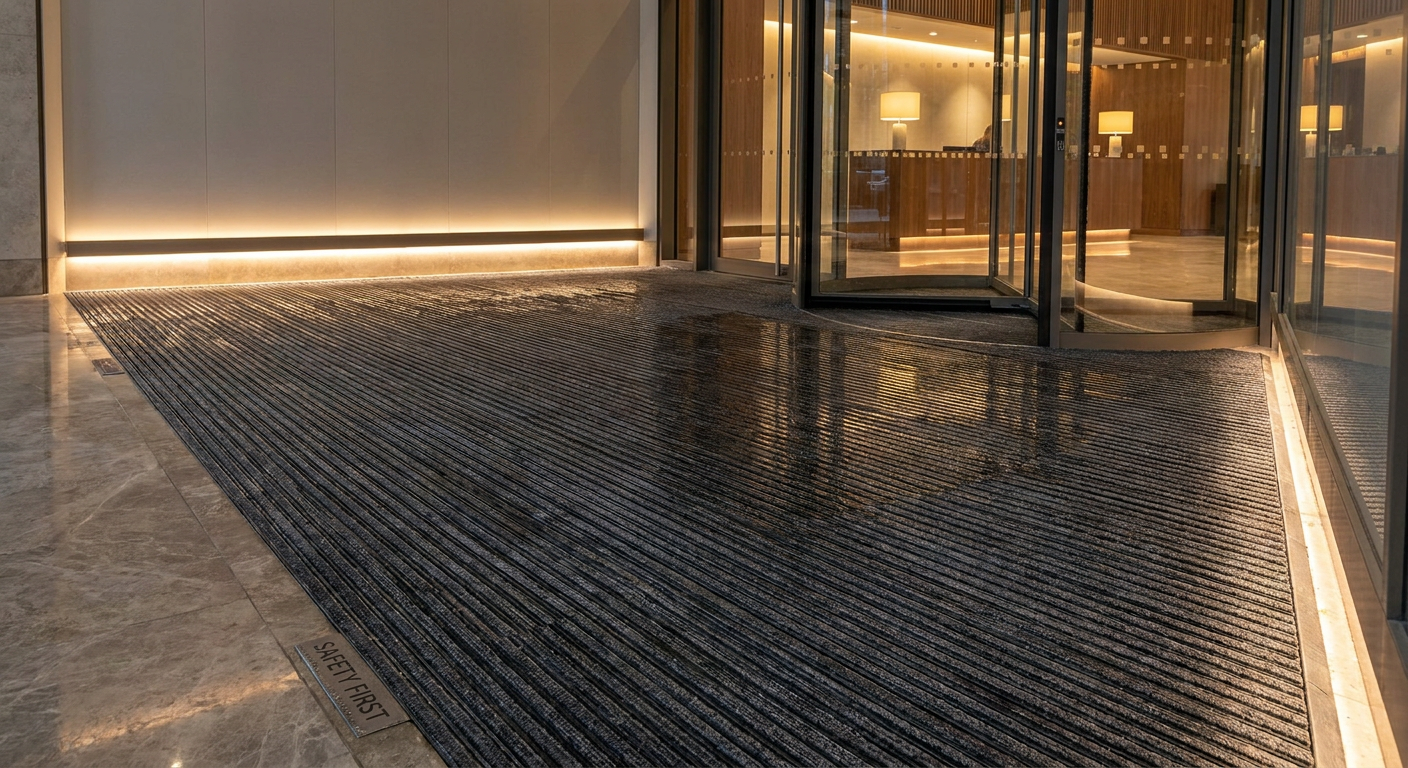
Ensuring workplace winter safety in the UK means creating a seamless transition from the hazardous conditions outside to a safe and dry interior. Your building’s entrance is the primary battleground against wet, slippery floors. A flimsy doormat won’t suffice in a commercial setting; you need a system. The most effective solution is high-quality commercial entrance matting for winter. We advise a two-mat approach: a coarse, outdoor ‘scraper’ mat to remove snow and heavy debris, followed by a highly absorbent indoor mat to capture moisture and fine dirt. This simple investment protects expensive flooring and, more importantly, drastically reduces indoor slip hazards.
Once inside, staff and visitors need a designated space to store wet outerwear. Piles of damp coats on chairs or bags left in walkways create clutter and new trip hazards. Providing adequate storage is a simple but often overlooked aspect of winter safety. Installing dedicated coat hooks, umbrella stands, or even a bank of heavy-duty storage cabinets in a reception or changing area keeps pathways clear and helps the building stay clean.
Finally, preventative maintenance on your building’s core systems is essential. Before the first cold snap, you should:
- Service Your Heating System: A failure in January is far more disruptive and expensive to fix than a routine check in October.
- Check Insulation: Inspect window seals, door drafts, and roof insulation to ensure you aren’t losing heat, which helps manage energy costs and maintain a comfortable temperature. As the Workplace (Health, Safety and Welfare) Regulations 1992 state, maintaining a ‘reasonable’ temperature is a legal duty [2].
Supporting Employee Wellbeing and Comfort
A successful winter plan extends beyond physical safety to address the wellbeing of your employees. Cold, dark months can significantly impact morale and productivity. A study highlighted by Safety Forward, an industry publication, advocates for considering the human factors in winter planning, including comfort and mental state [3]. Creating a warm and inviting indoor environment becomes more important when staff can’t step outside for a refreshing break.

One of the most effective ways to boost winter wellbeing is to enhance your breakout areas. If your team is stuck indoors during their lunch break, a dreary staff room won’t help. Investing in comfortable breakout furniture can transform a basic canteen into a welcoming space where employees can properly relax and recharge. It’s a simple change that shows you value their comfort.
Plus, small amenities can make a big difference. Providing a well-stocked hot drink station with tea, coffee, and hot chocolate is a low-cost, high-impact gesture that contributes to a positive atmosphere. It’s also wise to have a clear cold weather workplace policy that includes provisions for flexible working or adjusted travel times during severe weather. Communicating this policy in advance reduces employee anxiety about commuting in dangerous conditions and demonstrates that you’re a supportive employer. That’s a key part of building trust.
UK Legal Requirements & Cold Weather Workplace Policy
To ensure workplace winter safety in the UK, every employer must understand their specific legal duties. These obligations are not just suggestions; they are backed by law, primarily the Health and Safety at Work etc. Act 1974. Your primary responsibility is to provide a safe environment, which in winter means managing thermal comfort and preventing accidents.
A common question is about the minimum workplace temperature in the UK. While there is no legally binding minimum temperature, the Health and Safety Executive’s Approved Code of Practice for the Workplace (Health, Safety and Welfare) Regulations 1992 provides a clear guideline. It recommends that the temperature in a workplace should normally be at least 16°C for sedentary work (like an office) and 13°C for work involving strenuous physical effort [2]. ‘Thermal comfort’ is the term used, meaning a state where people feel neither too hot nor too cold. Employers are legally required to provide a ‘reasonable’ temperature, and these ACOP figures are the accepted benchmark.
Also, your duty of care explicitly covers preventing accidents. A comprehensive slips and trips risk assessment for winter is not optional. You must identify potential hazards (e.g., icy car parks, wet reception floors) and implement reasonable control measures. This record demonstrates you have fulfilled your legal obligations. A simple cold weather workplace policy should be created and shared with all staff, outlining:
- The procedure for gritting and who is responsible.
- The protocol for severe weather warnings and potential travel disruption.
- How to report issues with heating.
- Guidance on appropriate footwear and clothing.
Smart Procurement: Your Office Winter Preparation Checklist
For school business managers and procurement officers, preparing for winter is a strategic task that requires foresight and smart purchasing. An effective office winter preparation checklist is about more than just items; it’s about securing value and ensuring compliance. We’ll be honest – opting for cheap, domestic-grade products is a false economy. They often fail under heavy use, compromising safety and requiring replacement mid-season.
The key is to plan ahead. We recommend finalising your winter budget and placing orders in late summer or early autumn. This avoids last-minute panic buying when supplies are scarce and prices are high. Leveraging Bulk Buy Discounts for items like rock salt, shovels, and entrance matting can generate significant savings, especially for multi-site organisations. Also, working with a supplier that offers flexible payment options, such as Credit Accounts Or Pay Flexibly, is essential for managing public sector budgets.
Choosing a supplier that understands the demands of commercial and public environments is critical. For instance, when buying grit bins for schools, you need products that are durable, UV-resistant, and secure enough for a school environment. As a supplier on frameworks like ESPO, we ensure our products meet these stringent standards. Use the checklist below to guide your procurement process.
| Item Category | Essential Product | Key Consideration for Public Sector | Recommended Quantity (per 50 staff/100 pupils) |
|---|---|---|---|
| Grounds Safety | Brown Rock Salt & White De-icing Salt | BS 3247:2011 compliance for purity and effectiveness. | 250kg (10x 25kg bags) |
| Grounds Equipment | Heavy-Duty Grit Bin (200L or 400L) | Lockable, forklift-compatible, and made from durable polyethylene. | 1-2 Bins per key area (entrance, car park) |
| Entrance Safety | Commercial Entrance Matting (Scraper & Absorbent) | Heavy-duty, non-slip rubber backing and high water retention. | 1 of each per main entrance |
| Indoor Cleanliness | Wet Floor Signs & Umbrella Stands | High-visibility yellow signs and large capacity stands. | 2 signs, 1 stand per entrance |
| Employee Comfort | Portable Heaters & Hot Water Urn | PAT tested heaters with safety cut-outs; commercial-grade urns. | 1-2 heaters for cold spots, 1 urn for staff room |
Ready to get your procurement sorted? You can request a bulk purchase quote directly through our site, simplifying your budgeting process.
Frequently Asked Questions
What are the most important winter workplace essentials?
The most critical winter workplace essentials fall into three categories: ground safety, building integrity, and employee support. Key items include rock salt or grit, durable grit bins, high-absorption commercial entrance matting, and a clear cold weather policy communicated to all staff. A proactive approach that combines these elements is an effective way to ensure a safe and functional workplace throughout the colder months, minimising disruption and risk.
What is the legal minimum temperature for a UK workplace?
There is no single legally mandated minimum temperature, but there is an official and recognised guideline. The Health and Safety Executive’s (HSE) Approved Code of Practice suggests that for office-based work, the temperature should be at least 16°C. For work that involves strenuous physical activity, the recommended minimum is 13°C. Employers must maintain a ‘reasonable’ temperature, and these figures are the standard used to assess compliance.
How can we prevent slips and trips on ice at work?
A three-step process of assessing risks, gritting proactively, and clearly signposting hazards is the most effective method. an effective defence is a proactive gritting plan for car parks, paths, and entrances before temperatures are forecast to drop near freezing. This is far more effective than reacting after ice has already formed. Combine this with ‘Caution: Icy Surface’ signs for known problem areas to fulfil your duty of care.
What should be included in a cold weather workplace policy?
A comprehensive cold weather policy should clearly outline procedures, responsibilities, and communication channels. It must include the plan for gritting grounds, the company’s stance on flexible working during severe weather, how staff should report heating or facility issues, and any guidelines on appropriate workwear or footwear. Having this documented and shared with all employees sets clear expectations and reduces confusion during a weather event.
Do employers have to provide heating at work?
Yes, UK employers have a legal duty of care to provide a ‘reasonable’ temperature in the workplace. This is mandated by the Workplace (Health, Safety and Welfare) Regulations 1992. This means the heating system must be maintained, in good working order, and capable of keeping the indoor temperature at a comfortable and safe level. Failure to do so can be considered a breach of health and safety law.
How often should car parks and paths be gritted?
Gritting frequency should be dictated by the weather forecast, not a fixed schedule. Best practice is to grit surfaces when road surface temperatures are predicted to fall to 0°C or below. This is most effective when done in the late afternoon or evening before a frost, as it helps prevent ice from bonding to the surface overnight, ensuring paths are safer for the morning commute.
What is an effective type of commercial entrance matting for winter?
The most effective solution is a dual-mat system designed to handle heavy footfall and moisture. This involves an external ‘scraper’ mat, often with coarse bristles, to remove heavy debris and snow. This is followed by a large, internal ‘absorbent’ mat that traps water and finer dirt. For high-traffic commercial or public spaces, typically choose heavy-duty, rubber-backed mats which are less likely to slip and are far more durable.
How can I support employee wellbeing during winter months?
Focus on providing comfort, security, and flexibility to boost morale during the darker months. Ensure the workplace is consistently warm and well-lit. Invest in comfortable breakout spaces for indoor breaks, offer complimentary hot drinks, and communicate a clear, supportive policy for travel disruptions. These small gestures reduce stress and show that you value your team’s welfare, which can positively impact productivity.
What are the key elements of a winter risk assessment?
A winter risk assessment should follow the standard five-step process: identify, assess, control, record, and review. First, identify winter-specific hazards like icy paths, wet floors from snow, and low indoor temperatures. Then, assess who is at risk (staff, visitors, pupils). Implement control measures like gritting, matting, and heating checks. Finally, you must record your findings and review the assessment annually or after any incident.
Where can I buy winter supplies in bulk for a school or office?
Specialised business-to-business (B2B) suppliers like Cost Cutters UK are your best option for compliant and durable goods. We offer Bulk Buy Discounts and flexible payment options like Credit Accounts Or Pay Flexibly for public sector bodies. Unlike retail outlets, we provide a comprehensive range of commercial-grade products, from certified rock salt and large-capacity grit bins to heavy-duty furniture, ensuring you get everything you need in one place.
Important Considerations
This guide provides a comprehensive overview based on general UK conditions and regulations. However, specific site requirements can vary significantly based on your geographical location, building age, and the demographics of its users (for example, a primary school has different needs from a corporate office). The effectiveness of any winter plan is also entirely dependent on timely execution and proper staff training, factors which are beyond the scope of a single article.
While a Do-It-Yourself approach to winter preparation is often feasible for smaller, single-site organisations, larger institutions or those with multiple locations may consider outsourcing to a dedicated facilities management company. These services can offer automated weather monitoring and likely to support gritting rotas. Still, this option typically comes at a significantly higher cost compared to procuring the necessary supplies and managing the process in-house with your own team.
For complex sites, or to ensure complete legal compliance, we recommend commissioning a formal health and safety audit from a qualified external consultant. For large-scale procurement and space planning to improve winter wellbeing, engaging with an experienced supplier for a free consultation can help you optimise your budget. Our “Design To Install We Do It All!” service ensures you select the most effective and cost-efficient solutions for your specific needs, all from a supplier that is Rated Excellent On Trustpilot.
Conclusion
Effectively managing your winter workplace essentials is a cornerstone of responsible and strategic facility management. It is not a task to be taken lightly. By proactively preparing your grounds, securing your building, adhering to legal standards, and supporting your staff, you successfully mitigate risks and ensure operational continuity through challenging weather. A thoughtful approach, guided by a detailed office winter preparation checklist, transforms a seasonal challenge into a clear demonstration of your organisation’s commitment to safety, care, and excellence.
With over 35 years of experience supplying UK schools, offices, and public sector organisations, Cost Cutters UK is more than just a supplier; we are your trusted partner in creating safe, compliant, and efficient spaces. From durable grit bins to comfortable breakout furniture, we provide everything you need in one place, Saving Time & Stress. If you’re planning for the colder months, book a free space planning consultation with our experts today to optimise your workplace for winter and beyond.
References
- Health and Safety Executive (HSE) – Governmental Guidance. This resource states that slips and trips are the single most common cause of major workplace injuries in the UK, making prevention a legal priority.
- Workplace (Health, Safety and Welfare) Regulations 1992 – Approved Code of Practice (ACOP). This document outlines employer duties regarding workplace temperature, ventilation, and welfare facilities, recommending a minimum of 16°C for sedentary office work.
- Safety Forward – Industry Publication. This article advocates for proactive risk assessments that include human factors and staff training as key components of any effective winter safety preparation plan.
- Kentec Training – Industry Best Practice Guide. This guide highlights the importance of vehicle checks, appropriate Personal Protective Equipment (PPE), and clear communication protocols for outdoor and mobile workers during winter conditions.
- GCVS – Organisational Guidance. This resource provides practical tips for maintaining workplace safety during autumn and winter, emphasising the need for regular checks on building infrastructure and clear pathways.