A School Business Manager’s Guide to Primary School Furniture Cost Analysis
🎯 Key Takeaway
The true primary school furniture cost extends far beyond the initial purchase price, incorporating critical long-term factors like durability, maintenance, warranty, and safety compliance to determine its Total Cost of Ownership (TCO). The initial price tag often represents less than half of the furniture’s whole-life cost; durability and a strong warranty are key indicators of long-term value. Compliance with UK standards like BS EN 1729 is a non-negotiable cost that prevents future expenses from accidents, breakages, and non-compliance fines. A reliable cost-benefit analysis must weigh tangible costs against intangible benefits like improved pupil concentration, better behaviour, and reduced staff time managing faulty equipment.
Managing a school’s finances is a delicate balancing act. As a School Business Manager (SBM), you are tasked with making every pound count, stretching a tight school furniture budget whilst ensuring pupils have the resources they need to thrive. For primary school furniture cost, the temptation to choose the lowest-priced option is strong. However, our 35+ years of experience show this is often a false economy. The real cost isn’t on the price tag; it’s hidden in future repairs, replacements, and administrative burdens. This guide provides a professional framework for analysing the true cost, looking beyond the initial outlay to the long-term value and Total Cost of Ownership (TCO), ensuring your investment is safe, compliant, and beneficial for learning.
Written by: Cost Cutters UK Content Team | Reviewed by: Cost Cutters UK Editorial Team, 35+ Years in Education & Office Fit-Out, Rated Excellent On Trustpilot
ℹ️ Transparency Disclosure: This article explores how to analyse primary school furniture costs based on our 35+ years of industry experience and research into UK government and safety standards. Our goal is to provide a trusted framework for School Business Managers. Some links may connect to our specialised services that align with the solutions discussed. All information is verified by our editorial team for accuracy as of its publication date.
Why Your School Furniture Budget Demands More Than a Price Comparison
A simple price comparison is insufficient for procuring school furniture because it completely ignores the critical whole-life costs that determine the true value of your investment. A low upfront price can conceal a cascade of future expenses. This is a crucial distinction, as a poor choice made to save money on the initial school furniture budget can place significant, recurring strain on school finances for years to come.
This is where the concept of ‘hidden costs’ becomes a major factor in school furniture procurement. These are the expenses that aren’t on the initial invoice but accumulate over the product’s lifespan. Research from UK regulatory bodies like the Health and Safety Executive (HSE) underscores the legal duty of care schools have, which extends to providing safe equipment [1]. Opting for non-compliant, low-quality furniture can lead to direct and indirect financial penalties. In our experience, these hidden costs manifest in several ways:
- Frequent Repairs & Replacements: Poorly constructed items break easily, leading to a constant cycle of repair bills and repeat purchases.
- Wasted Staff Time: Caretakers spend valuable hours fixing broken chairs, whilst administrative staff process repeat orders and deal with supplier issues-time that could be better spent elsewhere. This is a significant but often unmeasured cost.
- Health and Safety Liabilities: Furniture that doesn’t meet safety standards can lead to accidents, creating potential liabilities and, more importantly, endangering pupils. The Department for Education’s (DfE) statutory framework makes it clear that the suitability of equipment is a core safeguarding requirement [3].
- Disruption to Learning: A wobbly table or a broken chair is a distraction that directly impacts classroom management and pupil concentration.
To avoid these pitfalls, we advise schools to use approved procurement frameworks. These frameworks pre-vet suppliers for quality, financial stability, and compliance, Saving Time & Stress and ensuring you get value, not just a low price. You can learn more about how to avoid costly school furniture procurement mistakes in our detailed guide.
What are the Key Factors Driving Primary School Furniture Cost?
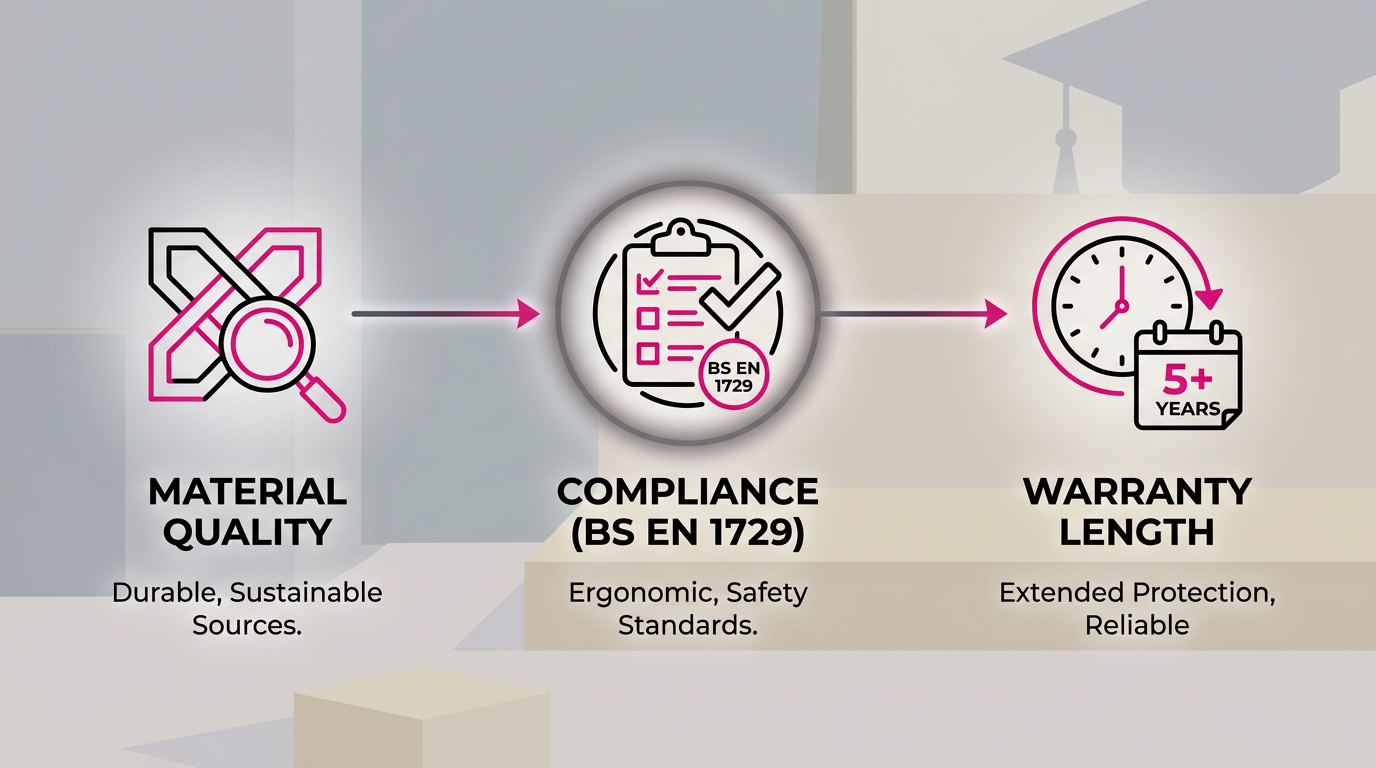
The primary drivers of primary school furniture cost are material quality, manufacturing standards, compliance certification, warranty length, and bundled supplier services like delivery and installation. A professional classroom furniture cost analysis must evaluate each of these factors to understand why one chair might cost £25 and another, seemingly similar one, costs £40.
Here’s a breakdown of what you are paying for:
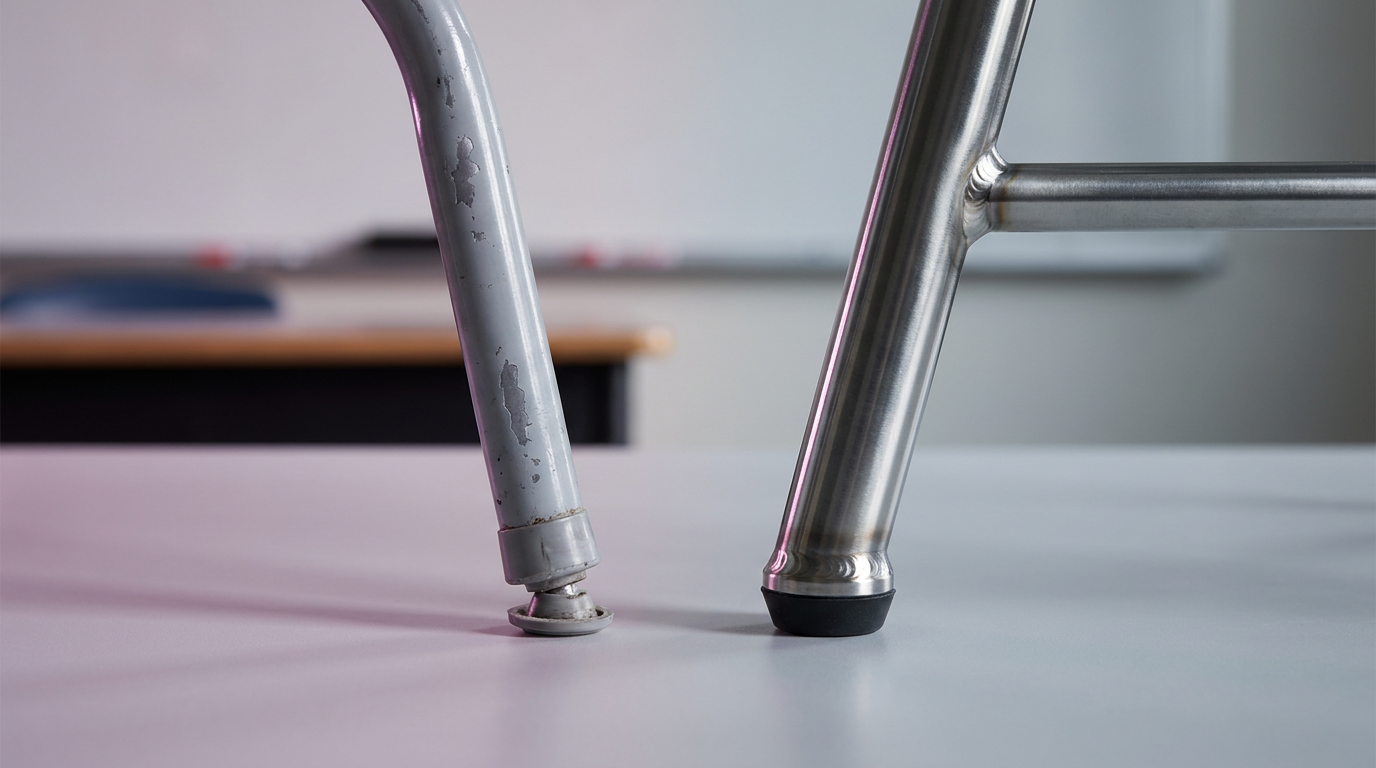
- Material Quality & Construction: The thickness of steel frames, the density of wood composites, and the quality of plastic polymers all impact durability and cost. For example, comparing wooden vs plastic school furniture reveals differences in longevity, maintenance, and suitability for different age groups. Stronger welds, tamper-proof fixings, and hard-wearing surfaces cost more to produce but withstand the rigours of a school environment far longer.
- Compliance & Certification: Achieving certification to standards like BS EN 1729 is a significant investment for manufacturers. BS EN 1729, the key European and UK standard for educational furniture, ensures items are ergonomically designed for children’s posture and strong enough for school use. This testing process is a key cost component, but it’s your guarantee of safety and suitability. Our guide to UK School Furniture Safety Standards explains this in more detail.
- Warranty Length: A warranty is a direct reflection of a manufacturer’s confidence in its product. A 1-year warranty suggests the item may not last much longer. In contrast, a 5, 10, or even 15-year warranty signals a durable product built to last, representing a much safer long-term investment.
- Supplier Services: Costs can also include delivery, unloading, placement in rooms, and removal of packaging and old furniture. Our “Design To Install We Do It All!” service, for instance, bundles these elements to provide a comprehensive solution that saves schools significant internal labour and logistical planning.
The table below illustrates how these factors translate into real-world costs.
| Cost Element | Low-Cost Example (1-Year Warranty) | Value Investment (10-Year Warranty) | Consideration for School Business Managers |
|---|---|---|---|
| Initial Unit Price | £25 | £40 | Is the price difference justified by the warranty and compliance? |
| Compliance | Often uncertified or self-certified | Independently certified to BS EN 1729 | Lack of certification is a major red flag for safety and durability. |
| Expected Lifespan | 2-3 years | 10+ years | Shorter lifespans require multiple replacement cycles within a decade. |
| 10-Year Repair Costs | Estimated £15 (parts & labour) | £0 (covered by warranty) | Repair costs are unpredictable and add administrative burden. |
| 10-Year Replacement | 3-4 replacements needed | 0 replacements needed | This is the single biggest hidden cost of choosing cheap furniture. |
| Total 10-Year Cost | £100 – £125 per chair | £40 per chair | The ‘value’ option is almost three times cheaper over the long term. |
Data based on internal analysis and typical market conditions as of 2024, with market context from Statista (2024).
Calculating the Total Cost of Ownership (TCO) for Primary School Furniture
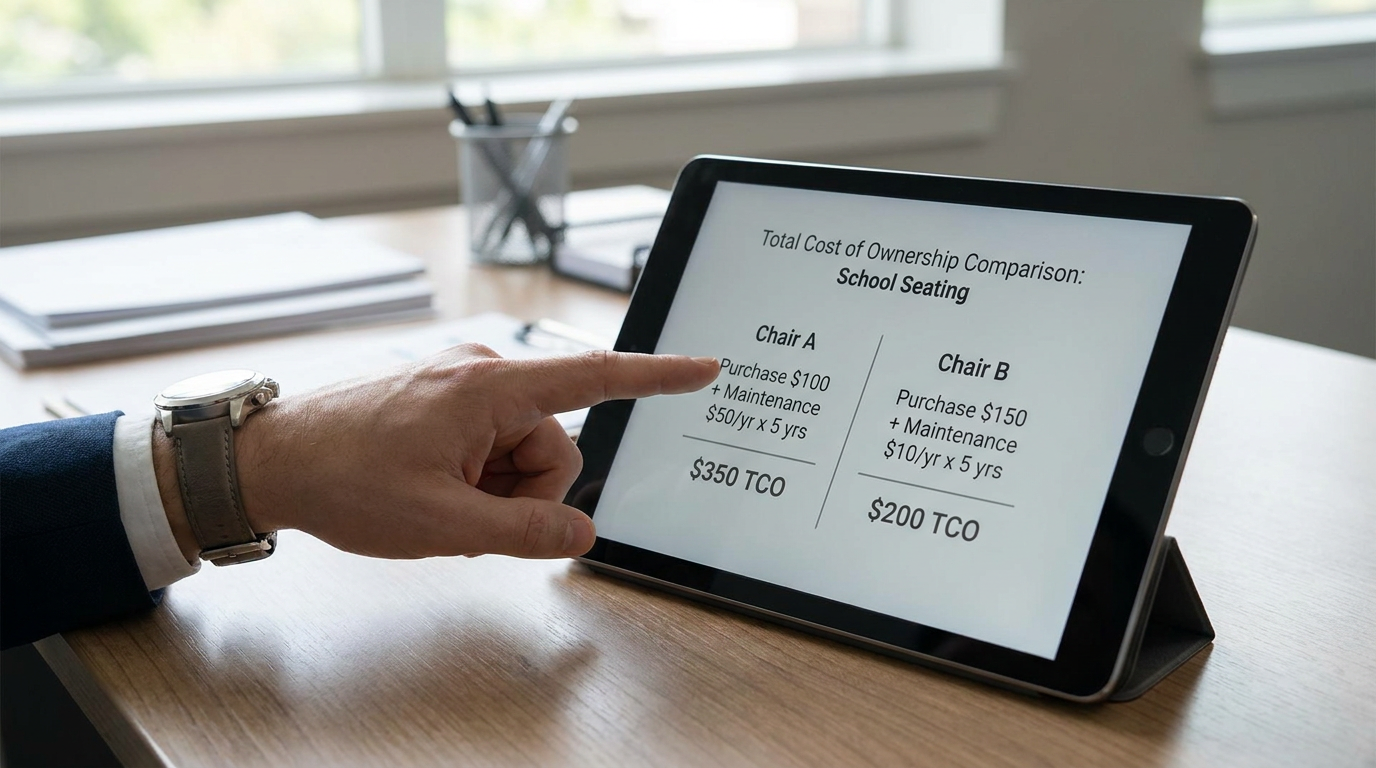
Yes, you can and should calculate the Total Cost of Ownership (TCO), a financial estimate that helps determine the direct and indirect costs of a product over its entire lifecycle. TCO is a concept that moves the conversation from “How much does it cost to buy?” to “How much does it cost to own?”. For a classroom furniture cost analysis, this is the most important calculation you can make. It provides a data-driven way to justify investing in higher-quality items and demonstrates a commitment to achieving genuine education furniture cost savings.
The formula is straightforward:
TCO = Initial Purchase Cost + (Maintenance + Repair Costs over Lifespan) – Residual Value
Let’s apply this in a practical scenario comparing two classroom chairs over a 10-year period, which is a typical timeframe to consider when you need to decide when to replace primary school tables and chairs.
- Chair A (Budget Option): Costs £25 per unit with a 1-year warranty. Based on experience, you expect it to fail and need replacement in year 4 and again in year 8.
- Chair B (Value Option): Costs £40 per unit with a 10-year warranty, covering all defects. It is expected to last the full 10 years.
Let’s calculate the 10-year TCO for one chair:
- Chair A TCO: £25 (initial purchase) + £25 (year 4 replacement) + £25 (year 8 replacement) = £75
- Chair B TCO: £40 (initial purchase) + £0 (repairs/replacements covered by warranty) = £40
In this scenario, the ‘cheaper’ chair is almost twice as expensive over its functional life. When you multiply this by 30 chairs for a classroom, the difference is stark: £2,250 for Chair A versus £1,200 for Chair B. That’s a £1,050 saving that can be reallocated elsewhere in the school furniture budget. This calculation transforms a simple purchase into a measurable, long-term investment.
Hypothetical Case Study: A Lancashire Primary School
- Challenge: A 2-form entry primary school was spending over £3,000 annually on repairing and replacing ‘budget’ classroom chairs that were failing within 18 months, causing classroom disruption and administrative strain.
- Solution: We conducted a TCO analysis, showing that investing in our BS EN 1729-compliant chairs with a 10-year warranty, despite a 40% higher initial cost, would break even in year 3. The school used our Credit Accounts Or Pay Flexibly option to fund the replacement of 60 chairs.
- Results: In the first two years, the school reported zero repair costs and reclaimed an estimated 50 hours of caretaker and admin time, equating to over £900 in saved labour. Pupil fidgeting decreased, according to teacher feedback.
- Key Insight: The true cost of furniture is revealed over its lifespan; a higher initial investment in durability and compliance delivers significant long-term savings and educational benefits.
How to Conduct a Cost-Benefit Analysis for School Furniture
A cost-benefit analysis for school furniture weighs the quantifiable TCO (the ‘costs’) against the often intangible but critical ‘benefits’ of creating a better learning environment. While TCO gives you the financial ‘cost’ side of the equation, a cost-benefit analysis, as defined by sources like Investopedia (2024), helps you articulate the ‘value’ side. This is essential for building a business case for quality investment.
The Costs (Tangible):
These are the numbers derived directly from your TCO calculation:
- Initial purchase price.
- Delivery and installation fees.
- Projected repair and replacement costs over the chosen timeframe (e.g., 10 years).
- Staff time for administration and maintenance.
The Benefits (Often Intangible):
This is where you evaluate the positive impact on your school. Research consistently shows a link between physical environment and educational outcomes.
- Improved Pupil Health, Concentration and Engagement: This is the most significant benefit. Ergonomic furniture designed to the correct size and standard reduces fidgeting and discomfort, allowing pupils to focus for longer. Global bodies like the World Health Organization (WHO) highlight the health risks of sedentary behaviour, reinforcing the need for supportive furniture [5]. You can learn more in our guide to ergonomic primary school furniture.
- Better Classroom Behaviour: A well-designed, organised, and comfortable classroom can reduce disruptions and support positive behaviour management strategies.
- Reduced Staff Stress: Teachers and support staff are not constantly dealing with broken equipment, allowing them to focus on teaching and learning.
- Enhanced School Reputation: A well-maintained and thoughtfully furnished school makes a positive impression on parents, staff, and visitors.
When conducting a cost-benefit analysis school furniture review, the goal is to show that the long-term educational and operational benefits far outweigh the initial cost difference between a cheap product and a quality one.
Frequently Asked Questions
What is the true primary school furniture cost?
The true primary school furniture cost is its Total Cost of Ownership (TCO), not just the ticket price. This includes the initial purchase, delivery, maintenance, repairs, and eventual replacement costs over the item’s full lifespan. A higher initial investment in a durable, compliant item with a long warranty often results in a significantly lower overall cost over a 5-10 year period, delivering better value for your school.
What is a cost-benefit analysis in a school context?
It’s a structured process for comparing the total costs of a project against its total benefits. For school furniture, this means weighing the financial outlay (TCO) against crucial benefits like improved pupil focus, better posture and health, reduced classroom disruption, and increased staff morale. According to business resources like Indeed.com, this analysis helps justify an investment decision based on overall value, not just price.
How do you calculate the Total Cost of Ownership (TCO) for furniture?
You can calculate TCO with a simple formula: TCO = Initial Price + Lifetime Operating Costs – Residual Value. In practice, this means adding the purchase price to all expected repair, maintenance, and replacement costs over a set period (e.g., 10 years). For a quality item with a long warranty, the operating costs are often near zero, making the calculation much simpler and more favourable.
Why is BS EN 1729 compliance so important for costs?
BS EN 1729 compliance is a critical long-term cost-control measure. While certified furniture may have a slightly higher upfront price, it may help the item is safe, durable, and ergonomically correct for children. This investment prevents significant hidden costs from accidents, frequent breakages, and failing to meet your legal duty of care under Department for Education and Health and Safety Executive guidelines.
What are the main differences between cheap and quality school furniture?
The key differences are materials, construction, certification, and warranty. Quality furniture uses thicker, more durable materials, features reliable construction like stronger welds, is certified to BS EN 1729, and is backed by a long warranty (5-10+ years). Cheaper alternatives often use thinner materials, cut corners on safety, lack certification, and typically offer only a 1-year warranty, leading to a much shorter, and more expensive, lifespan.
How does furniture affect student learning?
Ergonomic furniture directly improves a pupil’s ability to concentrate for longer periods. Correctly sized chairs and tables reduce fidgeting and physical discomfort, which are major sources of distraction in the classroom. Furthermore, a well-designed classroom layout with appropriate furniture can also reduce behavioural issues and support more effective teaching methods, creating a superior learning environment for everyone.
What warranty period should I look for in primary school furniture?
For high-wear items like chairs and tables, a 5-year warranty should be the absolute minimum. However, reputable suppliers who are confident in their product’s durability will offer warranties of 10 years or even longer. We believe the warranty length is one of the clearest and most reliable indicators of a product’s expected lifespan and its true long-term value for money.
Are there grants or special funding for school furniture in the UK?
While specific ‘furniture-only’ grants are rare, replacement can often be included in larger capital funding bids. For instance, the Condition Improvement Fund (CIF), available to eligible academies and sixth-form colleges, can be used for projects that address building compliance, health, and safety. This can include replacing old, unsafe furniture as part of a wider school refurbishment project.
How does VAT affect furniture costs for different types of schools?
Your school’s ability to reclaim VAT is a crucial budgetary factor. Most Local Authority-maintained schools can reclaim the VAT paid on furniture purchases, reducing the effective cost. However, many academies, free schools, and independent schools cannot and must therefore budget for the full VAT-inclusive price. It’s essential for SBMs to confirm their school’s specific VAT status before finalising any budget.
What’s a bigger priority: cost savings or durability?
This is a false choice, as the greatest cost saving comes directly from investing in durability. Prioritising a low upfront price over durable construction almost typically leads to higher overall spending through the cycle of frequent repairs and replacements. Therefore, our advice is that durability should be the primary driver for any SBM seeking to achieve genuine, long-term education furniture cost savings.
Important Considerations and Alternative Strategies
You should acknowledge that all cost analysis models, including TCO, are based on estimates. The actual lifespan of furniture can be affected by exceptionally heavy use or unforeseen damage. Furthermore, whilst we believe investing in high-quality, long-warranty items offers an effective long-term value, we recognise that initial capital outlay constraints are a real-world limitation for many school budgets, potentially impacting immediate education furniture cost savings.
If a full, school-wide replacement is not financially viable, consider alternative strategies. A phased procurement plan, replacing furniture for one year group at a time, can spread the cost over several budget cycles. This allows you to start realising the benefits of quality furniture without overwhelming your annual budget. For less critical items, refurbishment might be a short-term option, but this rarely offers the same safety may help or longevity as new, compliant furniture.
For a decision of this importance, we recommend consulting with a specialised education furniture supplier. An expert can provide detailed TCO projections, offer guidance on navigating procurement frameworks, and conduct a free space planning assessment to ensure your investment not only saves money but also creates the most effective learning environment for your pupils. Many suppliers, including us, offer Bulk Buy Discounts that can make larger projects more affordable.
Making a Smart, Cost-Effective Investment for Your School’s Future
Ultimately, a thorough analysis of the primary school furniture cost is not about finding the cheapest option, but the one that delivers the greatest long-term value. By moving beyond the initial price tag and embracing a Total Cost of Ownership approach, School Business Managers can make a financially sound and defensible decision. This method of school furniture procurement ensures compliance, enhances pupil well-being, and protects the school’s budget from the cycle of costly repairs and replacements. It’s a strategic choice for a sustainable future.
At Cost Cutters UK, we have spent over 35 years helping schools navigate these decisions. As our “Excellent” rating on Trustpilot shows, our focus on BS EN 1729 compliant, durable furniture with long-term warranties is designed to provide maximum value. If you are planning a furniture project, our “Design To Install We Do It All!” service can help. Our specialists can provide a complimentary space plan and a detailed quote to help you build a compelling case for investment.
References
- Health and Safety Executive (HSE) – UK Government Guidance. Provides the legal framework for workstation safety and ergonomics in the UK.
- European Agency for Safety and Health at Work (EU-OSHA) – EU Research Body. Highlights research linking poor workstation design to musculoskeletal disorders (MSDs).
- Department for Education (EYFS Framework) – UK Government Statutory Framework (2024). Section 3 mandates the safety and suitability of premises, environment, and equipment.
- British Educational Suppliers Association (BESA) – Professional Organisation Code of Practice. Ensures member suppliers provide products that are ‘fit for their intended purpose’ in an educational setting.
- World Health Organization (WHO) – Global Health Guidelines (2020). Recommends limiting sedentary behaviour, providing a health rationale for ergonomic furniture.
- Statista – Market Research Data (2024). Provides market size and revenue data for the UK office furniture market.
- Investopedia – Financial Education Resource (2024). Provides a detailed definition and explanation of cost-benefit analysis methodology.
- Indeed.com – Career Development Resource (2024). Outlines practical steps for conducting a cost analysis in a business context.
- Ramp – Financial Technology Blog (2023). Defines cost analysis and explains its role in strategic business decisions.
- UK Parliament – Official UK Government Source. Provides reports and guidance on public procurement and educational standards.
- The Health & Safety Dept – UK Safety Consultancy. Offers practical advice on implementing HSE regulations in workplaces, including schools.
- Oktra – UK Design & Build Company. Publishes insights on office and educational space design trends and costs.
Frequently Asked Questions on Primary School Furniture Costs
Q1: What is the true primary school furniture cost?
The true primary school furniture cost is its Total Cost of Ownership (TCO), not just the ticket price. This includes the initial purchase, delivery, maintenance, repairs, and eventual replacement. A higher initial cost for a durable, compliant item with a long warranty often results in a lower overall primary school furniture cost over a 5-10 year period.
Q2: What is a cost-benefit analysis in a school context?
It is a structured process for comparing the total costs of a project, like new furniture, against its total benefits. For schools, this means weighing the financial outlay against benefits like improved pupil focus, better posture
and health (ergonomics), reduced classroom disruption, and increased staff morale. It helps justify an investment beyond pure numbers by showing value to both the budget and the learning environment.
Q3: How do you calculate the Total Cost of Ownership (TCO) for furniture?
The simplest formula is: TCO = Initial Price + Delivery/Installation + (Annual Maintenance x Lifespan) + Expected Repair Costs – Residual Value. For a quality item with a long warranty, the maintenance and repair costs are often near zero, simplifying the calculation. This method allows you to compare different products on a like-for-like basis over their entire lifecycle, revealing the most cost-effective option in the long run.
Q4: Why is BS EN 1729 compliance so important for costs?
BS EN 1729 compliance is a crucial cost-control measure, not an expense. While certified furniture may have a slightly higher upfront price, it guarantees the item is safe, durable, and ergonomically suited for children. This prevents significant hidden costs from accidents, frequent breakages, and failing to meet your legal duty of care under Department for Education (DfE) and Health and Safety Executive (HSE) guidelines.
Q5: What are the main differences between cheap and quality school furniture?
The key differences are materials, construction, certification, and warranty. Quality furniture uses more durable materials (e.g., thicker steel, high-impact polypropylene), has robust construction like stronger welds, is certified to BS EN 1729, and comes with a long warranty of 5-10+ years. Cheaper furniture often uses thinner materials, cuts corners on safety features, lacks certification, and typically has only a 1-year warranty, leading to a much shorter lifespan.
Q6: How does furniture affect student learning?
Ergonomic furniture that is the correct size directly improves a pupil’s ability to concentrate. As specified by BS EN 1729, correct sizing reduces fidgeting and discomfort, allowing for longer periods of focus. A well-designed, organised classroom with appropriate furniture can also reduce behavioural issues and support more effective teaching methods, creating a better overall learning environment for everyone.
Q7: What warranty period should I look for in primary school furniture?
For high-wear items like chairs and tables, a 5-year warranty should be the absolute minimum. Reputable suppliers who are confident in their product’s durability will offer warranties of 10 years or even longer. The warranty length is one of the clearest and most reliable indicators of a product’s expected lifespan and its true long-term value for your school.
Q8: Are there grants or special funding for school furniture in the UK?
While specific ‘furniture grants’ are rare, furniture replacement can often be included in larger capital funding bids. For example, the Condition Improvement Fund (CIF) for eligible academies and sixth-form colleges can be used for projects that address building compliance and safety. This can include replacing old, non-compliant furniture as part of a wider refurbishment project.
Q9: How does VAT affect furniture costs for different types of schools?
VAT status is a critical factor that differs between school types. Most Local Authority-maintained schools can reclaim VAT on furniture purchases through their local council. However, many academies and free schools cannot and must budget for the full VAT-inclusive cost. It is crucial for School Business Managers to confirm their school’s specific VAT status before finalising their school furniture budget.
Q10: What’s a bigger priority: cost savings or durability?
This is a false choice, as the biggest long-term cost saving comes directly from investing in durability. Prioritising a low upfront price over durability almost always leads to higher overall spending through frequent replacements, repairs, and administrative time. Therefore, durability should be the primary driver for achieving genuine, long-term cost savings in any school furniture procurement process.
Important Considerations and Alternative Strategies
It is important to acknowledge that all cost analysis models, including TCO, are based on estimates. The actual lifespan of furniture can be affected by exceptionally heavy use or unforeseen damage. Furthermore, while investing in high-quality, long-warranty items offers the best long-term value, initial capital outlay constraints are a real-world limitation for many school budgets.
If a full, school-wide replacement is not financially viable, consider alternative strategies. A phased procurement plan, replacing furniture for one year group at a time, can spread the cost over several budget cycles. This allows the school to begin realising the benefits of quality furniture without requiring a single large capital expenditure. For less critical items, refurbishment might be a short-term option, but this rarely offers the same safety guarantees or longevity as new, compliant furniture.
For a decision of this importance, we recommend consulting with a specialised education furniture supplier. An expert can provide detailed TCO projections, offer guidance on navigating procurement frameworks, and conduct a free space planning assessment to ensure your investment not only saves money but also creates the most effective learning environment for your pupils.
Making a Smart, Cost-Effective Investment for Your School’s Future
In summary, a thorough analysis of the primary school furniture cost is not about finding the cheapest option, but the one that delivers the greatest long-term value. By moving beyond the initial price tag and embracing a Total Cost of Ownership approach, School Business Managers can make a financially sound and defensible decision. This ensures compliance, enhances pupil well-being, and protects the school’s budget from the cycle of costly repairs and replacements.
At Costcutters UK, we have spent over 35 years helping schools navigate these decisions. Our focus on BS EN 1729 compliant, durable furniture with long-term warranties is designed to provide maximum value. If you are planning a furniture project, our specialists can provide a complimentary space plan and a detailed quote to help you build a compelling case for investment.