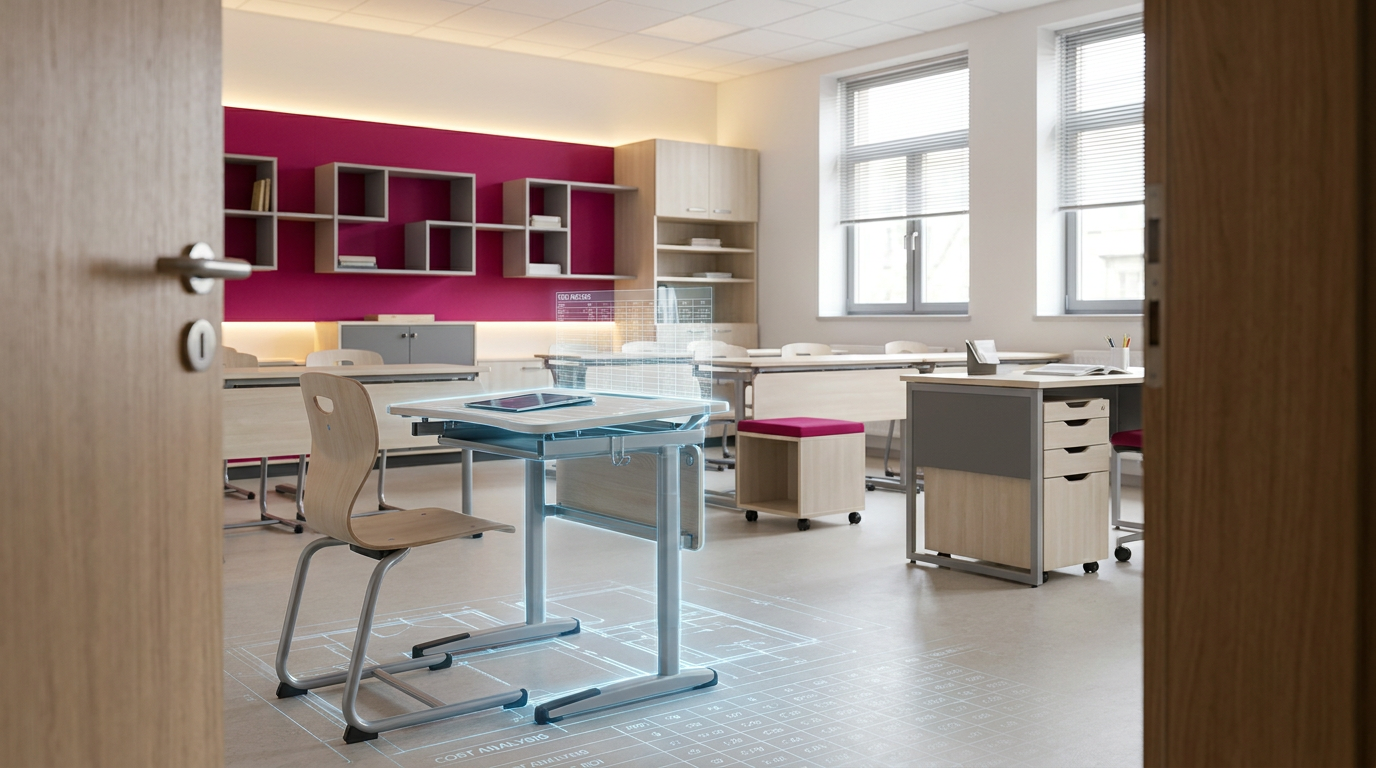
Budgeting for School Furniture: Cost Analysis & ROI Explained
🎯 Key Takeaway
Effective budgeting for school furniture involves a multi-stage process of assessing needs, analysing the total cost of ownership beyond the initial price, and strategically aligning procurement with long-term educational goals. This guide provides a step-by-step framework for School Business Managers to turn a necessary expense into a demonstrable investment.
• Focus on Total Cost of Ownership (TCO), not just the ticket price, to account for durability, maintenance, and replacement costs.
• A well-planned budget can directly improve learning outcomes and staff wellbeing by investing in ergonomic and fit-for-purpose furniture.
• use UK-specific procurement frameworks and understand VAT rules to maximise your education furniture budget and ensure compliance.
For any School Business Manager (SBM), the challenge is familiar: stretching a tight budget while being tasked with creating safe, effective, and inspiring learning environments. As of August 2026, the pressure to demonstrate value for every pound spent has rarely been greater. For budgeting for school furniture, it’s easy to view it as a simple line-item expense. However, we believe this is a missed opportunity. Strategic budgeting reframes furniture as a long-term investment in educational outcomes, pupil wellbeing, and staff retention.
This guide offers a practical framework for this strategic approach. We’ll explore how to analyse the Total Cost of Ownership (TCO) instead of just the sticker price, detail a clear process for building your education furniture budget, and show you how to measure the true Return on Investment (ROI) that quality furniture delivers.
👤 Written by: Content Team | Reviewed by: Editorial Team, Industry Specialists with 35+ Years Experience
Rated Excellent On Trustpilot
ℹ️ Transparency Disclosure: This article explores strategic budgeting for school furniture based on our 35+ years of industry experience and analysis of official UK standards. For transparency, some links may connect to our services. All information is verified by our editorial team to ensure accuracy and relevance for UK school managers.
Understanding the True Cost: A Total Cost of Ownership (TCO) Analysis
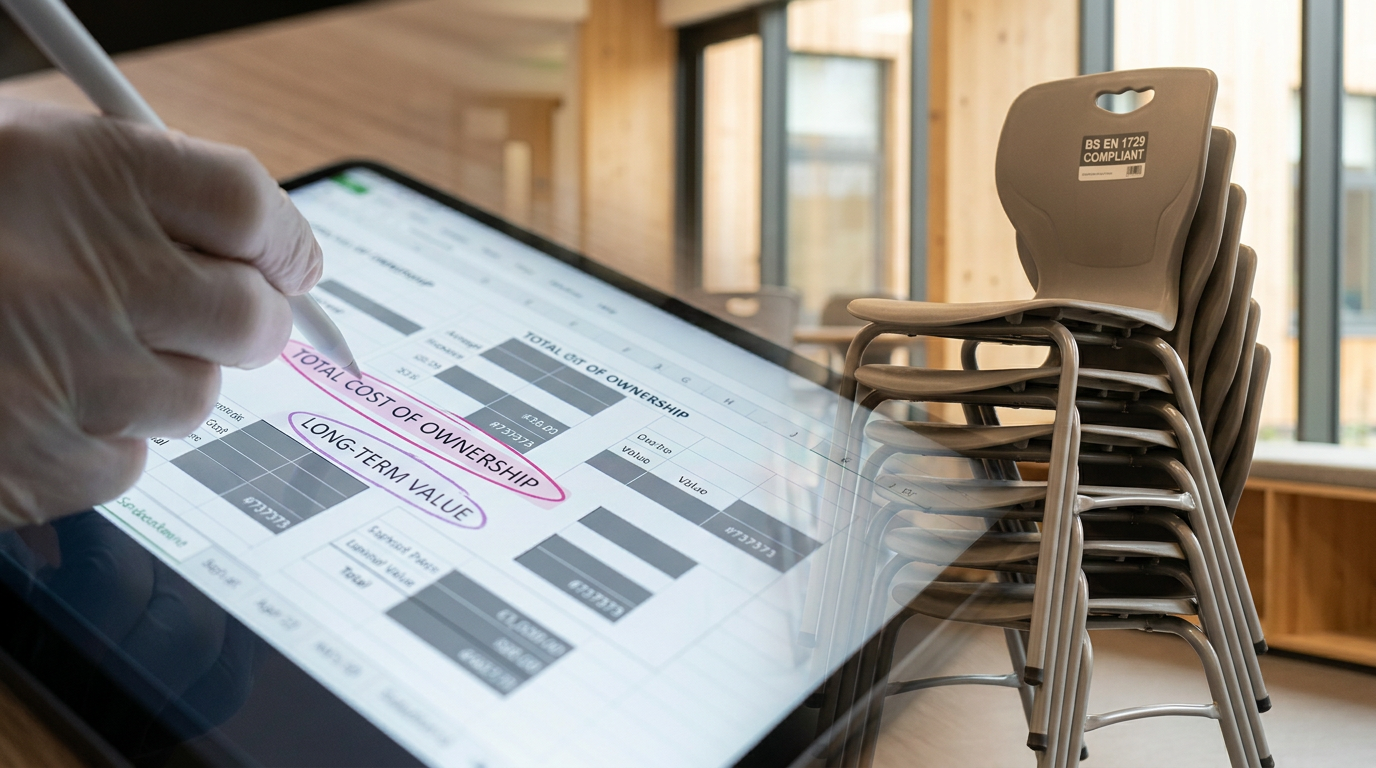
The true cost of school furniture extends far beyond the initial purchase price. A strategic budget must consider the Total Cost of Ownership (TCO), a financial calculation that encompasses the full lifecycle cost of an asset, from procurement to disposal. Opting for cheaper, non-compliant furniture may seem like a saving, but it often leads to a much higher TCO due to frequent repairs, early replacements, and potential safety risks. This is why focusing on genuinely cost-effective school furniture means looking at long-term value, not just the initial quote.
The key components of TCO include:
- Initial Purchase Price: The ticket price of the items.
- Delivery & Installation: Costs associated with getting the furniture into the correct rooms and assembled.
- Maintenance & Repairs: The ongoing labour and parts required to keep furniture safe and functional.
- Disposal & Replacement: The cost of ethically disposing of old items and the frequency of re-purchasing.
Adherence to BS EN 1729, the British and European standard for dimensions, strength, and stability, is a critical factor. Compliant furniture is built to withstand the rigours of a school environment, significantly lowering long-term maintenance and replacement costs. As the British Educational Suppliers Association (BESA) Code of Practice requires, products must be fit for purpose, and compliance is a key indicator of this. For a detailed overview, see our manager’s guide to compliance and safety. Below is a sample classroom furniture price guide illustrating the TCO difference.
| Furniture Item | Budget Range (per unit) | Mid-Range / BS EN 1729 Compliant (per unit) | Key TCO Consideration |
|---|---|---|---|
| Classroom Chair | £15 – £25 | £30 – £50+ | Compliant chairs may last 2-3 times longer, reducing replacement cycles. |
| Classroom Table | £40 – £60 | £75 – £120+ | More durable laminates and stronger frames resist wear and vandalism. |
| Tray Storage Unit | £120 – £180 | £200 – £350+ | Sturdier carcasses and runners prevent common failures and costly repairs. |
| Teacher’s Desk | £100 – £150 | £180 – £300+ | Higher quality finishes and reliable construction reduce signs of wear. |
A Step-by-Step Guide to Budgeting for School Furniture
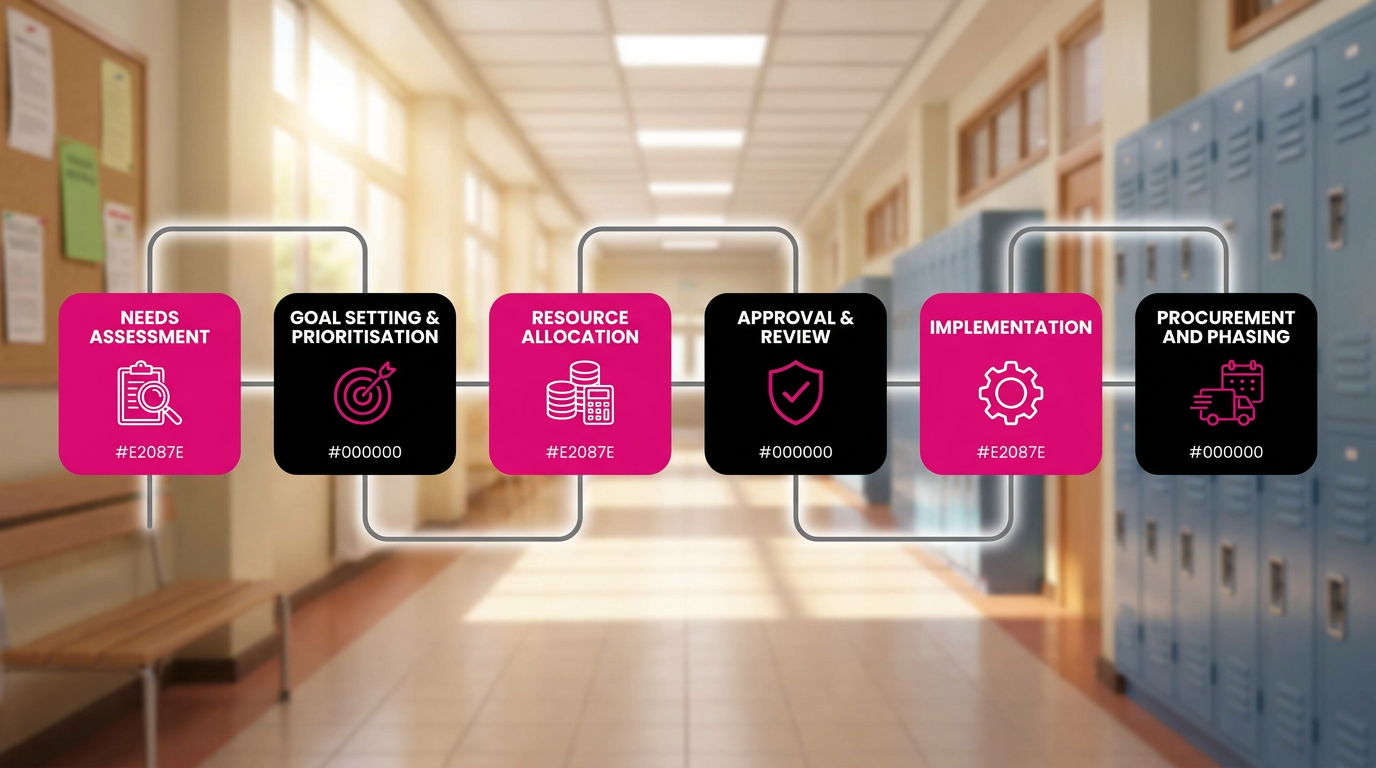
A successful education furniture budget is built on a clear, phased approach that moves from initial concept to final installation. This structured process helps ensure all needs are met, costs are controlled, and the final project delivers maximum value. In our experience, breaking the task down into manageable stages is the key to avoiding oversights and Saving Time & Stress.
We recommend the following five steps:
- Needs Assessment: Begin by auditing your existing furniture. What is broken? What is non-compliant? What no longer supports your teaching methods? Crucially, consult with teachers and pupils to understand their daily challenges and aspirations for the space.
- Market Research: Don’t just get one quote. Gather proposals from multiple suppliers. Explore options available through official procurement frameworks, which offer pre-vetted suppliers and competitive pricing. This is the stage to analyse different product ranges and materials.
- Draft Budget Creation: Using a spreadsheet, create a comprehensive budget. It’s vital to include line items for every element of the TCO: the furniture itself, delivery, installation, and removal of old items. Typically include a 5-10% contingency for unforeseen issues.
- Securing Approval: Present your draft budget to the school leadership team, governors, or trust board. Frame the request not as an expense, but as an investment. Use the ROI arguments from the next section to justify why choosing quality, compliant furniture is the most financially prudent long-term decision.
- Procurement and Phasing: Once approved, you can begin procurement. For large-scale projects, consider a phased approach. A detailed guide to planning your furniture replacement project can help break it down over several financial years to make the cost more manageable.
Measuring the Real ROI: How Quality Furniture Impacts Learning
Yes, quality school furniture delivers a significant Return on Investment (ROI) that goes far beyond simple durability. While a longer lifespan provides a clear financial return, the “soft” ROI has a more profound impact on your school’s core mission: education. Justifying a higher initial spend becomes much easier when you can demonstrate these tangible benefits to pupil and staff wellbeing.
The true school furniture ROI is measured in:
- Improved Learning Outcomes: Ergonomic furniture that fits the child, as specified by BS EN 1729, can improve posture and comfort, leading to better concentration and reduced fidgeting. Furthermore, flexible learning furniture allows for diverse teaching methods like group work and project-based learning, boosting engagement.
- Enhanced Staff Wellbeing: According to the European Agency for Safety and Health at Work (EU-OSHA) (2022), musculoskeletal disorders (MSDs) are one of the most common work-related health problems in Europe. Providing teachers with ergonomic desks and chairs helps meet Health and Safety Executive (HSE) guidelines and can reduce the risk of MSDs, potentially lowering costs associated with staff absence.
- Better Pupil Health: The World Health Organization (WHO) (2020) guidelines on physical activity recommend limiting sedentary behaviour. Furniture that encourages movement, such as standing-height tables or stools, can contribute to healthier habits.
Hypothetical Case Study: A Primary Academy Trust Scenario
- Challenge: A three-school academy trust faced inconsistent, ageing furniture, with an audit revealing 40% of chairs and tables were non-compliant with BS EN 1729. This led to high annual repair costs of £15,000 and teacher complaints about classroom functionality.
- Solution: The trust partnered with a specialist supplier to develop a three-year phased replacement plan. They used a procurement framework to secure a bulk buy discount on compliant, ergonomic furniture for all Year 3 and 4 classrooms in the first year.
- Results: In the first 18 months, reactive repair requests dropped by 80%. Teacher surveys showed a 50% improvement in perceived classroom suitability for modern teaching. The trust projects a full ROI within 7 years based on reduced replacement and repair costs alone.
- Key Insight: Phasing the investment and using a procurement framework made a large-scale project affordable and demonstrated immediate value to staff.
UK-Specific Considerations: Navigating Funding, VAT, and Procurement
For UK schools, budgeting for furniture involves navigating a specific financial and regulatory landscape. Understanding these factors is crucial for maximising your budget and ensuring full compliance. The complexity of these rules is why a deep dive into advanced school furniture procurement is often necessary for large projects.
Here are three key areas to consider:
- Funding Streams: Furniture projects are typically funded from a school’s capital budget. This often includes the Devolved Formula Capital (DFC), a grant allocated to schools and local authorities for capital projects. For academies, this funding is received directly. Larger projects may require bids for specific government grants or funds allocated by a Multi-Academy Trust (MAT).
- VAT Rules: The ability to reclaim Value Added Tax (VAT) significantly impacts your overall school furniture costs in the UK. Local authority-maintained schools and academies can generally reclaim VAT on furniture as it’s for non-business use. However, independent schools typically cannot. Typically confirm your institution’s specific VAT status with your finance team.
- Procurement Frameworks: Using a public sector buying organisation like the Crown Commercial Service (CCS) or YPO is highly recommended. These frameworks provide access to a list of pre-vetted suppliers who have already been assessed for quality, financial stability, and value for money. This simplifies due diligence, ensures compliance, and often provides more competitive pricing than going direct.
Important Considerations
This guide provides a strategic framework and estimated costs. However, actual school furniture costs in the UK can vary based on geographical location, supplier choice, and the scale of the project. Research on the direct causal link between specific furniture types and quantifiable academic improvement is ongoing and complex, often relying on qualitative feedback from teachers and pupils. That said, the evidence for the impact of ergonomics on health and concentration is well-established.
The primary alternative to a full, one-time refurbishment is a phased replacement programme. This approach spreads the cost over several financial years, making it more manageable for tight budgets. Another alternative for certain equipment is leasing. This is less common for standard classroom furniture but may be viable for specialised IT or science equipment. You’ll want to carefully compare the TCO against purchasing. We find that for most schools, ownership provides better long-term value.
For any project larger than a single classroom replacement, we strongly recommend consulting a school furniture specialist. An expert can provide a free space plan to optimise your layout, ensure all chosen items are compliant with BS EN 1729 and HSE guidelines, and create a detailed, fully-costed quote that may reduce hidden surprises. This professional guidance, part of our “Design To Install We Do It All!” service, is invaluable for presenting a reliable business case to governors or trust leadership and deciding between DIY or professional school furniture installation.
Frequently Asked Questions About School Furniture Budgeting
What is budgeting for school furniture?
Budgeting for school furniture is the strategic process of planning, allocating, and managing funds for purchasing new or replacement items. Effective budgeting considers not just the initial cost but also long-term value, educational requirements, safety compliance, and pupil wellbeing. It is a critical component of a school’s financial planning and facilities management, ensuring that physical resources actively support educational goals and provide a safe environment for students and staff.
How much should a school budget for furniture per classroom?
There is no single figure, as costs vary widely, but a helpful range for a standard 30-pupil primary classroom is £3,000 to over £10,000. The lower end would cover basic, like-for-like replacements, whilst the higher end would facilitate a full refurbishment with ergonomic or specialist flexible furniture. This figure depends heavily on the furniture types, quality, and whether items like storage and teacher furniture are included. A detailed quote is essential.
What is the ROI on ergonomic school furniture?
The school furniture ROI on ergonomic items is both financial, through greater durability, and qualitative, through improved wellbeing. Financially, high-quality compliant furniture lasts longer, reducing replacement costs. Qualitatively, studies suggest it can enhance student concentration and reduce musculoskeletal issues among staff, which may lower costs related to supply cover. It’s an investment in a healthier and more productive learning environment for everyone in the school.
How can UK schools save money on furniture?
Schools can achieve significant savings by planning purchases to secure bulk buy discounts and using approved procurement frameworks for competitive pricing. Focusing on Total Cost of Ownership rather than just the initial price also saves money long-term by avoiding cheap items that need frequent replacement. Phasing large projects over several financial years can make costs more manageable. Finally, consulting with a specialist can often uncover savings through efficient space planning.
What are the hidden costs of buying school furniture?
Hidden costs often include delivery charges, full installation fees, and the cost of removing and ethically disposing of old furniture. A “room of choice” delivery is typically more expensive than a kerbside drop. You might also encounter minor re-decoration costs or floor repairs after the old furniture is removed. A reputable supplier, like Cost Cutters UK, will be transparent about these costs and include them in a detailed, itemised quote.
What is BS EN 1729 and why is it important?
BS EN 1729 is the British and European standard covering the functional dimensions, strength, and stability for educational furniture. It is important because it ensures chairs and tables are ergonomically sized to support good posture for growing children. Furthermore, it sets durability standards to ensure the furniture can withstand the demanding school environment. Choosing compliant furniture is a key indicator of quality, safety, and long-term value for your investment.
How often should school furniture be replaced?
While there’s no fixed rule, high-quality, compliant school furniture can have a lifespan of 10-15 years or more. However, all items should be audited annually for safety and replaced immediately if broken or unstable. Many schools find a rolling replacement programme, where they aim to refurbish a certain number of classrooms each year, is the most effective and financially sustainable strategy for keeping standards high across the board.
Can schools claim back VAT on furniture purchases?
In most cases, yes, but it depends on the type of school. Generally, local authority-maintained schools, voluntary-aided schools, and academies can reclaim VAT on furniture as it is for non-business use. However, independent (fee-paying) schools typically cannot, as their educational provision is considered a business supply. We typically advise you to confirm your school’s specific VAT status with your finance department or accountant before finalising budgets.
What is ‘Total Cost of Ownership’ for school furniture?
Total Cost of Ownership (TCO) is a financial calculation that includes the initial purchase price plus all associated costs over the furniture’s entire lifespan. This covers everything from delivery and installation to maintenance, repairs, and eventual disposal. Using TCO helps schools make more strategic, cost-effective decisions by favouring durable, high-quality products over cheaper alternatives that often have higher long-term costs. It’s a crucial tool for smart budgeting.
What funding is available for school furniture in the UK?
Funding for school furniture typically comes from a school’s capital budget, such as the Devolved Formula Capital (DFC) grant. This funding is allocated to schools and local authorities to invest in their buildings and facilities. For larger, more ambitious projects, schools may bid for specific government capital grants or use funds allocated by their academy trust. Some smaller projects are also successfully funded through proactive Parent-Teacher Association (PTA) fundraising efforts.
From Budget Line to Strategic Asset: Your Next Steps
Effective budgeting for school furniture is about shifting perspective from a simple procurement task to a strategic investment in your school’s learning environment. By focusing on Total Cost of Ownership, measuring the true ROI in student wellbeing and staff retention, and navigating UK-specific procurement rules, you can build a compelling case for quality. This approach ensures every pound spent contributes not just to a functional space, but to an effective one.
At Cost Cutters UK, we’ve partnered with School Business Managers for over 35 years to deliver projects that meet budget without compromising on quality or compliance. We offer flexible payment options, including Credit Accounts Or Pay Flexibly, to support your financial planning. If you are planning a furniture project, our specialists can provide a complimentary space plan and a detailed, no-obligation quote to help you build your budget with confidence.
References
- Health and Safety Executive (HSE) – Official UK Guidance. Provides legal requirements and best practice for workstation ergonomics to prevent musculoskeletal disorders.
- European Agency for Safety and Health at Work (EU-OSHA) (2022) – EU Research. Highlights that work-related musculoskeletal disorders are a leading cause of absence, with poor workstation design being a key risk factor.
- Department for Education – UK Statutory Framework. The Early Years Foundation Stage (EYFS) framework mandates that premises, furniture, and equipment must be safe, suitable, and fit for purpose.
- British Educational Suppliers Association (BESA) – Industry Code of Practice. Members must ensure products are fit for purpose in an educational context, adhering to high standards of safety and quality.
- World Health Organization (WHO) (2020) – Global Health Guidelines. These guidelines on physical activity and sedentary behaviour recommend limiting sedentary time, providing a health-based rationale for furniture that encourages movement.
- Statista – Market Data Research (2024). Reports that revenue in the UK Office Furniture market is projected to be £1.80bn in 2024, indicating a significant market for institutional furniture.
From Budget Line to Strategic Asset: Your Next Steps
In summary, effective budgeting for school furniture is about shifting perspective from a simple procurement task to a strategic investment in your school’s learning environment. By focusing on Total Cost of Ownership, measuring the true ROI in student wellbeing and staff retention, and navigating UK-specific procurement rules, you can build a compelling case for quality. This approach ensures every pound spent contributes not just to a functional space, but to an effective one.
At Costcutters UK, we have partnered with School Business Managers for over 35 years to deliver projects that meet budget without compromising on quality or compliance. If you are planning a furniture project, our specialists can provide a complimentary space plan and a detailed, no-obligation quote to help you build your budget with confidence.
Frequently Asked Questions About School Furniture Budgeting
What is budgeting for school furniture?
Budgeting for school furniture is the strategic process of planning, allocating, and managing funds for purchasing new or replacement furniture. It is a key component of a school’s financial and facilities management. Effective budgeting for school furniture moves beyond simply finding the lowest price, incorporating considerations for educational needs, ergonomic suitability, UK compliance standards, and long-term value to ensure the investment supports the learning environment effectively.
How much should a school budget for furniture per classroom?
The budget for a standard classroom of 30 pupils can range from £3,000 to over £10,000, depending on the scope of the project. A basic replacement of like