Flexible Learning Furniture vs. Traditional: A UK School’s Complete Guide
🎯 Key Takeaway
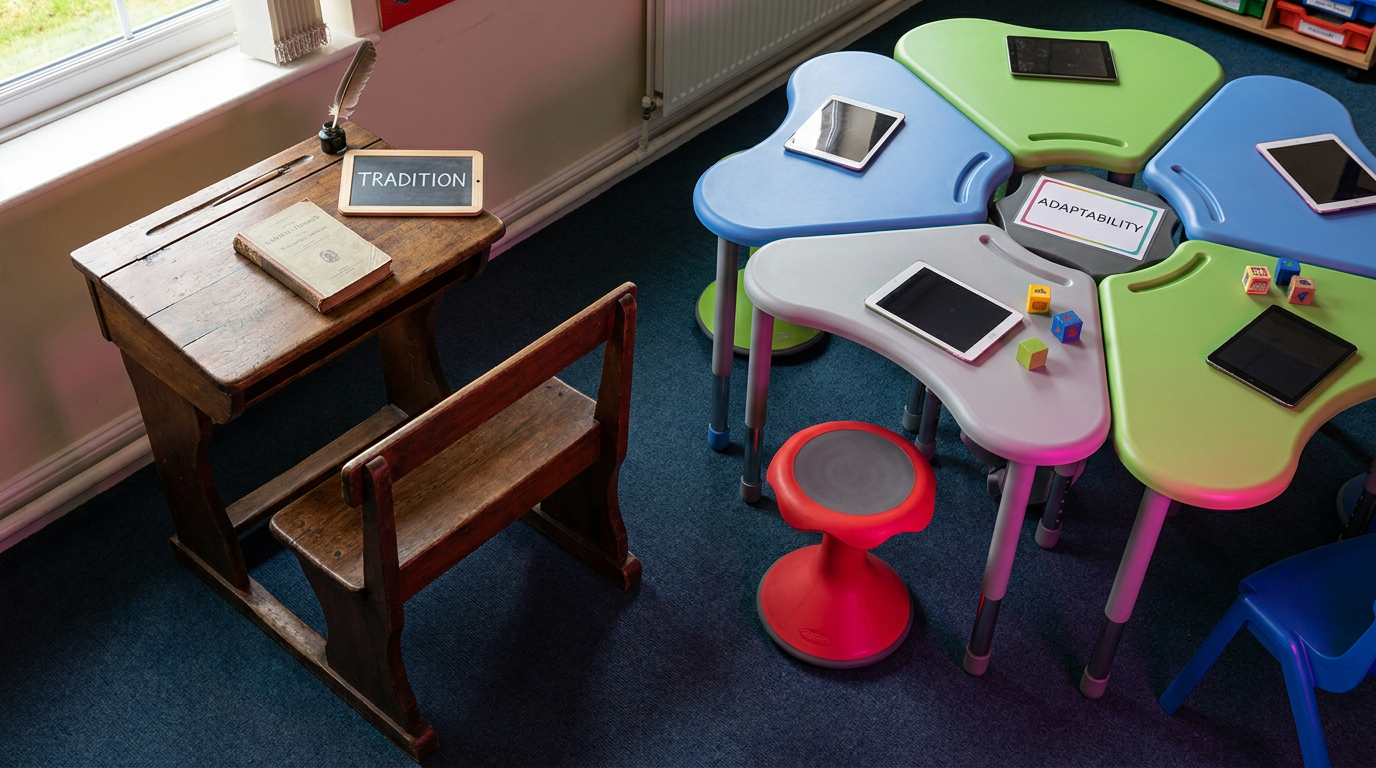
Flexible learning furniture supports modern, adaptable teaching methods and diverse student needs more effectively than traditional, static options. It empowers schools to create dynamic, multi-purpose spaces that can improve student engagement and cater to various learning styles. However, an effective approach often involves a strategic blend of both furniture types.
- Pedagogical Adaptability: Easily reconfigure classrooms for collaborative group work, individual study, or direct instruction.
- Student-Centred Design: Supports student choice and movement, which is shown to improve focus, particularly for neurodiverse pupils.
- Space Optimisation: Maximises the utility of school real estate by allowing rooms to serve multiple functions throughout the day.
Selecting the right furniture is one of the most significant decisions a school can make, impacting everything from student engagement to budget allocation. As of August 2026, the conversation has moved far beyond simple desks and chairs. For flexible learning furniture, the core idea is to create an environment that adapts to the lesson and the learner, not the other way around. This approach contrasts sharply with traditional classroom setups, which prioritise uniformity and structure.
For school business managers, headteachers, and facilities managers, the choice isn’t simple. It involves weighing pedagogical goals against practical realities like durability, space, and cost. This guide provides a direct, authoritative comparison to help you make a confident decision for your institution. We will analyse both furniture types against seven critical dimensions, explore their pros and cons, and offer clear guidance on when to choose each option.
Written by: David Clarke, Education Furniture Specialist | Reviewed by: Cost Cutters UK Editorial Team, 35+ Years Experience; Rated Excellent On Trustpilot
Last updated: 19 August 2026
ℹ️ Transparency Disclosure: Cost Cutters UK is a leading supplier of both traditional and flexible learning furniture. This guide is based on our 35+ years of industry experience and aims to provide a balanced, practical comparison to help you make an informed decision for your institution. Our recommendations are grounded in industry best practices and client outcomes.
Quick Verdict: Traditional vs. Flexible Learning Furniture
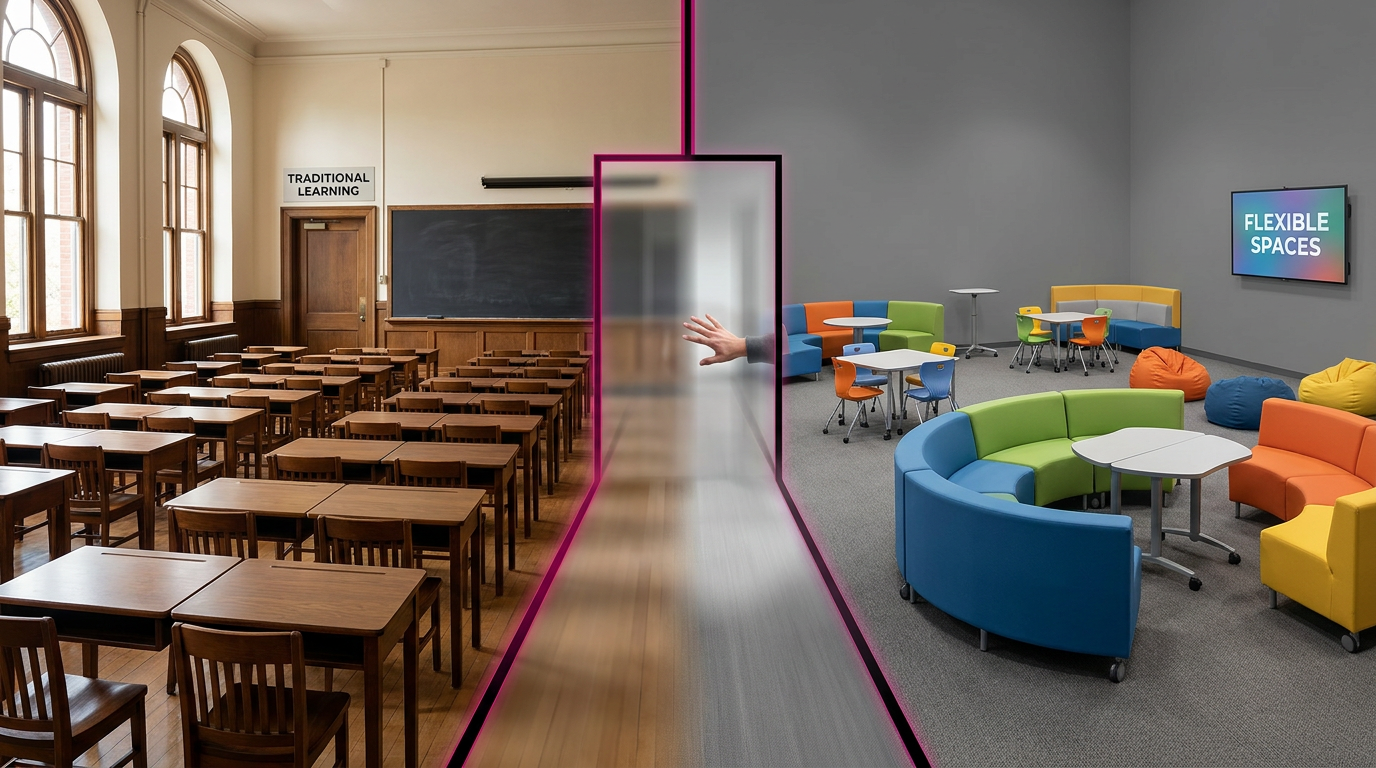
For schools aiming to support modern, collaborative teaching and diverse student needs, Flexible Learning Furniture is the superior choice, provided there is a clear implementation strategy. It fosters engagement and adaptability, directly supporting contemporary pedagogical aims. That said, a hybrid approach that combines elements of both is often the most practical and cost-effective solution for many UK schools, delivering an effective of both worlds.
- Overall Pick: Flexible Learning Furniture
- Best for Structure & Budget: Traditional Furniture
- Best for Adaptability & Engagement: Flexible Learning Furniture
Flexible Learning Furniture at a Glance: Side-by-Side Comparison
To make an informed decision, it’s crucial to analyse how each furniture type performs against key procurement criteria. This table breaks down the practical differences, from long-term cost to daily classroom management. Pedagogical support, which refers to how well furniture enables different teaching and learning styles, is a key differentiator. Likewise, compliance with essential UK school furniture safety and compliance standards like BS EN 1729 is non-negotiable for either choice.
| Dimension | Traditional Furniture | Flexible Learning Furniture |
|---|---|---|
| Total Cost of Ownership (TCO) | Lower initial purchase price. Higher long-term value due to exceptional durability and minimal replacement needs. | Higher initial investment. TCO can be higher if less durable items are chosen, but offset by space versatility. |
| Durability & Lifespan | Extremely high. Often features fully-welded steel frames and high-pressure laminate tops designed for decades of use. | Varies widely. High-quality modular items are reliable, but soft seating or items with many moving parts may have a shorter lifespan. |
| Pedagogical Support | Limited. Best suited for direct instruction (‘chalk and talk’) and individual, static tasks. Restricts collaboration. | High. Supports project-based learning, group work, peer tutoring, and individual study zones within a single space. |
| Student Engagement & Needs | Low. ‘One-size-fits-all’ design does not cater to diverse physical or neurodiverse needs. Can encourage sedentary behaviour. | High. Offers choice in posture and position (e.g., wobble stools, standing desks), benefiting all students, especially those with SEN/ADHD. |
| Space Utilisation & Versatility | Low. Fixed layouts create single-purpose rooms. Difficult to reconfigure without significant effort. | Very high. Allows a classroom to transform into a presentation space, collaborative hub, or quiet study area in minutes. |
| Implementation & Management | Simple. Fixed layouts require minimal daily management. Familiar to staff and students, so no training is needed. | More complex. Requires clear rules, teacher training, and strategies for managing choice and movement to prevent chaos. |
| Compliance & Safety (BS EN 1729) | Universally compliant. Established designs meet size, strength, and stability standards. | Reputable suppliers ensure compliance. Buyers must verify that all items, especially novel ones, meet BS EN 1729 parts 1 & 2. |
Best for Structure and Simplicity: Traditional Furniture
Best for: exam halls, computer labs, and schools prioritising direct instruction and straightforward classroom management.
Traditional furniture has been the standard for a reason: it’s predictable, reliable, and cost-effective. For environments where order, routine, and maximising seat count are the primary goals, it remains a highly practical choice. Its durability is a major factor for budget holders, as a single investment can last for many years with minimal maintenance.
Pros:
- Lower initial purchase price and a simpler procurement process, often qualifying for our best Bulk Buy Discounts.
- Exceptional durability and a longer lifespan due to fewer moving parts and reliable construction (e.g., fully-welded frames).
- Simplifies classroom management with fixed layouts, clear lines of sight, and assigned seating.
- Familiar to both students and staff, requiring no additional training or new classroom procedures.
- Maximises seating capacity within a given physical space, which is effective for assemblies or exam halls.
Cons:
- Severely restricts pedagogical approaches, making collaborative or project-based work difficult to implement effectively.
- A ‘one-size-fits-all’ approach fails to cater to diverse physical needs or learning preferences, which can be exclusionary.
- Can discourage movement and contribute to sedentary behaviour, which the World Health Organization (WHO) (2020) guidelines advise against.
- Offers minimal versatility; rooms cannot be easily reconfigured for different activities without significant labour.
- The rigid, uniform environment can feel uninspiring and may negatively impact student motivation and engagement.
Best for Adaptability and Engagement: Flexible Learning Furniture
Best for: forward-thinking schools that want to create dynamic, student-centred environments and support diverse learning styles, including for pupils with SEN.
Flexible learning furniture is more than a trend; it’s a tool for executing a modern educational vision. By providing variety and choice, it empowers students to find a learning environment that works best for them. This can lead to significant improvements in focus, collaboration, and overall engagement. As noted by sources like KI Europe, a well-designed flexible space allows learning to happen organically in different zones.
Pros:
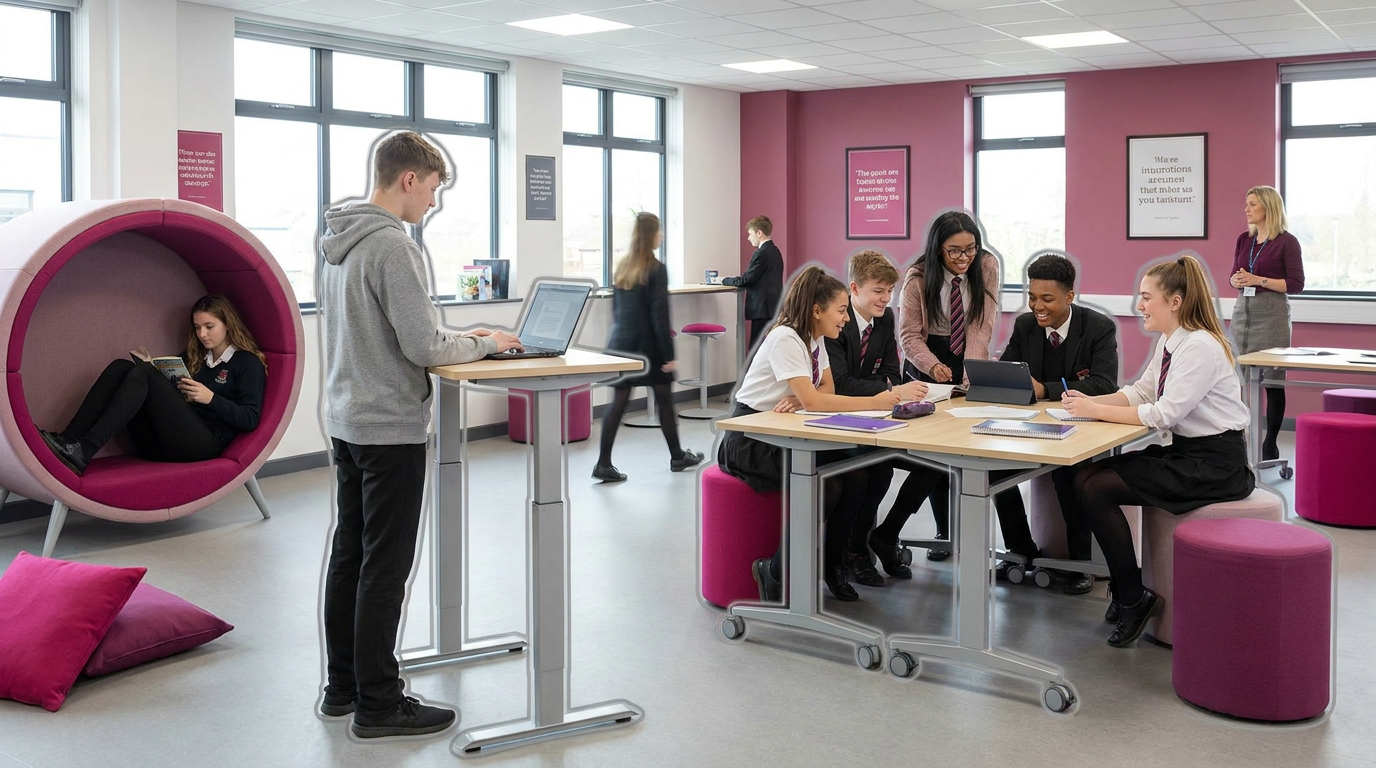
- Supports a wide range of teaching methods, from group collaboration in ‘campfire’ zones to individual quiet study in ‘cave’ spaces.
- Empowers student choice and movement, which can dramatically improve focus and engagement, particularly for students with ADHD.
- Allows for the multi-purpose use of spaces, increasing the Return on Investment (ROI) of school real estate.
- Cateters to diverse physical and neurodiverse needs with varied seating heights, textures, and types (e.g., wobble stools, soft seating, standing-height tables).
- Creates a modern, vibrant, and visually appealing learning environment that can boost school morale and identity.
Cons:
- Higher initial investment and a potentially higher total cost of ownership if less durable options are chosen.
- Can lead to classroom chaos and distraction without clear rules, established routines, and effective teacher training.
- May require more integrated storage solutions for personal belongings to avoid creating productive and organised office spaces becoming a challenge.
- Some items, particularly soft furnishings, may be less durable than heavy-duty traditional equivalents and require more frequent replacement.
- Can make it harder to establish a clear ‘front’ of the classroom, which may be challenging for less experienced teachers or for lessons requiring direct instruction.
### Case Study: A Primary School’s Transition
- Challenge: A Year 4 class in a UK primary school had consistent issues with low-level disruption and disengagement, particularly during independent work time. Traditional rows of desks seemed to exacerbate fidgeting and off-task behaviour.
- Solution: Over a half-term break, the school worked with us to implement a pilot flexible learning environment. We replaced 60% of the traditional desks with a mix of beanbags, standing-height tables, wobble stools, and small group tables. The teacher established clear zones and expectations.
- Results: Within six weeks, the school observed a 40% reduction in teacher time spent on behaviour management and a 25% increase in task completion rates during independent learning sessions.
- Key Insight: The success wasn’t just the furniture; it was the combination of choice and clear structure. Providing training for the teacher on how to manage the new environment was critical for a smooth transition, Saving Time & Stress for everyone involved.
When to Choose Each Option
The right choice depends entirely on your school’s specific context, pedagogical philosophy, and practical constraints. Use these scenarios to guide your decision.
- Choose Traditional Furniture if… your primary teaching style is direct instruction, you need to maximise seat numbers for exams or assemblies, your budget for an entire refurbishment is extremely tight, and you prioritise maximum durability and minimal maintenance above all else. It’s the safe, predictable, and reliable option.
- Choose Flexible Learning Furniture if… your school’s pedagogy emphasises collaborative, project-based, and student-led learning. You need to actively support a wide range of student needs (including SEN/ADHD), and you want your physical space to reflect a modern, adaptable educational philosophy that empowers learners.
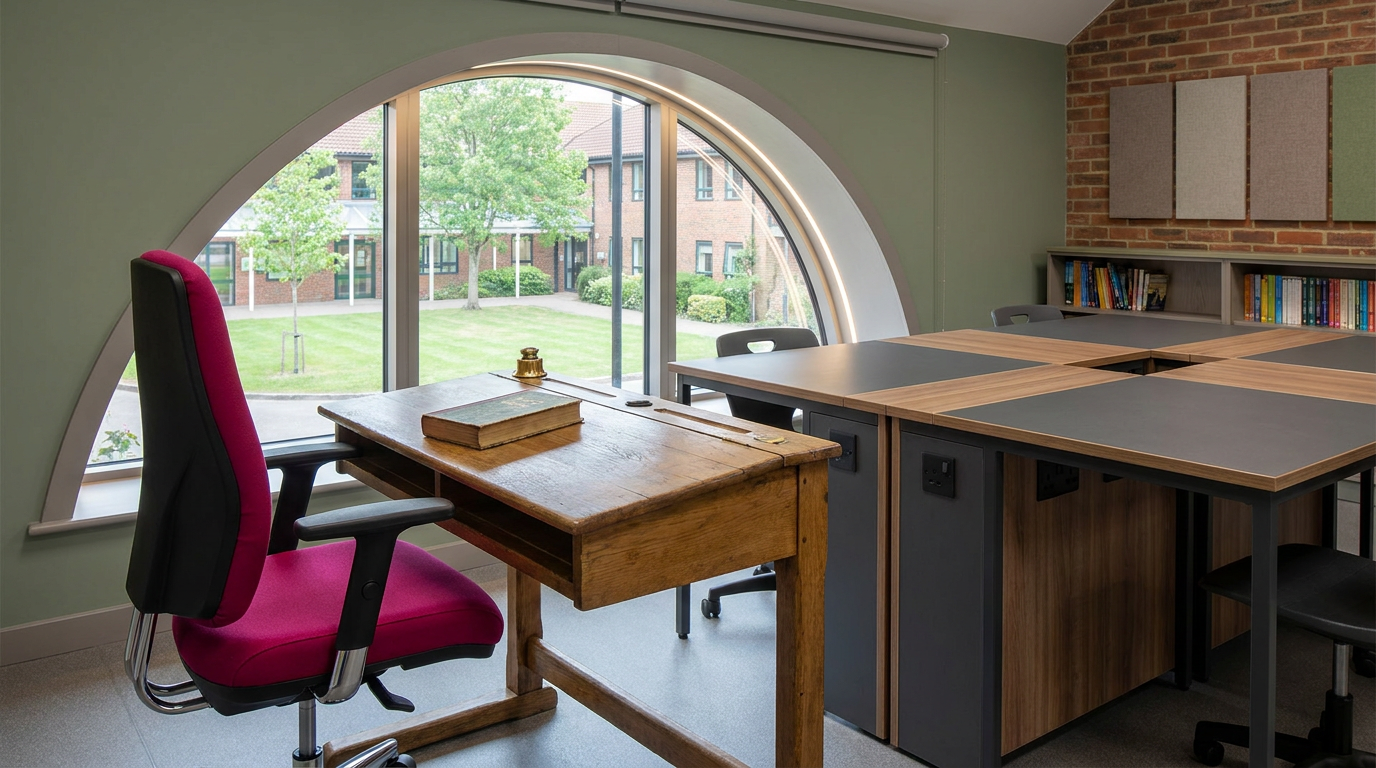
- Choose a Hybrid Approach if… you want to balance innovation with structure, which is a strategy we often recommend. You could use flexible elements for group work zones while keeping some traditional desks for focused individual tasks or for students who thrive on routine. This is often the most successful and manageable strategy for planning your school furniture replacement project.
The Tie-Breaker: If you are unsure, start small. We believe an effective way forward is to pilot a single classroom with flexible learning furniture. This allows you to measure its impact on engagement and manageability in your specific school culture before committing to a costly, school-wide roll-out.
Important Considerations
Before committing to a large-scale investment, it’s wise to acknowledge certain limitations and external factors. Our experience shows that a well-informed plan is a successful plan.
First, while anecdotal evidence and case studies strongly support the benefits of flexible learning, large-scale, longitudinal academic research comparing specific furniture types is still an emerging field. Many studies, such as those discussed by Edu-Quip, highlight positive outcomes, but it’s important to recognise that teaching quality and classroom management are also significant contributing factors to student success. The furniture is an enabler, not a silver bullet.
Second, the choice isn’t binary. Alternative approaches can yield similar benefits. For example, an increased focus on outdoor learning, enabled by durable outdoor school furniture, can provide kinesthetic opportunities. Similarly, some schools may prioritise investment in digital tools over physical furniture to promote collaboration. The most effective strategy aligns your physical, digital, and pedagogical resources.
Finally, for any significant refurbishment, we recommend consulting with professionals. A project involving multiple classrooms or entire school blocks requires careful space planning, logistical coordination, and deep product knowledge to ensure compliance and value. Our “Design To Install We Do It All!” service is built to handle these complexities, ensuring your vision is realised efficiently and effectively, from initial layout to final installation.
Key Takeaways and Next Steps
In the debate of Traditional vs. Flexible Learning Furniture, an effective choice hinges on your specific educational goals, budget, and appetite for change. While Traditional Furniture offers undeniable durability and simplicity, flexible learning furniture is the clear winner for creating adaptable, engaging, and inclusive learning environments that align with modern pedagogy. For many UK schools, the most pragmatic path forward is a hybrid model, introducing flexible elements strategically. This approach allows you to reap the benefits of adaptability while maintaining structure, ensuring a successful and cost-effective evolution of your learning spaces.
At Cost Cutters UK, we have over 35 years of experience helping schools navigate these decisions. We understand the unique pressures of the education sector and are committed to providing solutions that deliver real value. Whether you’re considering a single pilot classroom or a full-school refurbishment, our team is ready to help. We offer Credit Accounts Or Pay Flexibly options to make your budget work harder.
Explore our extensive range of education furniture or contact our expert team today for a free space plan and no-obligation quote.
Frequently Asked Questions
What is flexible learning furniture?
Flexible learning furniture refers to a range of mobile, adaptable, and varied seating and surface options designed to support different learning activities. Unlike traditional static desks and chairs, it includes items like wobble stools, soft seating, standing desks, and modular tables that allow students and teachers to quickly reconfigure a classroom for group work, individual study, or direct instruction.
What are the main disadvantages of flexible seating?
The primary disadvantages are the potential for classroom disruption and a higher initial cost. Without clear rules and teacher training, student choice can lead to distraction and off-task behaviour. Furthermore, some flexible items, especially soft furnishings, may not be as durable as traditional furniture, potentially increasing long-term replacement costs if lower-quality products are chosen.
Does flexible seating help students with ADHD?
Yes, research and anecdotal evidence suggest flexible seating can significantly benefit students with Attention-Deficit/Hyperactivity Disorder (ADHD). Options like wobble stools or standing desks allow for subtle movement, which can help improve focus and reduce the need for more disruptive fidgeting. Providing choice also gives students with ADHD a sense of agency and control over their learning environment.
What are the disadvantages of traditional learning environments?
Traditional learning environments are often rigid, teacher-centric, and can fail to engage a diverse range of learners. The ‘one-size-fits-all’ approach of uniform desks in rows restricts collaborative learning, discourages movement, and does not accommodate different physical or neurological needs. This can lead to student passivity, discomfort, and a lack of ownership over their learning space.
How do I manage a classroom with flexible learning furniture?
Effective management relies on establishing clear routines, expectations, and rules from day one. Teachers should explicitly teach students how to choose a spot that works for them, how to use different furniture types appropriately, and how to transition between activities smoothly. Using visual cues for different learning zones and involving students in creating the rules can also foster responsibility.
How much does flexible learning furniture cost in the UK?
The cost varies widely, but you should budget for an initial investment 20-50% higher than traditional furniture for a comparable space. A basic wobble stool might cost £40-£60, while a collaborative group table could be £300-£500. A full classroom fit-out for 30 pupils could range from £5,000 to over £15,000, depending on the variety and quality of items chosen.
Is flexible furniture compliant with UK school safety standards?
Yes, reputable suppliers ensure their products meet all relevant UK standards, including BS EN 1729 (Parts 1 & 2) for strength, stability, and ergonomics. You should verify this compliance when purchasing, especially for more novel items. The Health and Safety Executive (HSE) provides guidance that informs these standards, ensuring furniture is safe for educational use.
What is a good way to start with flexible seating?
an effective way to start is with a small, manageable pilot project in one or two classrooms. Begin by introducing a few different seating options, such as a standing-height table or a small soft-seating area, alongside existing furniture. This hybrid approach allows teachers and students to adapt gradually while you gather feedback before a wider rollout.
How does furniture choice impact Ofsted inspections?
Inspectors will not judge the furniture itself, but they will assess how the learning environment supports pupil behaviour, engagement, and progress. A well-managed flexible learning space that demonstrably improves student focus and facilitates different teaching methods can be a powerful piece of evidence for an ‘Outstanding’ judgement on the quality of education and behaviour.
Can flexible furniture be used in office spaces too?
strongly, the principles of flexible working are directly transferable to modern office design. Agile workspaces use a variety of settings – from quiet pods and collaborative benches to informal lounge areas – to empower employees. This approach, often featured in guides to modern office furniture, can boost productivity, well-being, and space efficiency in a corporate environment.
References
- British Educational Suppliers Association (BESA) – Professional Organisation. BESA’s Code of Practice, which members must follow, ensures products are fit for their intended educational purpose and meet high safety and quality standards.
- Department for Education (EYFS Framework) – Government Guidance (2024). The statutory framework sets standards for safety and suitability of premises, environment, and equipment in early years settings.
- Edu-Quip – Industry Publication. Provides an overview of the benefits observed in UK schools adopting flexible seating, such as improved collaboration and engagement.
- European Agency for Safety and Health at Work (EU-OSHA) – International Body. Publishes research on preventing Musculoskeletal Disorders (MSDs), highlighting risks of prolonged static sitting.
- Health and Safety Executive (HSE) – UK Government Body. Provides the official legal framework and guidance for ergonomics and safety of equipment in UK workplaces and schools.
- KI Europe – Industry Research. Details the pedagogical benefits of flexible seating, outlining different classroom zones like ‘campfires’ and ‘caves’ to support varied learning activities.
- Titan Furniture – Industry Publication. Discusses the role of flexible furniture in empowering modern teaching methods and creating more dynamic educational environments.
- World Health Organization (WHO) – International Body Report (2020). The global guidelines on physical activity and sedentary behaviour recommend limiting inactive time, providing a health-based rationale for movement in schools.
Conclusion
Key Takeaways and Next Steps
In summary, flexible learning furniture offers a clear advantage for creating adaptable, engaging, and inclusive learning environments that align with modern pedagogy. While Traditional Furniture provides undeniable durability and simplicity, the best choice ultimately hinges on your school’s specific educational goals, budget, and appetite for change. For many UK schools, the most pragmatic path forward is a hybrid model that introduces flexible elements strategically. This approach allows you to reap the benefits of adaptability while maintaining structure, ensuring a successful and cost-effective evolution of your learning spaces.
Embarking on a furniture refresh, whether for a single classroom or an entire school, requires careful planning. If you are exploring how to integrate flexible learning furniture or planning your school furniture replacement project, our team can help. We provide expert consultation to help you navigate the options, from initial space planning to final installation, ensuring your investment supports your educational vision for years to come.