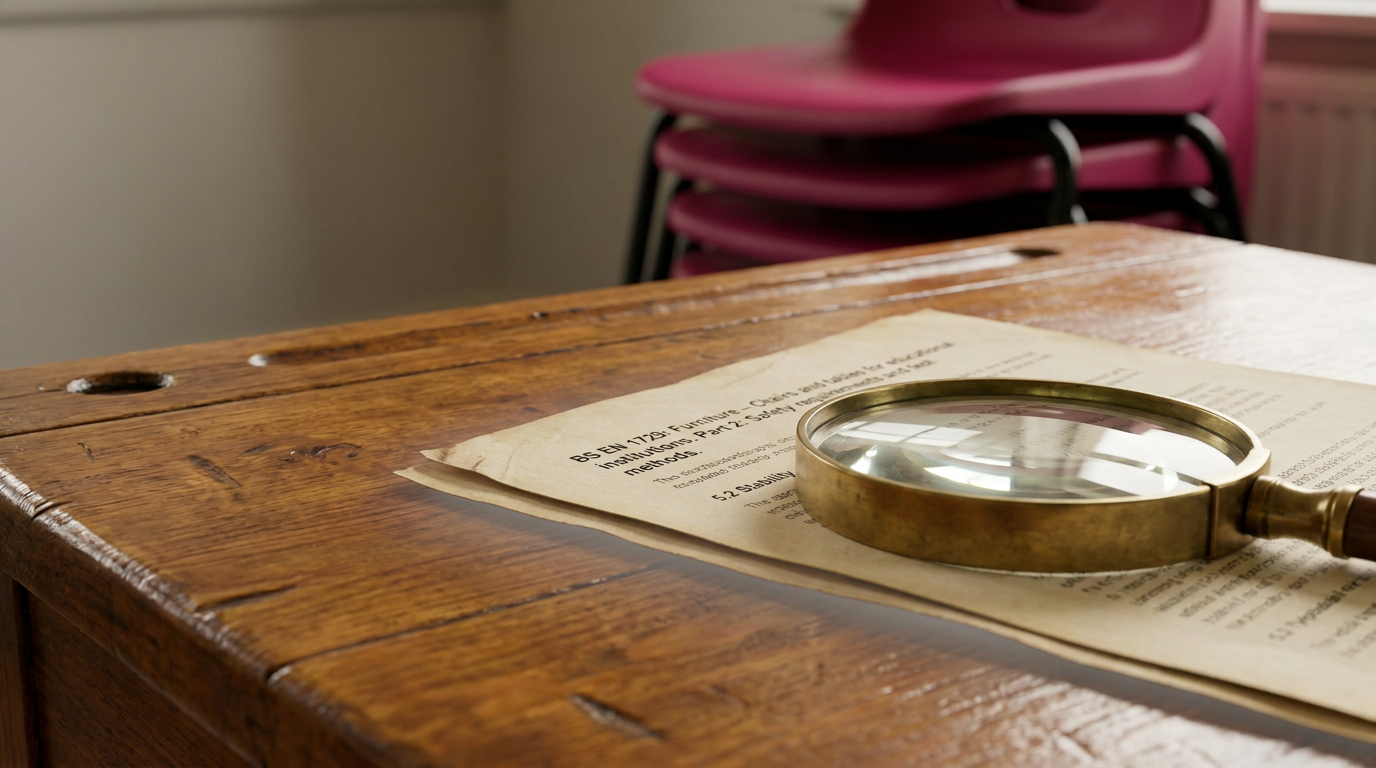
School Furniture Compliance: Your Definitive Guide to UK Safety Standards
🎯 Key Takeaway
Achieving school furniture compliance in the UK involves adhering to specific legal standards for ergonomics, strength, and fire safety, primarily BS EN 1729 and Crib 5. This process is a critical part of a school’s duty of care. For educational institutions, understanding these regulations isn’t just about procurement; it’s about safeguarding students and staff.
- Structural & Ergonomic Safety: All educational furniture must meet BS EN 1729 Parts 1 & 2 for correct sizing, posture, strength, and durability.
- Fire Safety: Upholstered items in schools must meet Crib 5 (BS 7176 Medium Hazard) standards to comply with UK fire regulations.
- Supplier Verification: Your legal duty includes verifying supplier claims by requesting and checking certificates of conformity for all furniture purchases.
Navigating the legal and moral responsibilities of ensuring student safety is a top priority for any educational institution. For fitting out learning spaces, furniture selection is far more than a design choice; it’s a critical risk management task. The challenge for many School Business Managers is the complex web of UK school furniture standards, including BS EN 1729 for ergonomics and stringent fire safety regulations. Failure to comply can have serious consequences. This guide provides a clear, actionable framework to ensure full school furniture compliance, helping you make safe procurement decisions. We’ll cover structural standards, fire safety, and specialised areas, and provide a checklist for verifying suppliers, which is a key part of any successful project outlined in our complete guide to school furniture replacement. This commitment to educational furniture compliance protects everyone on your premises.
👤 Written by: Costcutters UK Content Team
Reviewed by: Costcutters UK Editorial Team, BESA-Accredited Educational Furniture Specialists with 35+ Years Experience; Rated Excellent On Trustpilot
Last updated: 15 August 2026
ℹ️ Transparency Disclosure: This article explores UK school furniture compliance based on government regulations and industry best practices as of August 2026. For complete transparency, some links may connect to our specialised services. All information is verified by our editorial team to ensure accuracy.
What is BS EN 1729: The Core UK School Furniture Standard?
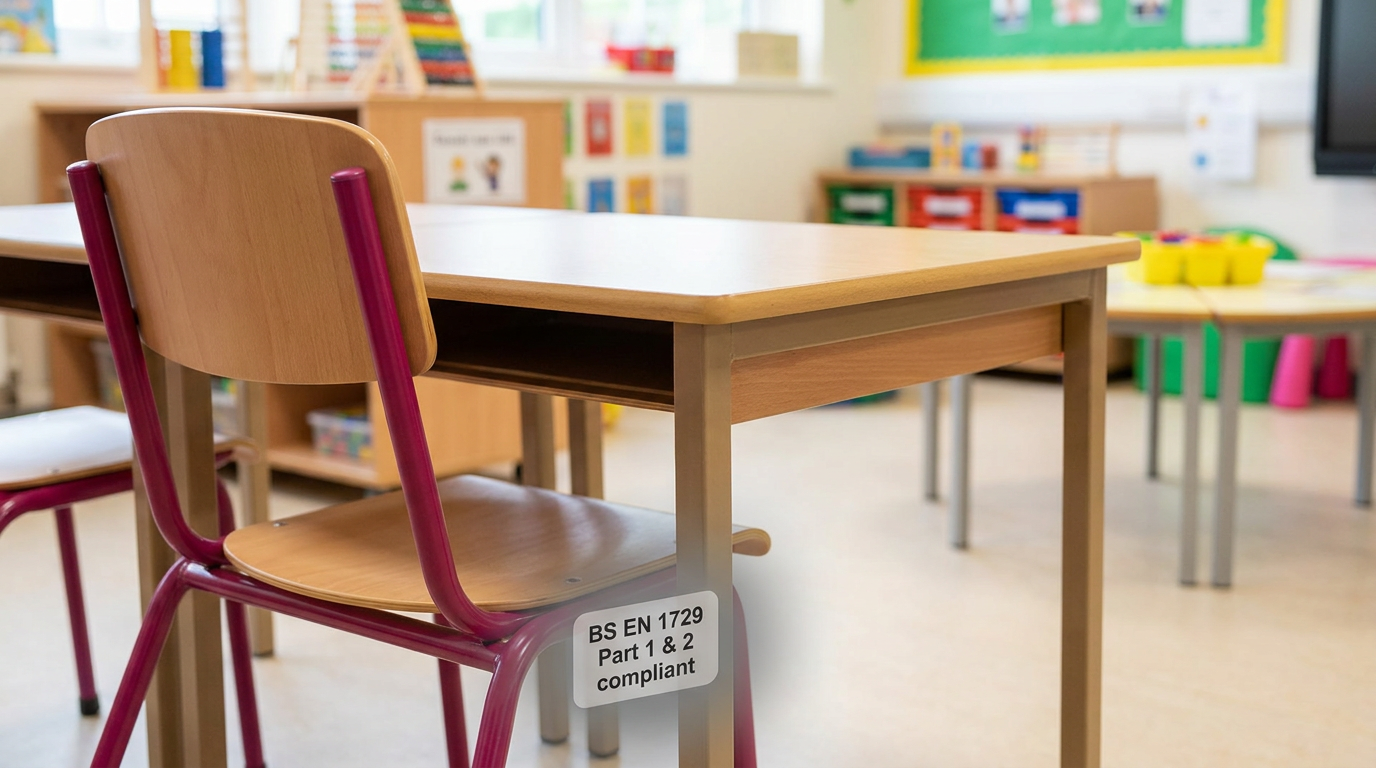
BS EN 1729 is the mandatory European standard, fully adopted in the UK, that governs the functional dimensions and safety requirements for chairs and tables used in educational institutions. This standard is fundamental to school furniture compliance. It is divided into two distinct parts, and compliance with both is essential.
Part 1 of the standard, focussed on Functional Dimensions, is all about ergonomics. It ensures that furniture is correctly sized for pupils, promoting good posture and reducing the risk of musculoskeletal disorders (MSDs), which research from the European Agency for Safety and Health at Work (EU-OSHA) (2023) identifies as a major issue stemming from poor workstation design. This part defines specific heights for chairs and tables corresponding to different age groups, identified by colour-coded size marks. This helps you choose the right fit for every classroom.
Part 2 addresses Safety, Strength, and Durability. This is where the furniture research suggests it can withstand the demanding school environment. Products undergo rigorous testing for stability (they shouldn’t tip over easily), strength (they must support specific loads without breaking), and durability to simulate years of wear and tear. A chair or table that only meets Part 1 might be the right size, but without Part 2 certification, it may not be safe or last.
| Standard | Focus Area | Key Requirement for Schools | Verification Method |
|---|---|---|---|
| BS EN 1729-1 | Ergonomics & Sizing | Furniture must match specified height/dimension ratios for different age groups to support healthy posture. | Check for size mark and supplier’s Certificate of Conformity. |
| BS EN 1729-2 | Safety & Durability | Furniture must pass tests for stability, strength, and endurance to handle rigorous daily use in schools. | Request the full Certificate of Conformity specifying Part 2 compliance. |
| BS 7176 (Crib 5) | Fire Retardancy | Upholstery (fabric and foam) must resist ignition from a specified source, meeting the ‘Medium Hazard’ level. | Look for a permanent label on the product and request certification. |
| HSE DSE Regs 1992 | Staff Workstations | Office chairs and desks for staff must be adjustable and meet ergonomic standards to prevent injury. | Confirm compliance with supplier; often overlaps with BS EN 527. |
Why is Fire Safety Non-Negotiable? Understanding Crib 5 for Schools
Yes, all upholstered furniture in UK schools must meet specific, stringent fire safety standards. This is a non-negotiable aspect of school furniture fire safety UK. While furniture for domestic homes has its own regulations, educational institutions are classified as ‘contract’ environments, which legally requires a higher level of fire retardancy.
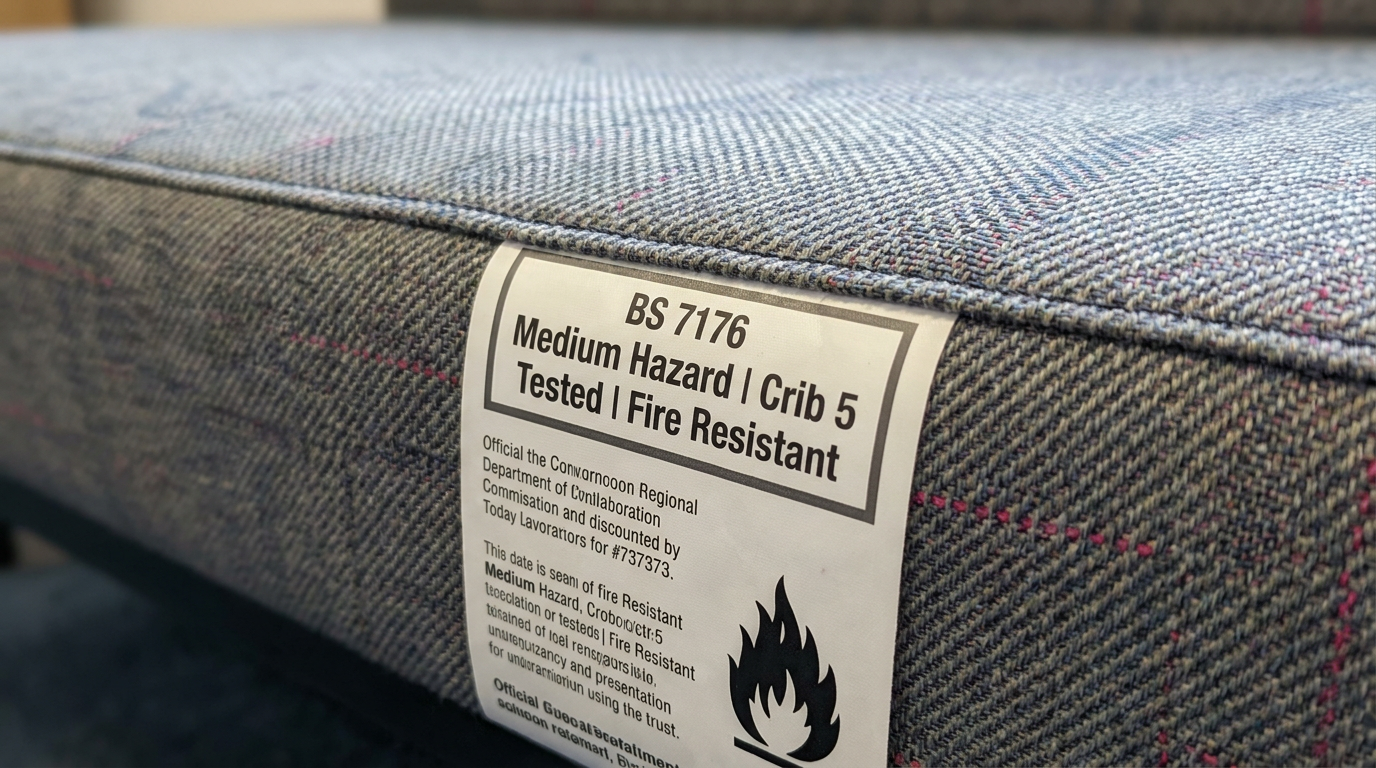
The governing legislation is the Furniture and Furnishings (Fire) (Safety) Regulations 1988. For schools, this points towards a specific test: Crib 5. Crib 5, also referred to as BS 7176 Medium Hazard, is an ignition source test that upholstery must pass to be deemed safe for public spaces. The test involves applying a small wooden crib (structure), which is set alight, to the furniture’s fabric and foam filling. To pass, the sample must not catch fire or smoulder beyond set limits. As experts at Huddle-space.co.uk note, this standard is essential for environments with a higher risk or where evacuation may be slower than at home.
So, what does this apply to? It applies to any item with significant upholstery. Think sofas and armchairs in common rooms and staffrooms, upholstered seating in reception areas, acoustic pods, and even some fabric-covered notice boards. Using non-compliant items is a serious breach of your duty of care and carries significant legal liability for the school in the event of a fire. It’s a risk that simply isn’t worth taking.
Specialised Areas of School Furniture Compliance
Beyond standard classroom chairs and tables, school furniture compliance extends into specialised areas, each with its own set of considerations. These environments often require a more nuanced approach to safety and functionality.
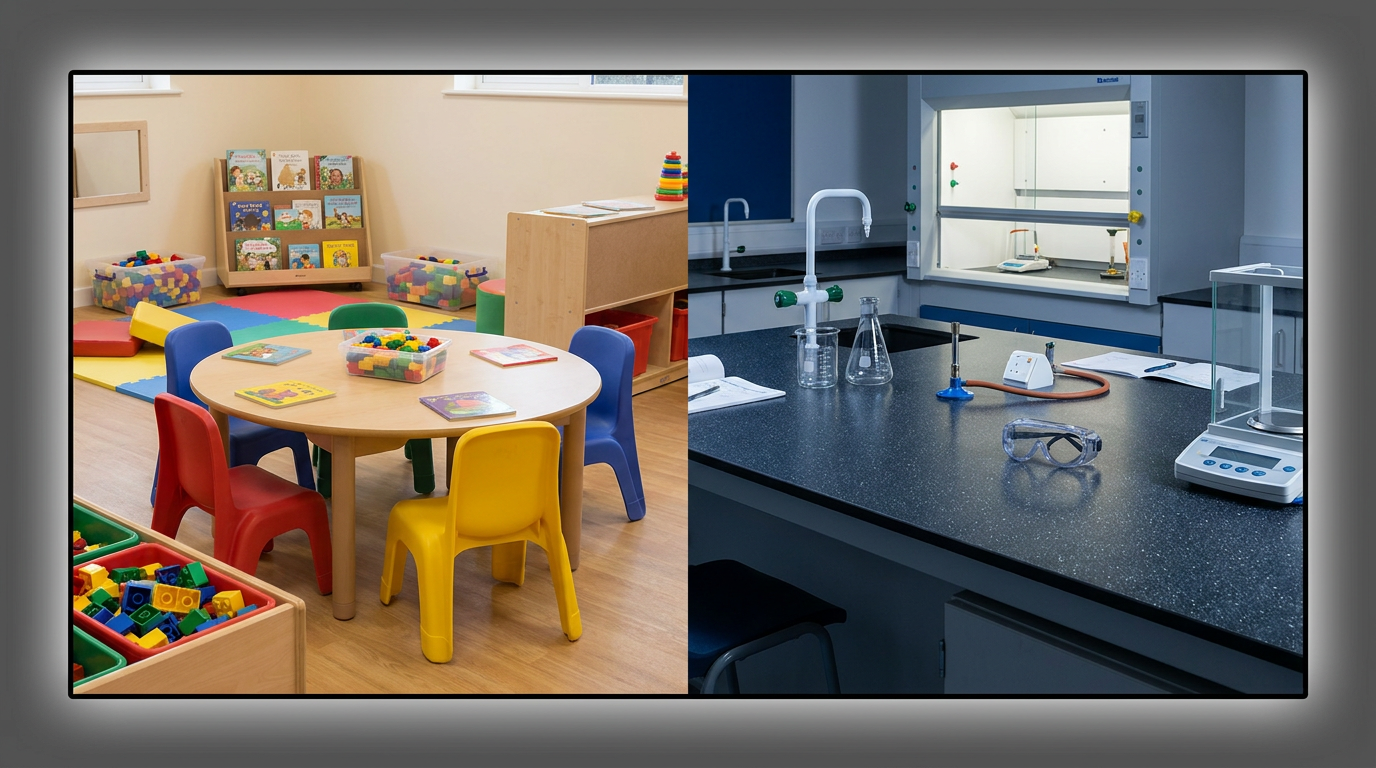
- Early Years (EYFS): For the youngest learners, the Department for Education’s (DfE) statutory framework is paramount. The EYFS Framework (2024) mandates that premises and equipment must be safe and suitable. This means furniture must be age-appropriate, with no sharp edges, stable construction, and low heights that facilitate learning through play. Compliance here is directly tied to safeguarding requirements.
- Special Educational Needs (SEN): In SEN settings, compliance involves more than just basic safety; it demands adaptability. Furniture may need to support specific physical or sensory needs, requiring features like height-adjustability, postural support, or durable surfaces for pupils with challenging behaviours. The goal is to create an inclusive environment where the furniture is an aid, not a barrier.
- Science & Technology Labs: These high-use areas are governed by additional guidelines from the Health and Safety Executive (HSE). Compliance here means selecting furniture built for specific hazards. For example, workbenches in science labs often require chemical-resistant surfaces like Trespa or Iroko hardwood. Stools must be stable and of the correct height for benches. According to guidance from sources like Werk Solutions, these specifications are often detailed in DfE building bulletins, linking furniture choice directly to the curriculum’s practical demands.
How to Verify School Furniture Compliance: A Practical Checklist
Ensuring classroom furniture safety regulations are met falls to the person procuring the items. It’s a process of due diligence that protects the school legally and its occupants physically. We’ll be honest – this part can be tedious, but it’s strongly crucial.
Here is a practical checklist for School Business Managers to follow:
- Demand the Certificate of Conformity: typically ask suppliers for a valid ‘Certificate of Conformity’ for every item. For classroom furniture, this must specify compliance with both BS EN 1729 Parts 1 and 2. For upholstered items, you need the Crib 5 certificate.
- Reject Vague Assurances: Do not accept phrases like ‘meets the requirements of’ or ‘designed in accordance with’. You need to see the official certificate that research suggests the product has been independently tested and passed.
- Check for Permanent Labels: For fire safety, compliant furniture must have a permanent label attached. This is a legal requirement. If it’s not there, the item is not compliant. It’s as simple as that.
- Question the Supplier’s Process: Ask your potential supplier about their quality assurance and testing processes. Reputable suppliers will be transparent and able to provide this information confidently. This is a key step in avoiding costly procurement mistakes.
- Prioritise Accredited Suppliers: Look for suppliers who are members of professional bodies like the British Educational Suppliers Association (BESA). As the BESA Code of Practice states, members are bound to supply goods that are safe and fit for purpose, providing an extra layer of reassurance.
Hypothetical Case Study: A Secondary School’s Compliance Challenge
- Challenge: A multi-academy trust needed to furnish a new science block for 300 pupils. They faced the challenge of sourcing furniture that was not only durable but also compliant with specific lab safety standards (chemical resistance) and general school regulations (BS EN 1729, Crib 5 for stools), all within a tight budget of £80,000.
- Solution: The trust partnered with us. We conducted a full site audit and used our “Design To Install We Do It All!” service. We specified Trespa-topped tables for chemical resistance, height-appropriate stools certified to BS EN 1729, and ensured all upholstered elements met Crib 5.
- Results: The project was delivered on time and 5% under budget, costing £76,000 due to our Bulk Buy Discounts. The school received a full compliance documentation pack, Saving Time & Stress for the Business Manager. The installation was completed over a two-week holiday period, ready for the new term.
- Key Insight: Engaging a specialist supplier early in the planning phase allows for the integration of compliance requirements from the start, preventing costly specification errors and ensuring a safe, functional, and fully documented outcome.
Frequently Asked Questions
What is school furniture compliance?
School furniture compliance is the process of ensuring all furniture within an educational setting meets specific UK legal standards for safety, ergonomics, and fire resistance. This involves verifying that products conform to key regulations like BS EN 1729 for size and strength, and Crib 5 for fire retardancy on upholstered items. It is a statutory requirement and a fundamental part of a school’s legal duty of care to its students and staff.
What is the difference between BS EN 1729 Part 1 and Part 2?
Part 1 of BS EN 1729 covers ergonomic and functional dimensions, while Part 2 covers safety, strength, and durability. Think of it this way: Part 1 ensures the chair and desk are the right size and shape for a child to sit comfortably and maintain good posture. Part 2, explained in detail in our guide, ensures the furniture is strong enough to withstand the demanding environment of a school without breaking or becoming unstable. Both parts are required for full compliance.
Is Crib 5 a legal requirement for schools?
Yes, Crib 5 is a legal requirement for upholstered furniture in UK schools. The Furniture and Furnishings (Fire) (Safety) Regulations 1988 mandate that furniture used in public-facing contract environments, which includes schools, must meet a higher fire safety standard than domestic furniture. Crib 5 (also known as BS 7176 Medium Hazard) is the recognised standard for this environment, and compliance is not optional for sofas, upholstered chairs, or similar items.
How can I check if a piece of furniture is compliant?
The two most reliable methods are requesting official documentation and checking for physical labels. First, you should typically ask your supplier for a formal ‘Certificate of Conformity’ which research suggests the item has been tested against the relevant standard (e.g., BS EN 1729). Second, for fire safety, all compliant upholstered furniture must have a permanent display label attached. Relying on verbal assurances or catalogue descriptions alone is insufficient.
What are the DfE guidelines for classroom furniture?
The Department for Education (DfE) provides overarching guidance on creating safe learning environments rather than specifying particular furniture models. Their guidelines, especially within the EYFS framework, reinforce the legal duty for schools to meet established safety standards like BS EN 1729. In essence, the DfE’s furniture guidelines state that you must follow the official British Standards to meet your safeguarding and welfare requirements, making it a matter of legal compliance.
What happens if a school uses non-compliant furniture?
Using non-compliant furniture exposes a school to severe legal, financial, and safety risks. It can invalidate insurance policies, lead to enforcement action and significant fines from the Health and Safety Executive (HSE), and demonstrates a serious failure in the school’s duty of care. Most importantly, it puts students and staff at a direct and avoidable risk of injury from structural failure or in the event of a fire.
Can schools buy second-hand furniture?
Whilst it is possible, we strongly advise caution when considering second-hand furniture. The school still bears the full legal responsibility for ensuring every item meets current safety and fire standards. It is often extremely difficult to obtain the original certificates of conformity or to verify the structural integrity of older items. The potential risks and liability often far outweigh any initial cost savings, making new, certified furniture a safer investment.
Do these rules apply to staffroom furniture too?
Yes, compliance regulations apply to all furniture on the school premises, including staff areas. Upholstered sofas and chairs in a staffroom or reception must meet the same Crib 5 fire safety standards as items in student common rooms. Furthermore, office chairs and desks used by staff must comply with Health and Safety (Display Screen Equipment) Regulations to ensure a safe and ergonomic workstation. The duty of care extends to all staff.
Who is responsible for ensuring furniture compliance in a school?
Ultimately, the school’s governing body and leadership team hold the final responsibility for compliance. However, in practice, the day-to-day duty of checking and verifying furniture during the procurement process typically falls to the School Business Manager, Headteacher, or Facilities Manager. It is a collective responsibility that requires a clear process to ensure nothing is overlooked. It’s a team effort, really.
How often are these standards updated?
British and European standards are reviewed periodically, typically every five to ten years, to reflect new research, materials, and safety data. This is why it’s so important to work with a reputable, specialist supplier who stays current with the latest versions of BS EN 1729, BS 7176, and other relevant regulations. This ensures your procurement is not only compliant today but also future-proofed against imminent changes.
Important Considerations
This guide is based on UK regulations as of August 2026. Standards can be updated, so it is vital to confirm current requirements during any procurement process. The scope of this article covers the primary furniture standards; highly specialised equipment, particularly in science, technology, or SEN environments, may be subject to additional, specific regulations. Using comprehensive workplace maintenance checklists can help track the condition of all assets over their lifecycle.
While purchasing new, certified furniture is the most direct route to compliance, some schools may consider refurbishing existing stock. This requires professional assessment to ensure structural integrity remains and that any new upholstery meets Crib 5 standards. This approach can be complex and may not typically be cost-effective once labour and material certification costs are factored in.
Navigating these standards can be challenging. For large-scale projects or complex spaces, we recommend consulting with an educational furniture specialist. An expert can conduct a site audit, provide space planning services to ensure optimal layouts, and guarantee that every item specified is fully compliant. This expert partnership is designed for Saving Time & Stress and mitigating long-term risk.
Partnering for a Safe and Compliant Learning Environment
achieving and maintaining school furniture compliance is a fundamental aspect of safeguarding and effective school management. It’s not a tick-box exercise. It requires a diligent approach that focuses on the critical pillars of ergonomic design (BS EN 1729), fire safety (Crib 5), and reliable supplier verification. By integrating these checks into your procurement process, you protect your students, staff, and the school’s legal and financial standing, ensuring a truly safe learning environment.
At Costcutters UK, we have over 35 years of experience helping schools navigate these complex requirements. As a BESA-accredited supplier that is Rated Excellent On Trustpilot, we ensure all our educational furniture compliance is certified to the latest UK standards. Our “Design To Install We Do It All!” service provides a complete solution from initial concept to final installation. If you are planning a project and need expert guidance, explore how we managed a recent school furniture transformation and request a free, no-obligation consultation with our specialists today. We also offer Credit Accounts Or Pay Flexibly to support your school’s budget.
References
- Health and Safety Executive (HSE) – UK Government Guidance. Provides the legal framework and practical advice for complying with the Health and Safety (Display Screen Equipment) Regulations 1992.
- European Agency for Safety and Health at Work (EU-OSHA) – EU Research Body (2023). Highlights risk factors for musculoskeletal disorders (MSDs) related to prolonged sitting and poor workstation design.
- Department for Education (EYFS Framework) – UK Government Statutory Framework (2024). Section 3 outlines the safeguarding and welfare requirements, including the safety and suitability of equipment.
- British Educational Suppliers Association (BESA) – Professional Organisation Code of Practice. Mandates that members supply goods that are fit for purpose and comply with relevant safety standards.
- World Health Organization (WHO) – Global Health Guidelines (2020). Recommends limiting sedentary behaviour, providing a health-based rationale for ergonomic furniture.
- Statista – Market Research Data (2024). Reports the UK office furniture market revenue at US$2.28bn, indicating the scale of the industry.
- Werk Solutions – Industry Analysis. Provides insights into interpreting Department for Education (DfE) building bulletin standards for school environments.
- Huddle-space.co.uk – Specialist Supplier Guidance. Explains the rationale for Crib 5 compliance as a standard in all student and public-use accommodation.
- FitoutSpecialists.co.uk – Procurement Guide. Outlines common and costly mistakes made during the school furniture procurement process and how to avoid them through due diligence.
Partnering for a Safe and Compliant Learning Environment
In summary, school furniture compliance is a fundamental aspect of safeguarding and effective school management. It requires a diligent approach that goes beyond aesthetics, focusing on the critical pillars of ergonomic design (BS EN 1729), fire safety (Crib 5), and robust supplier verification. By integrating these checks into your procurement process, you protect your students, staff, and the school’s legal and financial standing.
At Costcutters UK, we have over 30 years of experience helping schools navigate these complex requirements. As a BESA-accredited supplier, all our educational furniture is certified to the latest UK standards. If you are planning a furniture project and need expert guidance, request a free, no-obligation consultation with our specialists today.
Frequently Asked Questions About School Furniture Compliance
Q1: What is school furniture compliance?
School furniture compliance is the legal process of ensuring all furniture in an educational setting meets UK statutory requirements for safety, ergonomics, and fire resistance. This involves verifying adherence to key standards like BS EN 1729 and Crib 5. Fulfilling this duty of care is a non-negotiable responsibility for all schools, protecting both students and staff from preventable harm and ensuring the institution meets its legal obligations.
Q2: What is the difference between BS EN 1729 Part 1 and Part 2?
**BS EN 1729 Part 1 focuses on the ergonomic dimensions – the size and shape – of chairs and tables to