school furniture projects furniture at school: Common Challenges in School Furniture Projects & How to Solve Them
Navigating successful school furniture projects and selecting the right furniture at school involves overcoming several common hurdles, from budget limitations and compliance with safety standards to logistical complexities. This guide explores these challenges in detail, offering practical strategies and insights to ensure your school’s furniture procurement is efficient, cost-effective, and meets the specific needs of students and staff, ultimately enhancing learning environments.
🎯 Key Takeaway
Successful school furniture projects overcome key challenges in budgeting, compliance, and logistics through meticulous planning and strategic supplier partnerships. The most common issues involve balancing cost with quality, adhering to UK safety standards, and managing installation within tight holiday schedules.
- Budget constraints are the top concern, but focusing on whole-life cost and leveraging supplier discounts can maximise value.
- Navigating UK regulations like BS EN 1729 is non-negotiable for student safety and school liability.
- Effective project management, especially for delivery and installation, is crucial to avoid disruption to school operations.
This guide provides actionable solutions for each of these challenges, empowering you to deliver your project on time and on budget.
Managing school furniture projects is a high-stakes task for any School Business Manager or Headteacher. As of August 2026, the pressure to create inspiring, effective, and safe learning environments is immense. Yet, these initiatives are often fraught with common school furniture challenges, from navigating tight budgets and complex regulations to managing logistics within immovable holiday deadlines. A well-executed project is a significant opportunity to enhance student outcomes, but the path is rarely straightforward. This article serves as a clear playbook, providing practical, expert-led solutions to handle the complexities of school refurbishment planning and deliver exceptional results.
👤 Written by: Content Team | Reviewed by: Editorial Team, 35+ Years Experience; Rated Excellent On Trustpilot
Last updated: 15 August 2026
ℹ️ Transparency Disclosure: This article explores common challenges in school furniture procurement and installation based on our 35+ years of industry experience and analysis of UK regulatory guidelines. Our goal is to provide transparent, actionable advice. Some links may connect to our services, which we believe offer excellent solutions to the problems discussed. All information is verified by our editorial team to ensure accuracy and relevance for UK schools.
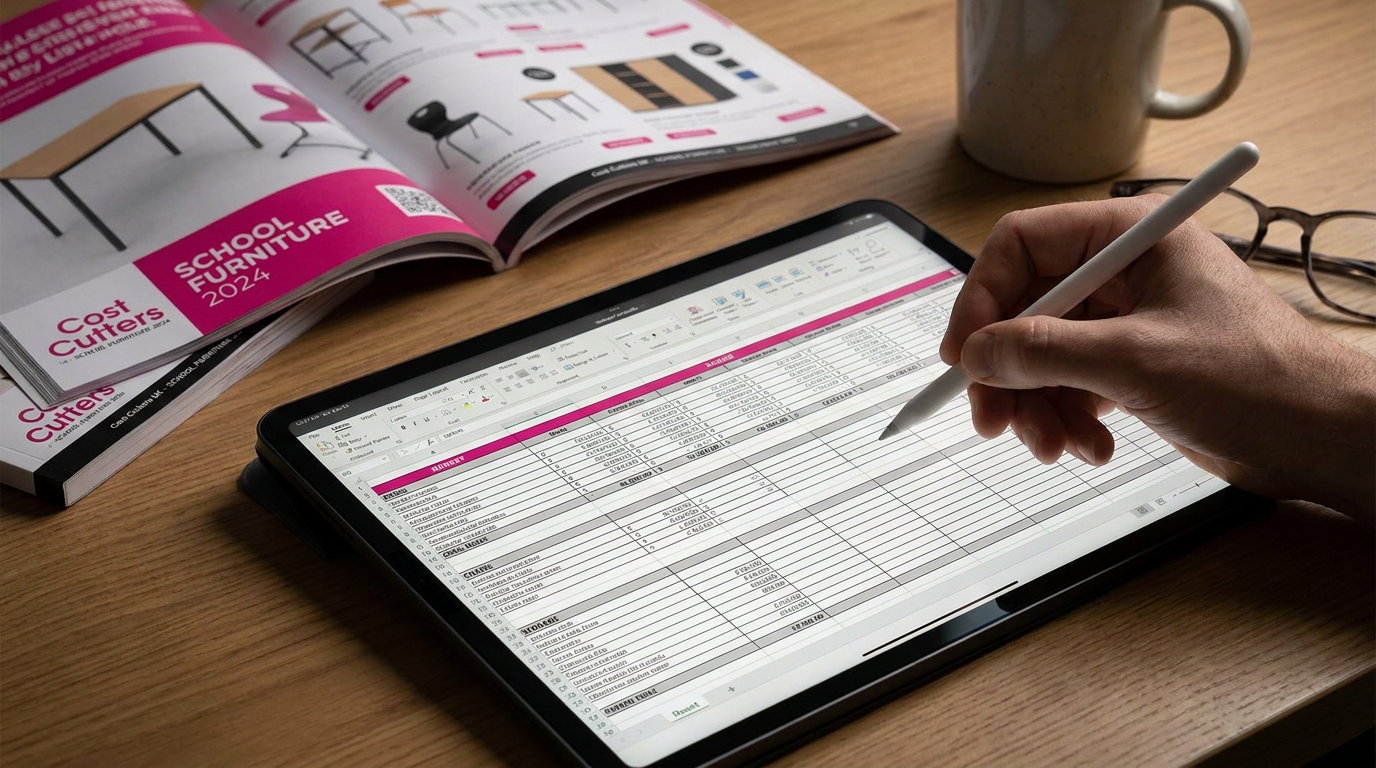
How Can You Manage Tight Budgets Without Sacrificing Quality?
The key to managing tight budgets is to shift your focus from initial ticket price to whole-life cost. Whole-life cost, a critical concept in procurement, considers not just the purchase price but also durability, warranty length, and repairability over the furniture’s lifespan. A cheaper chair that breaks in two years is far more expensive than a slightly pricier one likely to support for ten. The UK office furniture market alone is a significant sector, with Statista (2024) projecting revenue of £1.81 billion, highlighting the scale of investment involved.
One of the most common school furniture procurement problems is overlooking hidden costs. These can include steep delivery charges, separate fees for installation, and costs for the disposal of old items. These extras can quickly erode your budget if not accounted for from the outset.
Our experience suggests a three-pronged solution:
- use Supplier Benefits: Partner with suppliers that offer Bulk Buy Discounts. At Cost Cutters UK, we provide these to help your budget stretch further. It’s also wise to ask about flexible payment options; we offer Credit Accounts Or Pay Flexibly to support your school’s cash flow.
- Focus on may help: Prioritise furniture with long-term may help (5-10 years is a good benchmark). This is a direct indicator of the manufacturer’s confidence in its product’s durability and represents a commitment to long-term value.
- Plan Meticulously: Use a structured approach to analyse all potential expenses. Our comprehensive guide to budgeting for school furniture provides a detailed framework for this exact purpose, helping you avoid nasty surprises.
By adopting this value-based approach, you can navigate one of the biggest school furniture challenges and secure high-quality items that deliver a strong return on investment.
Navigating the Maze of UK Safety & Compliance Standards
Navigating compliance is complex, but understanding three key areas simplifies it: student ergonomics, staff welfare, and early years (EYFS) safety. This isn’t just about ticking boxes; it’s a fundamental duty of care. Non-compliant furniture poses a direct risk to students and staff and creates significant liability for the school.
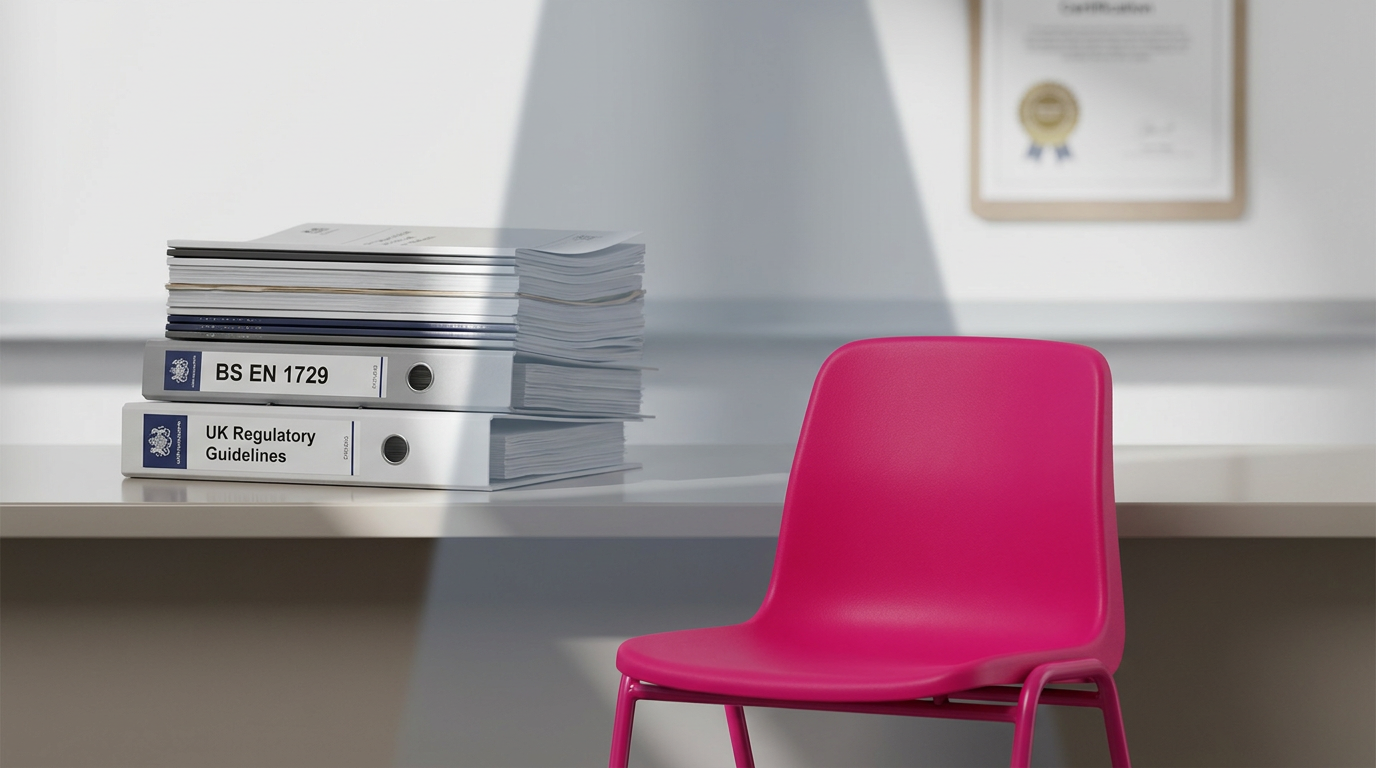
The cornerstone of student furniture safety is BS EN 1729, the European standard covering functional dimensions and strength for chairs and tables used in educational institutions. Part 1 ensures furniture is correctly sized for the age group to promote good posture, while Part 2 tests for strength and durability. The British Educational Suppliers Association (BESA) (2024) mandates in its code of practice that members must supply goods ‘fit for their intended purpose’, making BESA membership a reliable mark of quality.
For staff, the guidance from the Health and Safety Executive (HSE) on Display Screen Equipment (DSE) is paramount. The HSE’s DSE regulations require employers to perform workstation assessments and provide adjustable, ergonomic furniture to protect employees from musculoskeletal disorders (MSDs), which the European Agency for Safety and Health at Work (EU-OSHA) identifies as a major issue across Europe.
Finally, for the youngest learners, the Department for Education (DfE) statutory framework for the EYFS (2024) explicitly states that all furniture and equipment must be safe and suitable for purpose.
The most reliable solution is to work with a specialist supplier who may help all products are compliant and can provide the necessary certifications. For a deeper dive, explore our guide to UK school furniture regulations.
Why Do School Furniture Projects Face Logistical Hurdles?
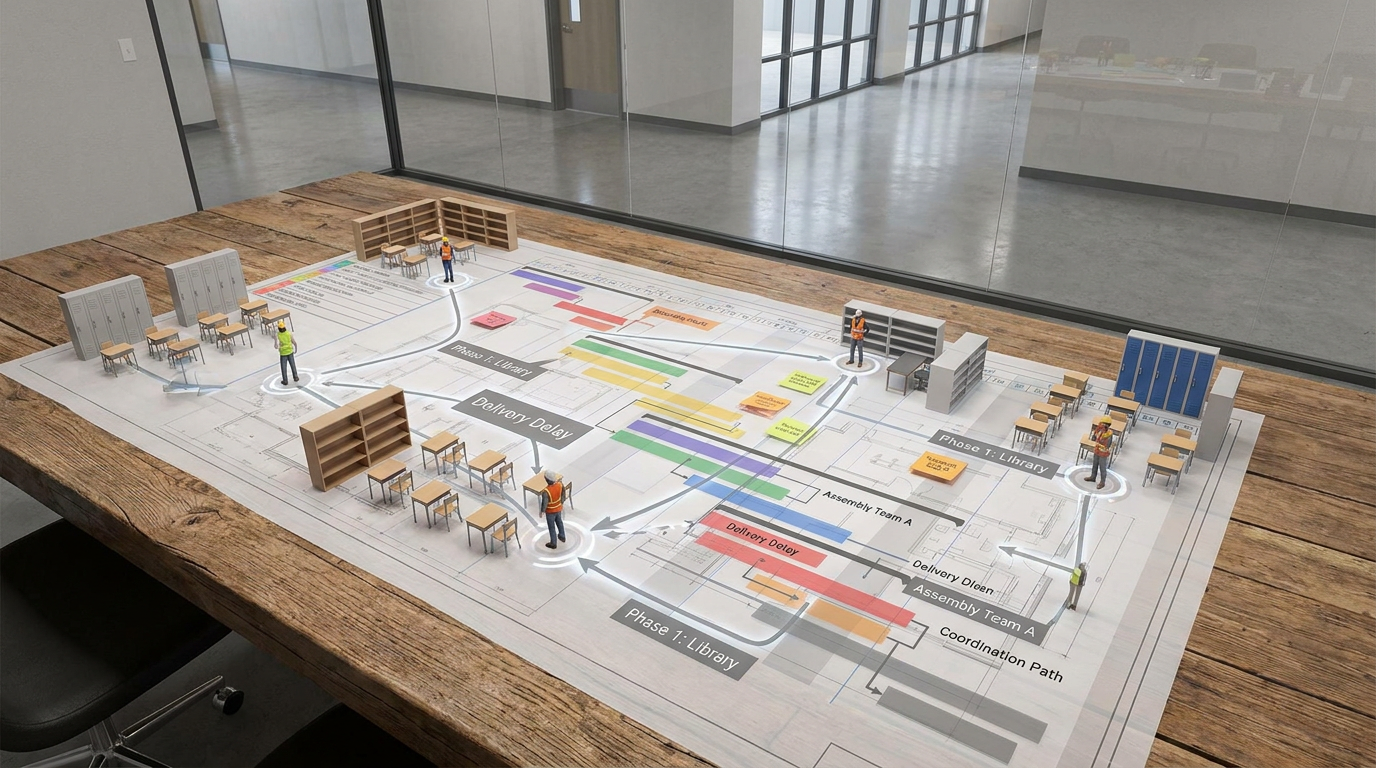
School furniture projects face intense logistical hurdles primarily because they operate on immovable deadlines with unique site challenges that don’t exist in typical commercial environments. The six-week summer holiday is often the only window for major works, creating immense pressure for flawless execution in a compressed timeframe. What could go wrong? (Spoiler: quite a lot without proper planning).
Common logistical problems in school refurbishment planning include:
- Site Access: Many schools have narrow corridors, multiple levels with no lifts, and restricted vehicle access, making the physical delivery and distribution of bulky furniture a significant challenge.
- Coordination with Other Trades: Furniture installation rarely happens in a vacuum. It must be sequenced precisely with decorators, flooring contractors, and IT installers. A delay in one area can have a costly domino effect.
- Disposal of Old Furniture: The removal and ethical disposal of hundreds of old desks and chairs is a major task that must comply with UK waste regulations. It’s not as simple as hiring a skip.
Effective classroom furniture project management is the solution. In our experience, this involves a proactive, multi-step approach.
| Project Phase | Typical Duration | Key Activities | Costcutters UK Solution |
|---|---|---|---|
| 1. Planning & Design | 4-8 Weeks | Site survey, stakeholder consultation, product selection, 3D space planning. | Free site survey and no-obligation 3D space plans to visualise the layout and prevent errors. |
| 2. Procurement & Ordering | 2-4 Weeks | Finalising quantities, placing orders, confirming lead times. | Dedicated account manager indicates all details and secures stock with Bulk Buy Discounts. |
| 3. Pre-Installation | 1-2 Weeks | Scheduling delivery, coordinating with other trades, risk assessments. | A dedicated project manager handles all coordination, Saving Time & Stress for the school. |
| 4. Delivery & Installation | 1-6 Weeks | Phased deliveries, assembly by trained fitters, placement as per plan. | Our own professional installation teams work efficiently within the agreed holiday window. |
| 5. Handover & Disposal | 1-3 Days | Quality checks, snagging resolution, removal and ethical disposal of old furniture. | Full project handover and provision of waste transfer notes for compliant disposal. |
A partner who manages this entire process transforms a logistical nightmare into a streamlined operation.
Ensuring Furniture Survives the School Day (And Decade)
To ensure furniture lasts, you must prioritise materials, construction, and may help over aesthetics alone. Furniture at school endures an incredibly demanding environment, facing far more wear and tear than in a typical office. Choosing items built for this reality is essential for achieving long-term value.
What should you look for? First, examine the construction. Fully-welded steel frames are significantly more durable than self-assembly flat-pack alternatives. Tabletops should feature high-pressure laminate (HPL) surfaces that resist scratching and impact, paired with reliable edge finishes like polyurethane (PU) or PVC that won’t peel or chip.
Second, consider ergonomics. Ergonomics, the science of designing environments to fit the people who use them, is directly linked to durability and wellbeing. A well-designed chair supports correct posture, reducing fidgeting and misuse that can lead to breakages. This aligns with recommendations from the World Health Organization (WHO) (2020) to limit sedentary behaviour by making sitting more comfortable and supportive. For more detail, our guide on ergonomic and durable school furniture is a valuable resource.
The ultimate indicators of quality are independent certifications and strong supplier may help. Look for products that are FIRA certified and backed by a 5 or 10-year warranty. These are not just marketing points; they are your assurance that the furniture is built to last, providing a reliable educational furniture solution.
The Solution: How a Strategic Partner Elevates Your School Furniture Projects
A strategic partner moves beyond a simple transaction to provide end-to-end service, mitigating risks and ensuring a better outcome for your school. The difference is stark. A transactional supplier sells boxes and leaves the complex challenges of design, compliance, and logistics to you. A strategic partner, like Costcutters UK, sells complete educational furniture solutions.
Our “Design To Install We Do It All!” philosophy is built on over 35 years of experience and is the ultimate solution to the challenges discussed. Here’s what that means in practice:
- Free Space Planning & 3D Design: Before you spend a penny, our design experts create a detailed 3D visualisation of your new space. This helps you avoid costly layout mistakes and secures buy-in from all stakeholders.
- Dedicated Classroom Furniture Project Management: We assign a dedicated project manager to your project. They handle everything – coordinating with other trades, managing delivery schedules, and overseeing the installation – Saving Time & Stress for you and your team.
- likely to support Compliance: We take the guesswork out of regulations. All our recommended products are likely to support to comply with relevant UK standards, including BS EN 1729, giving you complete peace of mind.
- Professional Installation & After-Sales Support: Our own trained and vetted installation teams build and place your furniture correctly, and our relationship doesn’t end there. We’re on hand for any after-sales support you need, backed by our “Excellent” rating on Trustpilot.
By consolidating these critical services, we transform complex school furniture projects from a source of anxiety into a smooth, successful investment. You can learn more in our ultimate school furniture projects guide.
#### Hypothetical Case Study: A Multi-Academy Trust Refresh
- Challenge: A Multi-Academy Trust (MAT) needed to refurbish 15 classrooms across three primary schools during the summer holidays. They faced a tight budget, complex logistical needs, and a non-negotiable deadline.
- Solution: The Trust partnered with Costcutters UK. We conducted site surveys at all three schools, created optimised 3D space plans for each classroom type, and developed a phased delivery and installation schedule. By leveraging our Bulk Buy Discounts, the Trust was able to afford higher-grade, ergonomic furniture.
- Results: All 15 classrooms were completed two days ahead of schedule and 5% under budget. The use of durable, compliant furniture with a 10-year guarantee reduced the Trust’s projected whole-life cost by an estimated 20%.
- Key Insight: A centralised, partner-led approach for a multi-site project provides significant cost savings and dramatically reduces administrative burden compared to managing each school’s project individually.
Frequently Asked Questions About School Furniture Projects
What are school furniture projects?
School furniture projects involve the planning, procurement, and installation of new or replacement furniture for educational environments. This ranges from a single classroom refurbishment to a whole-school fit-out, encompassing everything from desks and chairs to library shelving and staff room furniture. Successful projects require careful management of budgets, timelines, and regulatory compliance.
What is the most used piece of furniture at school?
The classroom chair is arguably the most used piece of furniture at school, closely followed by the desk. Students spend the majority of their day seated, making the chair’s ergonomic design, durability, and suitability for the age group critically important for both concentration and physical wellbeing. This high usage is why quality and compliance are paramount.
How do you budget for new classroom furniture?
Budgeting for new furniture should account for the total cost of ownership, not just the ticket price. Start by defining the scope and getting quotes from multiple suppliers. Factor in costs for delivery, installation, and the disposal of old items. Prioritise products with long may help, as investing in durability reduces long-term replacement costs and offers better value.
What is BS EN 1729 and why is it important for furniture at school?
BS EN 1729 is the key UK and European standard for the strength, durability, and ergonomic sizing of educational furniture. Compliance is vital as it ensures chairs and tables are the correct size for the intended age group, promoting good posture and comfort. Using compliant furniture is a crucial part of a school’s duty of care towards its students.
How can schools dispose of old furniture ethically?
Schools can dispose of old furniture ethically by partnering with a licensed waste carrier that prioritises recycling and reuse. Many specialist school furniture suppliers offer a disposal service. They will ensure items are broken down into recyclable materials (wood, metal, plastic) or donated to charities if they are still in a usable condition, providing you with the necessary waste transfer notes for compliance.
How does furniture impact student behaviour and learning?
Well-designed furniture significantly improves focus, comfort, and collaboration, which positively impacts behaviour and learning. Ergonomic chairs reduce fidgeting, while flexible table arrangements can facilitate different teaching styles, like group work or individual study. An uncomfortable or poorly arranged environment can be a major source of distraction and disruption for students.
What should you look for in a school furniture supplier?
Look for a supplier that offers more than just products; seek a partner with end-to-end services. Key attributes include a well-supported by research track record in education, likely to support compliance with UK standards (like BS EN 1729), free space planning services, and their own dedicated project management and installation teams. This ensures a smoother, lower-risk project.
What are the biggest challenges in school refurbishment planning?
The biggest challenges are typically adhering to a fixed budget, coordinating logistics within tight school holiday windows, and ensuring all new items meet strict UK safety standards. Balancing the needs and opinions of various stakeholders, such as teachers, governors, and facilities staff, is another common hurdle that requires clear communication and strong project management from the outset.
How long do school furniture projects typically take?
The timeline varies by scale, but a typical single-classroom project can be completed in a few days, while a whole-school project requires several weeks or even months of planning. The planning and design phase often takes 4-8 weeks, followed by ordering. The physical installation is almost typically condensed into a school holiday period, which could be one week or the full six-week summer break.
Should we choose new or refurbished school furniture?
New furniture is generally the recommended choice for core classroom items as it may help compliance, comes with long warranties, and offers the latest ergonomic designs. While refurbished items can seem cheaper initially, they may not meet current BS EN 1729 standards and often lack the durability and supplier support of new products, potentially costing more in the long run.
Important Considerations
This guide offers solutions based on common scenarios we’ve encountered in UK schools. However, every project is unique. Factors like the age and listed status of a building, or specific Special Educational Needs (SEN) requirements, may introduce challenges not covered in detail here. The cost estimates and timelines are illustrative and will vary based on project scale, location, and specific product choices.
The primary approach we advocate is a fully-managed project with a strategic partner. An alternative is for a school’s internal team to manage procurement and installation directly from multiple vendors. While this can sometimes appear to lower initial costs, our experience shows it significantly increases the administrative burden and risk for the School Business Manager, who becomes responsible for coordinating all logistics, ensuring every item is compliant, and managing multiple suppliers.
For any large-scale or complex refurbishment, especially one involving structural changes, we strongly recommend engaging a specialist partner early in the planning process. A partner with deep expertise in educational fit-outs can provide invaluable guidance on space planning, compliance, and project management. This early collaboration is an effective way to prevent costly errors and ensure the project delivers maximum long-term value for the school.
Your Next Steps to a Flawless Furniture Project
Executing successful school furniture projects hinges on proactively addressing challenges in budgeting, compliance, and logistics. By shifting focus from price to whole-life value, partnering with knowledgeable suppliers who guarantee compliance, and embracing meticulous school refurbishment planning, you can transform a potentially stressful task into a smooth process. The result is an enhanced learning environment that will benefit students and staff for years to come with high-quality educational furniture solutions.
At Costcutters UK, we specialise in turning these challenges into solutions. With over 35 years of experience serving the UK education sector and being Rated Excellent On Trustpilot, our team provides the end-to-end support you need. From a free, no-obligation space plan and quote to managed installation and ethical disposal, we act as your strategic partner. Contact our experts today to discuss your next project.
References
- Health and Safety Executive (HSE) – UK Government Guidance (1992, as amended). Provides the legal framework for workstation assessments under the Display Screen Equipment (DSE) Regulations, applicable to school staff.
- European Agency for Safety and Health at Work (EU-OSHA) – EU Research Body. Reports that musculoskeletal disorders are a leading cause of work-related health problems in Europe, emphasizing poor workplace design as a key risk factor.
- Department for Education (EYFS Framework) – UK Government Statutory Framework (2024). Section 3.54 of the Safeguarding and Welfare Requirements states that providers must ensure premises, including furniture and equipment, are safe and suitable for purpose.
- British Educational Suppliers Association (BESA) – Professional Organisation Code of Practice (2024). Requires members to supply goods that conform to safety standards and are ‘fit for their intended purpose’ within an educational setting.
- World Health Organization (WHO) – International Health Body Guidelines (2020). Recommends that children and adolescents limit sedentary time, providing a health basis for ergonomic support and movement in schools.
- Statista – Market Research Data (2024). Reports on the financial scale of the UK Office Furniture market, projecting revenue of £1.81bn.
- Witley Jones – Industry Blog Post. Outlines key steps for planning school furniture projects, from initial design consultation to installation and aftercare.
- UNICEF – International Body Guidelines. Provides global guidelines on the design and procurement of school furniture, focusing on creating effective learning environments in diverse contexts.
- Classroom Direct – Industry Blog Post. Discusses how furniture choices, such as colour and layout, can influence student behaviour and concentration.
- Furniture for Schools UK – Commercial Website. Offers a range of educational furniture and highlights the importance of durability and compliance in product selection.
- Fusion Classroom Design – Commercial Website. Specialises in the design and refurbishment of learning spaces, providing case studies and insights into modern classroom layouts.
What are the key takeaways?
Your Next Steps to a Flawless Furniture Project
In summary, successful school furniture projects hinge on proactively addressing challenges in budgeting, compliance, and logistics. By shifting focus from price to whole-life value, partnering with suppliers who provide guaranteed educational furniture solutions, and meticulous school refurbishment planning, you can transform a potentially stressful project into a seamless process that enhances your learning environment for years to come.
At Costcutters UK, we specialise in turning these challenges into solutions. With over 35 years of experience serving the UK education sector, our team provides the end-to-end support you need. From a free, no-obligation space plan and quote to managed installation and ethical disposal, we act as your strategic partner. Contact our experts today to discuss your next project.