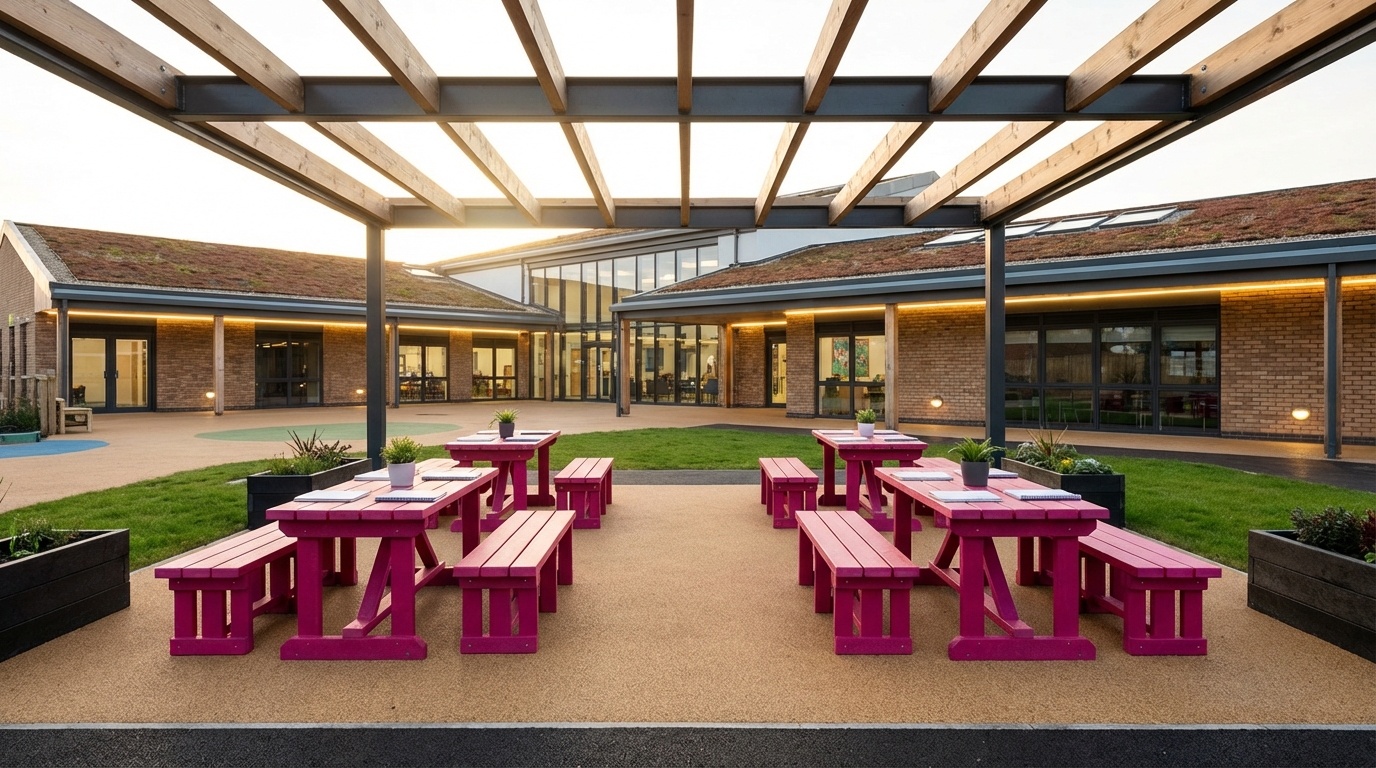
Outdoor Educational Furniture: The Complete Guide for UK Schools
🎯 Key Takeaway
Selecting the right outdoor educational furniture involves balancing curriculum needs, material durability for the UK climate, and strict adherence to safety standards like BS EN 1176. Prioritise materials like recycled plastic for longevity and low maintenance in damp conditions. Plus, you’ll need to ensure all furniture, especially for playgrounds, is certified to UK safety standards to mitigate risk. We recommend you develop a clear plan covering funding sources, spatial design, and curriculum goals before procurement. This guide provides school business managers with a comprehensive framework for making informed, compliant, and value-driven purchasing decisions.
The move towards outdoor learning has become a cornerstone of modern UK education, with its importance growing significantly since 2020. As of early 2026, more schools are recognising the profound benefits of taking lessons outside. This presents a unique challenge for the School Business Manager (SBM): how to source durable, safe, and effective equipment that enhances learning without exceeding the budget. For outdoor educational furniture, the choices can seem overwhelming. This guide cuts through the noise, offering a clear, step-by-step process for procuring high-quality outdoor classroom furniture uk that serves your pupils and stands the test of time.
Written by: The Cost Cutters UK Content Team | Reviewed by: Editorial Team, 35+ Years Experience; Rated Excellent On Trustpilot
Last updated: 17 March 2026
ℹ️ Transparency Disclosure: This article explores the procurement of outdoor educational furniture based on our 35+ years of industry experience and a thorough analysis of UK safety regulations. To maintain transparency, some links may connect to our products and services. All information is verified by our editorial team to ensure accuracy and relevance for UK schools. Cost Cutters UK is a leading supplier of educational and commercial furniture, and we’re proud to be Rated Excellent On Trustpilot.
Why Invest in Quality Outdoor Educational Furniture?
Yes, investing in quality outdoor educational furniture is crucial for enhancing both pupil wellbeing and academic attainment. This isn’t just about placing a few benches outside; it’s about creating structured, purposeful learning zones that extend the classroom. For younger pupils, this directly supports the Early Years Foundation Stage (EYFS), which emphasises the importance of outdoor play and exploration. A well-equipped outdoor space with items like early years outdoor furniture provides the tools for hands-on, experiential learning that is central to frameworks like Forest School.
The benefits are well-documented. Research from the Institute of Education (UCL) (2022) in a longitudinal study reported that well-designed outdoor learning environments can improve key developmental outcomes in children by up to 80%. Also, a national survey by Learning through Landscapes (2023) found that an overwhelming 90% of UK teachers believe outdoor learning improves pupil behaviour and reduces classroom disruption. This is because it provides a calming environment, reduces feelings of confinement, and allows for greater physical activity.
From a curriculum standpoint, quality outdoor classroom furniture uk facilitates a range of subjects. Weatherproof tables become stations for science experiments, story circles encourage collaborative literacy, and planters can be used for biology lessons. By investing in durable, safe, and appropriate furniture, you are not just buying equipment; you are investing in a more engaged, healthier, and higher-achieving student body.
Planning Your Outdoor Space: A Checklist for UK School Business Managers
A successful outdoor learning area doesn’t happen by accident. It requires careful planning. In our experience, breaking the process down into manageable steps is the key to Saving Time & Stress. Here is our recommended checklist for School Business Managers.
- Define Your Objectives: What is the primary purpose of the space? Is it for a science garden, a quiet reading zone, a social hub with durable breakout furniture, or a versatile outdoor classroom? Defining this first will guide every subsequent decision.
- Analyse Your Space: Assess the chosen area. Consider its size, sun exposure, drainage, and how it will be supervised. Plan distinct zones for different activities to maximise usability and prevent conflicts between quiet and active play. Also, ensure the layout is accessible for all pupils.
- Establish a Budget & Funding: Look beyond the initial purchase price. Your budget should account for the total cost of ownership, including delivery, installation, and any future maintenance. A survey from The Institute of School Business Leadership (ISBL) (2024) highlighted budget uncertainty as a major challenge. We recommend exploring multiple funding sources. Beyond the school’s capital budget and PTA fundraising, look into UK grants from bodies like the National Lottery Community Fund.
- Develop a Phased Approach: If the budget is tight, don’t feel you have to do everything at once. A multi-year plan can be highly effective. Start with foundational pieces like tables and seating in year one, then add specialised equipment or a canopy in year two.
- Seek Expert Advice: You don’t have to figure it all out alone. We offer a free space planning service to help you design a layout that meets your curriculum goals, budget, and safety requirements. It’s a simple way to get an expert view before committing funds.
Choosing the Right Materials for Outdoor Educational Furniture
The single most important factor for longevity is choosing the right material for your outdoor educational furniture. In the demanding UK climate of persistent rain, frost, and variable UV exposure, the wrong choice can lead to rapid deterioration, safety hazards, and wasted budget. Our recommendation is clear: for most UK school applications, recycled plastic is the superior choice.
Recycled High-Density Polyethylene (HDPE), the material used in products like recycled plastic school benches, is a thermoplastic polymer that is exceptionally durable. It is non-porous, meaning it does not absorb water, will not rot or host mould, and is impervious to frost damage. Unlike timber, it requires no annual staining or sealing, making its lifetime cost significantly lower. A lifecycle analysis by WRAP UK (2021) demonstrated that recycled HDPE products have a lower environmental impact and cost compared to alternatives.
While treated timber has a traditional aesthetic, a report from Forest Research (2023) notes that consistent, diligent maintenance is essential to prevent rot and achieve a 15-year lifespan. Metal furniture can be robust, but it requires high-quality powder coating to prevent rust, and it can become dangerously hot or cold to the touch. All fixings, regardless of material, should be stainless steel to avoid corrosion.
Here’s a direct comparison of the most common materials:
| Factor | Recycled Plastic (HDPE) | Pressure-Treated Timber | Powder-Coated Steel |
|---|---|---|---|
| Typical Lifespan | 40+ years | 10-15 years (with maintenance) | 15-20 years (if coating is intact) |
| Maintenance | Very Low (Wipe clean) | High (Annual cleaning & sealing) | Medium (Check for chips/rust) |
| Resistance to Damp | Excellent (Impervious) | Poor (Prone to rot without care) | Good (Until coating is breached) |
| Splinter Risk | None | Yes (Increases with age) | None |
| Eco-Credentials | Excellent (Uses waste plastic) | Good (If FSC/PEFC certified) | Fair (Energy-intensive production) |
For items like weatherproof school tables that will be in constant use, the durability and low maintenance of recycled plastic offer unmatched long-term value for a busy school environment.
Essential UK Safety Standards for Outdoor Educational Furniture
Yes, strict adherence to safety standards is a non-negotiable legal and moral responsibility. Schools have a ‘duty of care’ to ensure their premises and equipment are safe for pupils, staff, and visitors. For outdoor educational furniture, this means procuring items that are certified to the relevant British and European standards. Failure to do so can lead to serious injury and significant legal liability.
The most critical standard is British Standard BS EN 1176. This is the UK safety standard for public playground equipment and applies to any item that encourages or could be used for play, such as climbing frames, story chairs, and some forms of school playground furniture. Compliance involves rigorous testing for things like head and finger entrapment, structural integrity, and impact absorption.
For standard seating and tables, BS EN 1729 (Chairs and tables for educational institutions) is the key standard. It specifies dimensions, strength, and stability requirements appropriate for children of different age groups.
In practice, compliance means looking for furniture with:
- Rounded edges and corners to prevent impact injuries.
- No gaps or holes that could cause finger or limb entrapment.
- A stable design that won’t tip over easily.
- Non-toxic materials and finishes.
- For timber, certification from the Forest Stewardship Council (FSC) or Programme for the Endorsement of Forest Certification (PEFC) ensures responsible sourcing. Typically ask a potential supplier for certificates of conformity to prove their products meet these standards. Reputable suppliers will have these readily available. You can view our UK safety and quality certifications on our website. According to RoSPA (2024) annual injury data, equipment compliance is a major factor in preventing playground accidents. Sourcing from a supplier who understands and adheres to the official BSI Group publication of BS EN 1176 isn’t just best practice-it’s essential.
The Procurement Process for Outdoor Educational Furniture
We understand that for a busy School Business Manager, the procurement process needs to be straightforward and efficient. That’s why we’ve refined our approach over 35 years to make buying outdoor educational furniture as simple as possible. Our “Design To Install We Do It All!” philosophy covers every stage, ensuring you get the right solution with minimal hassle. Here’s our recommended 5-step process:
- Initial Consultation & Space Plan: The process begins with a conversation. We discuss your curriculum goals, budget, and pupil needs. Our team then produces a free, no-obligation 2D or 3D space plan, showing you exactly how the furniture will look and function in your environment.
- Formal, Itemised Quotation: Once you’re happy with the plan, we provide a detailed quotation. Crucially, this will break down all costs, including the furniture itself, delivery charges, and any installation fees. There are no hidden extras. This transparency allows for clear budget planning.
- Supplier Vetting: We encourage all schools to vet their suppliers. Check for genuine testimonials, ask for proof of insurance, and verify safety certifications. A reliable partner will be proud to share this information. Being Rated Excellent On Trustpilot is a testament to our commitment to service.
- Placing the Order: We make ordering easy for schools. We readily accept official school purchase orders and offer flexible payment options to suit your budget cycles. You can apply for Credit Accounts Or Pay Flexibly.
- Professional Delivery & Installation: The final step is getting the furniture in place. We schedule deliveries to suit you, often during school holidays to eliminate any disruption to learning. Our professional installation team ensures everything is assembled correctly and safely, ready for your pupils to enjoy.
This end-to-end service is designed for one purpose: Saving Time & Stress for busy school staff.
Frequently Asked Questions About Outdoor Educational Furniture
What is outdoor educational furniture?
Outdoor educational furniture is a category of durable, weatherproof seating, tables, and equipment specifically designed for learning activities outside the traditional classroom. This includes everything from picnic tables used for group work and story circles to specialised items like mud kitchens and planters that support curriculum-linked, hands-on learning in a school environment.
How do you make outdoor furniture weatherproof for the UK?
The key to weatherproofing is material choice and construction. For UK schools, we recommend using materials like recycled high-density polyethylene (HDPE), which is impervious to water and frost. For wooden furniture, it must be pressure-treated and ideally made from durable timber, then sealed annually. All metal fixings should be stainless steel or galvanised to prevent rust.
What are the main benefits of an outdoor classroom?
Outdoor classrooms significantly improve pupil engagement, mental wellbeing, and physical health. Research shows they can lead to better concentration, reduced behavioural issues, and provide a calmer learning environment. They also offer invaluable opportunities for hands-on, kinaesthetic learning that is difficult to replicate indoors, directly supporting subjects from science to art.
Are there grants available for outdoor classrooms in the UK?
Yes, several funding avenues exist for UK schools. Beyond the school’s own capital budget and PTA fundraising, schools can apply for grants from organisations like the National Lottery Community Fund, local council initiatives, and various environmental or educational trusts. It is typically best to check the latest criteria for these funds.
What is the most important outdoor furniture safety standard in the UK?
The primary safety standard is BS EN 1176. This standard covers school playground furniture and surfacing, specifying requirements to prevent injuries like entrapment, falling, and impact. Any item intended for play must be certified to this standard. For general weatherproof school tables and chairs, BS EN 1729 applies, ensuring correct sizing and stability for children.
Is recycled plastic school furniture safe for children?
Yes, recycled plastic furniture from a reputable supplier is extremely safe. The material, typically HDPE, is chemically inert, non-toxic, and does not splinter like wood can. It is also very easy to clean and sanitise. Ensure the supplier can provide documentation confirming the material’s safety and compliance for use in educational settings.
How long do recycled plastic school benches last?
It has an exceptionally long lifespan, often exceeding 40 years. Unlike timber, it does not rot, warp, or become infested by insects, even in the consistently damp UK climate. This makes recycled plastic school benches a highly cost-effective investment over the long term, as they require virtually no maintenance or replacement compared to other materials.
What should I look for in a school furniture supplier?
Look for experience, certification, and a comprehensive service. A good supplier for UK schools will have a well-supported by research track record, provide certificates for standards like BS EN 1176, offer services like free space planning, and manage the process from quote to installation. Check for testimonials from other schools and public sector bodies.
How much does an outdoor classroom typically cost?
Costs can vary widely, from a few thousand pounds for a basic setup to over £20,000 for a large, landscaped area with a canopy. A simple configuration with several recycled plastic picnic benches and a chalkboard might cost £3,000-£5,000. You should get a detailed, itemised quote that includes delivery and installation.
What is an effective early years outdoor furniture?
an effective early years outdoor furniture encourages exploratory and sensory play. Look for items at an appropriate height, such as sand and water tables, mud kitchens, and small benches or story chairs. Safety is paramount, so ensure all early years outdoor furniture items have rounded corners, are highly stable, and are made from non-toxic, splinter-free materials.
Important Considerations
This guide provides a general framework; however, specific site conditions, local authority planning rules, and unique student needs (e.g., Special Educational Needs) may require further specialised consideration. The funding opportunities mentioned are illustrative and subject to change; schools should typically verify current eligibility criteria directly with the granting bodies.
While purpose-built furniture is recommended for safety and durability, alternatives for schools on very tight budgets could include creating zones with natural elements like logs (sanded and treated) or DIY projects using reclaimed materials. However, these options carry significant safety, compliance, and longevity risks that must be carefully managed. They are often not cost-effective in the long term due to maintenance and replacement needs.
For large-scale projects, or those involving significant groundwork and landscaping, we recommend consulting a chartered landscape architect. For any questions regarding the suitability and compliance of furniture, typically consult a reputable, certified supplier. Our team at Costcutters UK can provide a free consultation to ensure your project meets all safety and educational requirements.
Creating Inspiring Outdoor Learning Spaces with Confidence
Investing in the right outdoor educational furniture is a strategic decision that pays dividends in pupil engagement, wellbeing, and academic achievement. By prioritising durable, climate-appropriate materials, ensuring strict compliance with UK safety standards, and following a structured procurement plan, schools can create valuable learning assets that last for decades. The most successful projects balance creative educational goals with the practical realities of budget and maintenance.
With over 35 years of experience serving UK schools and our Bulk Buy Discounts, Cost Cutters UK simplifies this entire process. Our expert team provides end-to-end support, from design to installation, ensuring a compliant, cost-effective, and stress-free solution. To discuss your project and get a free, no-obligation space plan and quote, book a free space planning consultation with our specialists today.
References
- Institute of Education (UCL) – Longitudinal Study (2022). Reported that well-designed outdoor learning environments can improve key developmental outcomes in children by up to 80%.
- Learning through Landscapes – National Survey (2023). A survey of UK teachers which found that 90% believe outdoor learning improves pupil behaviour and reduces classroom disruption.
- The Institute of School Business Leadership (ISBL) – Member Survey (2024). Highlighted budget uncertainty and complex procurement as the top two challenges for school facilities projects.
- WRAP (Waste & Resources Action Programme) UK – Material Lifecycle Analysis (2021). Concluded that recycled HDPE products have a significantly lower lifetime environmental impact and cost compared to virgin plastic or short-lifespan alternatives.
- Forest Research (Forestry Commission) – Timber Durability Report (2023). Analysed the performance of different timber treatments in the UK climate, noting that consistent maintenance is key to achieving a 15-year lifespan.
- RoSPA (The Royal Society for the Prevention of Accidents) – Annual Injury Data Report (2024). Provided statistics on playground-related injuries, emphasising the role of equipment compliance in prevention.
- BSI Group (British Standards Institution) – Standard Publication BS EN 1176. The official documentation outlining general safety requirements and test methods for playground equipment and surfacing.
Conclusion
Creating Inspiring Outdoor Learning Spaces with Confidence
In summary, investing in the right outdoor educational furniture is a strategic decision that pays dividends in pupil engagement, wellbeing, and academic achievement. By prioritising durable, climate-appropriate materials, ensuring strict compliance with UK safety standards, and following a structured procurement plan, schools can create valuable learning assets that last for decades. The most successful projects balance creative educational goals with the practical realities of budget and maintenance.