The ROI of Wellbeing: A Guide to Justifying Investment in Office Design
🎯 Key Takeaway
Calculating the ROI of wellbeing involves quantifying improvements in productivity, retention, and reduced absenteeism against the initial investment in strategic office design. Poor employee wellbeing costs UK businesses an estimated £56 billion per year through absenteeism and staff turnover. However, strategic investments in ergonomic furniture, biophilic design, and breakout areas can increase productivity by up to 17%. A clear framework linking design spend to key performance indicators (KPIs) is essential for securing budget approval. This guide provides the data and tools you need to justify your next office design project to any finance director.
For too long, office design has been viewed as a superficial expense. As of Q2 2026, however, the conversation is changing. Faced with rising operational costs and a competitive talent market, UK businesses are now scrutinising the tangible returns on every pound spent. For the ROI of wellbeing, the data is compelling. The cost of poor employee wellbeing in the UK is staggering, directly impacting profitability through sickness, staff turnover, and lost productivity. This article provides a practical guide for facilities managers and business leaders to move beyond aesthetics and build a data-driven business case for investing in wellbeing in office design. We’ll show you how to calculate and justify the investment, turning your workplace into a strategic asset that delivers measurable returns.
Written by: Cost Cutters UK Content Team | Reviewed by: Editorial Team, 35+ Years Experience
Credentials: Rated Excellent On Trustpilot
ℹ️ Transparency Disclosure: This article explores the financial Return on Investment (ROI) in workplace wellbeing through office design, based on industry research and our 35+ years of experience. Some links may connect to our services, such as our space planning consultation. All information is verified by our editorial team for accuracy and relevance to UK organisations.
The True Cost of an Outdated Office: Quantifying Poor Wellbeing in the UK
An outdated office environment directly contributes to measurable financial losses through absenteeism, presenteeism, and staff turnover. Research from Deloitte (2022) in a report on mental health found that the cost of poor employee wellbeing in the UK for employers is up to £56 billion annually. This isn’t an abstract figure; it’s a direct hit to the bottom line, composed of tangible expenses that can be tracked and mitigated.
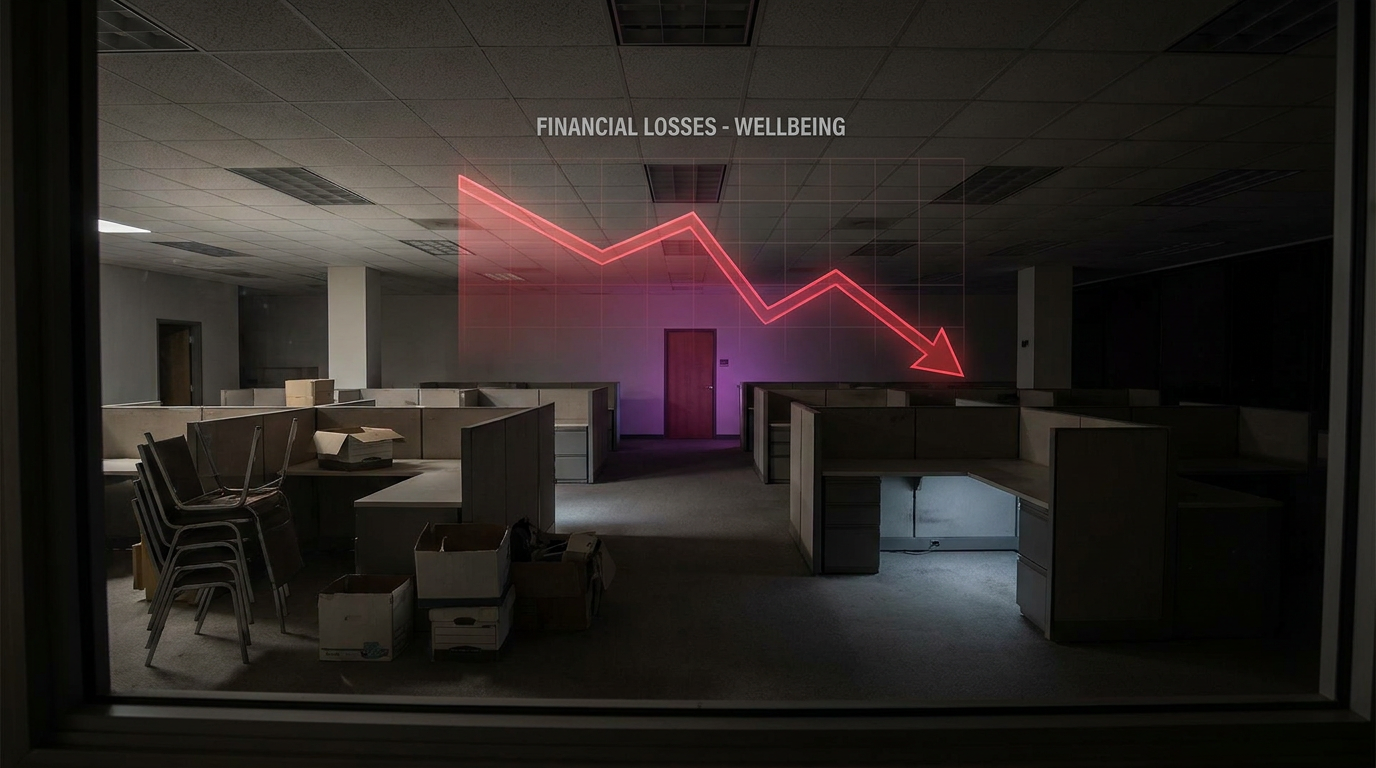
A significant portion of this cost comes from absenteeism. The Health and Safety Executive (HSE), Great Britain’s national regulator for workplace health and safety, reported that in 2022/23, stress, depression, or anxiety accounted for 49% of all work-related ill health cases (HSE, 2023 statistics). Outdated, noisy, and uncomfortable offices are major contributors to this stress. Also, the latest employee wellbeing statistics UK from the CIPD (2024) show the average number of sick days has risen to 7.8 per employee per year, the highest in over a decade.
Presenteeism-the phenomenon of employees being physically present but mentally disengaged and unproductive-is even more costly, though harder to measure. An uninspiring or uncomfortable environment can easily lead to a decline in focus and motivation. When combined with the high cost of recruiting and training replacements for staff who leave due to a poor work environment, the financial argument for inaction becomes impossible to defend. The total cost of poor employee wellbeing in the UK is a liability that proactive office design can directly address.
How Strategic Office Design Improves the ROI of Wellbeing
Strategic office design improves the return on investment by directly counteracting the key drivers of poor wellbeing costs: stress, discomfort, and disengagement. By creating environments that support physical health, mental focus, and social connection, a well-designed workplace becomes a tool for enhancing performance. This isn’t about choosing a new paint colour; it’s about engineering a space that makes people healthier, happier, and more effective. This is the core of wellbeing in office design.
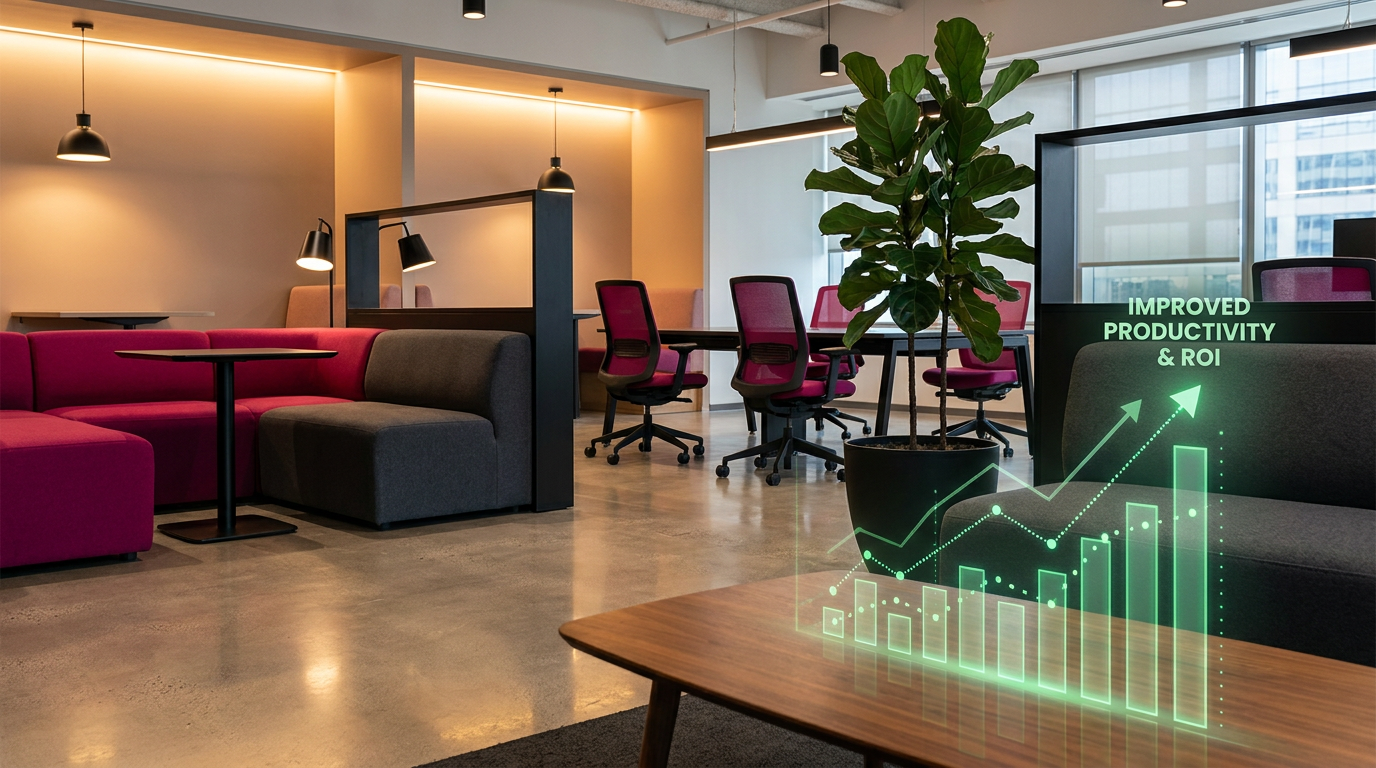
The link between office design and productivity is well-documented. A global benchmark study by the Leesman Index found that workplaces designed to support key employee activities can boost productivity by as much as 17%. This is achieved through specific interventions. For example:
- Acoustic Control: Implementing acoustic panels and quiet zones reduces distractions, a primary complaint in open-plan offices, allowing for deep focus and fewer errors.
- Ergonomic Support: Providing adjustable chairs and desks minimises physical discomfort and musculoskeletal issues, a leading cause of sickness absence.
- Choice and Variety: Offering a mix of work settings-from collaborative hubs to private pods-empowers employees to choose an effective environment for their task, boosting autonomy and engagement.
- Biophilic Design: Biophilic design is the practice of incorporating natural elements into built environments. This approach, which involves integrating plants, natural light, and organic materials, has been shown to lower stress and improve creativity.
By addressing these fundamental human needs, strategic wellbeing in office design moves from being a passive backdrop to an active participant in organisational success. It creates the conditions for employees to do their best work, directly improving metrics like output per employee and reducing the costs associated with a disengaged workforce.
A Practical Framework for Calculating the ROI of Wellbeing
Calculating the ROI of wellbeing requires a methodical approach that translates ‘soft’ benefits into hard numbers. In our experience, a simple, data-driven framework is the most effective way to secure budget approval and demonstrate value. We recommend this four-step process to build a compelling business case. This is essential when learning how to justify office refurbishment costs.
Step 1: Benchmark the Current Cost of Inaction
First, you need to establish a baseline. Using your company’s HR data and the employee wellbeing statistics UK mentioned earlier, calculate the current annual cost of absenteeism, staff turnover, and estimated lost productivity.
Step 2: Define the Project Investment
Work with a supplier to get a clear, itemised quote for the proposed refurbishment. This should include furniture, installation, and any associated building work. At Cost Cutters UK, we provide detailed quotes as part of our ‘Design To Install We Do It All!’ service, ensuring complete cost transparency.
Step 3: Project Realistic Improvements
Based on industry data, project conservative improvements. For instance, you could aim for a 15% reduction in sick days or a 10% improvement in staff retention over 18 months. Don’t overpromise; even modest gains deliver significant savings.
Step 4: Calculate the ROI
The final calculation is straightforward:
ROI (%) = (Net Financial Gain – Cost of Investment) / Cost of Investment x 100
The table below illustrates how to lay out these figures for a hypothetical company of 100 employees.
| Metric | Current Annual Cost (Example) | Target Improvement | Potential Annual Saving |
|---|---|---|---|
| Absenteeism (7.8 days/employee) | £93,600 | 15% Reduction | £14,040 |
| Staff Turnover (15% rate) | £75,000 | 20% Reduction | £15,000 |
| Productivity (Est. 5% loss) | £250,000 | 10% Improvement | £25,000 |
| Total Potential Annual Saving | £418,600 | £54,040 |
#### Case Study: A Typical Commercial Furniture Scenario
Challenge: A mid-sized UK tech firm with 150 employees was experiencing a 25% annual staff turnover rate, costing them an estimated £225,000 per year in recruitment and training. Exit interviews consistently cited a noisy, cramped, and uninspiring office environment as a key reason for leaving.
Solution: We implemented a £150,000 phased refurbishment focused on wellbeing in office design. This included creating designated quiet zones with acoustic pods, installing ergonomic chairs and sit-stand desks for all employees, and designing a vibrant breakout area with comfortable seating.
Results: Within 18 months, the staff turnover rate dropped to 12%, saving the company approximately £117,000 annually. Absenteeism also fell by 20%. The total investment was recouped in just over 15 months.
Key Insight: Phasing the project and focusing on high-impact areas first allowed the business to manage cash flow while demonstrating early wins, which built momentum for the full refurbishment.
High-Impact Design Investments with well-supported by research Returns
Strategic investment in office design delivers an effective returns when focused on areas that have a direct and well-supported by research impact on employee health and performance. While a complete overhaul offers the most significant transformation, targeted upgrades can also yield a substantial ROI. The connection between smart office design and productivity is clearest when you examine these four key areas.
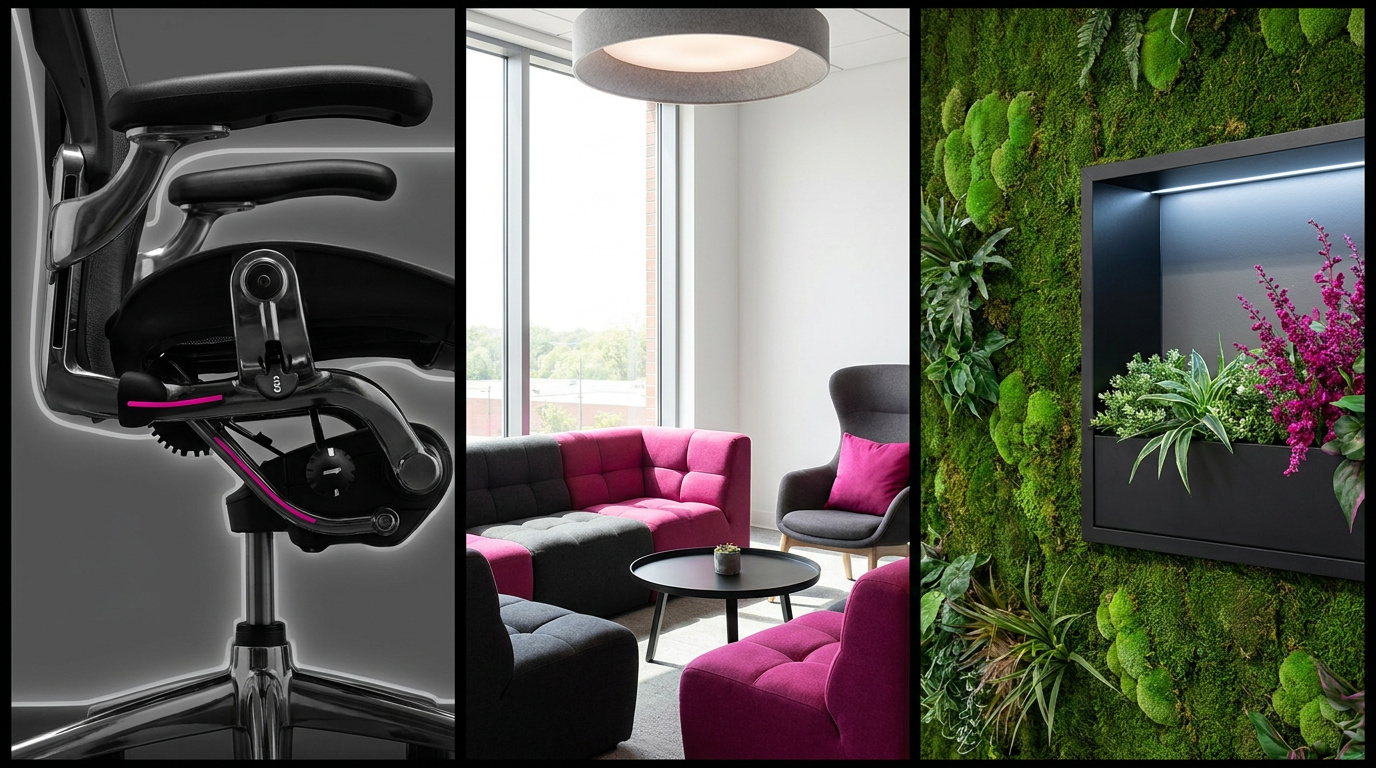
Investing in Ergonomics
The science of Ergonomics, which is about designing environments to fit the people who use them, offers one of the clearest returns. A primary driver of absenteeism is musculoskeletal disorders (MSDs). Providing high-quality, adjustable ergonomic furniture solutions directly mitigates this risk. By ensuring employees are comfortable and properly supported, you reduce physical strain, which in turn lowers the number of sick days taken for back, neck, and shoulder pain. This delivers a direct and easily measurable financial saving, making the benefits of ergonomic office furniture a cornerstone of any wellbeing strategy.
Designing Effective Breakout Spaces
Office breakout areas are far more than just a place for a coffee break; they are essential engines of collaboration and stress reduction. They provide a venue for the spontaneous, informal conversations that spark innovation and build strong team bonds-interactions that rarely happen in scheduled meetings. The breakout area benefits also include providing a crucial psychological “third space” where employees can step away from their desks to de-stress and recharge. This helps prevent burnout and maintain consistent energy levels throughout the day. Investing in well-designed breakout furniture turns underutilised space into a high-value asset for creativity and mental health.
Incorporating Biophilic Design
The human affinity for nature, known as biophilia, is a powerful tool in workplace design. Biophilic office design UK principles involve incorporating natural elements like plants, water features, natural light, and materials like wood and stone. A landmark Human Spaces Report, a global study of 7,600 office workers, found that employees in environments with natural elements reported a 15% higher level of well-being and a 6% increase in productivity. These interventions are relatively low-cost but have a profound impact on reducing stress and improving cognitive function, making biophilia one of the most cost-effective ways to enhance the workplace experience.
Frequently Asked Questions
What is the ROI of wellbeing?
The ROI of wellbeing is a business metric that calculates the financial return from investing in employee health and happiness, typically through improved productivity and reduced costs. For office design, it compares the cost of refurbishment against the financial gains from lower absenteeism and higher staff retention. This calculation turns a ‘soft’ benefit into a hard financial argument for your finance department.
How do you convince a CFO to invest in office refurbishment?
You convince a CFO by presenting a data-driven business case, not just a design proposal. Use the ROI framework to show projected savings on absenteeism and recruitment costs, plus gains in productivity that exceed the capital outlay. Frame it as an investment in the company’s most valuable asset – its people – with a predictable financial return. This shifts the conversation from expense to investment.
What are the most important employee wellbeing statistics for UK businesses?
Key statistics for UK businesses often centre on stress, anxiety, and depression, which the HSE identifies as the leading cause of work-related illness. Data from Deloitte showing that poor mental health costs UK employers up to £56 billion annually is also highly persuasive. These figures effectively highlight the financial risk of inaction and create urgency for change.
How does office design affect productivity?
Office design directly impacts productivity by controlling factors like noise, light, air quality, and ergonomics. A well-designed space reduces distractions, lowers physical discomfort, and provides a choice of settings for different tasks (e.g., quiet focus pods vs. Collaborative zones). This empowers employees to work more effectively and efficiently throughout their day, directly improving output.
What are the main benefits of ergonomic office furniture?
The primary benefits are reduced physical discomfort, lower risk of long-term injury, and increased comfort, which leads to better focus. By preventing musculoskeletal issues, ergonomic furniture directly cuts costs associated with absenteeism and presenteeism. We’ll be honest – a comfortable employee is simply a more productive and engaged employee. It’s a foundational investment.
Are office breakout areas worth the space they take up?
Yes, when designed correctly, breakout areas provide significant value that justifies their footprint. They foster informal collaboration and communication that scheduled meetings often miss, boosting innovation and team cohesion. They also provide a crucial space for employees to de-stress and recharge, which helps prevent burnout and maintain productivity. This makes them a highly efficient use of space.
How quickly can you see a return on an office design investment?
Some returns are immediate, while the full financial ROI is typically seen over 6 to 18 months. You’ll likely see an immediate boost in morale and engagement. Tangible financial returns, such as a noticeable drop in sick days or improved productivity metrics, become measurable in the medium term. The full impact on staff retention may take 1-2 years to become clear.
Is investing in wellbeing design suitable for small businesses?
strongly, the principles are scalable for any size of business. A small business might not do a full refurbishment but can achieve a significant ROI through targeted investments. This could include purchasing high-quality ergonomic chairs for all staff or improving lighting and adding plants. We often advise starting with high-impact, low-cost changes to build momentum.
What is biophilic office design?
Biophilic office design is the practice of connecting people with nature inside the workplace. This is achieved by incorporating natural elements like plants, water features, natural light, and materials like wood and stone. Studies show this approach can reduce stress, improve cognitive function, and enhance creativity, making it a cost-effective way to boost employee wellbeing and performance.
Where should I start with justifying office refurbishment costs?
Start by gathering data on the cost of inaction. Analyse your company’s existing data on absenteeism rates, staff turnover, and employee engagement survey results. If you don’t have this data, use industry benchmarks from sources like the HSE or CIPD. This baseline is the most critical part of building a persuasive business case for an office refurbishment.
Important Considerations
You should acknowledge that while a well-designed office provides a powerful foundation for wellbeing, it isn’t a silver bullet. The data presented assumes a baseline of good management and a healthy company culture. Office design can amplify a positive culture but cannot single-handedly fix deep-rooted organisational issues. The full ROI is realised when physical space improvements are paired with supportive policies and leadership.
Strategic office design should be viewed as a core component of a holistic wellbeing programme, not a standalone solution. Alternative or complementary approaches include offering flexible working hours, providing access to mental health support services, organising wellness workshops, and promoting financial wellbeing education. In our view, the most successful strategies integrate physical, mental, and social support.
Calculating the ROI and designing a space that truly meets your organisation’s needs can be complex. If you lack the internal resources to gather data or translate your needs into a functional design, it is advisable to consult a professional. As a fully accredited UK supplier, we can conduct utilisation studies, facilitate employee workshops, and provide detailed space plans, ensuring your investment is targeted for maximum impact and Saving Time & Stress.
From Expense to Investment: Build Your Business Case Today
Ultimately, calculating the ROI of wellbeing demonstrates that investing in your office environment is one of the most astute financial decisions a modern organisation can make. By moving beyond aesthetics and focusing on data, you can prove that strategic design is not a cost centre, but a powerful driver of productivity, talent retention, and profitability. The evidence is clear: a better workplace is a better business. We’re Rated Excellent On Trustpilot because we help our clients prove it.
At Cost Cutters UK, we have over 35 years of experience helping organisations across the public and private sectors create spaces that work for their people and their budgets. Our team of experts can help you build your business case and design a space that delivers a measurable return, with flexible payment options like Credit Accounts Or Pay Flexibly. Ready to start the conversation? Book your free, no-obligation space planning consultation today.
References
- Deloitte UK (2022) – Report based on analysis of national data and employer surveys. Found that poor mental health costs UK employers up to £56 billion per year.
- Health and Safety Executive (HSE) (2023) – Labour Force Survey statistics. Found that in 2022/23, stress, depression or anxiety accounted for 49% of all work-related ill health cases.
- Leesman Index (Ongoing) – Global benchmarking data from over 1 million employee responses. Reports that workplace design supporting key activities can boost productivity by 17%.
- Journal of Corporate Real Estate (Various) – Academic studies. One study found a direct correlation between the quality of the physical workplace and employees’ perceived levels of engagement.
- CIPD (2024) – Health and Wellbeing at Work Report based on a survey of HR professionals. Found the average number of sick days per employee per year is 7.8.
- Human Spaces (2015) – Global study of 7,600 office workers. Found employees in environments with natural elements report a 15% higher level of well-being.
- Wellity Global (2025) – Analysis of multiple data sources. Reinforces the financial case for investing in mental health support at work, showing returns between £5 and £6 for every £1 spent.
- Wellbeing People (2025) – Industry guide. Outlines frameworks for calculating wellbeing ROI, emphasising the link between engagement and profitability.
From Expense to Investment: Build Your Business Case Today
Ultimately, calculating the ROI of wellbeing demonstrates that investing in your office environment is one of the most astute financial decisions a modern organisation can make. By moving beyond aesthetics and focusing on data, you can prove that strategic design is not a cost centre, but a powerful driver of productivity, talent retention, and profitability. The evidence is clear: a better workplace is a better business.
At Costcutters UK, we have over 35 years of experience helping organisations across the public and private sectors create spaces that work for their people and their budgets. Our team of experts can help you build your business case and design a space that delivers a measurable return. Ready to start the conversation? Book your free, no-obligation space planning consultation today.
Frequently Asked Questions About Office Design and Wellbeing ROI
What is the ROI of wellbeing?
The ROI of wellbeing is a business metric that calculates the financial return from investing in employee health and happiness, typically through improved productivity and reduced costs. For office design, it compares the cost of refurbishment against the financial gains from lower absenteeism and higher staff retention. This calculation turns a ‘soft’ benefit into a hard financial argument.
How do you convince a CFO to invest in office refurbishment?
You convince a CFO by presenting a data-driven business case, not a design proposal. Use the ROI framework to show projected savings on absenteeism, recruitment costs, and gains in productivity that exceed the capital outlay. Frame it as an investment in the company’s most