Seasonal Adaptations: A Complete Guide to Winterising & Summerising Outdoor Spaces
🎯 Key Takeaway
Effective seasonal adaptations for commercial outdoor spaces involve a strategic programme of cleaning, protecting, and storing furniture in winter, followed by safety checks and thoughtful layout planning for summer to maximise usability and protect assets.
• Winterisation focuses on cleaning, drying, and either covering or securely storing furniture to prevent damage from damp, frost, and wind.
• Summerisation involves deep cleaning, conducting safety inspections, arranging furniture for optimal use, and providing adequate shade and UV protection.
• Choosing the right all-weather materials, such as recycled plastic or galvanised steel, significantly reduces the effort and cost of seasonal changeovers.This guide provides practical checklists and procurement advice for facilities managers and school business managers to implement a successful year-round outdoor strategy.
Neglected outdoor areas in schools, offices, and hospitality venues represent a significant missed opportunity and a potential financial drain. As of May 2026, many organisations still treat their outdoor furniture as a disposable asset, leading to premature decay and costly replacements. A strategic approach to seasonal adaptations is the solution. This involves a structured annual cycle of winterising to protect assets and summerising to prepare them for safe, effective use. This guide offers a practical framework for School Business Managers and Facilities Managers to manage their outdoor furniture effectively, transforming these spaces into valuable assets and providing inspiring outdoor breakout area ideas.
👤 Written by: Costcutters UK Content Team
Reviewed by: Costcutters UK Editorial Team, 35+ Years of Public Sector Supply Expertise
Last updated: 29 May 2026
ℹ️ Transparency: This article explores seasonal adaptations for commercial outdoor furniture based on over 35 years of industry expertise and analysis of material durability in UK conditions. Some links may connect to our services or product pages. All information is verified by our editorial team to ensure it meets our standards for practical, actionable advice.
Why Effective Seasonal Adaptations Are a Smart Investment
Yes, implementing a structured plan for seasonal adaptations provides a significant return on investment by turning a reactive, costly problem into a predictable management task. Neglecting your outdoor furniture doesn’t save money; it simply defers and increases the eventual cost of replacement. A proactive strategy is built on three core benefits that directly impact your budget and operational effectiveness.

First, it protects the value of your assets. Commercial outdoor furniture is a considerable investment. Allowing it to degrade due to preventable weather damage effectively writes off that investment years ahead of schedule. A proper winterisation programme can extend the life of benches, tables, and seating by 50% or more.
Second, it ensures safety and compliance. Damaged furniture isn’t just an eyesore; it’s a liability. A cracked wooden bench can cause splinters, a rusted metal chair can have sharp edges, and a wind-damaged parasol can become a projectile. A seasonal inspection and maintenance routine is a critical part of your duty of care, helping to prevent accidents and ensuring your organisation remains compliant with safety standards.
Finally, it maximises the year-round utility of your space. A well-maintained outdoor area enhances student wellbeing, improves employee morale, and offers valuable extra capacity. By ensuring your spaces are safe and ready for use when the weather is good, you gain a valuable asset that contributes positively to your organisation’s daily life.
Winter Seasonal Adaptations: Your Practical Checklist
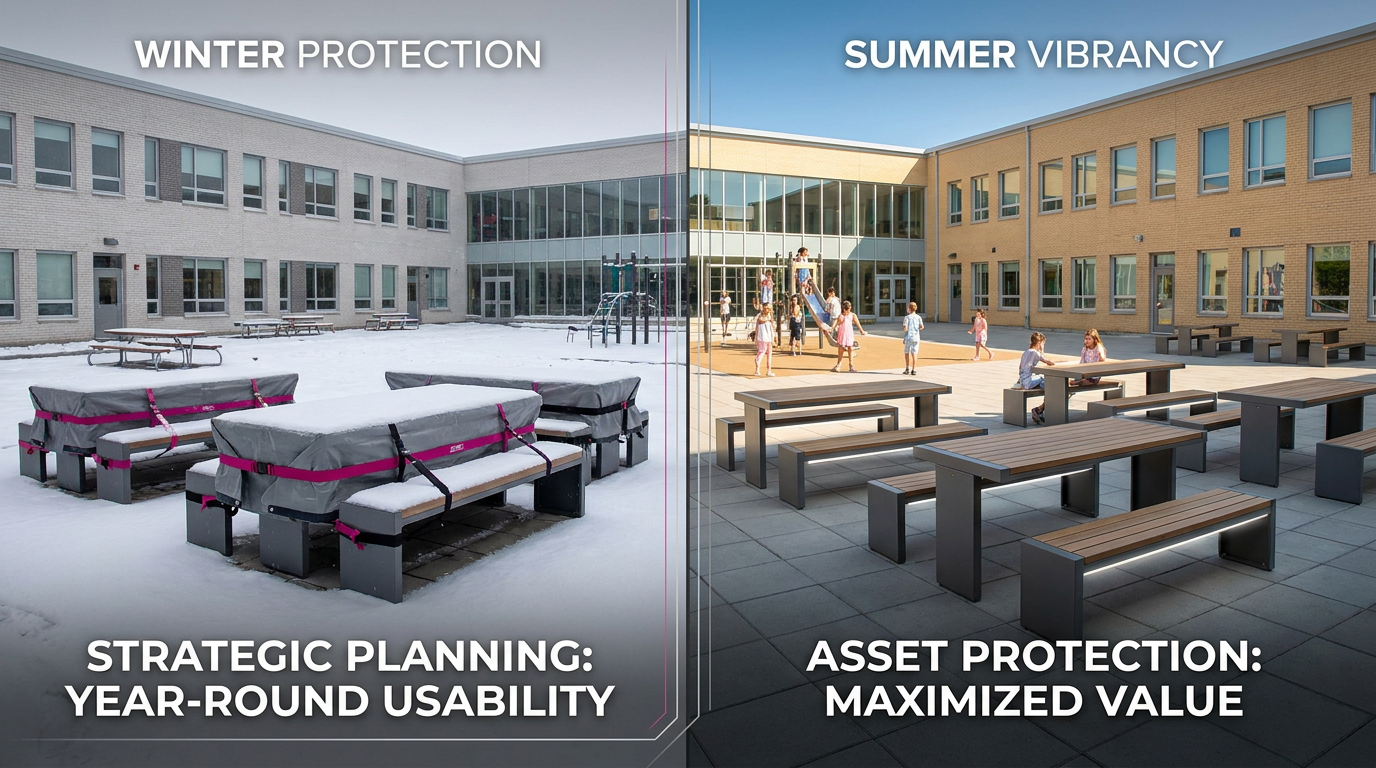
The goal of winterisation is to protect your furniture from the damp, frost, and wind that characterise a UK winter. A methodical approach in autumn saves significant time, stress, and money come spring. Our experience suggests a four-step process for effective school outdoor furniture maintenance and protection.
1. Clean & Dry: Before storing or covering any item, it must be thoroughly cleaned and completely dry. Remove all dirt, leaves, and bird droppings. This organic matter traps moisture against the surface, which accelerates rot in wood and corrosion in metal. Use a mild detergent and a stiff brush, then allow items to air dry fully.
2. Inspect & Repair: This is the well-suited time to conduct a thorough inspection. Check for loose bolts, developing cracks in wood, or chips in powder-coated metal that could expose the steel beneath. Making minor repairs now is far easier and cheaper than dealing with a major failure after months of winter damage.
3. Protect: You have two primary options for protecting outdoor furniture in winter uk: covering or storing.
- Covers: If storing isn’t feasible, invest in high-quality, breathable, heavy-duty covers. Non-breathable plastic tarps trap condensation, which can be more damaging than the rain itself. Ensure covers are securely fastened to withstand winter gales.
- Storage: The superior option is to move furniture indoors. This provides complete protection from all elements.
4. Store Securely: For schools and businesses with large inventories, logistics are key. Prioritise stackable or foldable furniture to maximise space. If you lack internal space, dedicated on-site storage is a wise investment. Purpose-built, secure, weatherproof storage units from Asgard offer outstanding protection from both weather and theft, ensuring your assets are safe until spring.
Summer Seasonal Adaptations: Preparing for Sun and Use
Preparing for summer is more than just putting the furniture back out; it’s about creating a safe, functional, and inviting environment. A structured approach to summerising outdoor spaces ensures you maximise their potential during the warmer months.
1. Retrieve & Deep Clean: Furniture that has been in storage will have gathered dust, whilst covered items may have grime. Start the season with a deep clean. For wooden furniture, this is the time to apply any protective oils or stains. For plastic and metal, a simple wash-down will restore its appearance.
2. Conduct a Safety Audit: This is a non-negotiable step. Winter can take a hidden toll, so a thorough safety check is crucial before allowing use.
- Check every bolt and screw to ensure they are tight.
- Inspect all surfaces for splinters, sharp edges, or cracks.
- Test the stability of each item. Ensure tables and chairs don’t wobble.
- On hot, sunny days, check metal surfaces to ensure they don’t pose a burn risk, especially in areas used by young children.
3. Plan Your Layout: Don’t just place furniture randomly. Think about how the space will be used and create zones. You can develop fantastic outdoor breakout area ideas by arranging furniture to support different activities. Create a quiet zone for reading or study, a social hub with large tables for group work or lunches, and relaxed seating areas for informal chats. Consider traffic flow and accessibility for all users. Our range of outdoor breakout furniture is designed for this kind of flexible use.
4. Provide Shade & UV Protection: The British sun can be surprisingly strong. Providing adequate shade is essential for user comfort and safety. Large parasols, sail shades, or gazebos are excellent options. Position seating in areas that benefit from natural shade from trees or buildings during the hottest parts of the day.
Procurement Guide: Choosing All-Weather Commercial Furniture
The most effective way to simplify seasonal adaptations is to make smart procurement choices from the outset. Focussing on whole-life cost rather than initial price is key. Investing in high-quality all-weather commercial furniture dramatically reduces the annual labour and expense of maintenance, Saving Time & Stress for facilities teams.
When choosing materials, consider the specific demands of your environment.
- Recycled Plastic Furniture: This is a top-tier choice for low-maintenance school outdoor furniture maintenance. Made from recycled polymers, it is incredibly durable, impervious to rot and frost, and requires no annual staining or painting. It’s heavy, making it resistant to theft and wind, and easy to clean.
- Treated Timber: Traditional wood offers a natural aesthetic but comes with a higher maintenance burden. To prevent rot and splintering, it requires regular cleaning and annual treatment with appropriate stains or oils. Look for FSC-certified timber from sustainable sources.
- Metal: Aluminium is lightweight, naturally rust-proof, and effective for moveable cafe-style seating. Steel is stronger and heavier but must be properly protected. Look for galvanised steel (dipped in molten zinc) or a thick powder-coat finish to prevent rust.
Crucially, for any furniture intended for public or commercial use, you must ensure it is fit for purpose. Typically ask your supplier for documentation showing compliance with relevant safety standards. For outdoor seating and tables, the key standard is BS EN 581, which is the European safety standard for outdoor furniture that specifies strength and durability requirements for contract use. You can view our UK and EU safety certifications to see how we ensure our products are safe and durable.
Material Comparison for UK Commercial Use
| Material | Avg. Lifespan (UK Climate) | Maintenance Level | Whole-Life Cost Index (1=Lowest) | Best For |
|---|---|---|---|---|
| Recycled Plastic | 25+ years | Very Low | 1.0 | Schools, parks, high-use public areas |
| Powder-Coated Steel | 10-15 years | Low | 1.8 | Staff breakout areas, modern designs |
| Aluminium | 15+ years | Very Low | 2.0 | Cafes, hospitality, flexible seating |
| Treated Softwood | 5-10 years | High | 2.5 | Areas where natural look is key, but with maintenance budget |
| Hardwood (e.g., Teak) | 20+ years | Medium | 3.0 | Premium hospitality, statement pieces |
Frequently Asked Questions on Outdoor Furniture Management
What are seasonal adaptations for outdoor spaces?
Seasonal adaptations are a structured, two-part annual programme for managing commercial outdoor furniture and spaces. The first part, winterisation, involves cleaning and protecting assets from harsh weather, whilst the second, summerisation, focuses on safety checks and preparing the area for use, ensuring maximum value and longevity.
How do I protect school picnic benches in a UK winter?
an effective protection involves a simple three-step process: clean, dry, and cover or store. First, scrub the benches to remove all dirt and allow them to dry completely. If you have space, storing them in a secure shed is effective. For immovable benches, use a heavy-duty, breathable commercial-grade cover that is securely fastened.
What’s an effective way to store large amounts of commercial outdoor furniture?
Dedicated, secure, on-site storage is the most effective solution for managing large inventories. This is often a purpose-built steel shed or a secure shipping container, which offers an effective protection from weather and theft. When procuring furniture, prioritising stackable or foldable designs can significantly increase your storage capacity and efficiency.
Are furniture covers better than storing furniture inside?
Indoor storage offers superior protection, but high-quality covers are a very effective alternative when space is limited. A good commercial cover will protect against rain and UV damage. However, it offers less protection against extreme winds or accidental physical impact. An effective choice ultimately depends on your available space, budget, and risk assessment.
What maintenance is needed for all-weather commercial furniture before summer?
Even robust all-weather furniture requires a pre-season check to ensure it’s safe and ready. We recommend a deep clean to remove winter grime and, most importantly, a full safety audit. Check and tighten every nut and bolt, inspect surfaces for any damage or sharp edges, and confirm each piece is stable and doesn’t wobble.
How can I make our outdoor breakout area safe for summer use?
Beyond the furniture, ensure the entire area is free from hazards before the summer season. Check that all pathways are clear, even, and free of trip risks. Any shade structures, such as large parasols or sail shades, must be securely anchored to withstand gusts of wind. Regular visual inspections throughout the season are also essential.
What materials are best for low-maintenance school outdoor furniture?
Recycled plastic is the leading choice for minimal maintenance in demanding school environments. It does not rot, splinter, or require annual painting, and it is exceptionally durable and easy to clean. For metal options, galvanised steel and powder-coated aluminium are also excellent, long-lasting choices that require very little upkeep.
How much should I budget for seasonal furniture maintenance?
A sensible rule of thumb is to budget 1-3% of the furniture’s initial purchase price annually for upkeep. This covers cleaning supplies, minor repairs, and replacement covers. This figure can be higher for wooden furniture requiring regular treatments. Investing in low-maintenance all-weather commercial furniture from the start significantly reduces this ongoing operational cost.
What safety standards should school outdoor furniture meet?
For public and educational use, furniture should comply with the BS EN 581 standard for strength, durability, and safety. It’s also wise to look for design features like rounded corners and anti-finger-trap mechanisms, which are crucial in a school environment. We believe you should typically ask suppliers for their compliance documentation.
Can recycled plastic furniture really withstand a British winter?
Yes, high-quality, solid-profile recycled plastic is perfectly suited to the UK climate. The material is non-porous, so water cannot penetrate its surface, which prevents it from cracking during frost-thaw cycles. It is also completely resistant to the rot and mould that can plague wooden furniture in our damp conditions, making it a reliable year-round solution.
Important Considerations and Alternative Strategies
This guide provides a framework for managing most UK school and business environments. However, organisations in highly exposed locations, such as coastal areas with salt spray or elevated sites with extreme winds, may require more specialised materials and anchoring solutions. The advice provided is based on general best practice and should be adapted to your specific site’s risk assessment.
An alternative to seasonal furniture rotation is to invest exclusively in permanent, immovable, all-weather installations. Heavy-duty recycled plastic benches or concrete table sets, for instance, are designed to be left in situ year-round with minimal maintenance. While this reduces seasonal labour, it offers less flexibility in reconfiguring your outdoor space for different events or seasons.
For large-scale projects, refurbishments, or if you are unsure about an effective strategy for your site’s unique challenges, we recommend seeking professional guidance. An expert can conduct a full site survey, help you plan your space for maximum impact, and ensure your procurement choices deliver an effective long-term value and compliance. Please feel free to book a free space planning consultation with our team.
A Strategic Approach to a Year-Round Asset
Implementing a proactive strategy for seasonal adaptations transforms your outdoor areas from a liability into a valuable, year-round asset. By following a clear programme for winterising and summerising, and by making informed procurement decisions based on whole-life cost, you protect your investment, ensure user safety, and maximise the potential of your space. Choosing robust all-weather commercial furniture is the foundation of a low-maintenance, high-value outdoor strategy, and we are Rated Excellent On Trustpilot for providing it.
With over 35 years of experience supplying schools, offices, and public sector organisations across the UK, we at Cost Cutters UK understand these challenges. We offer not just furniture, but a complete “Design To Install We Do It All!” partnership. We can provide Bulk Buy Discounts and flexible payment options like Credit Accounts Or Pay Flexibly. If you are planning to enhance your outdoor space, book a free space planning consultation with our expert team today or request a bespoke quote for your project.
References
- Costcutters UK – Certifications & Accreditations – Internal Resource. Provides documentation on compliance with UK and EU safety standards, including those relevant to public and educational furniture.
- Costcutters UK – Breakout Furniture Range – Product Category Page. Showcases a range of furniture suitable for creating informal outdoor and indoor spaces for collaboration and relaxation.
- Costcutters UK – Asgard Secure Storage – Brand Page. Details a range of secure, weatherproof steel storage units suitable for storing outdoor furniture and equipment.
- Costcutters UK – Main Homepage – Company Homepage. Overview of Costcutters UK’s full range of services, including design-to-installation and experience with public sector procurement.
Conclusion
A Strategic Approach to a Year-Round Asset
In summary, seasonal adaptations are the cornerstone of effective outdoor asset management for any public or commercial organisation. Implementing a proactive strategy transforms your outdoor areas from a seasonal liability into a valuable, year-round asset. By following a clear programme for winterising and summerising, and by making informed procurement decisions based on whole-life cost, you protect your investment, ensure user safety, and maximise the potential of your space. Choosing robust all-weather commercial furniture is the foundation of a low-maintenance, high-value outdoor strategy, and we are Rated Excellent On Trustpilot for providing it.
With over 35 years of experience supplying schools, offices, and public sector organisations across the UK,