School Space Utilisation: A Strategic Guide for UK School Business Managers
🎯 Key Takeaway
Effective school space utilisation involves strategically analysing and adapting a school’s physical environment to support educational goals, improve efficiency, and maximise return on investment from existing buildings. It’s a critical process for turning your school’s estate into a high-performing asset.
• A whole-school audit is the critical first step to identify underperforming ‘dead’ spaces.
• Investing in flexible, multi-purpose school furniture provides long-term value and adaptability.
• Smart space planning directly impacts pupil engagement, staff morale, and overall budget efficiency.
With budgets tightening and the demand for modern, adaptable learning environments growing, many School Business Managers (SBMs) face a significant challenge. As of May 2026, the pressure to do more with less has rarely been greater. The solution isn’t typically about securing funding for new buildings; it’s about unlocking the vast, untapped potential within your existing estate. Strategic school space utilisation is the key. This isn’t merely about tidying up; it’s a powerful financial and educational strategy for maximising school space. This guide provides a practical framework for auditing your current layout, planning transformative changes, and making smart procurement decisions that deliver lasting value. We’ve built this guide on our 35+ years of experience to help you turn your space into your most effective asset.
Written by: The Cost Cutters UK Content Team | Reviewed by: Editorial Team, 35+ Years Experience; Rated Excellent On Trustpilot
ℹ️ Transparency Disclosure: This article explores advanced school space utilisation based on our deep industry experience and analysis of UK school design trends. Some links may connect to our specialised furniture and space planning services. All information is verified by our editorial team to ensure accuracy and relevance. Cost Cutters UK is a leading supplier of educational equipment in the UK, and we’re proud of the expertise we share.
The Strategic Case for Effective School Space Utilisation
Effective school space utilisation is a fundamental component of a successful school’s financial and educational strategy. It goes far beyond aesthetics to directly influence learning outcomes, pupil behaviour, and staff morale. The Department for Education (DfE), the UK government department responsible for education, consistently emphasises the need for efficiency. As their guidance on maximising school space and value highlights, a well-managed estate is crucial for financial health. According to a publication from GOV.UK, optimising the use of existing assets is a core principle of achieving value for pupils.
Also, the physical environment is a key factor assessed by Ofsted, the Office for Standards in Education, Children’s Services and Skills. An environment that is cluttered, poorly organised, or inflexible can hinder teaching and learning. Conversely, a space that is well-planned and adaptable supports personalised learning and positive behaviour. Research published by Teaching Times indicates that transforming classroom spaces is directly linked to achieving more personalised learning outcomes. In our view, treating your school’s buildings as a strategic asset to be actively managed-rather than a passive backdrop-is the first step towards unlocking significant educational and financial benefits.
The Whole-School Audit: Your First Step in School Space Planning UK
A whole-school audit is the essential starting point for any successful school space planning UK initiative. This systematic review provides the objective data needed to move beyond assumptions and make informed decisions about improving school layout and design. It’s the most reliable way to identify inefficiencies and discover opportunities that are often hidden in plain sight. We recommend a four-step process to get a clear picture of your estate.
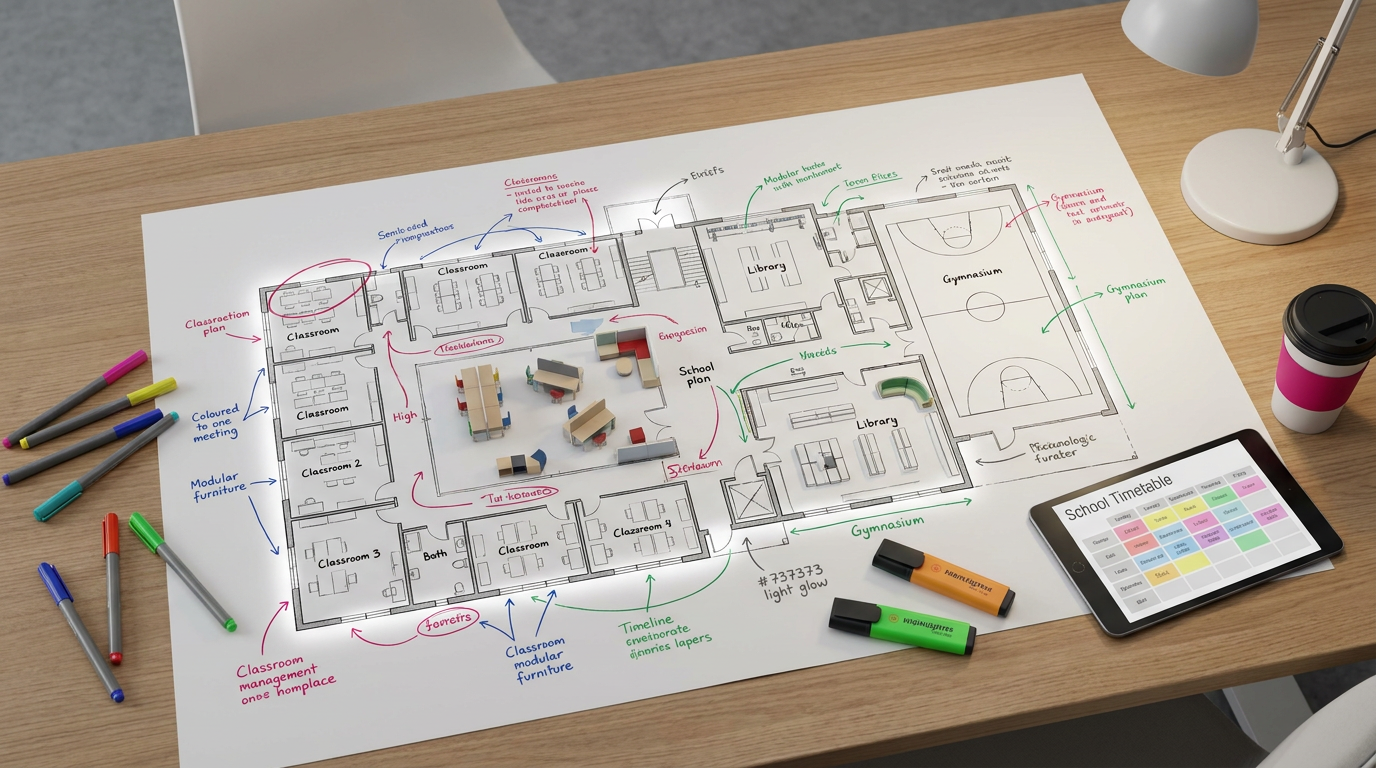
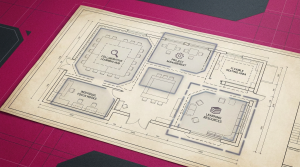
- Map the Estate: Begin by gathering up-to-date floor plans for every building. Annotate these with the current function of each room. If plans are outdated, it’s a worthwhile exercise to create simple, to-scale sketches. This visual inventory is your foundational document.
- Analyse Utilisation Rates: Compare your school’s timetables against the capacity of each space. Are specific classrooms consistently half-empty? Is the library only used for one period a day? This data will quickly reveal which areas are working hard and which are not.
- Identify ‘Dead Space’: Walk the entire school with a critical eye. Look for underutilised areas such as excessively wide corridors, oversized and disorganised storerooms, or staff rooms that are too large for their daily use. An article from education design specialists Envoplan reinforces that identifying and repurposing these zones is a key tip for maximising space.
- Consult with Stakeholders: The data tells one story; your staff and pupils tell another. Speak to teachers, department heads, and even students about how they use the space. What are their frustrations? What do they need to teach and learn more effectively? Their qualitative feedback is invaluable for creating solutions that work in practice.
Advanced Strategies for Transforming Key School Zones
Once you have audited your space, you can implement targeted strategies to make every square metre count. This often involves creating adaptable, multi-use spaces that can serve different functions throughout the school day, increasing the return on every part of your estate.
Flexible Classroom Design: Beyond Rows of Desks
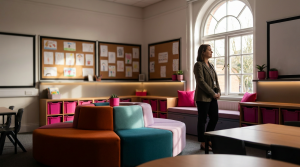
The traditional classroom layout is often rigid and unsuited to modern teaching methods. Implementing flexible classroom design ideas can revolutionise a learning space. Consider zoning the classroom for different activities: a collaborative area with modular tables that can be easily reconfigured, a quiet corner with soft seating for individual reading or focus work, and a presentation area with a clear focal point. Agile furniture, such as trapezoidal tables, mobile whiteboards, and lightweight stools, empowers teachers and pupils to adapt the room in minutes. This approach is particularly effective for younger years, where integrating specialised furniture for EYFS can support play-based learning.
Common Areas: Canteens, Libraries, and Corridors
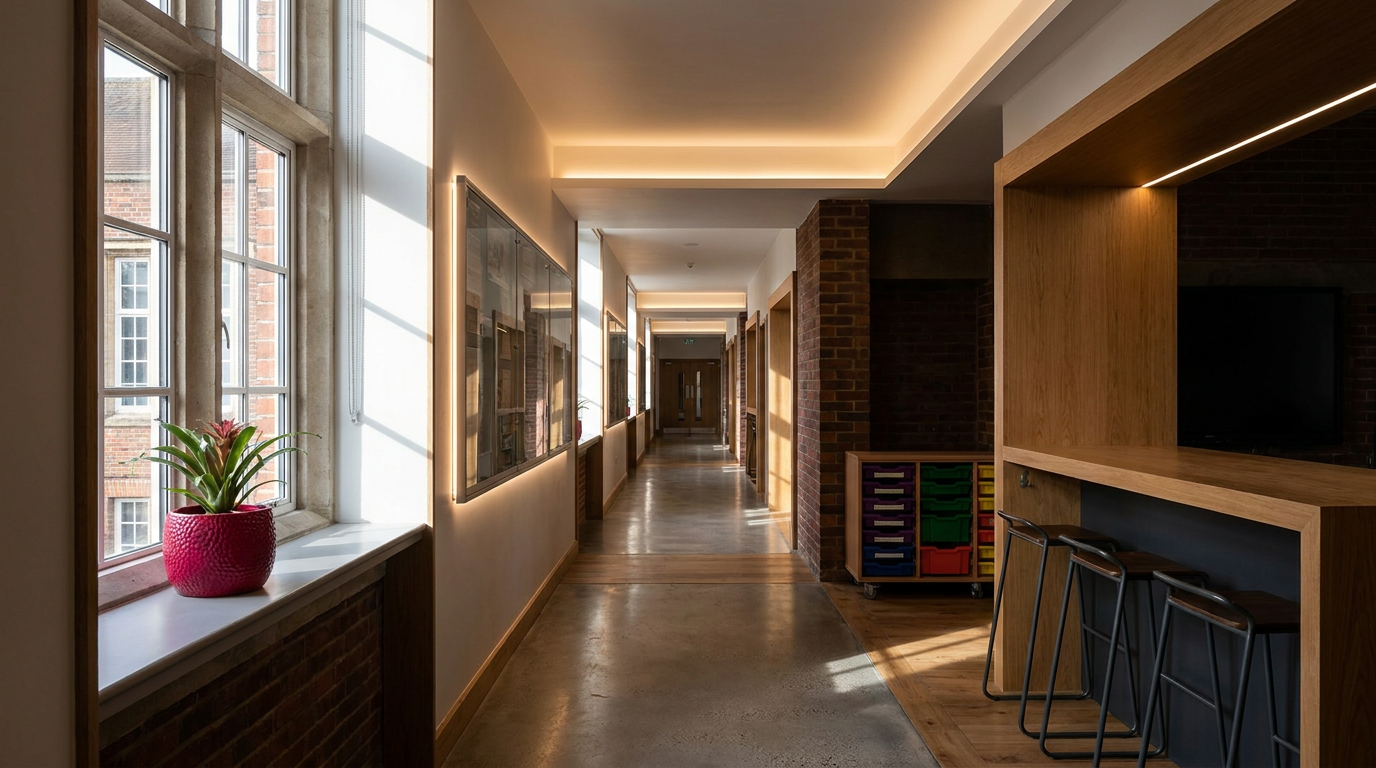
Common areas represent a huge opportunity for improved utilisation. Canteens, often empty for much of the day, can be transformed into vibrant social and study hubs with the right furniture. By introducing a mix of high benches, booth seating, and durable modern breakout furniture, the space becomes a valuable asset outside of lunch hours. Similarly, libraries can evolve from silent book repositories into modern media hubs with collaborative tech zones. Even wide corridors can be activated. As long as you maintain clear access routes, corridor nooks can become ‘touchdown’ learning spots with the simple addition of a high-counter and some stools. This strategy is also echoed by outdoor space experts like Playcubed, who advocate for making the most of every available space.
Intelligent School Storage Solutions
Clutter is the enemy of effective space utilisation. A robust strategy for school storage solutions is non-negotiable. Our experience shows that thinking vertically is key; tall, slim cupboards reclaim valuable floor space. Mobile storage units, such as tray trolleys or bookcases on castors, offer supreme flexibility, allowing resources to be moved where they’re needed. It is crucial that any storage solution complies with guidelines from the Health and Safety Executive (HSE), Britain’s national regulator for workplace health and safety, ensuring that fire exits and access routes remain clear at all times. Investing in robust, secure heavy-duty storage cabinets can also help centralise resources and declutter individual classrooms.
The Furniture Factor: Choosing Multi-Purpose Pieces for Maximum ROI
Choosing the right multi-purpose school furniture is one of the most impactful decisions you can make in a school refurbishment project. An effective furniture is a long-term investment in flexibility and efficiency, not just an operational cost. By selecting pieces that are mobile, stackable, modular, and durable, you equip your school with the ability to adapt to changing curriculum demands and pupil numbers without needing constant reinvestment. This approach ensures you get maximum value and utility from every single item.
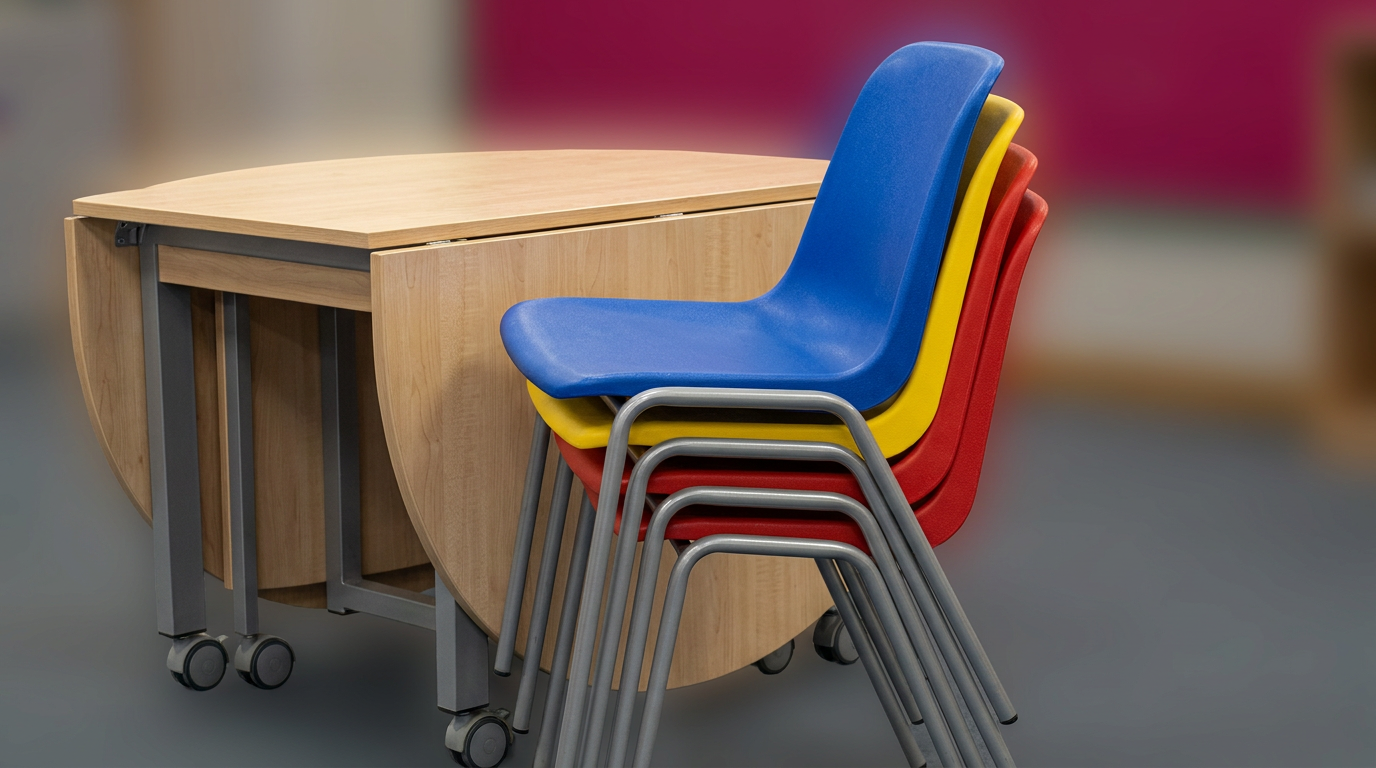
When selecting furniture, compliance with standards is paramount. All our relevant educational furniture adheres to BS EN 1729, the European standard specifying ergonomic and safety dimensions for chairs and tables in educational institutions. This ensures that furniture not only fits the space but is also appropriate for the pupils using it, supporting good posture and well-being. Checking for our UK compliance and safety certifications provides peace of mind.
The table below illustrates the tangible benefits of choosing multi-functional pieces over traditional, static items.
| Feature | Traditional Furniture (e.g., Single Desks) | Multi-Functional Furniture (e.g., Mobile Tables) | Impact on Space Utilisation & Budget |
|---|---|---|---|
| Adaptability | Fixed function, single-purpose design. | Easily reconfigured for group work, individual study, or presentations. | High. One room can serve multiple functions, reducing need for specialised rooms. |
| Mobility | Heavy, difficult to move, static layout. | Lightweight construction, often with lockable castors. | High. Allows for rapid layout changes, maximising timetabling options. |
| Storage | Occupies fixed floor space, cannot be compacted. | Stackable chairs, nesting tables, or foldable designs. | Very High. Frees up significant floor space for other activities when not in use. |
| Durability | Varies, but often designed for a single, static purpose. | Designed for movement and repeated reconfiguration. Typically robust frames. | Medium. Higher initial cost is offset by longer lifespan and lower replacement frequency. |
The SBM’s Checklist: Budgeting & Procurement for Cost-Effective School Refurbishment
For the School Business Manager (SBM), a senior administrative role responsible for school facilities, planning a cost-effective school refurbishment requires a strategic approach to budgeting and procurement. It’s about demonstrating long-term value, not just securing the lowest initial price. At Cost Cutters UK, we partner with SBMs throughout this process.
Here is our recommended checklist for your next school space planning UK project:
- Build a Robust Business Case: Go beyond “we need new tables.” Use the data from your space audit to quantify the problem. For example: “Classroom 7 is unusable for 40% of the timetable due to inflexible furniture, representing a significant loss of utility from a key asset.”
- Calculate Long-Term ROI: The true cost of furniture is not its purchase price. Calculate the Total Cost of Ownership (TCO), which includes maintenance, repairs, and eventual replacement. A durable, flexible table that costs 20% more but lasts twice as long and enables better space use offers a much higher Return on Investment (ROI).
- use Procurement Frameworks: Utilise approved UK public sector procurement frameworks. These can save significant time and provide assurance that suppliers have been vetted for quality and financial stability.
- Secure Comprehensive Quotes: Ensure quotes are for a complete, installed solution. Our “Design To Install We Do It All!” service means there are no hidden costs for delivery or assembly. We believe this transparency is crucial for accurate budgeting.
- Plan for LEA/Trust Approval: Prepare your business case and quotes in a clear, professional format ready for submission to the Local Education Authority (LEA) or academy trust board. We can provide detailed proposals and 3D plans to help you win approval.
- Explore Flexible Payments: Don’t let a tight annual budget halt a vital project. Ask suppliers about flexible payment options. We offer Credit Accounts Or Pay Flexibly to help schools manage their cash flow effectively.
Frequently Asked Questions About School Space Utilisation
What is school space utilisation?
School space utilisation is a strategic management process focused on making every square metre of a school’s estate work efficiently to support educational and financial goals. It involves analysing how spaces are currently used, identifying underperforming areas, and implementing changes to furniture, layout, and timetabling to maximise the value and functionality of the school’s physical assets.
How can I measure space utilisation in my school?
You can measure space utilisation by conducting a physical audit combined with data analysis. This typically involves walking the site to identify ‘dead space’, comparing timetabled room usage against the actual capacity of each room, and observing how common areas are used throughout the day. Some schools use simple heat maps or surveys to gather additional insights from staff and pupils.
What are the main benefits of flexible classroom design?
The primary benefits are improved adaptability, pupil engagement, and support for diverse teaching methods. A blog from teacher resource site Teachit suggests that well-organised spaces improve learning flow. Flexible layouts allow for seamless transitions between whole-class instruction, group collaboration, and individual work, better catering to different learning styles and future-proofing the classroom against curriculum changes.
How can multi-purpose school furniture save money?
Multi-purpose furniture saves money through a lower total cost of ownership and increased efficiency. While the initial purchase price may be slightly higher, its versatility reduces the need to buy multiple sets of furniture for different functions. Because one flexible classroom can replace two or three single-purpose rooms, it maximises the value of your existing space, delaying the need for costly extensions.
What are some quick wins for improving school layout?
Simple, low-cost quick wins include aggressive decluttering, implementing vertical storage solutions to free up floorspace, and replacing old, bulky items with modern stacking or nesting furniture. Creating small breakout zones in wide corridors with high tables and stools is another effective tactic. These small changes can have a surprisingly large impact on the perception and usability of a space.
Are there specific regulations for school space planning in the UK?
While there are no strict ‘utilisation’ rules, all planning must adhere to critical safety and building regulations. This includes compliance with Health and Safety Executive (HSE) guidelines for maintaining clear access and fire escape routes, and following Department for Education (DfE) Building Bulletins, especially for new builds or major refurbishments, which provide non-statutory guidance on space standards.
How do I get staff buy-in for a new school layout?
The key to gaining staff buy-in is consultation and demonstrating clear benefits from the very beginning. Involve teachers in the audit and design process, asking for their input on what works and what doesn’t. We recommend running a pilot scheme in one or two classrooms first. Once colleagues see the positive impact on teaching and pupil engagement, they are far more likely to support a wider rollout.
What’s the difference between refurbishment and just buying new furniture?
Buying new furniture is a simple transaction, whereas a refurbishment is a strategic project that transforms a space holistically. A refurbishment considers layout, traffic flow, lighting, acoustics, and function to achieve a specific educational goal. The furniture is a critical component of the project, but it’s selected as part of a comprehensive plan rather than as a standalone purchase.
Can older, Victorian-era school buildings be adapted effectively?
Yes, strongly, although they present unique challenges. We’ve found that the perceived limitations of fixed walls, high ceilings, and unusual room sizes can be overcome with clever design. The use of mobile partitions, modular furniture on castors, and intelligent zoning can transform these historic buildings into highly effective and surprisingly flexible learning environments, preserving their character while modernising their function.
How does Cost Cutters UK help with school space planning?
We provide a comprehensive “Design To Install We Do It All!” service that simplifies the entire process for schools. Our service begins with a free, no-obligation consultation to understand your goals. We then create detailed 2D and 3D space plans to help you visualise the potential of your environment, select the right furniture to meet your budget, and manage the project through to final installation.
Important Considerations and Limitations
This guide offers a strategic framework, but every school’s architecture, budget, and educational needs are unique. The effectiveness of these strategies depends on careful adaptation to your specific context, particularly in listed buildings or those with significant structural constraints. The solutions that work for a modern academy may need significant adjustment for a Victorian primary school.
Also, the strategies discussed focus on refurbishment and intelligent furnishing as a cost-effective approach. For schools with severe overcrowding or fundamental structural issues, these methods are a powerful optimisation tool but may not be a complete alternative to major capital works or new construction projects. They are designed to maximise the potential of what you have.
Finally, for complex projects or if you lack an in-house estates team, we recommend seeking professional guidance. A specialist can conduct a detailed site survey, ensure compliance with all UK regulations, and manage the project from design to installation. This professional oversight can be crucial for Saving Time & Stress and ensuring an effective return on your investment.
Your Next Step Towards a Smarter, More Efficient School
Ultimately, effective school space utilisation is one of the most powerful tools a School Business Manager has to enhance educational outcomes while achieving financial efficiency. By moving from a passive view of buildings to an active strategy of auditing, planning, and investing in flexible solutions, you can unlock hidden value across your entire estate. This process of improving school layout and design transforms your physical environment from a fixed cost into a dynamic asset that actively supports learning.
At Cost Cutters UK, we have over 35 years of experience helping schools across the UK transform their learning environments. We’re proud to be Rated Excellent On Trustpilot because we partner with schools to create spaces that work. To see how we can help you achieve your goals, request a no-obligation space planning consultation with our team today.
References
- Envoplan – Industry Article. Provides practical tips on decluttering, using multi-purpose furniture, and thinking vertically to maximise school space.
- GOV.UK – Government Guidance. Outlines the government’s perspective on achieving value in education, which includes efficient use of the school estate.
- Teachit – Teacher CPD Blog. Focuses on teacher-led strategies for organising classroom space to improve learning flow and reduce distractions.
- Playcubed – Industry Article. Reinforces the principle of utilising all available space to enhance the school’s appeal and function.
- Teaching Times – Educational Publication. Links the physical transformation of classrooms directly to achieving more personalised learning outcomes for pupils.
Conclusion
Your Next Step Towards a Smarter, More Efficient School
In summary, school space utilisation is one of the most powerful, yet often overlooked, tools a School Business Manager has to enhance educational outcomes while achieving greater financial efficiency. By shifting from a passive acceptance of your current layout to an active strategy of auditing, planning, and investing in flexible solutions, you can unlock hidden value across your entire estate. This process of improving school layout and design transforms your physical environment from a fixed cost into a dynamic asset that actively supports learning.
At Cost Cutters UK, we have over 35 years of experience helping schools across the UK transform their learning environments. We’re proud to be Rated Excellent On Trustpilot because we partner with schools to create spaces that