Troubleshooting School Furniture Issues: A UK Guide for SBMs
🎯 Key Takeaway
Addressing school furniture issues, which commonly include wobbly tables, loose chair components, and surface damage, is crucial for maintaining a safe and effective learning environment. These problems, often stemming from high-frequency use, can be managed with a proactive maintenance strategy. Regular inspections using a simple checklist can prevent minor wear from becoming a costly safety hazard. Moreover, understanding UK safety standards like BS EN 1729 is essential for compliance and protecting pupils. A clear ‘repair vs. Replace’ framework helps you make cost-effective decisions that maximise long-term value for your school.
A busy classroom is a high-wear environment. For School Business Managers (SBMs), this reality presents a constant challenge: balancing pupil safety against tight budgets. For school furniture issues, a loose chair leg or a chipped desk isn’t just an inconvenience; it’s a potential hazard and a drain on resources. As of September 2026, the pressure to make every pound count has rarely been greater.
This guide is designed for you. It provides a practical framework for identifying, fixing, and strategically managing your school’s furniture assets. We’ll cover a quick triage checklist for spotting problems early, provide step-by-step DIY repair guides, and outline a termly classroom furniture maintenance programme. Crucially, we’ll also deliver a clear ‘repair vs. Replace’ framework to help you make sound financial and safety decisions, ensuring your learning spaces remain fit for purpose.
Written by: Content Team | Reviewed by: Editorial Team, 35+ Years Experience; Rated Excellent On Trustpilot
Last updated: 17 September 2026
ℹ️ Transparency Disclosure: This article explores troubleshooting and maintaining school furniture, drawing upon our 35+ years of industry experience and analysis of UK safety regulations. To ensure full transparency, some links may connect to our products or services, which we believe offer excellent value to educational institutions. All information is verified for accuracy by our in-house experts. Cost Cutters UK is a trading name of Seated Furniture Ltd.
A Quick Triage: Identifying Common School Furniture Issues
A systematic visual inspection is the fastest way to identify emerging problems before they escalate. Implementing a simple triage process for facilities staff or even teaching assistants can save significant time and money. We recommend categorising potential school furniture issues into three groups: Structural, Component, and Surface.
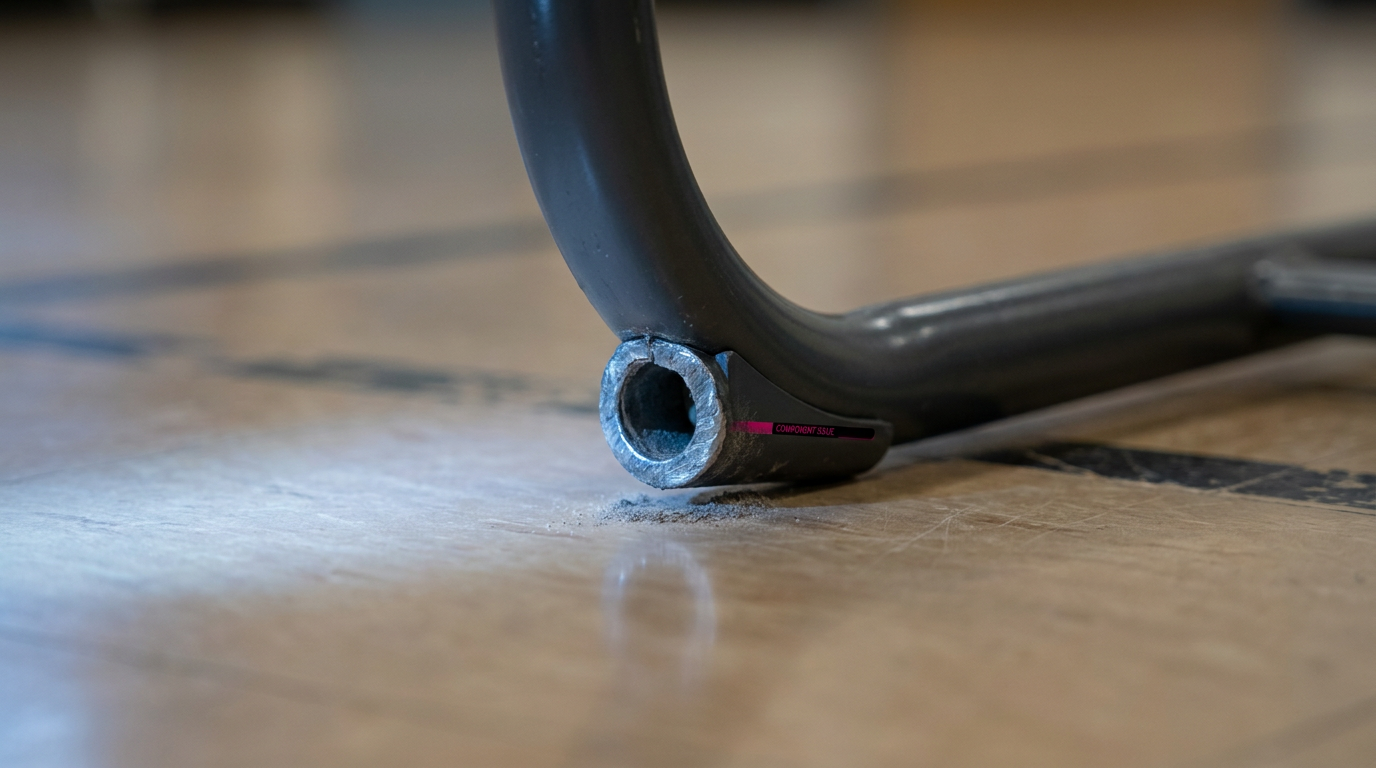
- Structural: This category covers the integrity of the item. Look for wobbly frames on tables and chairs, cracks in plastic shells, or stress fractures in metal welds. These are often the most serious issues.
- Component: These are failures of individual parts. Check for missing or loose screws and bolts, broken height-adjustment mechanisms, and missing plastic feet or glides on chair and table legs. A missing foot can make a chair unstable and damage flooring.
- Surface: This relates to the furniture’s finish. Inspect for deep scratches, peeling laminate edges, widespread graffiti, or sharp points on chipped wood or plastic.
According to the Health and Safety Executive (HSE), employers have a duty to ensure that equipment provided for use is maintained in a safe condition [1]. This triage system helps you document and prioritise actions to meet that obligation.
| Issue | Severity Level | Recommended Action | Time to Fix (Approx.) |
|---|---|---|---|
| Wobbly table/chair frame | High | Remove from service immediately. Inspect for cause. | 10-30 mins (if tightening) |
| Missing chair/table foot glide | Medium | Replace glide. | 2-5 mins |
| Peeling laminate edge | Medium | Assess for repair. If sharp, remove from service. | 15 mins (if repairable) |
| Deep scratch on desk surface | Low | Clean and monitor. | 5 mins |
| Loose backrest on a chair | High | Remove from service. Tighten fixings. | 5-10 mins |
The DIY Repair Toolkit: Step-by-Step Fixes for Common Problems
The good news is that many common furniture faults can be resolved quickly with basic tools and a methodical approach, representing a significant cost saving. Before starting any school chair repair or table fix, typically remove the item from the classroom to a safe maintenance area. Safety first, typically.
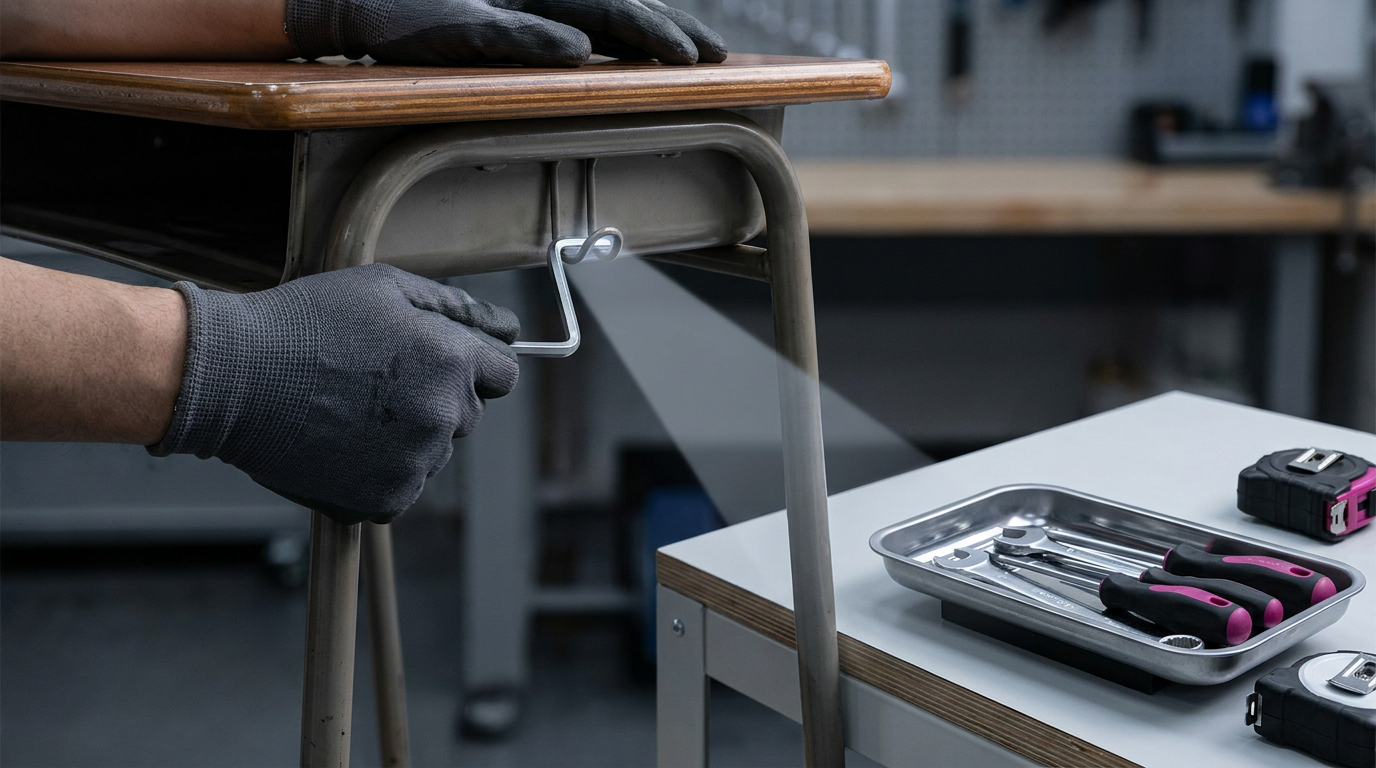
How to Fix a Wobbly Table or Desk
A wobbly school table fix is one of the most frequent tasks. It’s usually a straightforward job.
- Identify the Source: First, determine if the wobble comes from a loose leg, a loose frame joint, or simply an uneven floor.
- Tighten All Fixings: Using the correct Allen key or spanner, systematically tighten every bolt and screw connecting the legs to the frame and the frame to the tabletop.
- Adjust Levelling Feet: If the table has adjustable feet, turn them until all feet are firmly on the ground, eliminating the rock.
- Assess the Frame: If tightening bolts doesn’t solve it and the frame itself is bent or a weld is broken, the table is no longer safe. This is a candidate for replacement, not repair.
How to Secure Loose Chair Components
A chair with loose parts is a tipping hazard. Here’s how to perform a quick and effective school chair repair.
- Full Inspection: Turn the chair over and inspect all fixings connecting the base, legs, and seat shell or backrest.
- Tighten Systematically: Use the correct screwdriver or key to tighten every accessible fixing. Don’t just tighten the one that looks loose; check them all.
- Check and Replace Glides: Look for missing or worn-down plastic feet (glides). These are essential for stability and preventing floor damage. They are inexpensive and simple to replace.
How to Repair Scratched or Chipped Laminate Desks
Laminate, which typically refers to a decorative surface bonded to a core material like Medium-Density Fibreboard (MDF), is common in schools but can get damaged.
- Minor Scratches: For light surface scratches, a simple clean with a specialist laminate polish can often hide the mark and restore the sheen.
- Chips and Gouges: For deeper chips, a colour-matched laminate repair filler or wax kit can be used. Clean the area, apply the filler as per the product instructions, and smooth it level.
- Peeling Edges: This often signals the end of a desk’s life. While you can try to re-glue it with a strong contact adhesive, moisture has likely already penetrated the MDF core, causing it to swell. This type of damage is rarely a permanent fix.
Preventive Maintenance: A Termly Checklist for Furniture Longevity
A scheduled maintenance programme is the single most effective strategy to reduce long-term costs and mitigate safety risks. Shifting from a reactive “fix-it-when-it-breaks” model to proactive classroom furniture maintenance extends the life of your assets and demonstrates due diligence. This is a core component of effective preventive maintenance for school equipment.
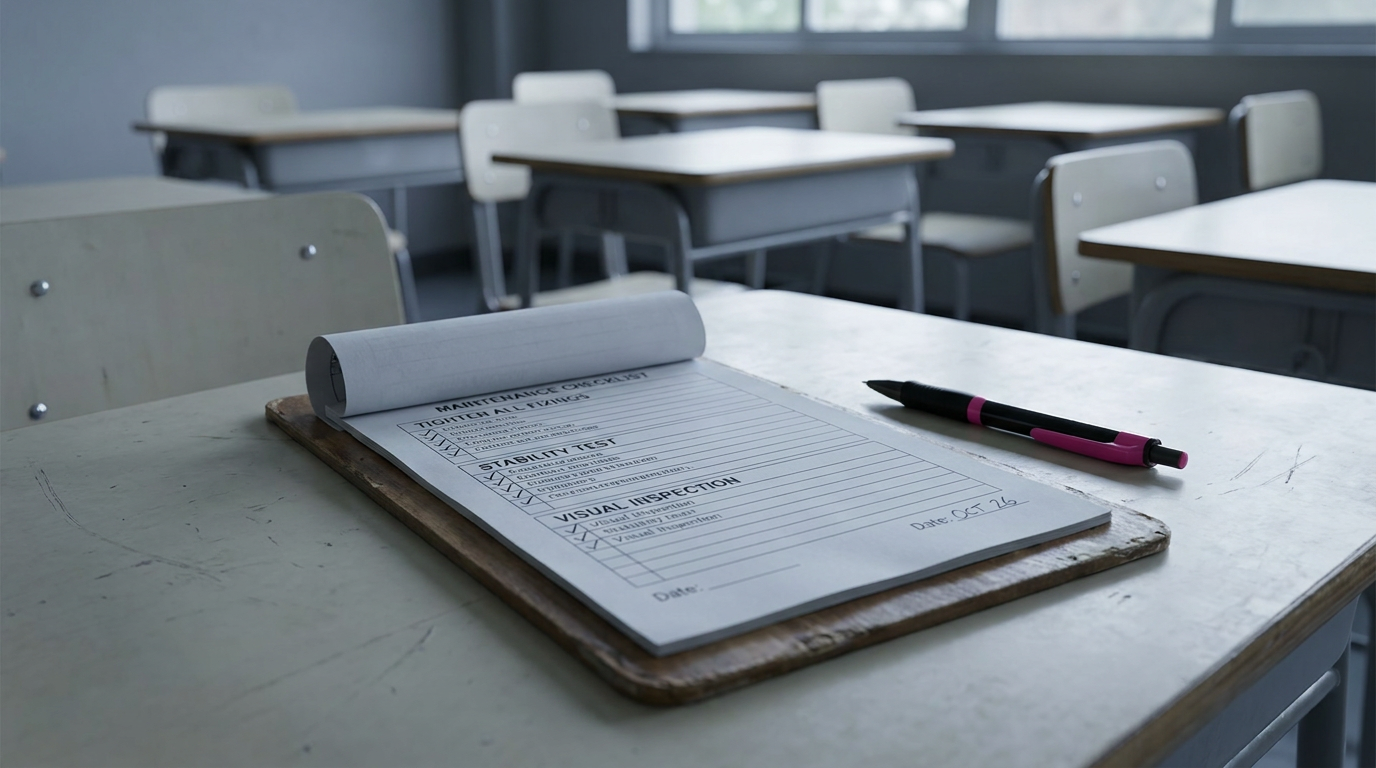
We recommend a simple checklist, performed during term holidays to minimise disruption.
Termly Checks (Every 3-4 Months):
- Tighten All Fixings: Go through each classroom and tighten all accessible bolts and screws on chairs and desks.
- Stability Test: Give every item a gentle push-and-pull test to check for wobbles.
- Visual Inspection: Check for new cracks, chips, or peeling laminate that could become a hazard.
- Height & Suitability: For Early Years settings, verify that chair and table heights are still appropriate for the age group, as required by the Department for Education (DfE) EYFS framework, which mandates equipment must be safe and suitable [3].
Annual Checks:
- Weld Inspection: On metal-framed furniture, closely inspect welded joints for any signs of stress fractures (fine cracks in the metal).
- Component Function: Test all moving parts, such as height-adjustment levers or chair swivels.
- Full Audit: Create a log of any items that may need replacing in the next budget cycle.
This proactive approach aligns with guidance from the European Agency for Safety and Health at Work (EU-OSHA), which highlights that well-maintained and ergonomic equipment is key to preventing musculoskeletal disorders [2]. It’s also a principle supported by the British Educational Suppliers Association (BESA), whose members commit to supplying products fit for purpose [4].
The Strategic Decision: When to Repair vs. Replace Your School Furniture
Knowing when to replace school furniture is a critical decision for any SBM. It’s a balancing act between budget constraints and the need for a safe, effective learning environment. Our experience suggests the decision on these school furniture issues should hinge on three key factors: Safety, Cost, and Appearance. This requires looking beyond the sticker price to the Total Cost of Ownership (TCO), which is a concept that includes the initial purchase price plus all maintenance and repair costs over an asset’s lifespan.
1. Safety Assessment
This is the most important factor and is non-negotiable. If a repair cannot restore an item to a condition that is unequivocally safe for use by a pupil, it must be replaced. Examples include:
- A cracked or bent metal frame.
- A splintered wooden leg.
- A plastic chair shell with a major crack.
No financial argument can outweigh your duty of care. The Health and Safety Executive (HSE) is clear that equipment must be safe for use [1], and a patched-up, structurally compromised chair does not meet that standard.
2. Cost-Benefit Analysis
Here, you need to be pragmatic. We recommend a simple rule of thumb: if the estimated cost of a repair (including staff time and materials) is more than 30% of the cost of a like-for-like replacement, replacement is almost typically the more sensible long-term option. A new item comes with a warranty and a full lifespan, whereas a costly repair on an old item is often just a temporary fix. You can analyse the cost-benefit of repairing versus replacing in more detail to support your budget proposals.
3. Classroom Environment & Appearance
Don’t underestimate the impact of aesthetics. A classroom filled with heavily worn, scratched, and mismatched furniture can negatively affect pupil morale and the perception of your school. Even if an item is technically functional after a repair, its poor appearance might justify replacement as part of a wider refurbishment project. Investing in a positive learning environment is an investment in student outcomes. You can see how we helped one primary school with a complete furniture renovation to understand the impact.
### Case Study: A Common UK Primary School Scenario
- Challenge: A Year 4 classroom had 30 desks, of which 8 were wobbly and 12 had badly chipped and peeling laminate edges, creating a poor learning environment and snagging hazards. The estimated repair time was 15 hours of caretaker labour plus £150 in materials, with no guarantee of a lasting fix.
- Solution: The SBM decided to replace all 30 desks. Using our Bulk Buy Discounts, the cost per new, fully compliant desk was significantly lower than the individual price.
- Results: The replacement project took half a day to install. The school now has durable, matching desks with a 10-year warranty, eliminating ongoing repair costs and creating a positive, safe environment. The TCO of the new desks was calculated to be 40% lower over 5 years compared to the projected cost of continuing to repair the old ones.
- Key Insight: Sometimes, a strategic replacement is more cost-effective than a cycle of recurring, time-consuming repairs.
Understanding UK Compliance: A Plain-English Guide to BS EN 1729
BS EN 1729 is the key European and UK standard that governs the dimensions, strength, and stability of chairs and tables for educational institutions. Understanding what it means is crucial for ensuring both safety and ergonomic wellbeing. It’s the primary benchmark for school furniture safety standards uk.
The standard is split into two main parts:
- BS EN 1729 Part 1: Functional Dimensions. This part is all about getting the size right. It specifies the correct height, depth, and width of chairs and tables for different age groups, from nursery to sixth form. The goal is to promote good posture and reduce the risk of musculoskeletal problems by ensuring children aren’t using furniture that is too big or too small for them.
- BS EN 1729 Part 2: Safety Requirements and Test Methods. This part ensures the furniture is tough enough for the school environment. It sets minimum requirements for strength, stability, and durability. Furniture is subjected to rigorous testing to simulate years of heavy use, including dropping weights on it and applying pressure to the frames to ensure it won’t collapse or tip over easily.
As an SBM, specifying furniture that complies with both parts of BS EN 1729 during procurement is the most reliable way to meet your legal and safety obligations. This is reinforced by the Department for Education’s (DfE) EYFS framework, which requires all equipment to be safe and suitable [3]. Reputable suppliers, particularly members of the British Educational Suppliers Association (BESA), will typically state if their products are compliant, providing you with peace of mind [4].
Frequently Asked Questions
What are the most common school furniture issues?
The most common school furniture issues are instability, component failure, and surface damage. These typically manifest as wobbly tables and chairs, loose or missing screws and feet, and scratched or peeling desktops. They are the result of constant, high-frequency use and can evolve from minor annoyances into genuine safety hazards if they aren’t addressed through a regular maintenance programme.
How often should we conduct a classroom furniture safety inspection?
We recommend a two-tier approach to inspections for optimal safety. Teaching staff can perform a quick visual check weekly for obvious hazards. A more thorough, documented inspection should then be carried out by facilities staff every term, or at minimum during the summer holidays, to tighten fixings and log items for repair or replacement.
What is BS EN 1729 and does all school furniture need to comply?
BS EN 1729 is the definitive UK and European standard for the sizing, strength, and stability of educational furniture. While it isn’t a law itself, sourcing furniture that complies with this standard is the recognised best practice for meeting your legal duties under health and safety law. We strongly recommend that all new furniture you purchase is fully compliant.
How can I remove permanent marker and graffiti from school desks?
Start with the mildest cleaning method first to avoid damaging the surface. A magic eraser sponge or a cloth with isopropyl alcohol can remove most marks from a laminate desk. For stubborn graffiti, you may need a specialist remover, but it’s crucial to test it on a small, hidden area first to ensure it doesn’t discolour or damage the finish.
When should I decide to replace school furniture instead of repairing it?
You should replace furniture when a repair cannot guarantee safety or isn’t cost-effective. Key triggers for replacement are structural damage like a cracked frame, a repair cost that exceeds 30-40% of a new item’s price, or if the furniture’s poor condition negatively impacts the learning environment. It’s a strategic decision balancing safety, budget, and classroom quality.
What are the signs that a school chair is unsafe for pupils?
Key danger signs of an unsafe chair include any wobble, cracks in the frame or seat, and sharp edges. Also look for broken welds, splintering wood, or missing feet that cause instability. If a chair shows any of these signs, it poses a clear risk to pupils and must be removed from the classroom immediately for assessment.
What makes some school furniture more durable than others?
Durability is determined by the quality of materials and construction. Features like fully-welded steel frames (which are stronger than bolted ones), high-pressure laminate tops instead of standard MDF, and reliable components designed for contract use are key. Compliance with the strength and stability tests in BS EN 1729 Part 2 is a reliable indicator of a durable product.
How do I fix a wobbly school table quickly and safely?
First, tighten all accessible leg and frame bolts with the correct spanner or Allen key. If the wobble persists, check and adjust the levelling feet to ensure they are all in firm contact with the floor. If you find the frame itself is bent or a weld is broken, the table is unsafe and should be replaced, not repaired.
Are there any specific furniture requirements for EYFS settings?
Yes, the EYFS statutory framework mandates that furniture must be safe and suitable for the children using it. This means it must be the correct size to promote good posture (as per BS EN 1729), be extremely stable to prevent tipping, have no sharp edges or toxic materials, and be durable enough to withstand a high-energy environment.
Can our school get a discount for a bulk furniture order?
Yes, most specialist suppliers, including Cost Cutters UK, offer Bulk Buy Discounts for larger projects. Whether you are furnishing a single new classroom, a whole year group, or undertaking a full-school refurbishment, requesting a formal quote for the entire project is an effective way to secure preferential pricing and maximise your budget.
Important Considerations
This guide provides practical advice for common and simple furniture repairs. However, it does not cover complex structural failures. Issues like broken welds on a steel frame or severely bent legs compromise the core integrity of the furniture and almost typically mean the item must be replaced for safety reasons. Furthermore, the effectiveness of any repair is often dependent on the quality of the original item; some budget furniture isn’t designed to be serviceable.
When the time comes for replacement, consider alternatives to standard MDF. Materials such as high-pressure laminate (HPL) or solid-core laminate (SCL) offer vastly superior resistance to scratches, impact, and moisture, which can significantly increase the asset’s working life and improve your Total Cost of Ownership. For chairs, polypropylene shells offer a great blend of flexibility and impact resistance, while fully-welded steel frames are inherently more durable than bolted designs.
For any repair you are not 100% confident in performing safely, or for large-scale furniture audits and replacement projects, You should consult a professional. At Cost Cutters UK, our “Design To Install We Do It All!” service means we can manage the entire process for you. From a full site audit and space planning to ensuring all new furniture is fully compliant with UK standards, we’re here to help, Saving Time & Stress.
Future-Proofing Your Classrooms with a Proactive Furniture Strategy
To conclude, effectively managing school furniture issues requires a proactive strategy, not just a reactive repair list. By combining regular inspections with a scheduled preventive maintenance for school equipment programme and using a clear framework for making repair-or-replace decisions, you create a safer learning environment for pupils, extend the life of your school’s assets, and ultimately maximise the value of your budget. This approach transforms furniture management from a recurring headache into a strategic part of your school’s operational success.
If you are planning a refurbishment or need to replace furniture that’s beyond economical repair, the team at Cost Cutters UK is ready to assist. With over 35 years of experience serving UK schools and being Rated Excellent On Trustpilot, we offer expert advice, compliant products, and flexible payment options like Credit Accounts Or Pay Flexibly. Explore our guides on choosing the right primary school tables and chairs or use our comprehensive school furniture procurement checklist to get started.
References
- Health and Safety Executive (HSE) – Government Guidance. Provides the official UK legal requirements and practical advice for maintaining safe work and learning equipment under UK law.
- European Agency for Safety and Health at Work (EU-OSHA) – International Body Research. This research highlights that poor ergonomics and inadequately maintained equipment are major risk factors for musculoskeletal disorders affecting millions across Europe.
- Department for Education (EYFS Framework) – Government Statutory Framework. Section 3.54 of this statutory document mandates that premises, furniture, and equipment in early years settings must be safe, suitable for purpose, and properly maintained.
- British Educational Suppliers Association (BESA) – Professional Organisation Code of Practice. The code requires members to ensure their products are fit for purpose, safe for use in educational environments, and of a high quality standard.
- World Health Organization (WHO) – Global Health Guidelines (2020). These guidelines recommend limiting sedentary time, providing the global health context for why well-designed and functional school environments are important.
- Statista – Market Research Data (2024). This market data reports that revenue in the UK Office Furniture market, a related sector, is projected to be US$2.28bn in 2024, indicating the economic scale of commercial furniture.
Conclusion
Future-Proofing Your Classrooms with a Proactive Furniture Strategy
In summary, school furniture issues require more than just ad-hoc repairs; they demand a proactive strategy that incorporates preventive maintenance for school equipment. By combining regular inspections, timely maintenance, and a clear framework for making repair-or-replace decisions, you can create a safer learning environment, extend the life of your assets, and maximise the value of your budget. This approach transforms furniture management from a reactive chore into a strategic part of your school’s operational planning.
If you are planning a refurbishment or need to replace furniture that is beyond economical repair, the team at Costcutters UK can help. With over 35 years of experience serving UK schools, we can provide expert advice, compliant products, and a free space plan and quote to meet your specific needs. Explore our range of durable classroom chairs and tables to see how investing in quality pays off, and use our comprehensive school furniture procurement checklist to get started.