UK School Furniture Safety Standards: The Definitive BS EN 1729 Guide
🎯 Key Takeaway
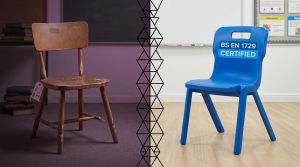
UK school furniture safety standards are primarily governed by the British and European standard BS EN 1729, which ensures furniture is ergonomically sound, appropriately sized, strong, and durable for educational use. This standard is crucial for compliance and pupil well-being.
• BS EN 1729 Part 1 specifies six size marks to ensure correct posture and comfort for pupils of different ages.
• BS EN 1729 Part 2 details safety requirements, including rigorous tests for stability, strength, and durability to withstand demanding classroom use.
• Compliance is essential not only for pupil well-being and learning but also for meeting Health and Safety Executive (HSE) and Ofsted expectations.
This guide breaks down these standards into practical steps for procurement, auditing, and ensuring a safe learning environment.
As of September 2026, For school furniture safety standards, School Business Managers face the constant challenge of balancing tight budgets with their legal and moral duty of care. Furniture is far more than just a purchase; it’s a fundamental component of the learning environment and a direct responsibility under UK health and safety law. Getting it wrong can impact everything from pupil concentration to long-term health. The key to navigating this is understanding the primary educational furniture standards UK, chiefly BS EN 1729. This article provides a definitive guide to what this standard means in practice, how to audit your existing stock for compliance, and how to procure new, safe furniture cost-effectively.
Written by: Cost Cutters UK Content Team | Reviewed by: Editorial Team, 35+ Years Experience; Rated Excellent On Trustpilot
Last updated: 18 September 2026
ℹ️ Transparency Disclosure: This article explores UK school furniture safety standards based on official government and industry documentation, and our 35+ years of specialised experience. Some links may connect to our services, but all information is editorially independent and verified. Cost Cutters UK is a trading name of Seated Furniture Ltd.
What is BS EN 1729 and Why Does it Matter for UK Schools?
BS EN 1729 is the principal British and European standard that governs the suitability of chairs and tables for educational institutions. In simple terms, it’s the official benchmark that indicates furniture is ergonomically sound, safe, and strong enough for the classroom. Compliance is the recognised method for schools to demonstrate they are meeting their legal duties under the Health and Safety at Work etc. Act 1974.
The standard is split into two critical parts:
- Part 1: Functional Dimensions. This part focuses on ergonomics, specifying the correct heights, depths, and angles for chairs and tables to suit different age groups. Its goal is to promote good posture and reduce the risk of musculoskeletal disorders (MSDs). Research from the European Agency for Safety and Health at Work (EU-OSHA) identifies prolonged sitting with poor posture as a key risk factor for MSDs, making this part of the standard vital for pupil health.
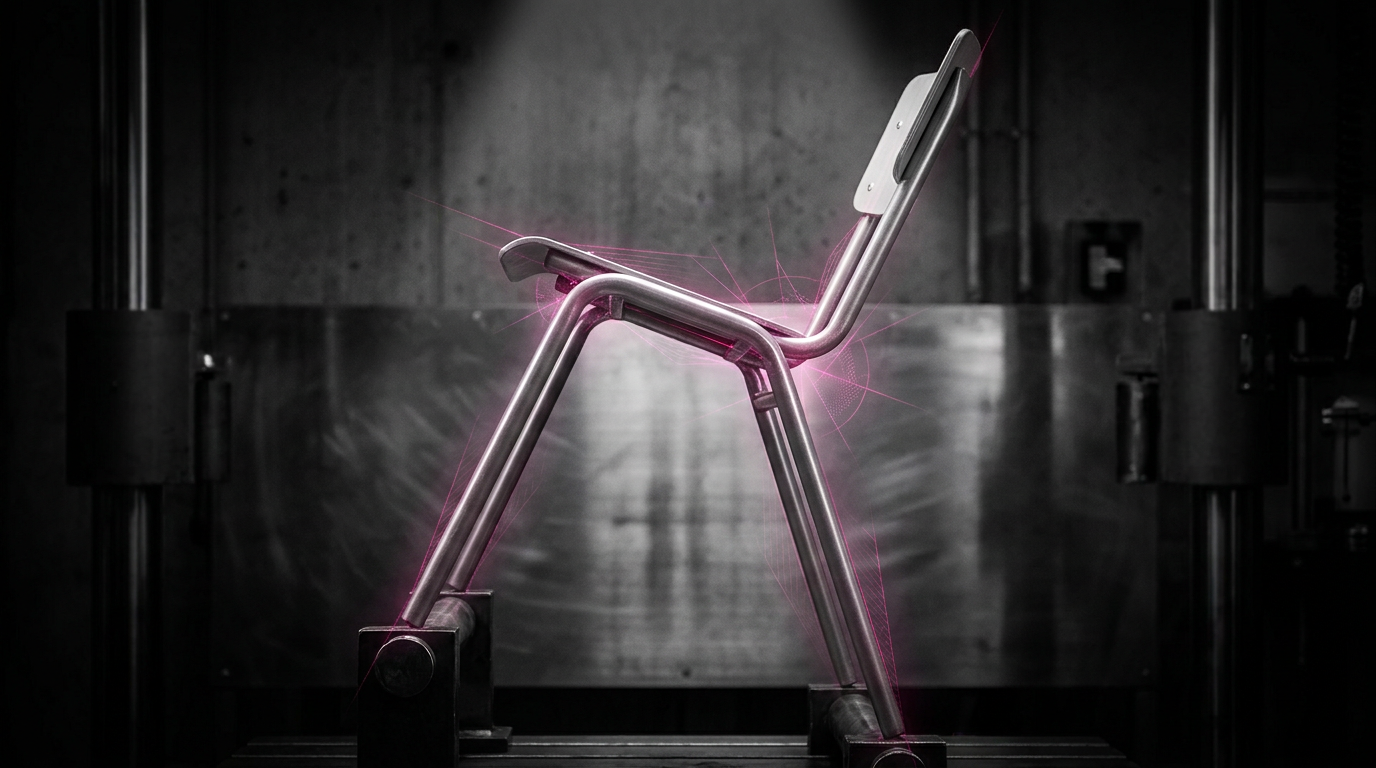
- Part 2: Safety Requirements and Test Methods. This section details the rigorous testing furniture must undergo for strength, stability, and durability. It ensures a chair won’t easily tip or break under the stresses of a dynamic classroom environment.
For UK schools, adhering to BS EN 1729 is not just best practice; it’s a core component of safeguarding. The Department for Education (DfE) statutory framework states that the school environment and equipment must be safe and suitable. Furthermore, whilst Ofsted inspectors don’t measure furniture, they assess the overall safety of the learning environment. Using furniture that is clearly non-compliant or in disrepair can be flagged as a welfare issue.
BS EN 1729 Part 1: The Right Size for Every Pupil
The first part of the standard addresses a fundamental question: is the furniture the right size for the child using it? This goes beyond simple comfort. Ill-fitting furniture forces children into unnatural postures, which can lead to fidgeting, poor concentration, and, according to the World Health Organization (WHO) (2020) guidelines on sedentary behaviour, contribute to long-term health issues. In our experience, providing correctly sized furniture is one of the most effective ways to improve classroom focus.
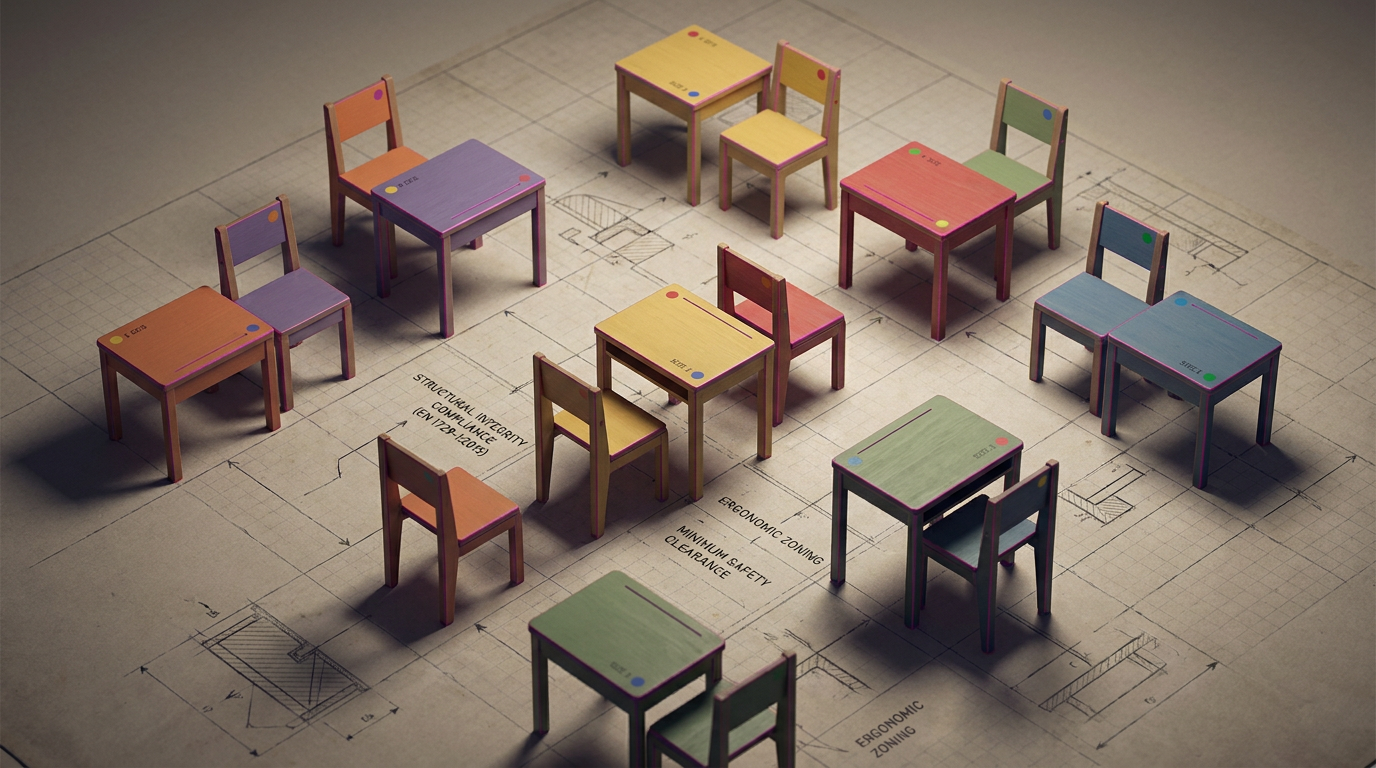
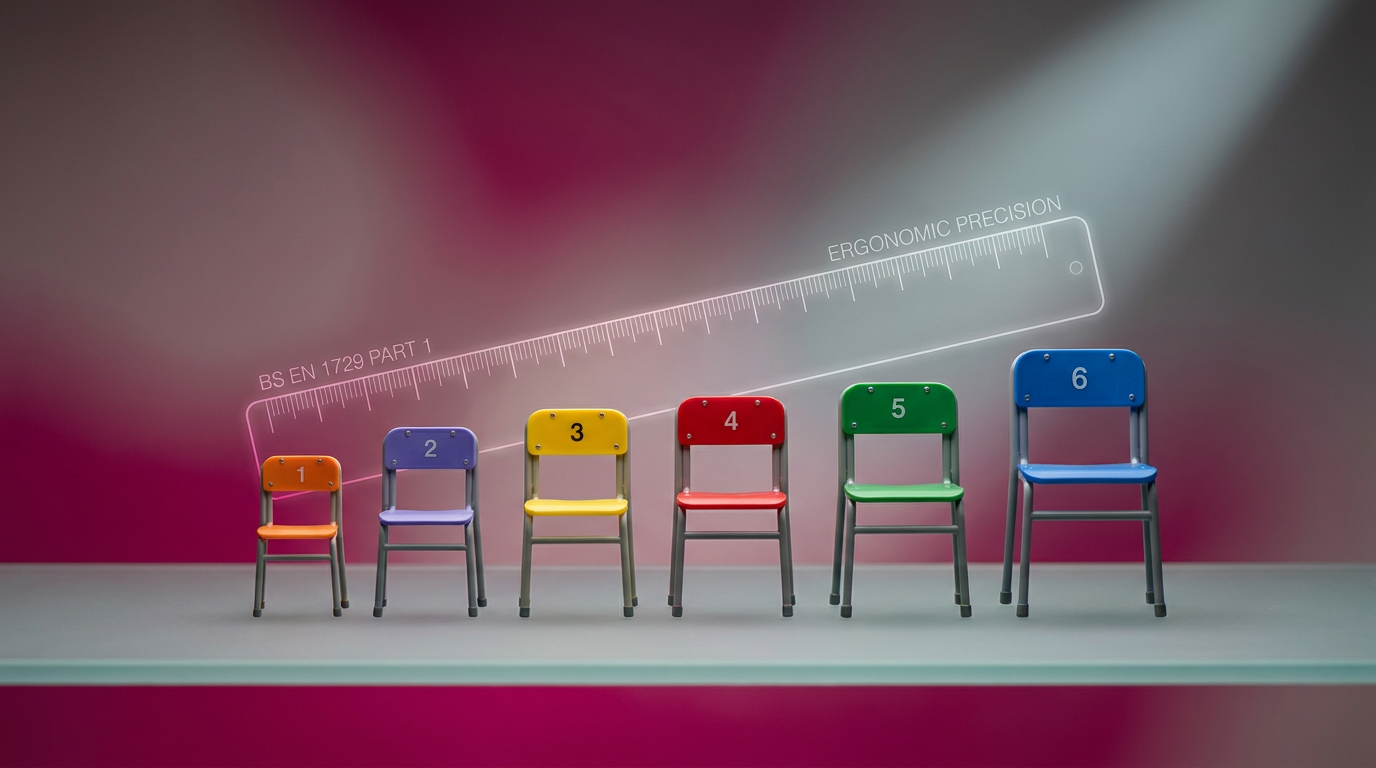
BS EN 1729 Part 1, a key component of primary school furniture regulations UK, establishes a clear system of school table and chair dimensions. It defines six official ‘Size Marks’ that correlate chair and table heights to specific age groups and pupil statures. This system simplifies procurement and classroom organisation significantly.
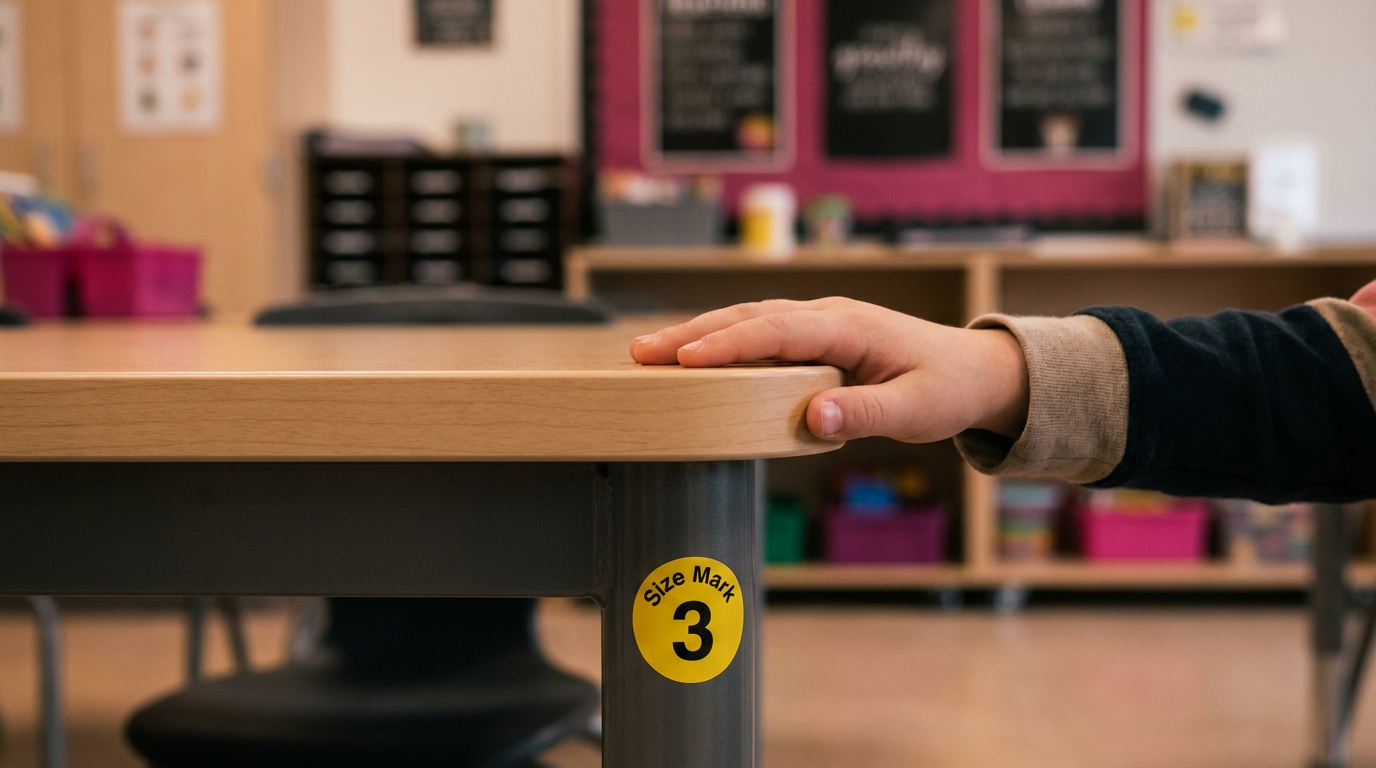
A key definition in this standard is the ‘size mark,’ which is a numerical or colour-coded identifier on furniture that indicates its intended user size group. You’ll often see these as coloured stickers or engravings on the legs of chairs and tables. This allows teachers and staff to quickly identify and arrange furniture for different year groups, ensuring every pupil has an ergonomic setup. For a more detailed breakdown, you might find our guide on how to choose ergonomic primary school furniture helpful.
The table below, based on guidance from sources like GLS Education and the standard itself, outlines these size marks.
| Size Mark | Colour Code | Suggested Age Group | Chair Seat Height (mm) | Table Height (mm) |
|---|---|---|---|---|
| 1 | Orange | 3 – 4 years | 260 | 460 |
| 2 | Violet | 4 – 6 years | 310 | 530 |
| 3 | Yellow | 6 – 8 years | 350 | 590 |
| 4 | Red | 8 – 11 years | 380 | 640 |
| 5 | Green | 11 – 14 years | 430 | 710 |
| 6 | Blue | 14+ years | 460 | 760 |
BS EN 1729 Part 2: Built for the Classroom Environment
While Part 1 ensures furniture fits the pupil, Part 2 ensures it can survive the school day. This part of bs en 1729 specifies the minimum classroom furniture safety requirements for strength, durability, and stability. Furniture that meets this standard has undergone a series of demanding laboratory tests designed to simulate the intense use, and occasional misuse, it will face in a school.
These tests are not arbitrary; they address common, real-world scenarios:
- Stability Tests: These ensure that a chair won’t tip over backwards if a pupil leans back or sideways. For tables, it verifies they won’t topple if someone leans heavily on an edge.
- Strength Tests: These apply significant weight and pressure to seats, backs, and table surfaces to ensure they can bear heavy loads without breaking. This simulates events like a pupil standing on a chair or a heavy box being dropped on a desk.
- Durability Tests: These are cyclical tests that simulate years of use in a short period. For example, a machine may apply and release pressure on a chair back thousands of times to check for fatigue in the frame and joints.
Beyond these performance tests, Part 2 also covers design safety. Compliant furniture should have no sharp edges or corners that could cause injury. It must also be free from entrapment points where fingers or clothing could get caught. As the British Educational Suppliers Association (BESA) Code of Practice mandates, products must be ‘fit for their intended purpose’, and Part 2 of bs en 1729 is the definitive measure of fitness for a classroom. When you buy compliant furniture, you’re investing in a product well-supported by research to be safe and reliable.
Your Practical Audit Checklist: Is Your Current Furniture Safe and Compliant?
As a School Business Manager, conducting regular furniture audits is essential for both safety and budget planning. It helps you identify hazards before they cause an injury and create a data-driven plan for repairs and replacements. We recommend a simple, visual traffic-light system for this process.
Here is a practical checklist to guide your audit:
- ✅ Structural Integrity:
- Gently push and pull each chair and table. Do they wobble or rock excessively?
- Check all joints, especially where legs meet the seat or tabletop. Are there signs of separation or loose fixings?
- Inspect wooden furniture for cracks and splinters. Check metal frames for bent components or cracked welds.
- ✅ Surface Condition:
- Run your hand carefully over all surfaces and edges. Are there sharp edges, peeling laminate, or splinters that could cause cuts?
- Look for exposed screws, nails, or staples.
- ✅ Stability and Safety:
- For chairs, check if they feel stable when you sit and lean back slightly. Do they feel at risk of tipping?
- Review the general safety considerations for kids tables, ensuring they are stable and not easily overturned.
- Look for any original compliance stickers or stamps (e.g., BS EN 1729). A lack of a mark on older furniture warrants a more thorough physical inspection.
- ✅ Sizing and Allocation:
- Are the chairs and tables in each classroom matched correctly according to their size marks? Mismatched sizes can undermine ergonomics.
Once you’ve inspected an item, assign it a status:
- Green: Safe and in good condition. No action needed.
- Amber: Minor wear and tear. Schedule for monitoring or repair.
- Red: Unstable, broken, or has a clear safety hazard. Remove from use immediately.
This audit will give you a clear picture of when to replace your school’s tables and chairs and helps you prioritise your budget effectively.
Procuring Compliant Furniture: A Cost-Effective Strategy for UK Schools
Procuring compliant school furniture can feel like a significant capital outlay, especially with budgets under constant pressure. However, we firmly believe that opting for the cheapest, non-compliant option is a false economy. The true cost of furniture is not its purchase price but its Total Cost of Ownership (TCO), which includes maintenance, repairs, and the cost of replacement over its lifespan.
Investing in furniture that meets school furniture safety standards like BS EN 1729 delivers better long-term value. These items are built to last, reducing the frequency of replacements and saving your school money and administrative hassle over time. The UK office and institutional furniture market is substantial, with Statista (2024) data showing revenue of US$2.28 billion, reflecting the scale of these investments. Making a smart choice is paramount.
Here is our recommended strategy for cost-effective procurement:
- Specify Compliance: When issuing tenders or requesting quotes, explicitly state that all furniture must comply with “BS EN 1729 Parts 1 and 2”. This ensures you are only comparing like-for-like, durable products.
- Partner with a Specialist: Work with a supplier who understands the educational sector. We can provide expert advice, offer Bulk Buy Discounts, and develop phased replacement plans that align with your budget cycles, “Saving Time & Stress”.
- Consider the Warranty: A long warranty is a manufacturer’s vote of confidence in their product’s durability. Look for warranties of 5 years or more on frames and structural components.
- Flexible Payment Options: Explore suppliers who offer flexible payment terms, such as Credit Accounts Or Pay Flexibly, to help manage cash flow for larger projects.
Case Study: A Hypothetical Academy Trust Scenario
- Challenge: A Multi-Academy Trust with five primary schools was facing rising repair costs and an increasing number of minor incidents related to old, failing furniture. Their annual furniture repair budget was £15,000, yet the problems persisted.
- Solution: The Trust partnered with us to develop a three-year phased replacement plan. We conducted a full audit and prioritised replacing the most hazardous ‘Red’ rated items in Year 1, focusing on Early Years and Year 1 classrooms, using BS EN 1729 compliant furniture.
- Results: In the first year, the Trust saw a 60% reduction in furniture-related incidents and cut its repair budget by over 50%. The new, correctly sized furniture was also credited by teachers for improved pupil focus.
- Key Insight: A strategic, phased approach to procurement, rather than sporadic replacements, allows for better budget control and delivers a greater impact on safety and learning outcomes.
Important Considerations
This guide focuses primarily on the BS EN 1729 standard, which is the definitive benchmark for conventional school tables and chairs in the UK. However, it’s important to recognise its limitations. The standard does not cover the highly specialised furniture required for many pupils with Special Educational Needs (SEN), which often demands bespoke dimensions, postural support, and accessibility features governed by different regulations. Similarly, furniture for early years settings (children under 3) may fall under different toy safety standards in addition to general product safety rules.
While traditional materials like wood laminate and polypropylene are ubiquitous, they aren’t the only options. For areas with exceptionally high wear and tear, fully welded metal frame furniture can offer superior durability. When making a selection, it’s worth exploring the pros and cons of wooden versus plastic school furniture, as the choice involves a trade-off between initial cost, longevity, weight, and classroom aesthetics. Your specific environment and usage should guide this decision.
Navigating the complexities of a large-scale replacement, a new build project, or a classroom with unique ergonomic challenges can be daunting. In these situations, we recommend consulting a specialist educational furniture supplier. An expert partner can provide a comprehensive “Design To Install We Do It All!” service, including site surveys, space planning, and ensuring your final selection is fully compliant, optimising both your budget and your learning environment.
Conclusion: Ensuring a Safe, Compliant, and Effective Learning Space
Ultimately, adhering to UK school furniture safety standards is a non-negotiable responsibility that directly impacts pupil welfare, concentration, and long-term health. By understanding the core principles of BS EN 1729, conducting regular and thorough audits of your current stock, and making informed procurement decisions based on total cost of ownership, School Business Managers can create an environment that actively supports learning. Sourcing compliant school furniture is not merely an expense; it’s a foundational investment in educational outcomes and a cornerstone of your school’s duty of care.
At Cost Cutters UK, our 35+ years of experience have been dedicated to helping schools, colleges, and nurseries navigate these exact requirements. Our extensive range of educational furniture standards UK-compliant products is designed for the realities of the modern classroom, and we’re proud to be Rated Excellent On Trustpilot. If you need assistance auditing your current furniture or planning a future project, our specialists are ready to help. Explore The Complete Guide to Primary School Tables and Chairs or contact us today for a free space plan and quote to ensure your next investment is safe, durable, and cost-effective.
Frequently Asked Questions
What are the key school furniture safety standards in the UK?
The most important of the UK’s school furniture safety standards is BS EN 1729. This crucial two-part standard covers both the ergonomic dimensions (Part 1) to ensure a healthy posture and the strength and stability requirements (Part 2) to confirm furniture is safe and durable. Compliance demonstrates due diligence in protecting pupil welfare and meeting legal obligations.
What are the safety considerations for kids tables?
Key safety considerations for kids tables include stability, safe edges, and non-toxic materials. The table must be stable enough to prevent tipping if a child leans on it. All corners and edges should be rounded to minimise injury from impact. Furthermore, the materials and finishes must be non-toxic and the table height must be appropriate for the chair and child’s size per BS EN 1729.
What is BS EN 1729?
BS EN 1729 is the definitive British and European standard for chairs and tables in educational institutions. It provides a clear framework for manufacturers to produce furniture that is truly fit for purpose. The standard covers essential criteria including ergonomic dimensions, safety features, stability, strength, and durability. Adherence is the recognised way to ensure furniture is safe and suitable for UK schools.
How do I know what size furniture to buy for my primary school?
You should look for the BS EN 1729 size mark, which corresponds to specific age groups. For example, ‘Size Mark 2’ (often violet) is designed for ages 4-6, while ‘Size Mark 4’ (often red) is for ages 8-11. A reputable supplier’s catalogue or our size guide chart will match these marks to the correct chair and table heights for your pupils, simplifying the process.
Does Ofsted check school furniture?
While Ofsted inspectors do not typically measure individual items, they do assess the overall safety of the learning environment. This falls under their judgement on ‘Behaviour and attitudes’ and ‘Leadership and management’. Using old, damaged, or clearly inappropriate furniture can be flagged as a welfare concern. Therefore, compliance with standards like BS EN 1729 represents established best practice for safeguarding.
How often should I inspect school furniture for safety?
A quick visual check should be part of the daily routine, with a formal, documented inspection conducted at least annually. We’ll be honest – this part can be tedious, but it’s crucial. We strongly recommend a thorough check at the start of each of the three main school terms. This allows you to identify and address wear and tear before it becomes a genuine hazard to pupils or staff.
Are there regulations for the materials used in school furniture?
Yes, other UK regulations like REACH govern the chemical substances used in manufacturing. Whilst BS EN 1729 focuses on structure and safety, REACH (Registration, Evaluation, Authorisation and Restriction of Chemicals) is also critical. Reputable suppliers, like us, ensure that all materials, including paints, lacquers, and plastics, are non-toxic and completely safe for use in an environment with children.
What is the difference between BS EN 1729 Part 1 and Part 2?
Part 1 specifies the functional dimensions for ergonomics, while Part 2 details the safety and strength requirements. Part 1 ensures the chair and table heights are correctly matched to different age groups to promote good posture. Part 2 involves rigorous laboratory testing for strength, durability, and stability, making sure the furniture can withstand the demands of a busy classroom without failing.
Can I buy compliant furniture on a tight budget?
Yes, strongly, as compliant furniture represents better long-term value. While the initial price may be slightly higher, its durability reduces replacement and repair costs over time. We advise looking for suppliers offering Bulk Buy Discounts, phased delivery plans, or specific ranges designed to meet standards at an accessible price point. It’s a smarter, more sustainable use of your school’s budget.
What are the main safeguarding issues in schools?
Safeguarding covers the physical environment in addition to preventing abuse and neglect. The statutory guidance is clear that a school’s premises and equipment must be safe and not pose a risk to children. Therefore, providing safe, well-maintained, and age-appropriate furniture is not just a facilities issue; it is a fundamental aspect of a school’s core safeguarding duty to every pupil.
References
- British Educational Suppliers Association (BESA) – Code of Practice. Mandates that member-supplied products are ‘fit for their intended purpose’ and meet high safety and quality standards.
- BSI Knowledge – Standard Documentation. Provides the official text for BS EN 1729-2, detailing the specific safety requirements and test methods for strength and stability.
- Department for Education (DfE) – Statutory Framework. Section 3 of the EYFS framework requires that premises, environment, and equipment must be safe, suitable, and promote learning.
- European Agency for Safety and Health at Work (EU-OSHA) – Research Body. Provides extensive research highlighting that poor workstation design and prolonged sitting are key risk factors for developing musculoskeletal disorders.
- GLS Education – Industry Guide. Offers a practical visual guide that translates BS EN 1729 size marks into specific furniture measurements for different age groups.
- Health and Safety Executive (HSE) – Government Guidance. Outlines the legal framework and practical advice for risk assessments in the UK, which informs best practice for pupil and staff workstations.
- Statista – Market Research (2024). Reports that revenue in the UK Office Furniture market amounts to US$2.28 billion in 2024, contextualising the scale of investment in work and learning environments.
- World Health Organization (WHO) – Global Guidelines (2020). Recommends limiting sedentary time, reinforcing the international health basis for ergonomic furniture that supports good posture and well-being.