DIY or Professional School Furniture Installation? A UK Decision Guide
🎯 Key Takeaway
Deciding on school furniture installation requires a strategic choice between a DIY approach and hiring professional installers, a decision that hinges on project scale, complexity, and the critical need for regulatory compliance. For most UK schools, professional installation offers superior value by mitigating risks and ensuring safety. While a DIY approach might seem to offer initial savings, these are often offset by hidden costs like staff labour, project delays, and the liability of non-compliance. Professional services guarantee that furniture meets UK standards like BS EN 1729, manage all logistics from delivery to waste removal, and ensure your investment is protected.
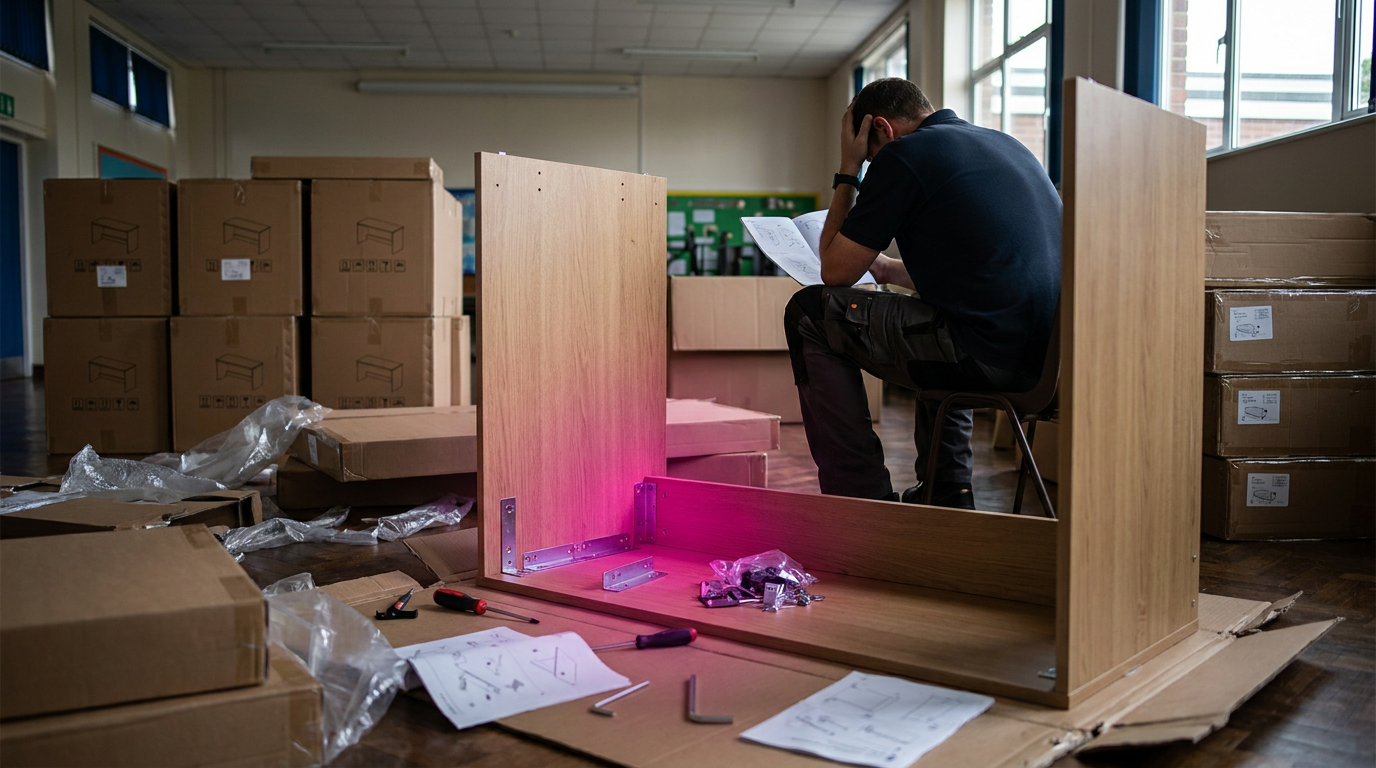
The delivery lorries arrive, and suddenly the school hall is a maze of flat-pack boxes. For any School Business Manager (SBM), this sight marks a critical decision point. The choice of how to handle the school furniture installation isn’t merely about cost; it’s a strategic decision involving risk, compliance, and resource allocation. As of August 2026, with budgets under constant scrutiny, the temptation to use internal staff for a DIY approach is strong. However, this decision has far-reaching consequences, impacting everything from student safety to the school’s legal standing. This guide provides a clear framework to help you make an informed choice, ensuring your project is a success from the outset and forms a key part of any wider school furniture replacement project.
Written by: The Cost Cutters UK Content Team | Reviewed by: Industry Specialists, 35+ Years Experience; Rated Excellent On Trustpilot
Last updated: 14 August 2026
ℹ️ Transparency Disclosure: This article explores the decision-making process for school furniture installation based on our 35+ years of industry experience and detailed analysis of UK regulatory requirements. We aim to provide a balanced view to help schools make informed decisions. Some links may connect to our services, such as our ‘Design To Install We Do It All!’ programme. All information is verified by our editorial team to ensure accuracy and relevance for UK educational institutions.
The DIY Route: A Realistic Assessment for UK Schools
The appeal of a DIY approach is undeniable: on paper, it looks like a significant cost saving. The idea is to use the school’s existing site team or other staff during quieter periods, such as school holidays, to undertake the school furniture assembly. However, our experience shows this calculation often overlooks critical hidden costs.
First, consider the opportunity cost. Is your site manager’s time, paid at their normal rate, best spent deciphering flat-pack instructions? Every hour they spend on a DIY classroom furniture setup is an hour not spent on essential site maintenance, health and safety checks, or preparing the school for the new term. This diversion of resources can lead to delays in other critical areas.
Second, there’s the issue of expertise and efficiency. A professional team can assemble and place furniture for a standard classroom in a few hours; a non-specialist team could take a full day or longer for the same task. This time difference becomes a major factor during the tight 6-week summer holiday period. Delays can have a domino effect, impacting decorators, IT installers, and cleaners, potentially jeopardising the school’s readiness for the first day of term. We’ve seen projects delayed by weeks because a key component was incorrectly installed, requiring a complete re-build.
Finally, there’s the risk of damage and missing parts. If your staff damage a component during assembly, the school bears the cost of replacement. If parts are missing from the box, it’s your staff who must spend time chasing the supplier, adding administrative burden and further delays.
The Professional Service: More Than Just Assembly
Engaging professional school furniture installers is about more than just getting desks and chairs built. It’s an end-to-end project management service that mitigates risk and may help a high-quality outcome. At Cost Cutters UK, our ‘Design To Install We Do It All!’ service is a comprehensive solution designed for busy schools.
The process begins long before the furniture arrives. A professional service includes:
- Pre-Installation Survey: We conduct a site visit to check access, measure doorways and stairwells, and create a detailed installation plan.
- Delivery Coordination: We manage the logistics, receiving and checking the delivery to ensure all components are present and correct before the installation day.
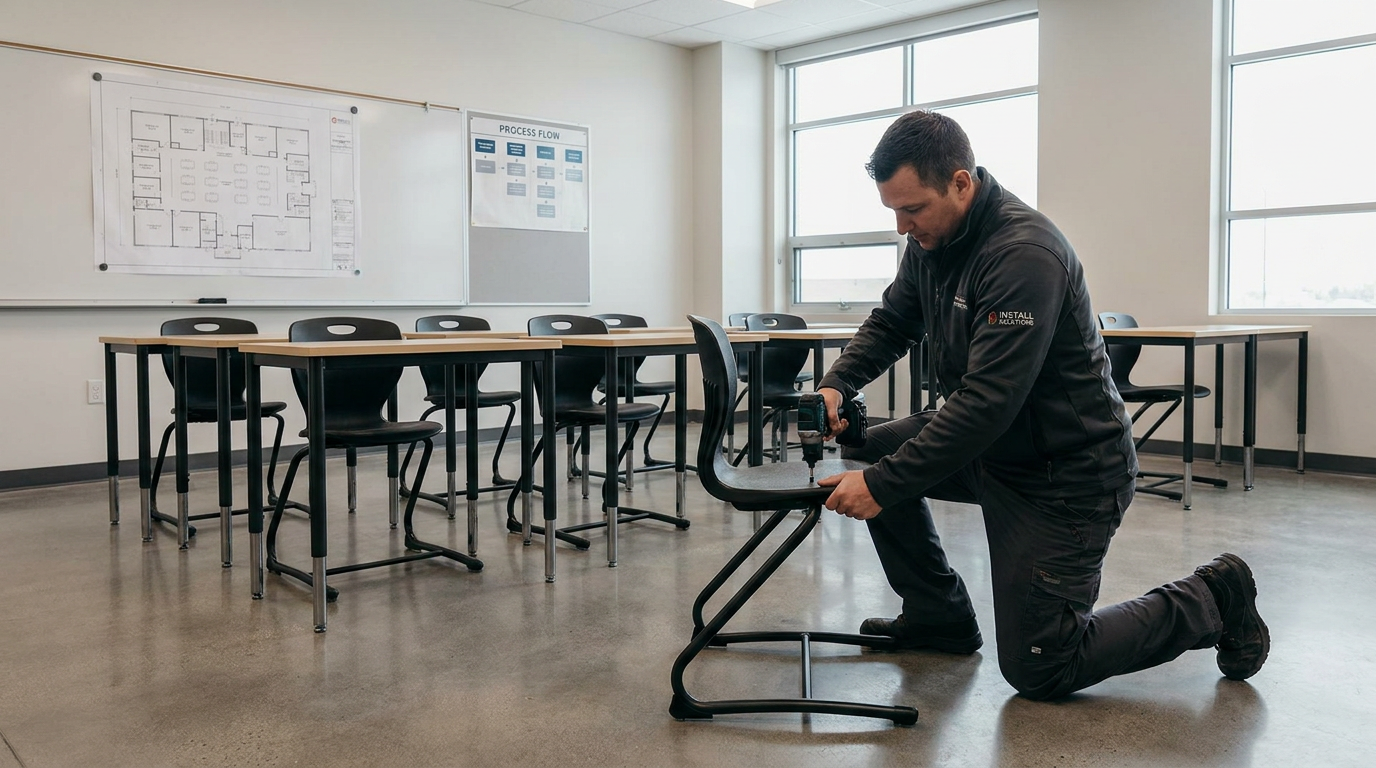
- Expert Assembly: Our teams are trained and experienced. They use specialised tools and are familiar with a vast range of education furniture, ensuring everything is built to manufacturer specifications. This is crucial for preventing common school furniture issues and protecting warranties.
- Placement and Fixing: Furniture isn’t just assembled; it’s placed according to the agreed-upon room plan and fixed securely where required (e.g., to walls).
- Waste Removal: All packaging, including cardboard and pallets, is removed from the site and disposed of responsibly, leaving the rooms clean and ready for use.
- Snagging and Handover: A designated site manager will walk through the completed project with you to identify and rectify any minor issues (snagging) before a formal handover.
This level of service transforms a logistical headache into a smooth process, Saving Time & Stress for the school’s leadership team. As members of the British Educational Suppliers Association (BESA), professional suppliers are held to a Code of Practice that ensures services are fit for purpose. BESA’s (2024) code provides a benchmark for quality and reliability in the sector.
Case Study: A Typical Academy Trust Scenario
- Challenge: A Multi-Academy Trust needed to furnish five new science labs across two schools within a three-week window during the summer holidays. The project involved 150 specialist stools, 75 high-spec lab tables, and chemical storage units.
- Solution: The Trust engaged our professional installation team. We created a detailed logistical plan, coordinated staggered deliveries to both sites, and deployed two experienced teams to work in parallel.
- Results: The entire project was completed in just eight working days, well ahead of schedule. There were zero assembly errors, and all packaging was removed. The Trust estimated this saved their internal site teams over 200 hours of work, which they could dedicate to other pre-term preparations.
- Key Insight: For complex or multi-site projects, the project management and logistical expertise of a professional service provide value that far exceeds the installation cost itself.
Cost-Benefit Analysis: A Data-Driven Look at School Furniture Installation
When comparing DIY to professional school furniture installation, it’s crucial to look beyond the initial quote. A true cost of school furniture installation analysis must account for all direct and indirect expenses. Data from market research firm Statista (2024) shows the UK office furniture market alone is valued at over £1.8 billion, highlighting the significant investment schools make and the importance of getting it right.
Let’s break down the hidden costs of a DIY approach versus the clear value of a professional service.
| Factor | DIY Approach (Using Internal Staff) | Professional Installation Service |
|---|---|---|
| Labour Cost | Staff time (e.g., 2 site staff x 40 hours @ £18/hr = £1,440) + opportunity cost of deferred tasks. | Included in a fixed quote (typically 10-20% of furniture value). No hidden extras. |
| Project Timeline | Unpredictable. High risk of overruns due to inexperience, missing parts, or errors. | Fixed and likely to support. Experienced teams work efficiently to meet deadlines, crucial for holiday projects. |
| Warranty & Liability | High risk of voiding manufacturer warranties through incorrect assembly. School retains liability for accidents. | Warranty is protected. Liability for assembly-related incidents is transferred to the insured installation company. |
| Tools & Equipment | May require purchase of specialised tools. Staff may not have correct Personal Protective Equipment (PPE). | Professionals arrive with all necessary specialist tools, equipment, and full PPE. |
| Waste Disposal | School’s responsibility. Can involve significant costs for skip hire and staff time to manage waste. | Included in the service. All packaging waste is removed from site, saving time and disposal fees. |
| Compliance | Risk of non-compliance with BS EN 1729 and HSE standards. Dependent on staff knowledge. | likely to support compliance. Installers are trained on all relevant UK safety and ergonomic standards. |
The data shows that while a professional service has an upfront cost, it effectively acts as an insurance policy against budget overruns, project delays, and long-term liability.
The Compliance Minefield: Navigating UK Safety Standards
This is where the argument for professional installation becomes most compelling. School furniture compliance UK is not an optional extra; it’s a legal requirement. The Health and Safety Executive (HSE), the UK’s workplace regulator, places a duty of care on employers (in this case, the school or trust) to provide a safe environment. The HSE’s guidance (2024) on workplace equipment is clear: it must be correctly installed and maintained to be safe.
Two key standards are paramount:
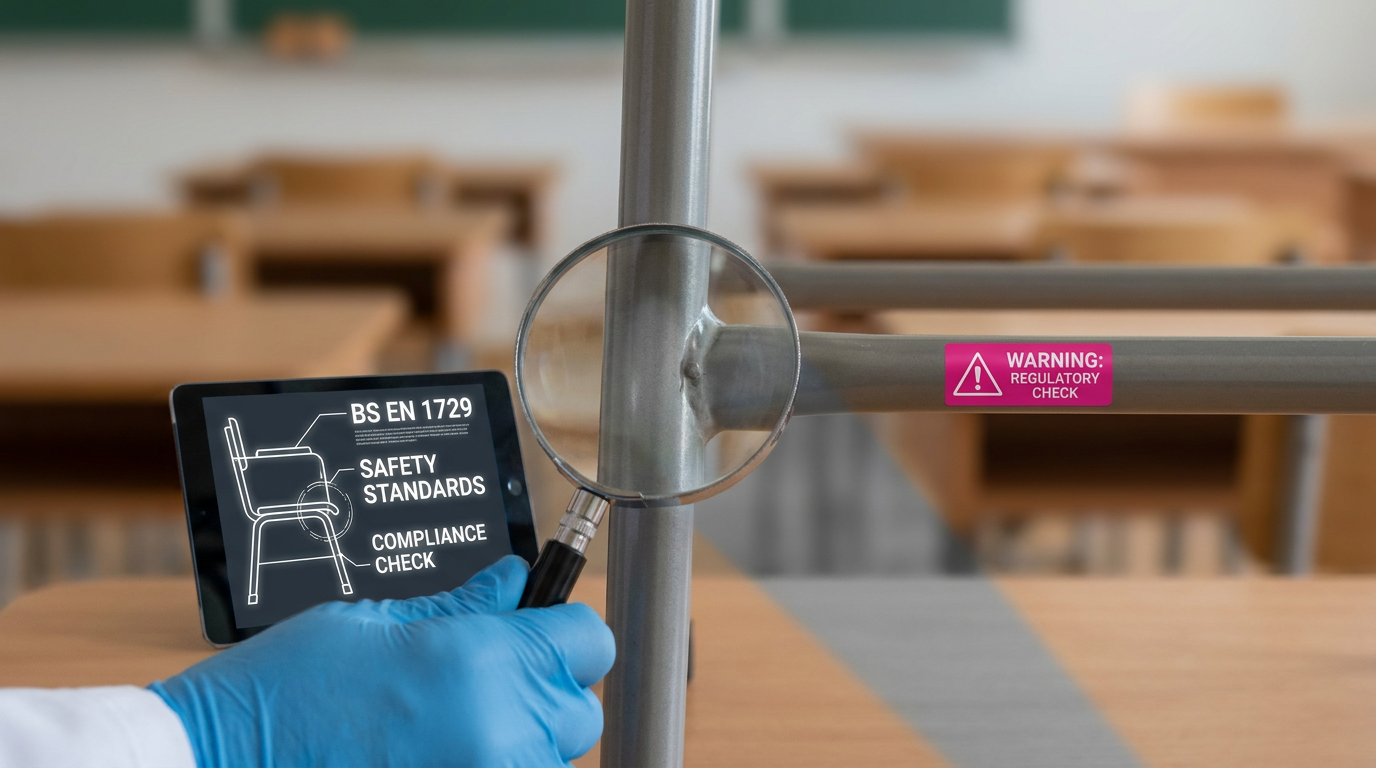
- BS EN 1729: This is the crucial British and European standard for furniture in educational institutions. It has two parts: Part 1 covers functional dimensions (ensuring chairs and desks are the right size for the children using them), and Part 2 covers safety, strength, and durability. Assembling a chair incorrectly, perhaps by using the wrong length screw, can compromise its structural integrity and cause it to fail the BS EN 1729 durability tests, creating a serious safety hazard.
- HSE & DfE Regulations: The Department for Education (DfE), in its EYFS Statutory Framework, mandates that “premises, furniture and equipment must be safe and suitable for their purpose” (DfE, 2024). Poorly assembled furniture is demonstrably not fit for purpose. In the event of an accident caused by furniture failure, an investigation would scrutinise the assembly process. If done by internal staff, the school would have to prove they were competent to do so. Using an accredited professional installer provides a clear, documented record that this duty of care was met.
The European Agency for Safety and Health at Work (EU-OSHA) (2024) has also highlighted that poor workstation design is a leading cause of musculoskeletal disorders. Correct ergonomic setup, which is part of a professional installation, is therefore a long-term investment in the health of both students and staff.
When Does a DIY Approach Make Sense?
A DIY classroom furniture setup can be a viable option, but only in very specific and limited circumstances. We would only recommend a DIY approach if the project meets all of the following criteria:
- Small Scale: The project involves a very small number of simple items, such as assembling one or two bookcases or a single teacher’s desk.
- Non-Complex Items: The furniture is basic, with straightforward assembly instructions, and does not have complex mechanisms or structural importance (e.g., simple chairs vs. Height-adjustable desks).
- No Fixed Deadline: The work can be done over a flexible period without impacting other school operations or deadlines. This is rarely the case for summer holiday projects.
- Staff Competence: The staff members assigned have well-supported by research experience and competence in flat-pack assembly and are confident using the necessary tools safely.
- Low-Risk Environment: The furniture is for a low-traffic, non-critical area like a staff admin office, rather than a bustling classroom of 30 children.
If your project involves furnishing an entire classroom, specialised areas like science labs, or includes the complexities of installing modern flexible learning furniture, a DIY approach introduces unacceptable levels of risk.
Why Large-Scale Projects Demand Professional School Furniture Installation
For large-scale projects, such as a new build, a whole-school refurbishment, or furnishing a new block, professional school furniture installation is not a luxury; it’s an operational necessity. The complexity of these projects extends far beyond simple assembly.
Professional school furniture installers act as project managers, coordinating a complex logistical chain. This includes phasing deliveries to match the build schedule, managing storage if site access is limited, and working alongside other trades like electricians and data cable installers. They can read and work from detailed floor plans to ensure every one of hundreds of items ends up in the correct room, placed exactly as the designer intended. The sheer volume of a large project makes a DIY approach impractical. Assembling 500 chairs and 250 desks is a monumental task that would overwhelm any internal site team. Professional teams have the manpower, systems, and experience to complete this volume of work efficiently and correctly within the tightest of deadlines. They bring an economy of scale and a level of efficiency that cannot be replicated by an ad-hoc team. In our experience, this is the only way to guarantee a large and expensive project is delivered on time, on budget, and to the required standard of safety and quality.
What are common questions about school furniture installation?
What is school furniture installation?
School furniture installation is the comprehensive process of assembling, placing, and securing furniture within an educational environment. This service can range from the simple assembly of a few items to a full-scale professional project management solution. A professional school furniture installation service typically includes delivery coordination, building all items to manufacturer and safety standards, room placement according to plans, and the removal of all packaging waste, ensuring rooms are ready for immediate use.
How much does professional school furniture installation cost?
The cost of professional installation is typically quoted as a percentage of the total furniture cost, often falling between 10% and 20%. This percentage can vary depending on factors like project complexity (e.g., science labs vs. Standard classrooms), site access, location within the UK, and whether work needs to be done out of hours. The cost of school furniture installation is best determined by requesting a fixed-price quote.
Is it cheaper to do a DIY classroom furniture setup?
While the upfront cost of a DIY classroom furniture setup appears cheaper, it often has significant hidden costs. When you factor in the cost of staff time (pulled from other duties), potential project delays, the expense of fixing errors, and commercial waste disposal fees, a professional service frequently offers better overall value. It also may reduce the financial risk associated with potential damages or compliance issues.
What are the key safety requirements for school furniture in the UK?
In the UK, school furniture should comply with BS EN 1729 standards for strength, stability, and ergonomics. This ensures the furniture is dimensionally appropriate and durable enough for the educational environment. Additionally, the overall installation must adhere to Health and Safety Executive (HSE) regulations to create a safe environment for both students and staff. Professional assembly is critical to meeting this school furniture compliance UK.
Does DIY school furniture assembly affect the warranty?
Yes, improper DIY school furniture assembly can generally void the manufacturer’s warranty. Most furniture warranties are contingent on the product being assembled precisely according to the provided instructions. Any deviation can be considered misuse. Professional installers are trained to build items correctly, which protects your school’s investment and ensures the manufacturer’s warranty remains fully valid for its intended lifespan.
Who is liable if a child is injured by poorly assembled furniture?
If furniture is assembled by school staff, the school or its governing body typically bears the full liability. In the event of an injury, you would need to prove the assembly was done competently. Using a professional, fully insured installation service transfers a significant portion of this liability to the installation company, as they are responsible for ensuring the furniture is assembled safely and to regulated standards.
What happens if parts are missing or damaged on delivery?
With a professional installation service, the installation team manages this entire process for you. They will inventory all parts upon delivery, immediately liaise with the supplier to order any necessary replacements, and adjust their workflow to minimise project delays. In a DIY scenario, this time-consuming administrative task falls directly on your school staff, causing significant disruption and delays to your project.
Do professional installers remove packaging waste?
Yes, a key benefit of using professional school furniture installers is that they handle all waste removal. This is a comprehensive service that includes breaking down and removing all cardboard, plastic wrapping, and pallets from your site. They leave the rooms clean, tidy, and ready for immediate use. This service alone saves considerable time, effort, and disposal costs for the school.
How long does a typical classroom installation take?
An experienced two-person team can typically install the furniture for a standard 30-pupil primary classroom in just 3-5 hours. This is significantly faster than a DIY approach because professionals possess specialised tools, product familiarity, and efficient workflows. A whole-school project timeline would be meticulously planned in advance with the school to ensure it meets key deadlines, such as the end of the summer holidays.
Can you install furniture during term time?
Yes, professional installers are equipped to work during term time by coordinating carefully with the school to minimise disruption. This often involves working outside of school hours, on weekends, or by phasing the installation in specific, cordoned-off zones. Crucially, all professional installers working on-site will be Disclosure and Barring Service (DBS) checked for safeguarding purposes.
What should be considered for school furniture installation?
This guide provides a comprehensive framework, but every school project is unique. The cost calculations are based on UK averages and our extensive industry experience; actual costs for your school’s staff or local contractors may vary. Any decision should typically be informed by a formal risk assessment specific to your site, staff competency, and overall project scope.
The primary alternatives discussed are a full DIY approach or a full-service professional installation. A hybrid model may seem appealing, where school staff handle simple items and professionals tackle complex ones. However, this often creates confusion around logistics, project management, and, most importantly, liability. Another alternative is to source furniture from suppliers who offer mandatory installation as part of the purchase price, simplifying the process.
For any project involving more than a single classroom or any specialised furniture, we strongly recommend consulting with a professional installation provider. We believe obtaining a no-obligation quote is the most valuable next step. It provides a clear, fixed cost that you can directly compare against the ‘true cost’ of a DIY approach. This allows for a fully informed, defensible decision for your school’s leadership, governors, and budget holders.
How to choose the best installation for your school?
Ultimately, the decision on school furniture installation is a strategic balance of cost, risk, and resources. While a DIY approach may seem financially prudent on the surface, our deep analysis reveals significant hidden costs in staff time, project delays, and the critical burden of compliance liability. For most UK schools, especially those undertaking substantial refurbishments within tight holiday schedules, professional education furniture fitting UK offers superior value, peace of mind, and a guarantee of safety and compliance. We are Rated Excellent On Trustpilot because we deliver on this promise.
At Cost Cutters UK, we have over 35 years of experience managing education furniture fitting UK projects of all sizes. Our dedicated teams ensure your project is completed on time, on budget, and to the highest safety standards, allowing you to focus on what truly matters: preparing for a successful new school year. We offer Bulk Buy Discounts and flexible payment options, including Credit Accounts Or Pay Flexibly. If you are planning a project, contact us for a free space plan and a no-obligation installation quote.
Related Resources
References
- Health and Safety Executive (HSE) – UK Government Guidance (2024). Provides the legal framework and practical advice for ensuring workplace equipment, including furniture, is safe and suitable for use.
- European Agency for Safety and Health at Work (EU-OSHA) – Pan-European Research Body (2024). Highlights poor workstation design as a key risk factor for musculoskeletal disorders, reinforcing the need for correctly assembled ergonomic furniture.
- Department for Education (DfE) – UK Government Statutory Framework (2024). The EYFS Statutory Framework mandates that premises, furniture, and equipment must be safe and suitable for their purpose.
- British Educational Suppliers Association (BESA) – UK Industry Professional Body (2024). Members must adhere to a Code of Practice ensuring products and services are fit for purpose in an educational setting.
- World Health Organization (WHO) – Global Health Body Guidelines (2020). Recommends limiting sedentary behaviour, underpinning the importance of well-designed learning environments.
- Statista – Market Research Data (2024). Reports that revenue in the UK Office Furniture market is projected to be US$2.28 billion in 2024.
CONCLUSION
Making the Right Strategic Choice for Your School
In summary, school furniture installation is a strategic balance of cost, risk, and resources. While a DIY approach may seem financially prudent on the surface, a deeper analysis reveals significant hidden costs in staff time, project delays, and compliance liability. For most UK schools, especially those undertaking substantial refurbishments within tight holiday schedules, professional installation offers superior value, peace of mind, and a guarantee of safety and compliance.
At Costcutters UK, we have over 35 years of experience managing education furniture fitting projects of all sizes. Our dedicated teams ensure your project is completed on time, on budget, and to the highest safety standards, allowing you to focus on what truly matters: preparing for a successful new school year.