School Furniture Myths vs. Facts: A UK School’s Guide
🎯 Key Takeaway
Debunking school furniture myths is crucial for any UK educational institution aiming to make sound financial and pedagogical decisions. Basing procurement on verifiable facts ensures long-term value, may help compliance with safety standards like BS EN 1729, and creates learning environments that support pupil wellbeing and academic success. This evidence-based approach protects your budget from the hidden costs of poor quality and safeguards your primary responsibility: the students in your care.
For school furniture myths, many institutions fall into the trap of focusing solely on the initial price tag, leading to costly long-term consequences. As of August 2026, the pressure on school budgets is immense, making it tempting to cut corners. However, our 35+ years of experience have shown us that decisions based on common misconceptions invariably lead to higher expenses, safety risks, and a compromised learning environment. This guide will directly compare the pitfalls of believing these myths with the clear benefits of an evidence-based approach. We’ll provide a framework for making choices that deliver genuine value, ensure compliance, and support your educational mission for years to come.
Written by: The Cost Cutters UK Team | Reviewed by: Editorial Team, 35+ Years Experience; Rated Excellent On Trustpilot
ℹ️ Transparency Disclosure: This article is written by the experts at Cost Cutters UK, a leading supplier of commercial and educational furniture. Our recommendations are based on over three decades of industry experience, adherence to UK standards, and feedback from thousands of schools. Our goal is to provide clear, actionable advice to help you make informed decisions.
⚡ Quick Verdict
Overall pick: School Furniture Facts – Basing procurement on verifiable facts ensures long-term value, compliance with UK standards like BS EN 1729, and better learning outcomes for pupils.
- Best for School Furniture Myths: Short-term budget thinking that ultimately risks higher future costs, pupil discomfort, and non-compliance.
- Best for School Furniture Facts: Making strategic, evidence-based procurement decisions that benefit the school, its staff, and its pupils for years to come.
School Furniture Myths vs. Facts at a Glance: Side-by-Side Comparison
Choosing the right furniture is a critical decision that impacts your budget, your legal obligations, and your pupils’ ability to learn. The table below contrasts the dangerous pitfalls of common misconceptions with the tangible benefits of an evidence-based procurement strategy.
| Dimension | School Furniture Myths (The Common Pitfall) | School Furniture Facts (The Evidence-Based Approach) |
|---|---|---|
| Cost Implication | Focus on low initial price leads to a high Total Cost of Ownership (TCO) due to frequent repairs and replacements. | Higher initial investment leads to a lower TCO, thanks to longer lifespans and may help. |
| Compliance & Safety | Often non-compliant with BS EN 1729, creating legal and safety risks for pupils and staff. | likely to support compliance with BS EN 1729 Parts 1 & 2, ensuring ergonomic suitability and durability. |
| Pedagogical Impact | Rigid, one-size-fits-all furniture hinders modern teaching styles and collaborative learning. | Flexible, ergonomic designs support diverse teaching methods and improve pupil engagement. |
| Durability & Lifespan | May fail within 1-2 years under classroom conditions, causing constant disruption and re-spending. | Built to last 10+ years with reliable may help (typically 5-10 years), reducing waste and admin time. |
| Pupil Wellbeing | Poorly sized furniture can cause discomfort, poor posture, and fidgeting, harming concentration. | Correctly sized furniture promotes good posture and comfort, directly supporting focus and learning. |
The contrast is stark. The ‘Fact’ column consistently points towards better long-term outcomes in every critical area, from financial stability to educational effectiveness. The ‘Myth’ column, while tempting, represents a false economy that schools cannot afford.
Why People Fall for School Furniture Myths
Believing in common school furniture myths offers the illusion of quick, cheap solutions but creates significant long-term problems. It’s an approach best suited for making short-term decisions based on perceived low costs, which often leads to higher long-term expenses, non-compliance, and poor pupil outcomes.
Pros (The Temptation):
- Appears cheaper with a lower initial quote, fitting a tight annual budget.
- Seems to simplify procurement by treating all furniture as a commodity.
- Feels quicker than researching compliance standards and long-term value.
- Suppliers may promise fast delivery without mentioning compliance checks.
Cons (The Reality):
- Leads to a much higher Total Cost of Ownership (TCO), as you pay repeatedly for repairs and replacements. You can learn more about how to understand the true total cost of ownership (TCO).
- Creates serious legal and safety risks. The Health and Safety Executive (HSE) places a clear duty of care on schools, and non-compliant furniture can lead to accidents and liability.
- Negatively impacts pupil concentration. Research from bodies like the European Agency for Safety and Health at Work (EU-OSHA) (2023) links poor ergonomics to musculoskeletal issues and distraction.
- Results in a poor learning environment that actively hinders modern, flexible teaching methods.
Why You Should Base Decisions on School Furniture Facts
An evidence-based approach requires more initial effort but delivers superior value, safety, and educational support. This strategy is best for making procurement decisions that prioritise pupil safety, long-term value, and compliance with UK educational standards.
Pros (The Benefits):
- Achieves a significantly lower TCO, saving the school thousands of pounds over the furniture’s lifespan.
- may help compliance with critical UK safety standards like BS EN 1729, protecting both pupils and the institution from liability.
- Supports better pedagogical outcomes. Modern classroom furniture trends show that flexible and ergonomic designs directly enhance learning.
- Enhances the school’s reputation by demonstrating a commitment to high-quality, safe facilities.
- Furniture lasts longer, reducing environmental waste and the administrative disruption of frequent replacement cycles.
Cons (The Challenges):
- May require a higher upfront investment compared to cheap, non-compliant alternatives.
- Involves more time for due diligence, such as verifying supplier credentials and certifications from organisations like the British Educational Suppliers Association (BESA).
- Requires clear justification to governors or stakeholders who may be overly focused on short-term budgets.
Case Study: The False Economy of “Cheap” Chairs
Challenge: A primary academy in the North West needed to furnish two new classrooms on a tight budget. They opted for a supplier offering chairs at 30% below the average market price, ignoring the lack of BS EN 1729 certification.
Solution: Within 18 months, 25% of the chairs had failed (cracked seats, bent legs), causing classroom disruption and safety concerns. We were brought in to implement a phased replacement using fully compliant furniture with a 10-year guarantee.
Results: The school had to re-spend its budget. The total cost over two years was 40% higher than if they had chosen compliant furniture initially. The new, correct furniture eliminated replacement needs and improved student comfort.
Key Insight: The initial “saving” was a costly mistake. Prioritising verified compliance over upfront price is the most financially responsible decision.
When to Choose Each Approach
For any School Business Manager or Headteacher, the choice should be clear. This isn’t a matter of preference but of professional responsibility.
Here is how to make the right decision:
- Prioritise FACTS if: Your primary responsibility is ensuring pupil safety and meeting your legal duty of care, as outlined in frameworks like the Department for Education’s EYFS Statutory Framework (2024).
- Prioritise FACTS if: You are accountable for the school’s long-term budget and must demonstrate exceptional value for money to governors and trustees.
- Prioritise FACTS if: Your school is committed to modern teaching practices and wants to create an inclusive environment that supports diverse learning needs.
- AVOID MYTHS if: You are offered a price that seems significantly lower than all competitors. This is a major red flag for non-compliance, poor materials, or a non-existent guarantee.
- AVOID MYTHS if: A supplier cannot provide clear, verifiable certification for BS EN 1729 Parts 1 & 2. Don’t just take their word for it; ask for the documentation.
Tie-breaker: If you’re ever in doubt, typically choose the path backed by verifiable data and official UK standards. The long-term safety of your pupils and the financial health of your school depend on it.
Are there any frequently asked questions?
What are the biggest school furniture myths?
The most damaging school furniture myths are that the cheapest quote is an effective value, that standard office furniture is suitable for classrooms, and that traditional layouts are typically sufficient. that value is measured by total cost of ownership, not the initial price. Furthermore, school furniture must meet specific durability and sizing standards (BS EN 1729) that office furniture does not, making the latter unsafe and unsuitable for pupils.
What is BS EN 1729 and why is it important?
BS EN 1729 is the mandatory British and European standard for chairs and tables in educational institutions. Part 1 specifies dimensions, heights, and ergonomic requirements for different age groups to ensure good posture, whilst Part 2 tests for strength and durability to withstand the rigours of a school environment. Compliance is essential for pupil safety, comfort, and ensuring the furniture is fit for purpose.
How can I calculate the Total Cost of Ownership (TCO) for school furniture?
You can estimate TCO with the formula: TCO = Initial Price + (Annual Maintenance x Lifespan) + Replacement Costs. While simple, this shows that a higher-priced chair with a 10-year guarantee and zero maintenance will almost typically have a lower TCO than a cheap chair that needs replacing every two years. Typically factor in the lifespan and guarantee when comparing prices.
Is plastic school furniture bad for the environment?
Not necessarily; in fact, high-quality plastic furniture is often a sustainable choice. Modern polypropylene chairs are extremely durable, lightweight, and often made from recycled materials. Because they last for over a decade, they generate far less waste than low-quality wood or metal alternatives that are frequently sent to landfill after only a year or two of use.
Can we use chairs from a standard office supplier in a classroom?
No, you should strongly avoid using office chairs in a classroom environment. Office furniture is not designed or tested for the unique demands of schools, such as being tilted back on two legs. More importantly, it fails to meet the specific ergonomic sizing requirements of BS EN 1729 needed for growing children, creating clear safety and postural risks. It’s crucial to understand why office furniture often fails to meet school compliance standards.
What are the benefits of flexible classroom furniture?
Flexible classroom furniture supports dynamic teaching, improves student engagement, and allows for easy room reconfiguration. Lightweight, stackable chairs and mobile tables enable teachers to switch from individual study to group work in minutes. This adaptability caters to diverse student needs and learning styles, which can lead to better collaboration and focus in the classroom.
How long should school chairs and desks last?
A BS EN 1729 compliant chair or desk from a reputable supplier should be expected to last for at least 10-15 years. Reputable suppliers will back this up with may help of 5 years or more. In contrast, cheap, non-compliant alternatives often fail within 1-2 years of purchase, representing extremely poor value for money and causing constant disruption.
Does the furniture in a school really affect learning?
Yes, research and experience show a direct link between appropriate furniture and learning outcomes. Uncomfortable, poorly sized furniture is a significant cause of fidgeting, poor concentration, and bad posture. A comfortable and well-designed physical environment removes these physical distractions, helping pupils to focus better on their lessons and engage more effectively.
What should I look for in a school furniture supplier?
Look for a supplier with well-supported by research expertise, excellent reviews, and transparent compliance. Key criteria include membership of the British Educational Suppliers Association (BESA), clear proof of BS EN 1729 certification for their products, long may help (5+ years), and experience in educational space planning. At Cost Cutters UK, we are proud to be “Rated Excellent On Trustpilot” by schools across the country.
Our budget is extremely tight. What is the most cost-effective first step?
The most cost-effective strategy is a phased replacement plan that prioritises compliance. Start by replacing furniture in one high-priority area, such as a specific year group or a high-traffic library. Typically choose compliant furniture, even if it means buying less. A good supplier can help you create a multi-year plan that works within your budget, and options like our “Credit Accounts Or Pay Flexibly” can help manage cash flow.
Important Considerations
This guide compares two opposing approaches to procurement, but the reality on the ground can be complex. The data and standards referenced, such as BS EN 1729, are definitive. However, the specific Total Cost of Ownership for any given school will depend on usage patterns, maintenance schedules, and the initial quality of the products purchased. Our analysis is based on typical outcomes observed over 35+ years in the industry.
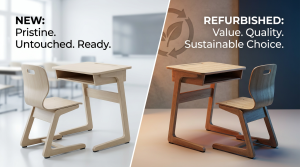
Alternative approaches to a full replacement exist. For example, some high-quality furniture with cosmetic damage might be suitable for refurbishment, although this requires expert assessment to ensure structural integrity remains. Another approach is a phased procurement strategy, replacing one year group or department at a time. This spreads the cost while systematically improving the school’s asset quality, which is a service we often help schools to plan.
Ultimately, if you are unsure about compliance, durability, or how to plan a large-scale project, it is best to consult with a specialist. A reputable supplier will do more than just sell you products; they will act as a partner. At Cost Cutters UK, our “Design To Install We Do It All!” service provides expert guidance from initial space planning to final installation, “Saving Time & Stress” for busy school managers.
Conclusion: Making Evidence-Based Decisions for Your School
avoiding costly school furniture myths is fundamental to responsible school management. While the allure of a low upfront cost is strong, the evidence is clear: basing decisions on the well-supported by research facts of total cost of ownership, UK compliance standards, and pedagogical impact is the only sustainable path. By rejecting common misconceptions, you safeguard your pupils, protect your budget from future shocks, and create learning environments built to last. This evidence-based approach transforms furniture from a simple expense into a long-term investment in your school’s success.
With over 35 years of experience partnering with UK schools, we’ve seen firsthand the difference that quality makes. If you’re planning a refurbishment or new build, our team can provide a free space plan and quote to help you maximise your budget and create an inspiring learning environment. We offer “Bulk Buy Discounts” for larger projects and flexible payment options to make quality accessible.
References
- Health and Safety Executive (HSE) – government. Provides official UK guidance and legal requirements for workstation safety under the Display Screen Equipment (DSE) Regulations, which inform best practice for pupil ergonomics.
- European Agency for Safety and Health at Work (EU-OSHA) – international-body. A 2023 overview highlights that poor workstation design is a leading cause of musculoskeletal disorders (MSDs), reinforcing the need for ergonomic school furniture.
- Department for Education (2024) – government. The statutory framework for the Early Years Foundation Stage (EYFS) explicitly requires that premises, furniture, and equipment must be safe and suitable for their purpose.
- British Educational Suppliers Association (BESA) – professional-org. BESA’s Code of Practice, which members must follow, ensures products are of good quality, safe, and fit for purpose in an educational setting.
- World Health Organization (WHO) (2020) – international-body. The WHO’s guidelines on sedentary behaviour provide the global health rationale for using furniture that encourages movement and good posture in schools and workplaces.
- Statista – research. Data from 2024 shows the significant scale of the UK furniture market, highlighting the economic importance of making durable, long-term procurement decisions.