School Furniture vs Office Furniture: A UK School’s Guide to Compliance and Value
🎯 Key Takeaway
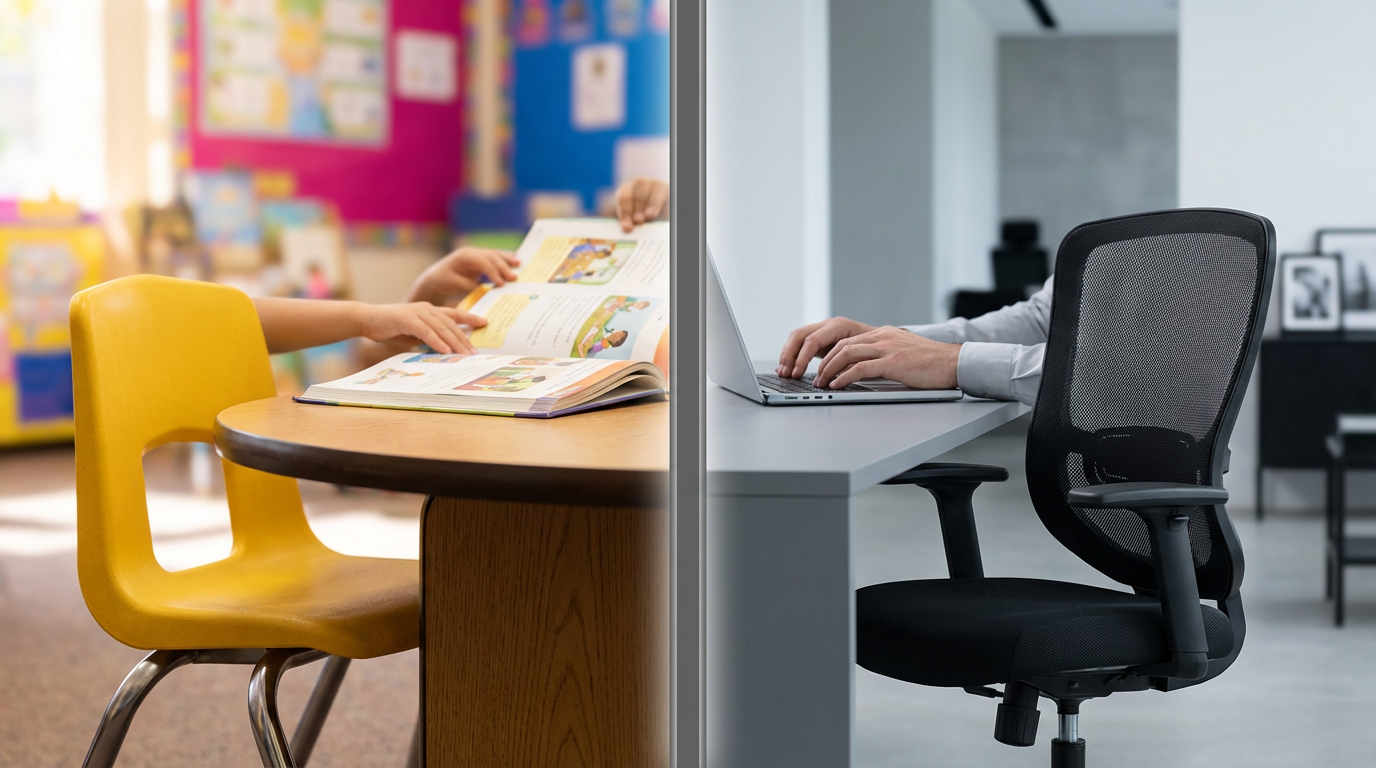
When comparing school furniture vs office furniture, the primary difference is that school furniture is legally required to meet specific UK safety and ergonomic standards (BS EN 1729) for children, whereas office furniture is designed for adults and lacks these protections. School furniture is engineered for high-impact, daily use by children, featuring robust materials and tamper-resistant designs not found in standard office products. While office furniture may have a lower initial price, compliant school furniture offers a lower ‘whole-life cost’ due to superior durability, longer warranties, and reduced replacement needs.
As of April 2026, School Business Managers across the UK are under immense pressure to make budgets stretch further. In this environment, the lower price tag of standard office furniture can seem like a tempting way to save money. However, this is a dangerous false economy. When evaluating school furniture vs office furniture, the choice isn’t merely about cost; it’s a critical decision that directly impacts pupil safety, your school’s legal compliance, and long-term financial health. The classroom furniture requirements uk are not suggestions, they are strict mandates. This guide provides a clear framework for understanding the crucial differences, ensuring your next procurement decision is safe, compliant, and offers genuine value. Explore our complete range of school equipment and educational supplies to see compliant solutions.
Written by: Content Team | Reviewed by: Editorial Team, Industry Specialists with 35+ Years Experience; Rated Excellent On Trustpilot
ℹ️ Transparency Disclosure: This article explores the key distinctions between educational and commercial furniture based on over 35 years of industry experience and analysis of UK regulations. Our goal is to provide clear, actionable information. Some links may connect to our services, which are part of how we fund this expert content. All information is verified by our editorial team. Costcutters UK is a leading UK supplier of school and educational equipment, dedicated to helping schools create safe and effective learning environments.
At a Glance: School Furniture vs. Office Furniture
While a school chair and an office chair might look similar, their underlying specifications are worlds apart. The key differences lie in compliance, durability, and ergonomic design – factors that have significant implications for safety and budget. This table summarises the most critical distinctions a school procurer needs to understand before committing public funds to a purchase.
| Feature | School Furniture (BS EN 1729 Compliant) | Standard Office Furniture |
|---|---|---|
| Primary User | Children & teenagers (aged 3-18+) | Adults |
| Legal Compliance (UK) | Must meet BS EN 1729 Parts 1 & 2 for safety and ergonomics. | Meets adult-focused standards (e.g., BS EN 527); not suitable for children. |
| Durability Standard | Designed and tested for ‘Severe Contract Use’. | Designed for ‘General Contract Use’ (lighter wear and tear). |
| Ergonomics | Fixed sizes (Size Marks 1-6) based on age/height to support growing bodies. | Focuses on adjustability for a single, adult user. |
| Construction | Heavy-gauge steel, solid-grade laminates, tamper-proof fixings, rounded edges. | Lighter materials, standard MDF, conventional fixings. |
| Typical Warranty | 5-15 years. | 1-3 years. |
Durability & Construction: Built for Pupils, Not Professionals
School furniture is significantly more durable than office furniture because it is engineered for a fundamentally different, and far more demanding, environment. The term used in our industry is ‘severe contract use’. This anticipates the reality of a classroom: chairs being rocked on, tables being dragged across floors, and surfaces enduring spills, scratches, and the creative energy of hundreds of pupils daily. Office furniture, by contrast, is built for ‘general contract use’ – the far more predictable behaviour of professional adults.
The durability of school furniture comes from its core construction. We use materials specified to withstand this relentless use. For example:
- Frames: School chair frames often use a thicker steel gauge (e.g., 1.2mm-2.0mm) compared to the lighter frames of many office chairs.
- Surfaces: Tables and desks frequently feature Solid Grade Laminate (SGL), a material impervious to water and highly resistant to impact and scratches. This is a major step up from the standard Melamine Faced Chipboard (MFC) or Medium-Density Fibreboard (MDF) common in office desks, which can chip and swell if damaged.
- Fixings: We use tamper-proof fixings to prevent pupils from disassembling furniture, a safety and maintenance issue that doesn’t exist in an office. Edges are often finished with tough, cast Polyurethane (PU) or are smoothly rounded to prevent both injury and deliberate damage.
As commercial guide data from UK Educational Furniture highlights, school furniture is built to withstand heavy use. This robust construction isn’t just for longevity; it’s a critical safety feature, preventing structural failures that could cause injury.
Safety & Compliance: The Non-Negotiable UK Standards
No, standard office furniture is not compliant with UK school regulations, and this is the most important distinction in the school furniture vs office furniture debate. Educational institutions have a legal duty of care, and part of fulfilling that duty is providing a safe physical environment. For furniture, the primary legal benchmark is BS EN 1729.
BS EN 1729 is the key UK and European standard for chairs and tables in educational institutions. It’s a critical piece of the education furniture standards puzzle and is split into two parts:
- BS EN 1729 Part 1: Functional Dimensions. This part deals with ergonomics. It specifies the correct chair height, seat depth, and table height for different age groups to ensure good posture and comfort, which aids concentration.
- BS EN 1729 Part 2: Safety Requirements. This part covers strength, stability, and durability. Furniture is subjected to rigorous testing to ensure it won’t tip over easily, can withstand heavy loads, and won’t collapse under the strain of classroom life. It also may reduce hazards like sharp edges and entrapment points where a child’s fingers or head could get stuck.
Choosing bs en 1729 compliant furniture is not optional; it’s a legal requirement that impacts your school’s insurance and liability. In the event of an accident involving non-compliant furniture, the school could be found negligent. Also, all furniture must meet fire retardancy standards, typically BS 5852 (Crib 5) for institutional use, which is a higher standard than for many domestic or office items. You can view our full list of certifications and accreditations to see how we meet these standards.
Ergonomics: Designing for Growing Bodies vs. Adults
Yes, the ergonomic needs of a child and an adult are fundamentally different, and this is reflected in furniture design. The core principle of ergonomic school chairs and tables is providing postural support for developing bodies.
School furniture achieves this through a sizing system defined in BS EN 1729, known as ‘Size Marks’. There are six size marks, corresponding to specific age groups and stature ranges:
- Size Mark 1-2: Early Years Foundation Stage (EYFS) and Key Stage 1 (Ages 3-6)
- Size Mark 3-4: Key Stage 2 (Ages 6-11)
- Size Mark 5-6: Secondary School & Sixth Form (Ages 11-18+)
This system ensures that a Year 1 pupil and a Year 11 pupil both have a chair and desk that allows their feet to be flat on the floor, their knees at a 90-degree angle, and their forearms resting comfortably on the table. As a blog from Calibre Furniture explains, correct ergonomic support is crucial for student health, comfort, and concentration.
Office furniture takes a different approach. It’s built for the adult body and relies on adjustability (seat height, back tilt, lumbar support) to fit an individual user. This model is impractical and unsafe in a school, where a single chair will be used by hundreds of differently sized children over its lifespan. Fixed, size-appropriate furniture is the only safe and effective solution.
Whole-Life Cost vs. Initial Price: A Financial Breakdown
No, cheaper office furniture is almost generally more expensive for a school in the long run. To understand why, you must look beyond the initial price tag and consider the ‘Total Cost of Ownership’ (TCO), sometimes referred to as whole-life cost.
In our experience, a simple TCO calculation reveals the truth. Let’s compare a hypothetical compliant school chair with a standard office chair over a 10-year period:
- Compliant School Chair:
- Initial Cost: £45
- Repair Costs (10 yrs): £0 (covered by 10-year warranty)
- Replacement Cost (10 yrs): £0
- Total Cost of Ownership: £45
- Standard Office Chair:
- Initial Cost: £30
- Repair Costs (10 yrs): £15 (e.g., one gas lift or castor replacement)
- Replacement Cost (10 yrs): £90 (replaced 3 times, every ~3 years)
- Total Cost of Ownership: £135
In this realistic scenario, the “cheaper” chair costs three times as much over a decade. The superior durability of school furniture, backed by long may help, means you buy it once. The weaker office chair becomes a recurring expense, draining your budget year after year. This calculation doesn’t even include the unquantifiable costs of non-compliance: the administrative headache of managing breakages, the disruption to lessons, and the severe financial and reputational risk if an accident occurs. Choosing bs en 1729 compliant furniture is the only financially sound decision.
Procurement for UK Schools: A Partner in Value
The procurement process for schools is about more than finding the lowest price; it’s about securing best value for public money. This is where specialist school furniture suppliers uk become essential partners. We understand the complex regulatory landscape, from BS EN 1729 to Crib 5 fire retardancy, “Saving Time & Stress” for busy School Business Managers.
Many schools use public sector purchasing frameworks like the ESPO (Eastern Shires Purchasing Organisation), which vet suppliers for compliance, financial stability, and value. Working with an approved supplier on such a framework provides an immediate layer of assurance.
At Costcutters UK, we see our role as consultants, not just vendors. Our “Design To Install We Do It All!” service is built on this principle. We offer services tailored to the needs of the education sector:
- Free Space Planning: To help you maximise your learning environment.
- Bulk Buy Discounts: Ensuring you get an effective possible value on large orders.
- Credit Accounts Or Pay Flexibly: We offer flexible payment options for public sector bodies to help manage cash flow.
A good supplier doesn’t just sell you chairs; they help you invest wisely in a safe, effective, and long-lasting learning environment. It’s why we’re consistently “Rated Excellent On Trustpilot”.
Frequently Asked Questions About School and Office Furniture
What is the main difference between school furniture vs office furniture?
The crucial difference between school furniture vs office furniture is legal compliance and user-centric design. School furniture is legally mandated in the UK to meet BS EN 1729 standards for child safety, durability, and ergonomics. In contrast, office furniture is designed for adults and does not meet these specific requirements. This distinction impacts pupil safety, a school’s legal liability, and long-term costs.
What furniture should be in a classroom?
A modern classroom should contain a mix of flexible, durable, and ergonomically appropriate furniture. This includes pupil tables and chairs compliant with BS EN 1729, teacher desks, secure storage units for resources and personal belongings, and often mobile whiteboards. Increasingly, agile furniture like soft seating and collaborative tables are included to support varied learning styles and create dynamic spaces.
Why is BS EN 1729 so important for schools?
BS EN 1729 is vital because it provides a legal framework for ensuring pupil safety and wellbeing. Compliance ensures furniture is strong enough to prevent accidents, sized correctly to promote good posture, and free from hazards like sharp edges or entrapment points. For a school, adhering to this standard is a cornerstone of due diligence, risk management, and fulfilling its duty of care.
Are desks or tables better in classrooms?
The choice between desks and tables depends on the age group and teaching style. Traditional single or double desks offer personal space, which can aid focus and individual work. However, larger tables (such as trapezoidal or circular ones) are increasingly popular as they promote collaboration, group work, and offer greater layout flexibility for modern, dynamic lesson plans in today’s schools.
Can I use office chairs in a school library or common room?
It is strongly advised not to use standard office chairs in any school environment. Even in less formal settings, furniture must be ‘severe contract’ grade and meet fire safety regulations (BS 5852 Crib 5). Specialised modern breakout furniture offers the contemporary aesthetic of office design but is engineered with the required durability and safety standards built in, making it the appropriate choice.
What is considered office furniture?
Office furniture encompasses items designed for a commercial adult workplace. This typically includes adjustable task chairs, computer desks (workstations), meeting tables, filing cabinets, and reception seating. Its design prioritises adult ergonomics, professional aesthetics, and moderate durability. Critically, it is not tested or certified for use by children in an educational setting and lacks the required safety features.
How do I choose the right size furniture for different year groups?
You should use the BS EN 1729 ‘Size Mark’ system, which links furniture size to pupil age and height. Reputable school furniture suppliers uk provide charts showing which size mark (from 1 to 6) corresponds to EYFS, Key Stage 1, Key Stage 2, and secondary school pupils. We typically recommend measuring a sample of pupils if you’re unsure to ensure an effective possible ergonomic fit for your students.
What are the four main types of school furniture?
The four primary categories are seating, surfaces, storage, and specialised furniture. Seating includes pupil chairs and stools. Surfaces cover pupil desks, collaborative tables, and teacher desks. Storage includes bookcases, tray units, and cupboards. Specialised furniture includes items for specific areas like science labs, art rooms, or early years, each with their own unique requirements for safety and function.
Does the colour of classroom furniture matter?
Yes, colour can significantly impact the learning environment’s atmosphere and student behaviour. Bright, stimulating colours are often used in early years settings to encourage creativity. Calmer, more natural tones like blues, greens, or wood finishes are often preferred for older pupils to promote focus and reduce over-stimulation. Consistent colour schemes can also help reinforce school branding and identity.
What is the warranty on school furniture?
Compliant school furniture from a reputable supplier typically comes with a robust warranty of 5 to 15 years. This is a key indicator of its quality and the durability of school furniture, designed to withstand the rigours of a school environment. In contrast, most standard office furniture is only likely to support for 1 to 3 years, reflecting its much lighter intended use.
Important Considerations
You should acknowledge that high-end, ‘executive’ office furniture may offer significant durability. However, it still typically lacks the specific child-safety features mandated by BS EN 1729, such as anti-entrapment designs and age-appropriate sizing. Also, publicly available data quantifying furniture-related incidents in UK schools is limited, making direct statistical risk comparison challenging. This guide therefore relies on regulatory standards and established industry best practices for its recommendations.
For schools on extremely tight budgets, one alternative is sourcing second-hand school furniture. Whilst this can offer initial cost savings, it carries significant risks. The furniture’s history is unknown, compliance with current standards cannot be likely to support, and there is no warranty. Our experience suggests this approach often leads to higher long-term costs through frequent replacements and potential safety liabilities, undermining the initial saving.
The complexities of compliance, ergonomics, and space planning mean that professional guidance is invaluable. We recommend that School Business Managers and Headteachers consult with an educational furniture specialist before making any large-scale procurement decisions. An expert can conduct a site survey, ensure all chosen items meet legal requirements, and create a layout that maximises the educational potential of your space, ensuring true value for public money.
Conclusion: Your Partner in Creating Safe, Effective Learning Spaces
The debate over school furniture vs office furniture concludes with a clear verdict: the two are not interchangeable. Choosing purpose-built, compliant school furniture is a fundamental responsibility, not a luxury. It is an investment in pupil safety, a legal necessity for compliance with UK education furniture standards, and a financially prudent decision that delivers a lower total cost of ownership. Opting for cheaper office furniture introduces unacceptable risks and may help higher long-term expenditure.
With over 35 years of experience, Costcutters UK understands the unique challenges faced by educational institutions. We are more than just one of many school furniture suppliers uk; we are your partner in creating safe, inspiring, and budget-conscious learning environments. Our team of experts can guide you through every step, from ensuring compliance to optimising your space. To ensure your next project meets all safety and value criteria, we invite you to Book a Free Space Planning Consultation with our team today.
References
- UK Educational Furniture – Commercial Guide. This guide notes that school furniture must be appropriately sized for different age groups and robustly constructed to withstand heavy daily use.
- Office Furniture Online – Product Catalogue. Their site demonstrates the market separation by offering distinct categories for school furniture, separate from their main office ranges, highlighting the different specifications.
- Calibre Furniture – Blog Article. This article explains that properly designed ergonomic school furniture is essential for student health, posture, and concentration, which can contribute to better academic outcomes.
- Spaceist – Blog Article. This source discusses the trend towards modular furniture in schools to create flexible learning spaces that can be easily reconfigured for different activities.
- Westcountry Group – Informational Page. This page notes that materials like metal and durable plastics are commonly used for classroom furniture to ensure it can endure the wear and tear of a school day.