
Your Guide to UK School Environment Guidelines: Tools & Resources
🎯 Key Takeaway
Adhering to UK school environment guidelines requires a thorough understanding of regulations from the Health and Safety Executive (HSE), Department for Education (DfE), and specific British Standards like BS EN 1729 to ensure a safe, healthy, and effective learning space. Key regulations include BS EN 1729 for furniture dimensions and safety, and the Regulatory Reform (Fire Safety) Order 2005 for fire compliance. The Department for Education’s Building Bulletins provide non-statutory guidance on space, acoustics, and SEN provision. This guide provides the essential tools and resources to navigate these requirements with confidence.
As of May 2026, navigating the complex regulations for UK school environments remains a primary challenge for School Business Managers, Headteachers, and Facilities Managers. For school environment guidelines, the pressure to ensure compliance, safety, and value for money is immense. Failure isn’t just a matter of paperwork; it directly impacts pupil well-being, learning outcomes, and the school’s legal standing. The web of rules from the Health and Safety Executive (HSE) and best practice advice like the dfe furniture guidelines can feel overwhelming.
We understand these challenges. With over 35 years of experience as a leading supplier of school and educational equipment, we’ve built our expertise by helping schools create spaces that are not just compliant, but also inspiring. This guide is designed to cut through the complexity, offering a practical roadmap for understanding and implementing the essential guidelines, ultimately Saving Time & Stress for your team.
👤 Written by: Costcutters UK Content Team
Reviewed by: Costcutters UK Editorial Team, 35+ Years of Educational Supply Experience
Last updated: 16 May 2026
ℹ️ Transparency: This article explores UK school compliance based on government publications, British Standards, and our 35+ years of industry experience. Some links may connect to our services or product pages. All information has been verified by our editorial team for accuracy as of the publication date. Costcutters UK is a leading educational supplier in the United Kingdom.
Decoding Key UK School Environment Guidelines
Understanding UK school environment guidelines begins with recognising that compliance is multi-layered, involving mandatory laws, official guidance, and technical benchmarks. The three core bodies you need to know are the Health and Safety Executive (HSE), the Department for Education (DfE), and the British Standards Institution (BSI). While the HSE sets legally binding rules, the DfE provides crucial best-practice advice that influences funding and inspections, and the BSI delivers the technical specifications to meet those goals.

Health and Safety Executive (HSE): The Legal Framework
The Health and Safety Executive (HSE), a UK government agency, is responsible for enforcing the Health and Safety at Work etc. Act 1974. This legislation forms the absolute legal foundation for safety in your school. It treats schools as workplaces for staff and premises for pupils. According to the HSE (2026), schools have a legal duty to conduct regular risk assessments to identify and mitigate potential hazards, from trailing cables to unstable furniture. Failure to comply can result in investigation and prosecution.
Department for Education (DfE): Building Bulletins
The Department for Education (DfE) is the government department that publishes a series of ‘Building Bulletins’ (BB). Documents like BB103 on area guidelines and BB104 on designing for pupils with Special Educational Needs (SEN) are central to the dfe furniture guidelines. As the Department for Education (2024) clarifies, these bulletins are non-statutory guidance. However, they are the established best practice and are often prerequisites for securing capital funding. Also, inspectors from The Office for Standards in Education, Children’s Services and Skills (Ofsted) may reference them when evaluating a school’s physical environment.
British Standards Institution (BSI): The Technical Benchmarks
The British Standards Institution (BSI) is the UK’s national standards body. It creates the detailed technical benchmarks that help manufacturers and suppliers meet the broader safety objectives set by the HSE and DfE. For schools, the most critical of these educational furniture standards is BS EN 1729. This standard provides precise, evidence-based specifications for the dimensions, strength, and stability of classroom chairs and tables, ensuring they are both safe and ergonomically suitable for children.
Furniture-Specific Regulations: BS EN 1729 & Fire Safety
For anyone purchasing school furniture, BS EN 1729 and UK fire safety regulations are the two most critical, non-negotiable standards for ensuring pupil safety and legal compliance. These regulations provide the specific, testable criteria that separate professionally manufactured educational furniture from unsuitable domestic or office alternatives. Understanding them is fundamental to responsible school procurement guidelines uk.
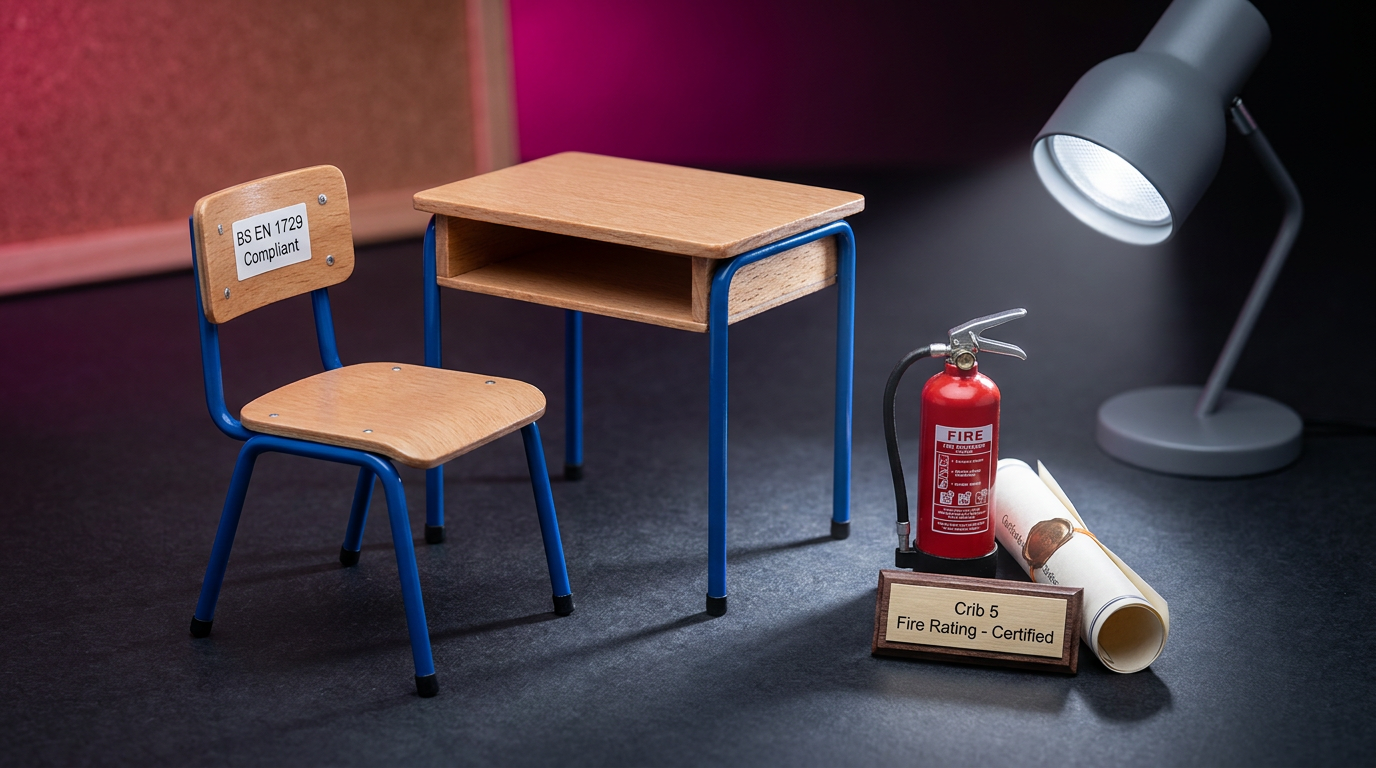
BS EN 1729 is the definitive British and European standard for chairs and tables for educational institutions. It is split into two parts: Part 1 focuses on ergonomics and sizing, while Part 2 covers safety, strength, and durability. Choosing bs en 1729 compliant furniture ensures that items are not only built to last in a demanding school environment but are also designed to support healthy posture and concentration.
Alongside this, fire safety regulations in uk schools are governed by The Regulatory Reform (Fire Safety) Order 2005. This law mandates that upholstered furniture and seating must meet specific fire resistance levels. For schools, this typically means products must pass the ‘Crib 5’ test (officially BS 7176 Medium Hazard). This is a critical check, as non-compliant furniture can pose a severe risk in the event of a fire.
| Standard Part | Primary Focus | Key Requirements Checked | Benefit for Schools |
|---|---|---|---|
| BS EN 1729 Part 1 | Ergonomics & Sizing | Chair/table height, seat depth, backrest height, and clearances for different age groups (size marks). | Promotes good posture, reduces fidgeting, and improves pupil comfort and concentration. |
| BS EN 1729 Part 2 | Safety & Durability | Stability (anti-tilt), strength under load, and durability over thousands of cycles of use. | Prevents accidents from breakages, ensures furniture withstands classroom use, and delivers better long-term value. |
| BS 7176 Medium Hazard | Fire Retardancy | Resistance of upholstery fabric and foam to ignition sources equivalent to a lit match and a small wooden crib (Crib 5). | Slows the spread of fire, providing crucial evacuation time. A legal requirement for institutional settings. |
| FIRA Certification | Independent Verification | Voluntary testing by an independent body like FIRA International (2026) to confirm compliance with the above standards. | Provides third-party assurance that a product genuinely meets the required educational furniture standards. |
Designing for All: Compliance for SEN and Flexible Learning Spaces
A truly compliant school environment goes beyond basic safety; it must also be inclusive and adaptable to modern teaching methods. This means translating the dfe furniture guidelines into practical choices that support every pupil, including those with Special Educational Needs (SEN), and facilitate dynamic, flexible learning. Adhering to these principles is not just about ticking boxes; it’s about creating spaces where all children can thrive.
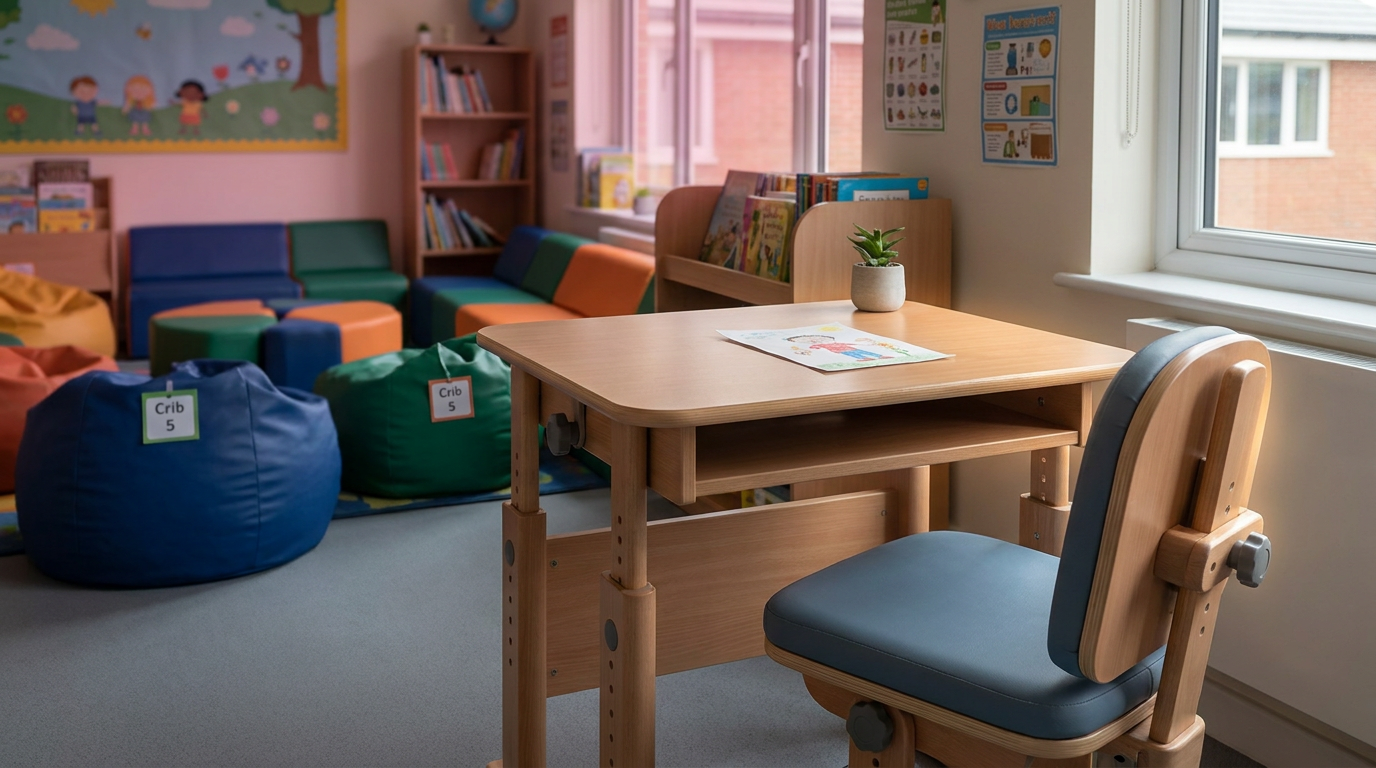
For pupils with SEN, compliance is directly linked to the guidance in Building Bulletin 104 from the Department for Education (2024). The special needs school furniture requirements derived from this guidance focus on adjustability and accessibility. This includes:
- Height-adjustable tables to accommodate wheelchair users comfortably.
- Robust and stable furniture for pupils with behavioural challenges.
- Specialised seating that offers postural support.
- Sensory equipment for breakout rooms, such as weighted blankets or tactile surfaces, to create calming spaces.
At the same time, modern pedagogy emphasises flexible learning environments over traditional rows of desks. Creating compliant breakout areas, collaborative pods, and quiet study zones is essential. When furnishing these spaces with modern breakout furniture, you must still ensure every item meets the relevant standards. This means checking that soft seating is Crib 5 compliant and that tables and chairs, even if informal in style, are stable and durable enough for a school setting. Our “Design To Install We Do It All!” service helps schools plan these complex spaces to ensure they are both functional and fully compliant.
The Practical Compliance Process: A School Business Manager’s Checklist
The most effective way to ensure a project meets all school environment guidelines is to follow a structured, methodical process from start to finish. A robust project plan acts as your classroom health and safety checklist uk and prevents critical details from being overlooked. In our experience, breaking a refurbishment project into distinct phases is an effective approach for managing procurement and ensuring a successful outcome. This checklist provides a practical framework for School Business Managers.
Phase 1: Audit and Planning
This initial phase is about defining the project’s scope and requirements before you even think about suppliers.
- Conduct a room-by-room audit: Assess the condition of existing furniture, identifying items that are broken, non-compliant, or no longer fit for purpose.
- Consult with stakeholders: Speak with teaching staff, the SEN Coordinator (SENCO), and pupils to understand their functional needs and pedagogical goals.
- Define project parameters: Establish a clear budget, an effective timeline, and key objectives for the new space.
Phase 2: Specification and Tendering
Here, you translate your needs into a formal document that potential suppliers can respond to.
- Write a detailed specification: Clearly state all requirements, referencing mandatory standards like bs en 1729 compliant furniture and Crib 5 fire retardancy.
- Request layout plans: Ask suppliers to provide 2D and 3D space plans to visualise the proposed solution and check for compliance with circulation and access requirements.
- Issue the tender: Use an approved procurement portal or framework to invite bids from a list of qualified suppliers.
Phase 3: Supplier Vetting and Selection
This is the crucial due diligence stage to ensure you partner with a reliable and compliant company.
- Request proof of compliance: Ask for certificates showing products are tested to BS EN 1729 and other relevant standards.
- Check references: Speak to other schools the supplier has worked with to verify their service quality and reliability.
- Verify insurance and warranties: Ensure the supplier has adequate public liability insurance and provides clear, long-term warranties on their products.
Choosing a Compliant Supplier & Managing Procurement
Selecting the right supplier is arguably the most critical step in the entire school procurement guidelines uk process. A reputable partner does more than just sell furniture; they act as a compliance safeguard, ensuring every item specified meets the necessary standards. Conversely, a poor choice can introduce significant risk, liability, and wasted expenditure.
A key strategy for de-risking procurement is to use public sector purchasing frameworks, such as the Crescent Purchasing Consortium (CPC) or ESPO. These frameworks pre-vet suppliers for financial stability, quality control, and compliance with public procurement regulations, Saving Time & Stress.
When evaluating suppliers, whether on a framework or not, here are some red flags to watch for:
- Vague specifications: Descriptions that lack specific references to BS EN 1729 or fire safety standards.
- Lack of certification: Inability or unwillingness to provide documentation proving product compliance.
- Price seems too good to be true: Extremely low prices often indicate corners have been cut on materials, safety testing, or durability.
- No physical address or limited contact details: A sign of a potentially unreliable or transient operation.
A trustworthy supplier will be transparent about their credentials. For example, you should easily be able to find our full list of certifications and accreditations on our website. We believe that demonstrating compliance upfront is a hallmark of a professional partner. Remember to consider the total cost of ownership – including delivery, installation, and warranty – not just the initial ticket price. This is where options like our Bulk Buy Discounts and flexible payment terms can provide significant long-term value.
### Case Study: A Primary School Refurbishment
Challenge: A multi-academy trust needed to refurbish four Year 5 classrooms across two sites. The project required furniture that was not only bs en 1729 compliant furniture but also met specific special needs school furniture requirements for three pupils with Education, Health and Care (EHC) plans, all within a tight budget of £35,000.
Solution: The trust engaged Costcutters UK. Our “Design To Install We Do It All!” service began with a free site survey and space planning consultation. We proposed a layout using certified furniture, including three height-adjustable tables and specialised postural chairs, ensuring full compliance. By using our Bulk Buy Discounts, we kept the project within budget.
Results: The classrooms were fully installed during the summer holidays with zero disruption. The trust achieved full compliance, received positive feedback from the SENCO, and saved an estimated 15% compared to sourcing items individually.
Key Insight: Partnering with a single, experienced supplier who understands educational compliance streamlines the entire process, from design to installation, mitigating risk and ensuring value.
Frequently Asked Questions About School Compliance
What are school environment guidelines?
The term school environment guidelines refers to the collection of mandatory regulations and official best-practice advice governing the safety, suitability, and accessibility of UK school premises. This includes rules from the HSE, guidance from the DfE, and technical standards like BS EN 1729. Following these guidelines is essential for legal compliance and creating an effective learning environment for pupils.
What is BS EN 1729 and why is it important?
BS EN 1729 is the British Standard for educational furniture, specifying dimensions, safety, and strength. Part 1 ensures furniture is ergonomically sized for pupils to promote good posture, while Part 2 tests for stability and durability to prevent accidents. Choosing compliant furniture is crucial for pupil well-being and ensuring your investment lasts.
Are all UK schools required to follow DfE building bulletins?
DfE building bulletins are technically non-statutory guidance, meaning they are not law in the same way as HSE regulations. However, they are considered best practice and are often a condition for securing government funding for new builds or major refurbishments. They also provide a benchmark that Ofsted may consider when evaluating a school’s physical environment.
How do I check if school furniture is fire retardant?
Look for a permanent label stating compliance with BS 7176, which is the standard for fire resistance of upholstered furniture. For schools, this should typically be rated as ‘Medium Hazard’ (also known as Crib 5). Reputable suppliers must provide this certification and it should be a key item on your procurement checklist. Rarely purchase upholstered items without this explicit certification.
What are the key considerations for special needs school furniture requirements?
Key considerations include adjustability, accessibility, and sensory integration to support diverse learning needs. This means height-adjustable tables for wheelchair users, robust furniture for pupils with behavioural needs, and items designed for sensory rooms. Typically consult with your school’s SENCO to ensure furniture choices meet the specific needs outlined in pupils’ EHC plans.
How often should school facilities be audited for compliance?
A formal risk assessment of the entire premises should be reviewed at least annually, or whenever there is a significant change. A specific furniture and equipment audit is best practice when planning a refurbishment or at the start of each academic year. This helps identify wear and tear, potential hazards, and needs for replacement before they become a risk.
What is the role of the Health and Safety Executive (HSE) in schools?
The HSE enforces workplace health and safety law, and schools are considered workplaces for staff and premises for pupils and visitors. The HSE can inspect schools, investigate incidents, and prosecute for breaches of the Health and Safety at Work Act. Their regulations form the mandatory legal basis for your school’s health and safety policy.
Can I use a general procurement framework for school furniture?
Yes, using a public sector procurement framework is highly recommended for ensuring compliance and value. Frameworks like ESPO or the Crescent Purchasing Consortium (CPC) pre-vet suppliers for financial stability, insurance, and compliance, saving you significant time and risk. It ensures you adhere to public spending regulations. Typically check the framework specialises in educational furniture.
What are the main risks of using non-compliant furniture?
The primary risks are pupil or staff injury, legal liability, and financial loss. Non-compliant furniture can tip over, break, or contribute to poor posture. In the event of an accident or fire, using non-compliant items could lead to HSE prosecution or invalidate insurance. It is also a poor use of public funds as it will likely need replacing far sooner.
How can I create a budget for a school refurbishment project?
Start by getting quotes based on a detailed specification document from reputable suppliers. Break the budget down into key areas: furniture, decoration, flooring, technology, and a contingency fund (at least 10%). Reputable suppliers can provide a free space planning service and detailed quotation to help you build an accurate budget proposal for governors.
Important Considerations
This guide provides a comprehensive overview of the key regulations and resources related to UK school environments. However, it is not a substitute for professional legal advice. Regulations can be updated, and their application may vary depending on your specific building type (e.g., listed status), school type (e.g., academy vs. Maintained), and local authority policies. Typically refer to the latest official documentation from the HSE, DfE, and BSI.
While using a full-service supplier like Costcutters UK streamlines the process from design to installation, alternative approaches exist. Some schools may choose to hire an independent interior designer or project manager and source furniture from multiple vendors. This can offer flexibility but requires more internal management time to coordinate deliveries, vet each supplier individually for compliance, and manage installation.
We strongly recommend consulting a chartered surveyor or a specialist health and safety consultant for large-scale new builds, significant structural alterations, or if you are dealing with complex legacy issues like asbestos. For furniture-specific projects, a consultation with an experienced educational supplier is the most efficient way to ensure your plans are compliant, practical, and within budget.
Achieve Compliance with a Trusted Partner
Navigating the complex web of school environment guidelines is a significant responsibility, but it is manageable with the right knowledge and support. By understanding the core principles of the HSE, DfE, and British Standards like BS EN 1729, you can make informed decisions that protect pupils, support staff, and create outstanding learning spaces. A methodical approach using checklists and verified suppliers is the key to a successful, stress-free project.
With over 35 years of experience partnering with UK schools and being Rated Excellent On Trustpilot, Costcutters UK simplifies compliance. Our expert team can help you plan your space, select certified products, and manage the entire process, with options to Credit Accounts Or Pay Flexibly. To ensure your next project is fully compliant and perfectly tailored to your needs, Book a Free Space Planning Consultation with our specialists today.
References
- Health and Safety Executive (HSE) – Government Guidance. Provides the legal framework for health and safety in UK schools.
- Department for Education (DfE) – Building Bulletins – Government Guidance Collection. Offers non-statutory best practice on school design, including BB103 for area guidelines and BB104 for SEN/disability.
- British Standards Institution (BSI) – BS EN 1729 – Technical Standard. Defines the specific dimensional, safety, and strength requirements for chairs and tables in educational institutions.
- The Regulatory Reform (Fire Safety) Order 2005 – UK Legislation. Outlines the responsibilities of the ‘responsible person’ in a school for ensuring fire safety.
- FIRA International – Industry Body. Provides testing and certification services for the furniture industry, including for BS EN 1729.
Conclusion
Achieve Compliance with a Trusted Partner
In summary, navigating the complex web of school environment guidelines is a significant responsibility, but it is manageable with the right knowledge and support. By understanding the core principles of the HSE, DfE, and British Standards like BS EN 1729, you can make informed decisions that protect pupils, support staff, and create outstanding learning spaces. A methodical approach using checklists and verified suppliers is the key to a successful, stress-free project.