A Landlord’s Guide to Pub Outdoor Play Equipment: Safety, Repairs & ROI
🎯 Key Takeaway
Effective management of pub outdoor play equipment involves regular inspections, timely repairs, and strict adherence to UK safety standards like EN 1176 to ensure child safety, minimise legal liability, and maximise your return on investment.
• UK publicans have a legal ‘duty of care’, requiring compliance with Health and Safety Executive (HSE) guidance and EN 1176/77 standards.
• Proactive, seasonal maintenance addressing rot, rust, and wear is crucial to prevent accidents and avoid costly emergency replacements.
• Investing in durable, commercial-grade equipment is a long-term strategy to enhance your pub’s reputation and increase revenue from family customers.This guide provides the checklists and expert advice you need to transform your play area from a potential liability into a safe, profitable business asset.
A well-maintained beer garden that welcomes families is one of the most powerful assets a modern pub can possess. However, For pub outdoor play equipment, that asset carries a significant and often underestimated liability. Faulty or non-compliant equipment is a primary concern, capable of turning your family-friendly attraction into a source of legal and financial risk. As of July 2026, understanding your obligations isn’t just good practice; it’s essential for business survival. This guide provides a comprehensive framework covering your legal duties, a practical maintenance checklist, common repair advice, and the financial calculations for repairing versus replacing equipment. We’re here to empower you to manage your play area safely and profitably, and our advice on planning your complete outdoor hospitality space can help put it all into context.
👤 Written by: Content Team
Reviewed by: Editorial Team, Industry Specialists
Last updated: 9 July 2026
ℹ️ Transparency: This article explores the maintenance and safety management of commercial play areas based on official UK regulations and over 35 years of industry experience. Some links may connect to our services. All information is verified by our editorial team to ensure accuracy and compliance as of the publication date.
Best For: Pub landlords, brewery operations managers, and hospitality business owners with outdoor commercial spaces.
Not effective For: Homeowners seeking advice on domestic garden play equipment.
What are my legal duties for pub playground safety?
Yes, as a pub owner, you have a strict legal ‘duty of care’ for every person using your premises, and this strongly includes the play area. This duty is not a vague concept; it is a legal requirement to take reasonable steps to ensure visitors are safe. For a pub play area, this means proactive management is non-negotiable.
The Health and Safety Executive (HSE), the UK government agency for workplace health and safety, provides guidance that states employers have a responsibility to protect the public from risks arising from their work activities. According to the Health and Safety Executive (HSE), this principle forms the foundation of your legal obligations. Failure to meet this duty, especially if it results in an injury, can lead to prosecution and civil claims for compensation.
The cornerstone of compliance for pub play area safety is adherence to specific standards. The key standard is BS EN 1176, which is the British and European safety standard for public playground equipment. This standard is crucial because it’s designed for unsupervised public settings, exactly like a beer garden. It covers everything from equipment design and materials to installation and the required depth of impact-absorbing surfaces.
Your beer garden play area rules must be backed by equipment that meets this commercial standard-domestic equipment is not sufficient or compliant. Think of the standards required by the Early Years Foundation Stage (EYFS), the statutory framework for early education in England. The Department for Education (EYFS Framework) sets incredibly high safety requirements for nursery equipment. While you’re not running a nursery, adopting a similar mindset towards the principles of safe and durable equipment for children demonstrates the level of diligence expected.
How do I maintain and inspect play equipment seasonally?
Proactive maintenance is the most effective strategy for preventing accidents, managing liability, and avoiding the high cost of emergency repairs. It’s the practical application of your duty of care. A structured inspection schedule helps you identify and rectify issues before they become dangerous hazards.
There are three essential tiers of inspection:
- Routine Visual Inspections (Daily/Weekly): Carried out by your staff before opening. This is a quick check for obvious hazards like vandalism, litter (especially broken glass), and easily visible damage.
- Operational Inspections (Monthly/Quarterly): A more detailed, hands-on check. This involves testing the stability of equipment, checking for wear on moving parts like swing chains, and ensuring surfacing is adequate.
- Annual Main Inspection (Yearly): This must be conducted by a certified, independent inspector. Organisations like the Royal Society for the Prevention of Accidents (RoSPA), a UK charity providing safety advice and inspections, or a registered inspector can perform this. They provide a detailed report that is critical for your insurance and legal defence.
The UK’s variable climate-from wet winters to hot summers-accelerates wear and tear. This schedule helps you stay ahead of weather-related degradation. The following commercial playground inspection checklist UK provides a practical framework.
| Item / Area | Check Frequency | What to Look For | Action if Faulty |
|---|---|---|---|
| Swings | Daily (Visual), Monthly (Operational) | Worn chains/shackles, loose bolts, damaged seats, excessive wobble in frame. | Isolate the swing immediately. Tighten bolts or replace worn components. |
| Timber Structures | Monthly (Operational) | Splintering wood, signs of rot (soft/dark spots), loose joints, algae growth. | Sand and treat minor splinters. Cordon off areas with rot for professional assessment. |
| Metal Components | Monthly (Operational) | Rust/corrosion, sharp edges, loose or missing bolts/screws. | Remove rust and repaint with appropriate metal paint. Replace missing fixings. |
| Slides | Daily (Visual), Monthly (Operational) | Cracks, sharp edges, debris or foreign objects on the sliding surface. | Close off slide. Minor cracks may be repairable; major damage requires replacement. |
| Safety Surfacing | Daily (Visual), Weekly (Operational) | Compacted bark/sand, exposed ground, damaged wet pour, trip hazards at edges. | Rake loose-fill surfacing to maintain depth. Cordon off areas with exposed ground. |
| Fencing & Gates | Weekly (Operational) | Broken panels, gaps children could get through, faulty gate latches. | Repair immediately to ensure the area remains enclosed and secure. |
How do I identify and fix common play equipment failures?
Even with a great maintenance schedule, components will eventually fail. Knowing how to spot and address common issues is key to repairing outdoor play equipment effectively and safely. Focus your operational inspections on these three areas of frequent failure.
Problem 1: Material Degradation (Rot, Rust & UV Damage)
Material degradation is inevitable due to British weather, but catching it early prevents major structural problems.
- Wood Rot & Splinters: Visually inspect all timber for dark, soft patches, especially around joints and ground contact points. Use a screwdriver to gently probe suspicious areas; if the wood is soft and crumbles, rot has set in. For minor splintering, sand the area smooth and apply a child-safe, weather-resistant wood treatment. If you find significant rot, the component or entire structure may need professional repair or replacement.
- Metal Rust: Check all metal fixings, chains, and support poles for signs of rust or corrosion. Surface rust can often be removed with a wire brush, and the area can be protected with a suitable metal-based paint. However, if the rust is causing flaking or has weakened the component, it must be replaced. Pay close attention to welds and joints.
- Plastic UV Damage: Sunlight makes plastic brittle over time. Look for faded colours, a chalky surface texture, and fine cracks, particularly on slides and panels. Brittle plastic can shatter under load, creating sharp and dangerous edges. Minor cracks cannot be safely repaired; the component must be replaced.
Problem 2: Mechanical Wear & Tear
Moving parts are, by their nature, high-wear areas. They require constant vigilance.
- Loose Bolts & Fixings: Manually check the tightness of all nuts and bolts. Equipment vibration can cause them to loosen over time. A wobbly frame or moving panel is a clear sign that fixings need tightening. If a bolt cannot be tightened, the thread may be stripped, and it must be replaced.
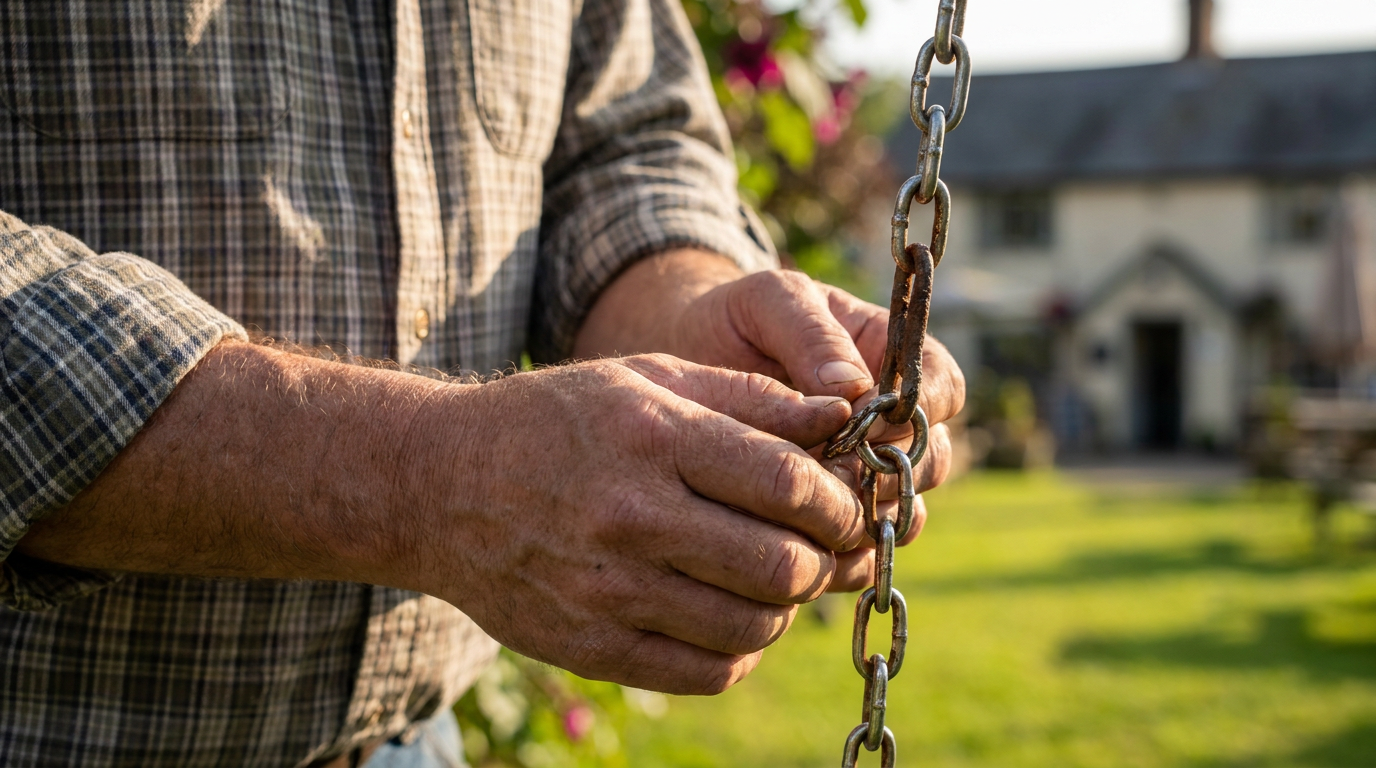
- Worn Swing Components: Swing chains and their connection points (shackles) are critical safety components. Inspect chain links for excessive wear, which usually appears as a thinning of the metal where links rub together. A rule of thumb is that if a chain link has lost more than 50% of its original thickness, it must be replaced. Check that swing seats are securely attached and free from cracks.
Should I repair or replace my pub’s play equipment?
Every publican eventually faces the question: is it better to keep repairing outdoor play equipment or invest in a new set? The answer isn’t just about the immediate cost. It is a strategic decision involving safety, compliance, and long-term value.
Our experience suggests a simple framework for this decision:
- Cost of Repair vs. Replacement: A simple repair, like replacing a swing seat, is an obvious choice. However, if the cost of multiple repairs (including parts, labour, and equipment downtime) approaches 50% of the cost of a new, comparable item, replacement is often the more sensible financial option.
- Safety & Compliance: This is the most important factor. Can a repair restore the equipment to a state that is fully compliant with BS EN 1176? For structural damage or widespread rot, a patch-up job may not suffice and could leave you legally exposed. Replacement with certified equipment removes this ambiguity.
- Long-Term Value & Durability: Is this a recurring problem? Constantly replacing the same cheap components is a false economy. Investing in durable commercial play equipment made from high-quality, weather-resistant materials reduces long-term maintenance costs and extends the asset’s life. According to Statista (2024) data on the UK commercial furniture market, businesses are increasingly investing in quality to ensure longevity.
- Brand Image: Old, heavily patched, and faded equipment sends a negative message to customers about your standards. A new, vibrant, and modern play area signals that you care about families and their safety, enhancing your pub’s reputation and attracting more customers.
While repair is suitable for minor, non-structural issues, we find that replacement is frequently the superior long-term investment in safety, compliance, and profitability. When you do decide to replace, choosing the right commercial equipment supplier is a critical step in guaranteeing quality and compliance.
What are common questions about pub play areas?
What is pub outdoor play equipment?
Pub outdoor play equipment refers to commercial-grade apparatus specifically designed and certified for use in public, unsupervised settings like a beer garden. Unlike domestic equipment sold for home use, it must be reliable enough to withstand heavy use and comply with rigorous safety standards, most importantly BS EN 1176 in the UK. This ensures it is built to minimise risks like entrapment and structural failure in a commercial environment.
What are common safety concerns with playground equipment?
The most common safety concerns are falls from height, impact from moving equipment like swings, and head or neck entrapment. Other significant issues arise from poor maintenance, including injuries from splinters on wooden structures, cuts from sharp edges on damaged plastic or metal, and inadequate impact absorption from poorly maintained safety surfacing. Regular inspections are designed to mitigate these specific risks before an accident can occur.
What are the essential safety rules for a pub play area?
Essential rules, displayed on clear signage, should include a clear age or height limit and a strict requirement for adult supervision at all times. You should also prohibit food, drinks, and glass from the play area to prevent slips and hazards. Finally, the sign should instruct patrons to report any visible damage or concerns to staff immediately, making them partners in maintaining a safe environment.
What are the main risks of an outdoor play area for a pub?
The primary risks are legal liability for injuries and the subsequent financial and reputational damage. If an accident occurs due to negligence, such as failing to maintain equipment, your business could face significant compensation claims. Furthermore, a serious incident can damage your pub’s reputation beyond repair and may even invalidate your public liability insurance if you are found to be non-compliant with safety standards.
How often should pub play equipment be inspected?
Pub play equipment requires three levels of inspection: daily or weekly visual checks by staff, monthly or quarterly operational checks, and a mandatory annual inspection. The annual check must be conducted by a certified independent professional, for example, from RoSPA or The Register of Play Inspectors International (RPII). These documented inspections are crucial for proving due diligence and ensuring safety.
What does the law require for pub playgrounds?
UK law requires pub owners to exercise a ‘duty of care’ to ensure visitors are reasonably safe. For playgrounds, this is demonstrated by conducting and documenting regular risk assessments, maintaining a logbook of inspections and repairs, and ensuring all equipment and surfacing comply with recognised safety standards, primarily BS EN 1176. Adherence is not just best practice; it’s a core legal defence.
What is ‘risky play’ and is it allowed?
‘Risky play’ refers to thrilling activities that involve a chance of physical injury but are crucial for a child’s development and risk-assessment skills. Commercial play equipment is specifically designed to provide beneficial, manageable risks (like climbing high or sliding fast) while engineering out unacceptable hazards that a child cannot foresee, such as head entrapment or structural failure. It allows for adventure within a safe framework.
Can a pub be held liable for an accident in the play area?
Yes, a pub can strongly be held liable if an accident was caused by its negligence. If it can be well-supported by research that the injury resulted from poorly maintained equipment, a failure to follow safety standards, or a lack of adequate supervision warnings, the business is likely to be found at fault. A reliable and well-documented inspection and maintenance record is your most important legal defence.
What surfacing is best for a play area?
an effective surfacing depends on the Critical Fall Height (CFH) of the equipment, which is the maximum height from which a child might fall. Options include loose-fill materials like wood chip or bark, sand, and synthetic surfaces like wet pour rubber or rubber tiles. Each must be installed to a specified depth, as defined by BS EN 1177, to provide adequate impact absorption for the CFH.
Can a pub play live music in its beer garden?
Yes, but this activity is typically governed by specific conditions on the premises licence issued by your local council. These conditions often include restrictions on times, days, and maximum noise levels to prevent public nuisance to neighbours. You should review the specific terms of your licence before hosting any live music events outdoors to avoid penalties.
What important considerations and guidance should I know?
This guide provides general advice and best practices for maintaining pub outdoor play equipment. It is not a substitute for a formal risk assessment or a certified annual inspection by a body like RoSPA. All repairs and maintenance must be documented in a logbook to provide evidence of your diligence.
For minor issues like sanding a small patch or tightening a bolt, a competent in-house team may be sufficient. However, for any structural repairs, replacement of key components, or surfacing work, using a professional service that may help compliance with EN 1176 is strongly recommended over DIY approaches.
We advise all pub owners to schedule an annual independent inspection with a certified playground inspector. For any significant upgrades, repairs, or full replacements, consult a specialist commercial play equipment supplier to ensure the products, layout, and installation are fully compliant and fit for purpose.
Turn Your Play Area into a Guaranteed Asset
Properly managing your pub outdoor play equipment is a critical responsibility that directly impacts customer safety, legal compliance, and your bottom line. By moving from a reactive to a proactive approach – built on regular inspections, timely maintenance, and adherence to UK safety standards – you transform a potential liability into a powerful tool for attracting families and building a loyal customer base. Investing in durable commercial play equipment is an investment in your business’s future success.
Choosing the right equipment and having a clear maintenance strategy is key. With over 35 years of experience supplying durable, compliant furniture and equipment to the UK hospitality sector, the Costcutters UK team can help you plan a safe and profitable outdoor space. “Design To Install We Do It All!”, saving you time and stress. We’re Rated Excellent On Trustpilot and offer Bulk Buy Discounts and flexible payment options.
Contact us today for a free space plan and quote.
References
- Health and Safety Executive (HSE) – Government Guidance. Provides the legal framework and employer responsibilities for ensuring safety in public and work environments, forming the basis of the ‘duty of care’ principle.
- European Agency for Safety and Health at Work (EU-OSHA) – International Body Research. Highlights risk factors in physical environments, which by extension applies to poorly designed or maintained play equipment that can cause injury.
- Department for Education (EYFS Framework) – Government Statutory Framework. Section 3 sets stringent requirements for the safety and suitability of equipment in early years settings, establishing a benchmark for child safety standards.
- British Educational Suppliers Association (BESA) – Professional Organisation Code of Practice. Mandates that members supply products that are ‘fit for their intended purpose’ and meet high safety standards, relevant when selecting a reputable equipment supplier.
- World Health Organization (WHO) – International Body Guideline. Emphasises the importance of physical activity for children, reinforcing the value of providing safe and engaging play opportunities.
- Statista – Market Research Data (2024). Reports on the UK commercial furniture market size, providing context for the scale of investment businesses make into their physical premises.
- Active Garden – Industry Blog. Provides ideas and justification for investing in pub play areas to boost family trade, reinforcing the commercial benefits.
- Absolute Play – Commercial Supplier Information. Outlines the design and installation considerations for commercial play areas in the hospitality sector, emphasising compliance and bespoke design.
- Stephensons Solicitors LLP – Legal Commentary. Details the legal basis for personal injury claims arising from accidents in beer gardens, highlighting the importance of maintenance and risk assessment as a defence.
CONCLUSION
Turn Your Play Area into a Guaranteed Asset
Properly managing your pub outdoor play equipment is a critical responsibility that directly impacts customer safety, legal compliance, and your bottom line. By moving from a reactive to a proactive approach – built on regular inspections, timely maintenance, and adherence to UK safety standards – you transform a potential liability into a powerful tool for attracting families and building a loyal customer base.
Choosing the right equipment and having a clear maintenance strategy is key. With over 35 years of experience supplying durable, compliant furniture and equipment to the UK hospitality sector, the Costcutters UK team can help you plan a safe and profitable outdoor space. Contact us today for a free space plan and quote.