Open Plan vs Hybrid Office: Choosing an effective Layout for Productivity
🎯 Key Takeaway
The open plan vs hybrid office decision depends on your team’s work styles; open-plan layouts foster ambient collaboration, while hybrid layouts offer flexibility and support for focused and remote work. Open-plan offices can increase spontaneous interaction but often suffer from noise and distractions, impacting deep work. Hybrid office layouts support flexible work schedules by combining shared desks, quiet zones, and collaborative spaces. The most effective solution is often a ‘zoned’ approach, incorporating elements of both models to suit varied tasks. This guide provides a decision framework to help you choose the right layout for your organisation’s unique needs and budget.
Since the early 2020s, UK work culture has undergone a fundamental shift. As of mid-2026, the debate around the open plan vs hybrid office is no longer just a discussion about desks; it’s a critical strategic decision impacting productivity, talent retention, and operational costs. For modern businesses, schools, and public sector organisations, making the right choice in office layout planning is paramount. The physical environment must now support a more diverse range of work styles than ever before. With over 35 years of experience, we at Costcutters UK have guided countless organisations through this exact challenge. This article provides a clear, practical framework to help you make an informed decision, ensuring your workspace is an asset, not an obstacle.
Written by: Content Team | Reviewed by: Editorial Team, 35+ Years Experience; Rated Excellent On Trustpilot
Last updated: 3 May 2026
ℹ️ Transparency Disclosure: This article explores the debate between open-plan and hybrid office designs based on industry research, case studies, and our 35 years of experience in workplace planning. This content is for informational purposes. For a tailored solution, we recommend a professional consultation. Our goal is to provide a balanced overview to support your decision-making process.
The Open-Plan Office: A Re-evaluation of Collaboration and Cost
An open-plan office, a workspace design with minimal to no dividing walls between employee desks, was originally championed for its perceived benefits of cost savings and enhanced collaboration. By removing physical barriers, organisations hoped to foster spontaneous communication and create a more egalitarian atmosphere, all whilst maximising real estate. However, extensive research and real-world experience have highlighted significant drawbacks. The primary issue affecting open plan office productivity is the acoustic environment.
Data from a study published in the Harvard Business Review (2019) is particularly revealing; their observational study found that transitioning to open-plan offices actually decreased face-to-face interactions by around 70%, while electronic communication increased. This suggests employees create their own ‘digital walls’ to regain focus.
The core disadvantages of an open plan office are clear:
- Noise and Distractions: Constant background chatter and movement make deep, concentrated work extremely difficult.
- Lack of Privacy: Sensitive conversations are compromised, and employees report feeling constantly ‘on display’.
- Increased Stress: According to an analysis by The Employment Law Solicitors (2024), the high-stimulation environment can significantly impact employee well-being and productivity.
While the model offers undeniable space efficiency, especially in expensive UK city centres, its negative impact on individual focus often outweighs the benefits.
The Hybrid Office Model: Defining the Future of Work
A hybrid office is a physical workspace designed to support a flexible work style where employees split their time between the office and remote locations. It’s more than just a policy; it’s a fundamental rethinking of the office’s purpose. Instead of being the mandatory place of work, the office becomes a destination for specific activities: collaboration, team building, and tasks that benefit from in-person interaction. If you’ve ever asked, “what is a hybrid office?”, this is the core concept.
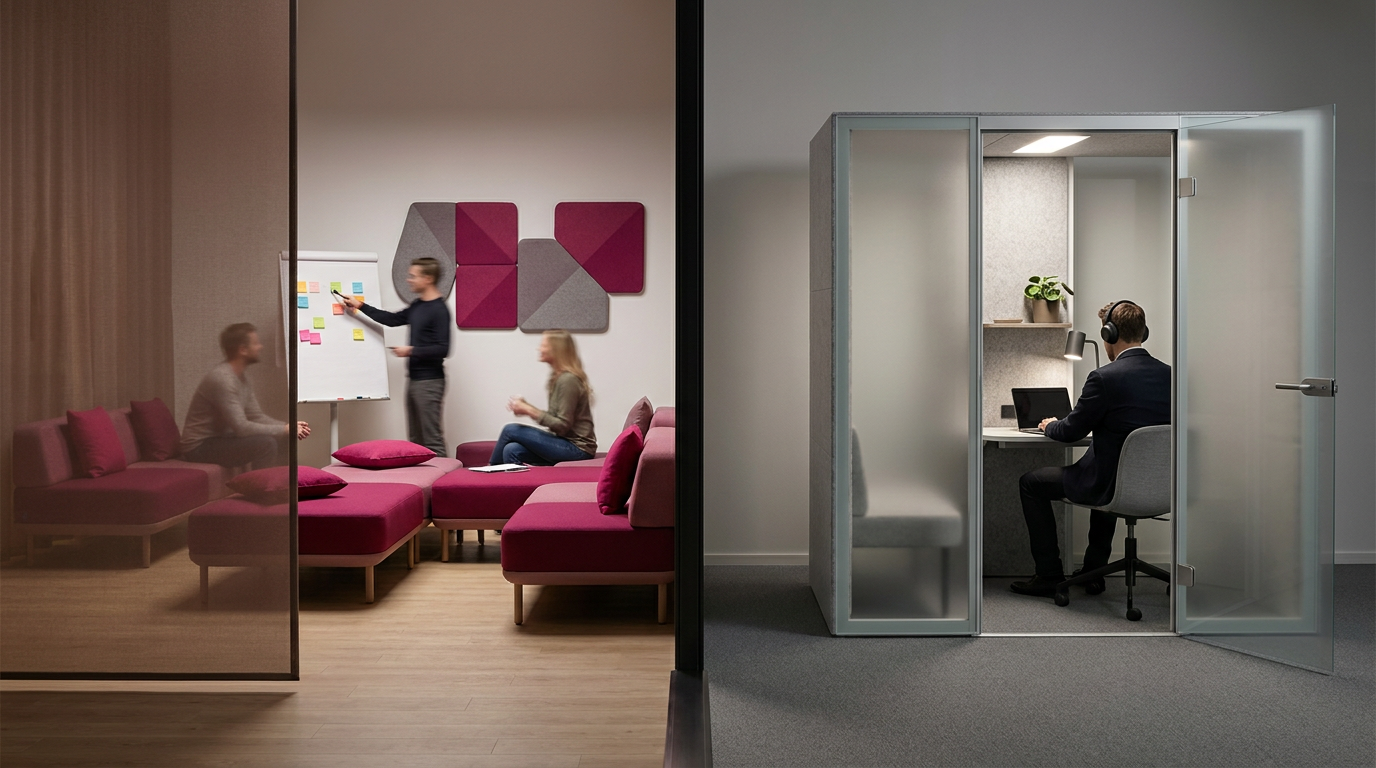
The central pillar of this model is Activity-Based Working (ABW), an approach where employees choose from a variety of settings based on the task at hand. This is reflected in popular hybrid office layout ideas, which might include collaborative hubs, quiet libraries, bookable private booths, and informal lounge areas.
Exploring the pros and cons of hybrid work is essential. On the one hand, data from the UK’s Office for National Statistics (ONS) shows a vast majority of UK workers who worked from home during the pandemic wish to continue a hybrid model. As highlighted by an article in European CEO (2023), this flexibility is a powerful tool for attracting and retaining top talent. However, the model isn’t without challenges. It requires robust scheduling systems and can risk creating a two-tier culture between in-office and remote staff if not managed with intention.
Open Plan vs Hybrid Office: A Decision Framework for UK Managers
Choosing between an open plan vs hybrid office requires a careful analysis of your organisation’s priorities. There isn’t a single correct answer; the optimal choice depends on your specific work culture, the nature of your team’s tasks, and your long-term business goals. To aid this decision, we’ve developed a framework comparing the two models across key factors.
This table synthesises data on how each layout performs against common business objectives. Use it to weigh the trade-offs and identify which model aligns more closely with what your organisation needs to thrive. For example, if your primary goal is reducing real estate costs, an open-plan layout appears attractive. However, if retaining talent that demands flexibility is more critical, a hybrid model may provide a better return on investment, even with potentially more complex upfront planning. Research from the Gensler Research Institute (2023) supports this, showing that employees with access to a variety of workspaces report higher job satisfaction and innovation. It’s about balancing cost with effectiveness.
| Factor | Open-Plan Office | Hybrid Office Layout | Key Consideration |
|---|---|---|---|
| Cost Per Square Foot | Generally lower due to high desk density. | Can be higher due to varied spaces (pods, rooms) but offset by reduced overall footprint (fewer staff in daily). | What is your primary financial driver: minimising rent or maximising employee effectiveness? |
| Collaboration Style | Encourages spontaneous, ambient interaction. Can be disruptive. | Supports planned, intentional collaboration in dedicated zones. | Does your team rely on serendipitous encounters or structured project meetings? |
| Concentration & Deep Work | Poor. High levels of noise and visual distraction are major disadvantages. | Good, if designed correctly with quiet zones, libraries, or bookable pods. | What percentage of your team’s work requires deep, uninterrupted focus? |
| Employee Autonomy & Well-being | Low. Employees have little control over their environment. | High. Empowers employees to choose where and when they work best, improving work-life balance. | How important is employee autonomy to your company culture and talent retention strategy? |
| Flexibility & Scalability | Rigid. Difficult to adapt without significant disruption. | Highly flexible. Can scale up or down by adjusting remote work policies and desk booking. | How much do you expect your team size and work patterns to change in the next 3-5 years? |
The Solution: ‘Zoning’ Your Office for Maximum Efficiency
The most efficient office layout isn’t strictly open-plan or hybrid; it’s a strategic blend of both. We recommend a ‘zoned’ office, an environment designed around activities rather than departments. This approach, often called Activity-Based Working (ABW), provides a diverse ecosystem of spaces that employees can choose from throughout the day, ensuring they typically have the right environment for the task at hand. This is the practical answer to the open plan vs hybrid office dilemma.
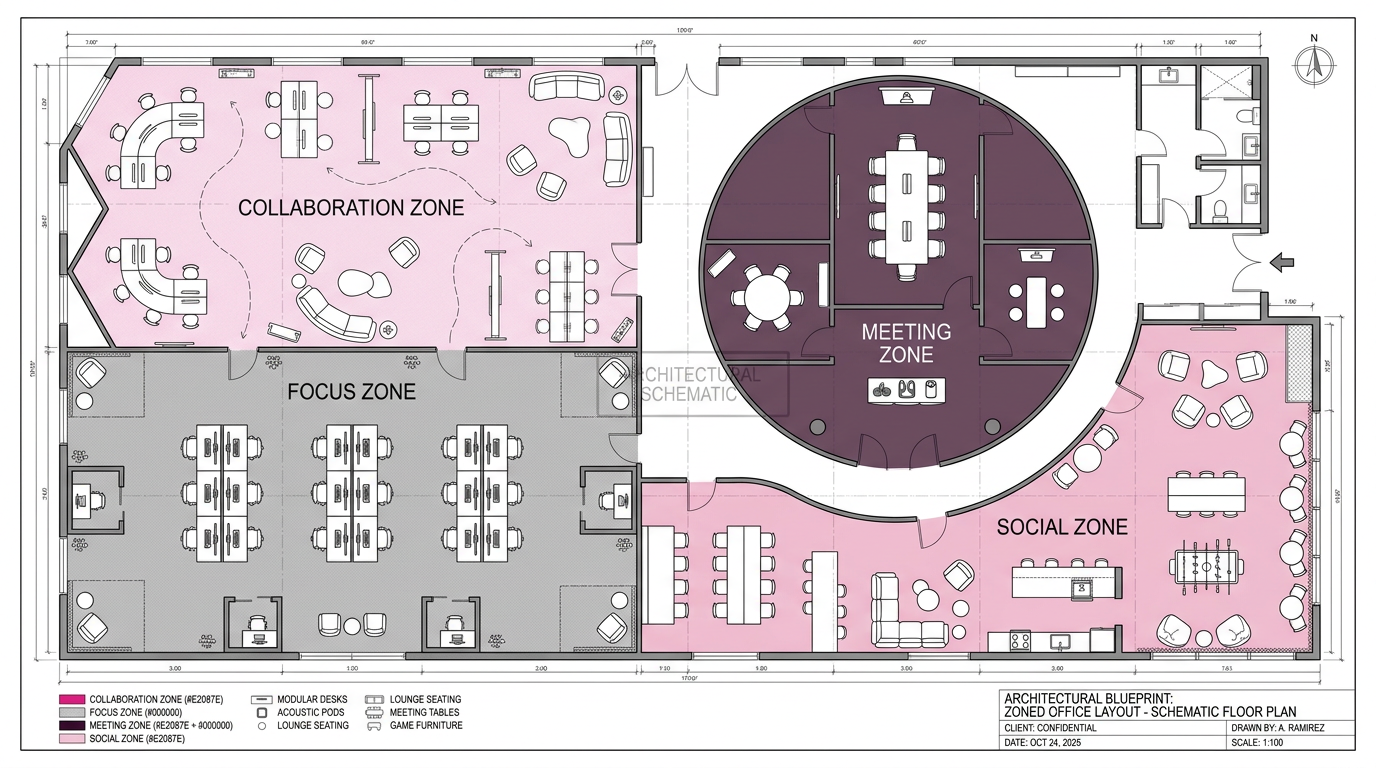
A zoned office moves beyond the binary choice and creates a more sophisticated, effective workplace. Here’s what it looks like in practice:
- Collaboration Zone (‘The Plaza’): An open, energetic area with modular furniture, mobile whiteboards, and large tables. This space captures the collaborative spirit of an open-plan office but contains it, preventing noise from spilling into other areas.
- Focus Zone (‘The Library’): A designated no-talking area with individual workstations, separated by acoustic screens. This is where employees go for deep, concentrated work, solving a key problem of the traditional open-plan model.
- Meeting Zone (‘The Hub’): A mix of enclosed meeting rooms for formal discussions and soundproof pods for confidential calls or video conferences.
- Social Zone (‘The Café’): A relaxed breakout area with comfortable seating and refreshments, designed for informal chats, breaks, and building team cohesion.
This approach, supported by providers like Novex Solutions (2023), offers the flexibility needed for a hybrid workforce and provides the variety required for peak performance. It requires thoughtful planning and investment in the right kind of agile working furniture UK businesses need.
### Case Study: A Hypothetical UK Tech Firm
Challenge: A 150-person tech company in Manchester was struggling with its fully open-plan office. Developers couldn’t concentrate due to noise from the sales team, and project teams lacked private spaces for collaboration. Employee satisfaction was low, and productivity was suffering.
Solution: We implemented a ‘Design To Install’ zoned office layout. 40% of the space became a quiet Focus Zone with acoustic pods. 30% was a collaborative hub with modular furniture. The rest was allocated to meeting rooms and a social café area.
Results: Within six months, the company reported a 25% increase in developer productivity (measured by project completion rates) and a 40% reduction in noise-related complaints. Employee satisfaction scores rose by 18%.
Key Insight: Providing distinct zones empowered employees to choose their environment, directly addressing the core conflicts of the previous open-plan design and “Saving Time & Stress” for everyone.
Practical Furniture for Your Zoned Office
Creating an effective zoned office goes beyond just putting up a few walls. The key is selecting practical, flexible furniture that supports the intended activity of each zone. The right choices in agile working furniture UK-based organisations make are critical for success. At Cost Cutters UK, our “Design To Install We Do It All!” service ensures that your layout and furniture work in well-suited harmony.
Here’s our advice on what to prioritise for each zone:
- For Focus Zones: Invest in acoustic solutions. This includes single-person acoustic pods for complete silence during calls or deep work, and high-backed armchairs that create a sense of privacy. Desks with acoustic screens between them are also highly effective.
- For Collaboration Zones: Flexibility is everything. Choose modular breakout furniture that can be easily reconfigured for different group sizes. Mobile whiteboards and flip chart easels are essential for brainstorming sessions.
- For Hot-Desking/Hybrid Hubs: With employees not having assigned desks, providing secure storage is non-negotiable. Banks of personal lockers are a must. Also, ensure every bookable workstation is equipped with a high-quality, adjustable ergonomic chair to accommodate different users comfortably.
- For Social Zones: Create a welcoming atmosphere with a mix of café-style tables, comfortable sofas, and high-top counters. This encourages informal interaction and helps build the social fabric that can be lost in a hybrid model.
By selecting furniture that is fit for purpose, you transform a theoretical layout into a functional, productive, and inviting workspace.
Important Considerations and Next Steps
This guide is based on current trends and extensive research, but every organisation is unique. The effectiveness of any office layout is influenced by company culture, management styles, and specific job functions, which cannot be fully captured in a general comparison. We recommend using this as a starting point for a deeper, internal analysis of your own operational needs.
While open-plan and hybrid are dominant models, other alternatives exist, such as cellular offices (private offices for all) or fully remote setups. For some specialised roles, these may be more suitable. The ‘zoned’ approach we advocate is a flexible framework that can be adapted to incorporate elements from various models as needed, making it a future-proof strategy.
Choosing a new office layout is a significant investment. For a decision of this scale, especially within the public sector or for large teams, we strongly recommend a professional space planning consultation. An expert can help you analyse your specific needs, ensure compliance with UK regulations like guidelines from the Health and Safety Executive (HSE), Britain’s national regulator for workplace health and safety, and create a budget-conscious plan that delivers long-term value through our UK-accredited suppliers and frameworks.
Plan Your Future-Proof Office with Confidence
The debate over open plan vs hybrid office layouts reveals that an effective solution lies in flexibility and choice. A successful modern workplace moves beyond a single, rigid design, instead offering a ‘zoned’ environment with varied spaces for collaboration, concentration, and connection. This approach not only enhances productivity but also demonstrates a commitment to employee well-being, a crucial factor in today’s competitive talent market. By acknowledging the pros and cons of each model, you can create a blended space that truly works.
With over 35 years of experience helping UK schools, businesses, and public sector bodies create effective and inspiring spaces, Cost Cutters UK is ready to help you navigate this decision. Being Rated Excellent On Trustpilot, we pride ourselves on a customer-centric approach. Our free space planning and design service can help you translate your team’s needs into a practical, budget-friendly layout, with options for Bulk Buy Discounts and flexible payments. Contact our team today to book a free, no-obligation consultation and start your journey towards a better workplace.
Frequently Asked Questions
What is the difference in an open plan vs hybrid office?
An open-plan office refers to a physical layout with no walls, whereas a hybrid office is a workplace model supporting both in-office and remote work. The key distinction in the open plan vs hybrid office debate is that ‘open-plan’ describes the architecture of the space, while ‘hybrid’ describes the operational philosophy of how and where work gets done. A hybrid office can contain open-plan elements but will also include other types of spaces.
What are the main disadvantages of an open-plan office?
The primary disadvantages are high levels of noise, constant distractions, and a significant lack of privacy. These factors are frequently cited in studies on open plan office productivity as leading to decreased performance on focused tasks, increased employee stress, and even more sick days. The very design intended to foster collaboration often becomes a barrier to individual work, which is one of the biggest disadvantages of an open plan office.
What are the main disadvantages of hybrid work?
The main challenges include maintaining a strong and equitable company culture, logistical complexities with scheduling, and potential communication gaps. Ensuring that remote employees have the same opportunities and sense of belonging as their in-office counterparts requires deliberate effort. Without careful management, a two-tier system can emerge, representing one of the key pros and cons of hybrid work to consider.
What is the most efficient office layout?
The most efficient office layout is one tailored to the specific activities of your workforce, often a ‘zoned’ or ‘activity-based’ design. This model provides a mix of collaborative open areas, quiet zones for concentration, private rooms for meetings, and social spaces. By allowing employees to choose an effective space for their current task, it maximises productivity across the entire team, making it the most efficient office layout for diverse needs.
What is the biggest issue in open plan office design?
The single biggest issue is almost universally recognised as unmanaged noise and a lack of acoustic privacy. The constant hum of conversations, phone calls, and general movement is the top complaint from employees and the largest detractor from concentration and well-being. Effective acoustic management is therefore the most critical factor to address in any open-plan environment.
How does a hybrid office layout affect company culture?
A hybrid layout requires a more intentional and structured effort to build and maintain a strong company culture. While it can enhance culture by demonstrating trust and offering autonomy, it also risks creating a disconnect between in-office and remote staff. Success depends on implementing inclusive communication practices, regular all-hands events (both virtual and in-person), and leadership that actively bridges the gap.
What are the 5 C’s of hybrid work?
While various models exist, the 5 C’s often refer to: Communication, Collaboration, Culture, Coordination, and Compassion. These pillars serve as a framework for managing a successful hybrid team. They highlight the need for clear communication protocols, effective collaboration tools, inclusive cultural practices, smart scheduling (coordination), and empathy for individual employee circumstances.
What furniture is essential for a hybrid office?
Essential furniture supports flexibility and a variety of work styles, including bookable ergonomic workstations and soundproof acoustic pods. Other key items are comfortable modular breakout furniture for informal meetings and secure personal lockers for employees who don’t have a permanent desk. This selection of agile working furniture UK companies need is crucial for a functional hybrid space.
Can an open-plan office be good for concentration?
An entirely open-plan office is rarely conducive to concentration, but it can be one component of a larger, well-designed space. For it to work, the open-plan area must be supplemented with easily accessible quiet zones, bookable focus rooms, or acoustic pods. This ‘zoned’ approach provides the necessary balance, allowing employees to escape the noise for deep work when needed.
How do I start planning an office redesign?
Begin by surveying your employees to understand their daily work habits, pain points, and preferences. Follow this by analysing your current space utilisation data to see which areas are overused or underused. The next step in office layout planning is to partner with a specialist who can translate that data into a functional design that aligns with your budget and business goals.
References
- Harvard Business Review – Observational Study (2019). Found that transitioning to open-plan offices decreased face-to-face interactions by approximately 70%.
- UK Office for National Statistics (ONS) – Survey Data (2022). Showed a large majority of UK workers who worked from home intend to continue with a hybrid model.
- Gensler Research Institute – Workplace Survey (2023). Reports that employees with access to a diverse range of workspaces have higher levels of innovation and job satisfaction.
- Health and Safety Executive (HSE) – UK Government Guidance. States that employers have a legal duty to protect employees from stress at work.
- The Employment Law Solicitors – Legal Analysis (2024). Highlights how noise and lack of privacy in open-plan environments can significantly impact productivity and employee well-being.
- European CEO – Business Analysis (2023). Discusses how the flexibility of hybrid models is a key advantage in attracting and retaining talent in a competitive market.
- Novex Solutions – Industry Insight (2023). Argues that in a hybrid world, the most effective offices blend open, private, and collaborative spaces to offer flexibility.
Conclusion
Plan Your Future-Proof Office with Confidence
In summary, the debate over open plan vs hybrid office layouts reveals that the best solution lies in flexibility and choice. A successful modern workplace moves beyond a single, rigid design, instead offering a ‘zoned’ environment with varied spaces for collaboration, concentration, and connection. This approach not only enhances productivity but also demonstrates a commitment to employee well-being, a crucial factor in today’s competitive talent market.
With over 35 years of experience helping UK schools, businesses, and public sector bodies create effective and inspiring spaces, Costcutters UK is ready to help you navigate this decision. Our free space planning and design service can help you translate your team’s needs into a practical, budget-friendly layout. Contact our team today to book a free, no-obligation consultation.