Early Years Storage Solutions: A Guide to Creating Engaging Nursery Spaces
🎯 Key Takeaway
Effective early years storage solutions are fundamental for creating safe, organised, and stimulating learning environments that meet UK Early Years Foundation Stage (EYFS) standards by making resources accessible to children. Proper storage is a key component of an ‘enabling environment’ as required by the EYFS framework and inspected by Ofsted. Child-accessible units, such as low-level open shelving and clear tray systems, promote independence, decision-making, and responsibility. Choosing durable, compliant furniture (e.g., meeting BS EN 1729 standards) ensures pupil safety and provides long-term value for money. This guide provides practical nursery storage ideas and a procurement checklist for School Business Managers to make informed, budget-conscious decisions.
As of June 2026, nursery managers and School Business Managers across the UK face the persistent challenge of balancing tight budgets with the critical need for high-quality, engaging learning spaces. For furnishing these foundational environments, it’s easy to view storage as a purely functional item for tidiness. However, this perspective overlooks a powerful opportunity. Strategic early years storage solutions are not just about organisation; they are a cornerstone of pedagogical practice and a key element in creating enabling environments eyfs practitioners strive for. An Ofsted-rated ‘Outstanding’ setting almost invariably demonstrates thoughtful and effective use of storage.
This guide explores the vital link between the Early Years Foundation Stage (EYFS) framework and your furniture choices. We will provide practical ideas for your space and present a definitive procurement checklist designed to deliver both educational impact and long-term value.
👤 Written by: Content Team | Reviewed by: Editorial Team, Industry Specialists with 35+ Years Experience; Rated Excellent On Trustpilot
Last updated: 15 June 2026
ℹ️ Transparency Disclosure: This article explores early years storage solutions based on our 35+ years of industry experience and analysis of UK educational frameworks. As a leading supplier of school and educational equipment, some links may connect to our services, such as our free space planning consultation. Our editorial team has verified all information for accuracy and relevance to UK educational settings. We believe in transparency and providing authoritative, practical advice.
Why Effective Storage is the Cornerstone of the EYFS Framework
Effective storage is far more than a logistical exercise; it is a fundamental pedagogical tool that directly supports the Early Years Foundation Stage (EYFS), the statutory framework for early childhood education in the UK. The framework mandates the importance of creating enabling environments eyfs, which are rich and varied spaces that support children’s learning and development. Well-designed early years storage solutions are central to achieving this. According to the
When resources are stored in low, open, and clearly labelled units, children are empowered to make their own choices. This simple act of selecting a toy or returning a set of crayons fosters independence, builds confidence, and develops decision-making skills – all key aspects of Personal, Social and Emotional Development. An organised environment reduces frustration and conflict over resources, creating a calmer and more purposeful atmosphere for learning. Also, organised storage directly supports early literacy and mathematics. When children engage with labelled trays and sorted materials, they are practising vital pre-reading and numeracy skills like categorisation, sorting, and matching. When Ofsted inspectors evaluate a setting, as outlined in their [Education inspection framework](https://www.gov.uk/government/publications/education-inspection-framework” target=”_blank” rel=”noopener noreferrer”>Department for Education (DfE)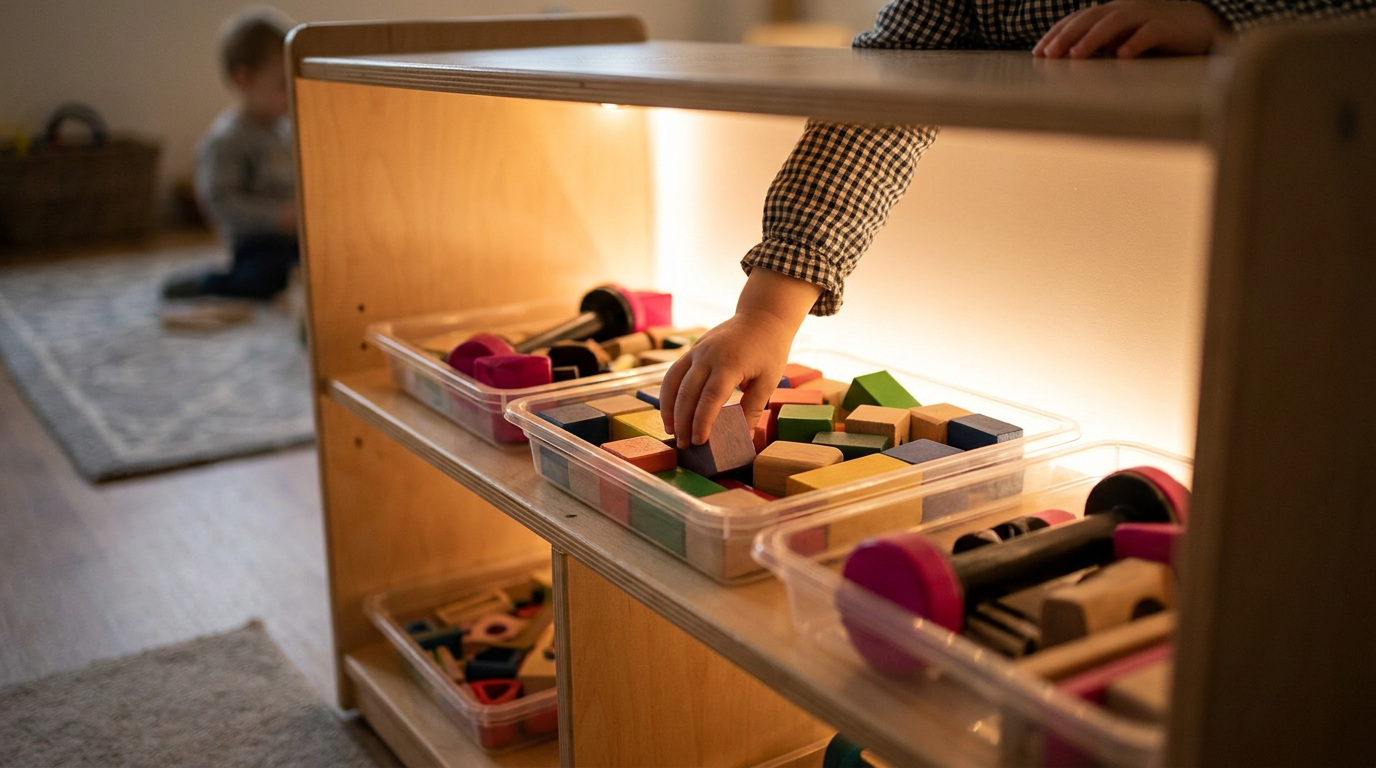
A Visual Guide to Practical Early Years Storage Solutions
The right furniture transforms a room from a simple space into a dynamic learning environment. An effective early years storage solutions are those that combine durability with pedagogical purpose, making resources both accessible and appealing. Here are some of the most effective nursery storage ideas uk settings can implement.
Low-Level Open Shelving
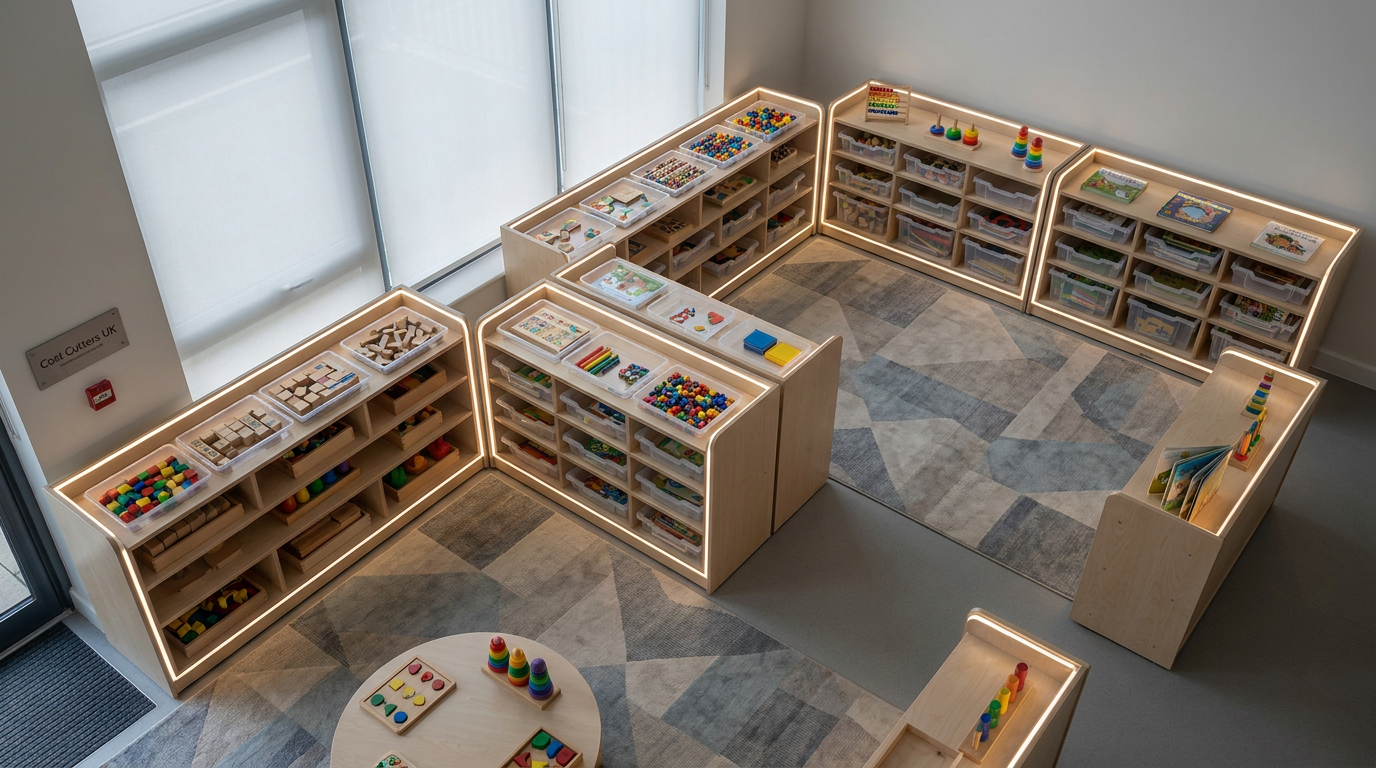
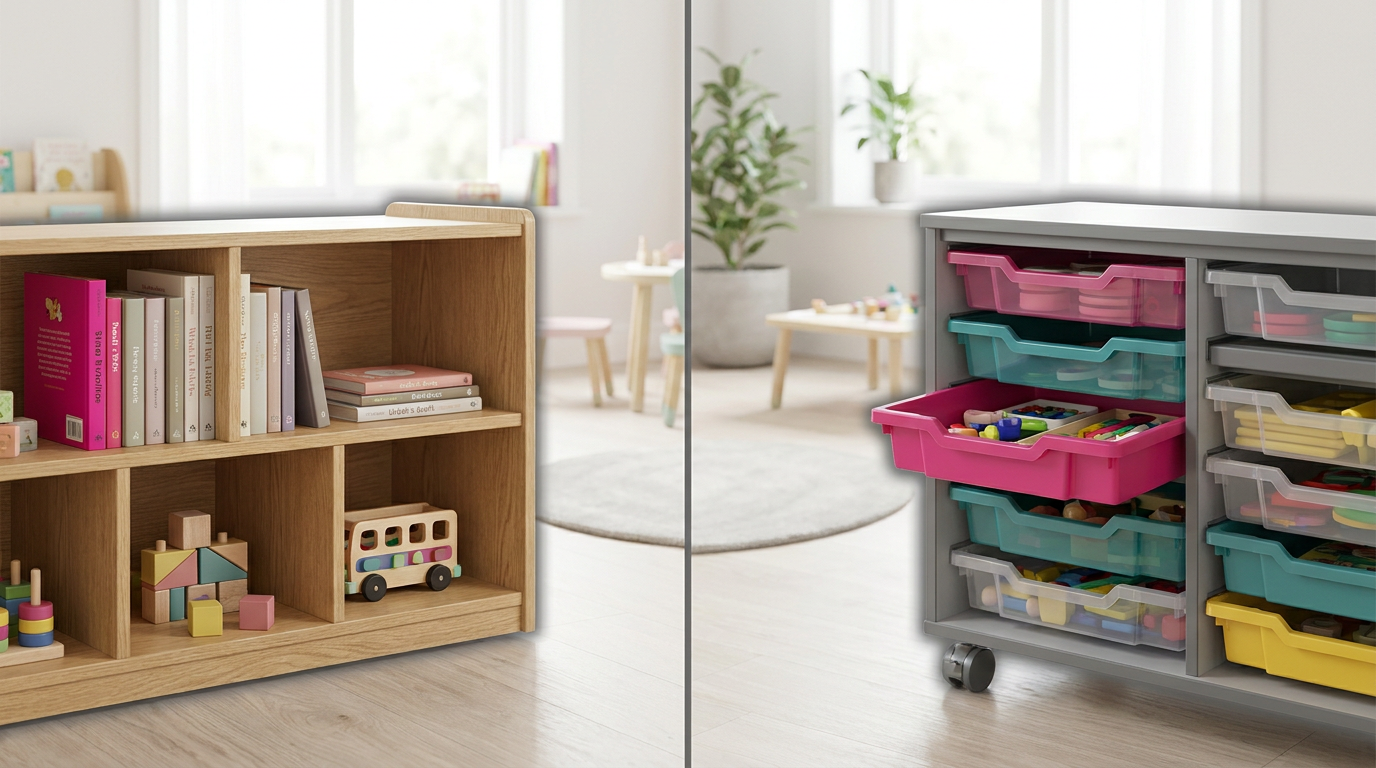
This is the quintessential storage unit for any early years setting. Its open-fronted design allows children to see all available resources at a glance, encouraging them to make independent choices. These units are well-suited for displaying Montessori-style activities on trays, storing construction blocks, or organising themed resources in baskets. They create a calm, orderly, and accessible environment.
Tray Storage Units
A true workhorse of the classroom, tray storage offers incredible versatility. Available with shallow, deep, or jumbo trays, these units can store everything from paper and small manipulatives to larger art supplies and construction kits. Clear trays allow for easy identification of contents, whilst coloured trays can be used to code different learning areas. Mobile versions on castors offer excellent flexibility, allowing staff to reconfigure spaces with ease. We’ve found that high-quality, specialised early years furniture ranges like Twoey offer exceptional durability for this type of unit.
Book Browsers and Display Units
Fostering a love of reading starts with making books inviting. Forward-facing book browsers are far more effective than traditional spine-out shelves, as children are drawn to the colourful covers. Wall-mounted displays can save floor space, while low-level book ‘tubs’ or browsers allow even the smallest children to select their own stories. These are essential pieces of classroom storage furniture uk nurseries need.
Cloakroom and Personal Storage
An organised cloakroom area does more than keep coats off the floor; it teaches children responsibility and self-care. Low benches with integrated shoe storage, clearly labelled hooks, and personal trays for bags or artwork give each child a sense of ownership over their belongings. This organised start and end to the day contributes significantly to a settled classroom atmosphere. This is one of the most practical preschool toy storage ideas and personal item solutions.
The Montessori Approach to Early Years Storage Solutions
The Montessori Method, an educational approach that emphasises independence, is renowned for its concept of the ‘prepared environment’. Central to this philosophy are specific montessori storage solutions designed to empower the child and create a sense of calm and order. When we design spaces based on this pedagogy, the focus is typically on simplicity, accessibility, and natural beauty.
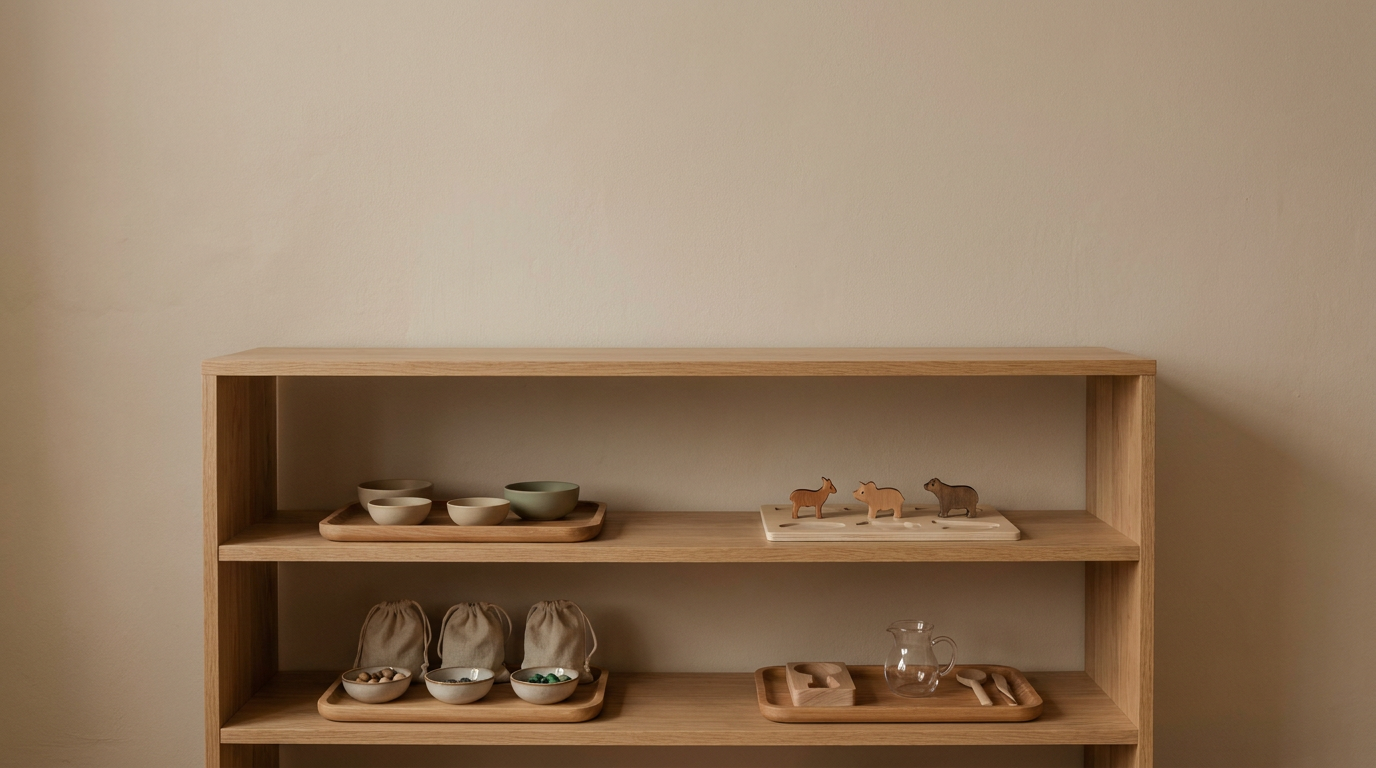
The effective Montessori storage consists of low, open-fronted shelving, typically made from natural wood. This choice of material is deliberate; it’s aesthetically pleasing, durable, and connects children to the natural world. Unlike cluttered toy boxes, Montessori shelves display a limited, curated selection of activities. Each activity is self-contained on its own tray or in a basket. This presentation has a profound impact: it makes the activity look special and inviting, helps the child focus on one task at a time, and clearly shows them how to return it to its proper place.
This system of early years storage solutions minimises overstimulation and visual chaos, which research from bodies like the Montessori St Nicholas Charity (2022) suggests can hinder concentration. The principle is ‘a place for everything, and everything in its place’. By interacting with this orderly environment, children internalise a sense of order, develop respect for their learning materials, and build the foundations of responsibility. It’s a stark, effective contrast to environments where resources are hidden away or piled high in inaccessible containers.
The School Business Manager’s Checklist for Procuring Early Years Storage Solutions
For a School Business Manager (SBM), procuring early years storage solutions is an exercise in balancing compliance, durability, and budget. The decisions made have a long-term impact on classroom safety and the school’s finances. We’ll be honest – choosing the cheapest option is rarely an effective value. Our experience suggests focussing on total cost of ownership is a much smarter strategy.
Here is a practical checklist to guide your procurement process for classroom storage furniture uk.
1. Safety and Compliance First
This is non-negotiable. All furniture intended for educational use in the UK should conform to BS EN 1729. This standard, detailed by the British Standards Institution (BSI), governs size, strength, and stability to prevent items from tipping over and ensure they are ergonomically appropriate for children. Typically ask a potential supplier for proof of compliance. It’s a key part of demonstrating due diligence and safeguarding pupils. You can review our commitment to UK safety and quality standards for peace of mind.
2. Durability, Materials, and Construction
The early years environment is demanding. Look for durable classroom storage built to last. Key features include:
- Material: Melamine-Faced Chipboard (MFC) is a cost-effective and hard-wearing industry standard. Birch plywood offers superior strength and a premium aesthetic but at a higher cost.
- Edges: Look for 2mm PVC or ABS edging, which is highly impact-resistant, rather than thin paper edging that will peel.
- Backs: Ensure units have solid 8mm or 18mm backs, not flimsy hardboard, for structural rigidity.
- Design: Rounded corners and edges are essential to prevent injuries.
3. Calculating True Value for Money
A low initial price can be deceptive. A unit that needs replacing in three years is more expensive than a premium one that lasts for ten or more. When evaluating quotes, consider:
- Warranty: A long warranty (10+ years) is a strong indicator of a manufacturer’s confidence in their product.
- Supplier Support: Does the supplier offer a “Design To Install We Do It All!” service? A supplier who manages delivery and installation saves you significant time and stress.
- Payment Options: Look for suppliers offering flexible payment terms. At Cost Cutters UK, we provide options to Credit Accounts Or Pay Flexibly, which can greatly assist with budget management.
Storage Comparison for Early Years Settings
| Storage Type | Key Features | Best For (Learning Zone) | Durability Factor (1-5) | Typical Cost per Unit (£) |
|---|---|---|---|---|
| Mobile Tray Unit | Castors for flexibility, shallow/deep tray options | Art & Craft, Maths, Small World Play | 4 | £180 – £400 |
| Low-Level Open Shelving | Accessible display, often wooden | Reading Corner, Construction, Montessori | 5 | £150 – £350 |
| Book Browser | Forward-facing book display | Reading Corner, Quiet Zone | 4 | £120 – £250 |
| Cloakroom Bench | Combined seating and shoe/bag storage | Entrance & Cloakroom Area | 5 | £200 – £500 |
Data compiled from industry averages and FIRA durability guidelines.
Case Study: Transforming a London Nursery with Smart Storage
### Hypothetical Scenario: Willow Tree Nursery, London
Challenge: Willow Tree Nursery operated from a converted Victorian house with a small, awkwardly shaped main playroom. Mismatched, domestic-grade storage units cluttered the space, making free-flow play chaotic and tidy-up time a constant battle for staff. Resources were often damaged, and the environment felt overstimulating for the children.
Solution: We provided a free space planning service. Our design used 3D visuals to map out distinct learning zones. We specified a tall corner unit to maximise a previously ‘dead’ area, two mobile tray units to create a flexible art zone that could be moved for group time, and several low-level open shelves to create an accessible construction area. Wall-mounted book browsers were used to free up critical floor space.
Results: The transformation was immediate. The Headteacher reported a 40% reduction in time spent on tidying up and a noticeable improvement in child engagement. Children began accessing and returning resources independently. The atmosphere became calmer and more purposeful, with staff able to focus on interaction rather than crowd control.
Key Insight: Even the most challenging rooms can be transformed with a strategic plan. Using multi-functional and space-maximising furniture is more effective than simply adding more of the same type of storage.
Frequently Asked Questions
What are early years storage solutions?
Specialised furniture designed for nursery and reception classrooms to organise resources safely and accessibly for young children. These solutions are crucial for supporting learning, independence, and safety. Effective early years storage solutions range from low-level shelving and tray units to book browsers, all built to withstand the rigours of a classroom while meeting UK safety standards.
How do you organise a nursery classroom for EYFS?
Organising a classroom for EYFS involves creating distinct, well-resourced ‘enabling environments’ or zones for different types of play. For example, you might have a reading corner, a construction area, and a messy play station. We recommend using low, open storage with clear labels (pictures and words) to allow children to independently access and return materials, a key aspect of meeting eyfs storage requirements.
What makes classroom storage durable?
Durable classroom storage is typically made from contract-grade materials like high-density melamine-faced chipboard (MFC) or birch plywood. Key features to look for are solid backs (not flimsy hardboard), reinforced and rounded PVC edges, and robust joints. This construction ensures the furniture can withstand the heavy, daily use of a busy school environment for many years.
Are plastic or wooden storage units better?
Both have their place; the choice depends on use and budget. Wooden units, a key part of our durable classroom storage ranges, offer superior longevity and a calmer aesthetic, making them effective for shelving. Tough plastic trays and boxes are lightweight, easy to clean, and very cost-effective for storing smaller, messier items like paint, sand, or modelling clay. A mix of both is often an effective approach.
How can I store small parts safely in a nursery?
Use a system of shallow, transparent trays or lidded containers stored within a larger, secure unit. This method allows adults to see the contents at a glance while keeping small items like beads, counters, or threading materials organised. For younger children where items could be a choking hazard, these trays can be stored on higher shelves, ensuring adult supervision is required for access.
What storage works best for a Montessori classroom?
Low, open wooden shelving is the hallmark of Montessori storage solutions. The core philosophy is to have a curated number of activities beautifully presented on individual trays or in baskets on these shelves. This orderly presentation encourages choice, focus, and respect for the learning materials. It’s the opposite of a cluttered toy box, promoting a calm and purposeful atmosphere.
How much should I budget for nursery storage?
Budgeting can range from £1,000 for a few basic units to over £10,000 for a full room refurbishment with our ‘Design To Install’ service. Key factors influencing the cost include the room size, the number of children, and the quality of the materials selected. We recommend using our Bulk Buy Discounts and getting a free, itemised quote to build an accurate budget.
What safety standards apply to UK school furniture?
The key standard is BS EN 1729, which covers strength, stability, and appropriate sizing for children in educational settings. Reputable suppliers must confirm their furniture is compliant. This standard ensures that items won’t tip over easily and are ergonomically designed for children, which is a critical part of your school’s health and safety obligations.
How can storage encourage independent learning?
By making resources visible and reachable, good storage empowers children to make their own choices and act on them. When a child can see the building blocks, select the tray themselves, and knows exactly where to put it back, they are practising independence, decision-making, and responsibility. This process reduces their reliance on adult intervention for basic tasks.
What are an effective storage ideas for small nursery rooms?
Maximise vertical space with wall-mounted units and use multi-functional, mobile furniture to maintain flexibility. Some great nursery storage ideas uk schools use include corner units to reclaim awkward spaces and storage benches that offer seating and storage in one. Mobile tray units are fantastic as they can be moved to create different activity zones as needed, which is invaluable in a smaller room.
Important Considerations and Next Steps
This guide provides principles and ideas for effective nursery storage, but it’s important to recognise that every learning space has unique dimensions, challenges, and cohort needs. The solutions presented are based on common scenarios in UK schools, but a bespoke plan may be necessary for rooms with unusual layouts, listed building constraints, or specific Special Educational Needs and Disabilities (SEN/D) requirements.
While purpose-built educational furniture offers likely to support compliance and durability, some settings may consider using domestic or repurposed items. If taking this approach, a thorough risk assessment is critical to evaluate stability, potential finger traps, material safety, and overall robustness. In our experience, the total cost of ownership for non-contract furniture can be higher due to frequent replacements and potential safety issues.
For a complete refurbishment, a new build, or simply to ensure you are making the most of your space and budget, we recommend professional guidance. An experienced educational space planner can provide a free, no-obligation 2D or 3D plan that optimises flow, ensures compliance, and provides a clear, itemised quote for your project, Saving Time & Stress.
Partner with Experts for Your effective Nursery Environment
Investing in the right early years storage solutions is an investment in children’s development, staff efficiency, and classroom safety. By choosing accessible, durable, and well-organised furniture, you create an enabling environment that fosters independence, supports the EYFS curriculum, and stands up to the rigours of daily use. From flexible mobile units to classic Montessori shelving, the key is to match the storage to your pedagogical goals and physical space.
At Costcutters UK, we have over 35 years of experience helping schools and nurseries across the UK transform their learning spaces, and we’re Rated Excellent On Trustpilot. Our team understands the unique pressures School Business Managers face. We can help you navigate safety standards, maximise your budget, and design a space that truly works. To see how our ‘Design To Install We Do It All!’ approach can bring your vision to life, book a free, no-obligation space planning consultation with our experts or browse our full range of school equipment.
References
- Department for Education (DfE) – Statutory Framework. Outlines the standards for ‘enabling environments’, which includes how the physical space and resources are organised to support learning.
- Ofsted: Education inspection framework – Government Guidance. Details how inspectors evaluate the quality of education, including the effective use of the learning environment to support the curriculum.
- National Day Nurseries Association (NDNA) – Industry Body Publication. Provides best-practice advice for nursery managers on creating high-quality learning environments, often citing the importance of organised storage.
- Montessori St Nicholas Charity – Charity Publication. Defines the principles of the ‘prepared environment’ in Montessori pedagogy, emphasising order, accessibility, and the use of natural materials.
- British Standards Institution (BSI) – Technical Standard (BS EN 1729). Specifies the functional dimensions, strength, and stability requirements for furniture intended for use in educational institutions.
- Furniture Industry Research Association (FIRA) – Industry Research. Provides testing and certification for contract furniture, establishing benchmarks for durability and safety in commercial and educational settings.
CONCLUSION
Partner with Experts for Your Ideal Nursery Environment
In summary, early years storage solutions are a fundamental investment in children’s development, staff efficiency, and classroom safety. By choosing accessible, durable, and well-organised furniture, you create an enabling environment that fosters independence, supports the EYFS curriculum, and stands up to the rigours of daily use. From flexible mobile units to classic Montessori shelving, the key is to match the storage to your pedagogical goals and physical space.
At Costcutters UK, we have over 35 years of experience helping schools and nurseries across the UK transform their learning spaces. Our team understands t