School Furniture Regulations UK: A School Business Manager’s Guide
🎯 Key Takeaway
The core school furniture regulations UK schools must follow are BS EN 1729 for sizing and ergonomics, and The Furniture and Furnishings (Fire) (Safety) Regulations 1988 for fire resistance. BS EN 1729 ensures furniture is correctly sized for pupil age groups, aiding posture and concentration. Meanwhile, fire safety compliance, often tested to BS 5852 standards, is a legal requirement for most upholstered items in schools. Choosing durable, compliant furniture is not just about safety; it’s a long-term investment that maximises school budgets and supports effective learning environments.
As a School Business Manager, you balance the critical responsibilities of ensuring pupil safety and managing a tight budget. For school furniture regulations in the UK, these two duties converge. Navigating this complex web of standards is essential for meeting your legal obligations and making sound financial investments that will stand the test of time. As of August 2026, compliance rests on three main pillars: reliable fire safety standards, specific ergonomic and sizing rules outlined in BS EN 1729, and general requirements for strength and durability. This guide provides a clear, practical breakdown of these standards to help you make confident and compliant procurement decisions.
Written by: The Cost Cutters UK Content Team | Reviewed by: Editorial Team & Industry Specialists with 35+ Years Experience; Rated Excellent On Trustpilot
ℹ️ Transparency Disclosure: At Cost Cutters UK, transparency is a core part of our service. This article explores UK school furniture regulations based on government guidance, British Standards, and over 35 years of industry experience. We aim to provide clear, actionable information to help schools create safe and effective learning environments. Some links may connect to our services, which we believe offer excellent value and compliance. All information is verified by our editorial team.
What UK Fire Regulations for Furniture Must Schools Adhere To?
Yes, specific and legally binding fire safety laws apply to most school furniture. The primary legislation is The Furniture and Furnishings (Fire) (Safety) Regulations 1988 (FFR), a set of rules governing the fire resistance of upholstered furniture. For contract environments like schools, the requirements are more stringent than for domestic settings. This is because the risk profile in a public building is significantly different.
The FFR regulations cover any item with upholstery, including staff room sofas, reception seating, classroom soft furnishings, and many items in nursery or early years settings. Compliance is typically demonstrated through rigorous testing to British Standards. The most relevant one here is the BS5852 standard. For most public spaces, furniture must meet the ‘Crib 5’ (or Ignition Source 5) level of this test. This involves exposing the furniture item to a small wooden structure (a ‘crib’) that is set alight to simulate a more significant ignition source than a cigarette or match.
According to guidance from UK government bodies, this is a non-negotiable legal requirement. The Department for Education (DfE) statutory framework for the Early Years Foundation Stage (EYFS), for instance, explicitly states that furniture and equipment must be ‘safe and suitable for their purpose’ [3]. Ensuring your upholstered furniture is Crib 5 compliant is a crucial part of meeting that duty and protecting pupils and staff. It’s a fundamental aspect of school furniture safety standards.
How Does BS EN 1729 Impact UK Classrooms?
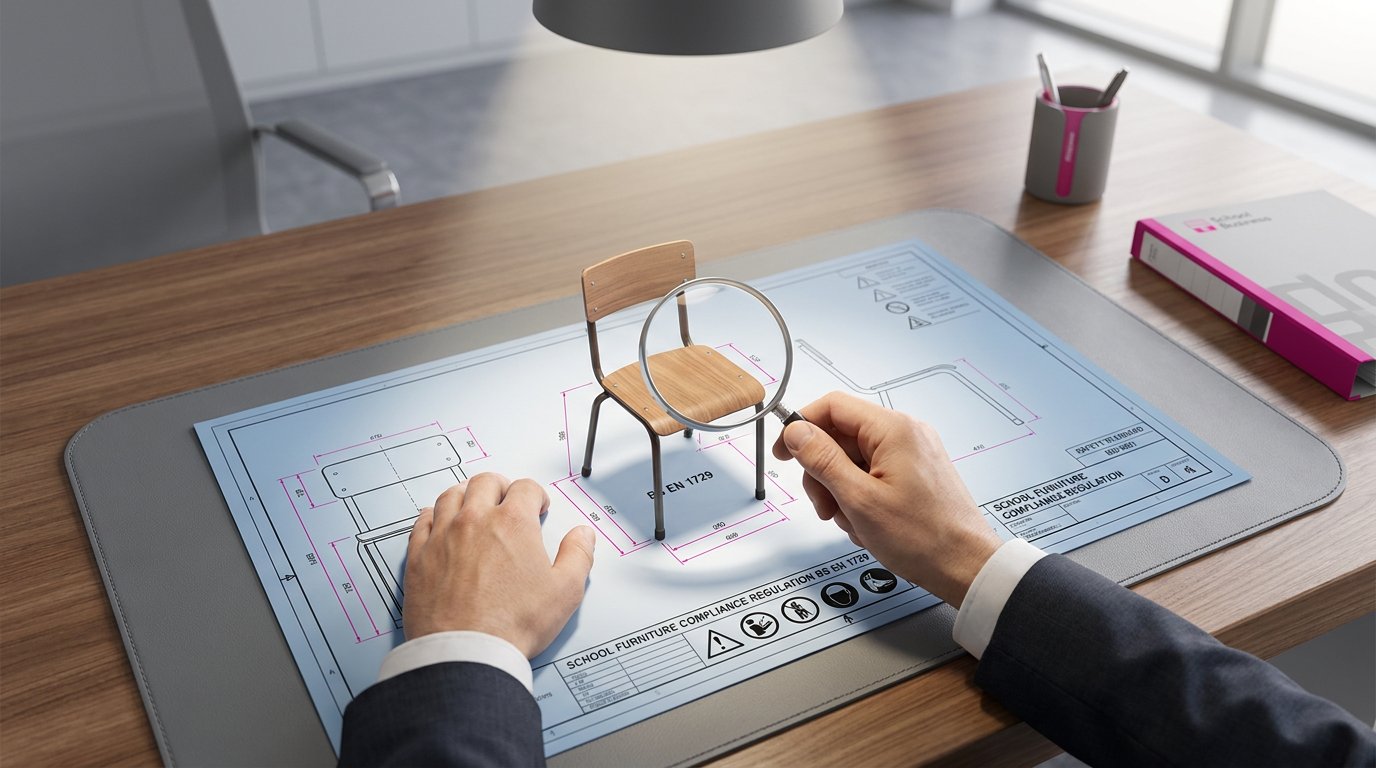
Yes, BS EN 1729 is the definitive European Standard that dictates the appropriate size, shape, and ergonomic design of chairs and tables within UK educational institutions. It is not just a recommendation; it is the benchmark for creating physically supportive learning environments. Adherence to this standard directly impacts pupil well-being, concentration, and long-term health.
BS EN 1729 is divided into two key parts:
- Part 1: Functional Dimensions. This part focuses on getting the size right. It specifies chair seat heights, desk heights, and the spacing between them for different age groups. The goal is to ensure pupils can sit comfortably with their feet flat on the floor and their elbows at a natural height relative to the desk, promoting good posture.
- Part 2: Safety Requirements and Test Methods. This part ensures the furniture is strong and stable enough to withstand the demanding school environment. It sets requirements for strength and durability, simulating years of ‘severe contract use’.
The connection between correct posture and learning is well-documented. Research from bodies like the European Agency for Safety and Health at Work (EU-OSHA) (2022) highlights how prolonged sitting in poorly designed workstations is a major risk factor for musculoskeletal disorders. By using BS EN 1729 compliant ergonomic school furniture, you are investing in your pupils’ health and ability to focus. The standard uses a ‘Size Mark’ system, often colour-coded, to make it simple for schools to select the right furniture for each Key Stage.
| Size Mark | Colour Code | Pupil Stature (mm) | Recommended Age Group / Key Stage |
|---|---|---|---|
| 1 | Orange | 800 – 950 | 3-4 Years (Nursery) |
| 2 | Violet | 930 – 1160 | 4-6 Years (Reception / KS1) |
| 3 | Yellow | 1080 – 1210 | 6-8 Years (KS1) |
| 4 | Red | 1190 – 1420 | 8-11 Years (KS2) |
| 5 | Green | 1330 – 1590 | 11-14 Years (KS3) |
| 6 | Blue | 1460 – 1810 | 14+ Years (KS4 / Adult) |
Source: Based on data from glsed.co.uk and rotherham.gov.uk furniture guides.
What Are the General Safety Requirements for School Furniture?
Yes, beyond specific fire and ergonomic standards, all school furniture must be ‘fit for purpose’ and inherently safe for a busy educational environment. The Health and Safety Executive (HSE), Britain’s national regulator, provides guidance that all workplace equipment must be suitable and safe [1]. In a school context, this translates into several common-sense principles for school furniture safety standards.
Key general safety considerations include:
- Stability: Furniture, especially storage units like bookcases and cupboards, must be stable and not pose a tipping hazard.
- Structural Integrity: Chairs and desks must be reliable enough to handle daily use without collapsing or breaking. This is where the durability tests in BS EN 1729 Part 2 become critical.
- Absence of Hazards: There should be no sharp edges, protruding screws, or points where fingers, limbs, or clothing could become trapped.
We believe this is also a crucial budget issue. Investing in furniture that meets high durability standards (often described as ‘severe contract use’) significantly reduces ongoing repair and replacement costs. While a cheaper, non-compliant chair might seem like a saving, it often represents poor long-term value. The UK office and institutional furniture market is substantial, with Statista data projecting significant revenue, highlighting the scale of investment organisations make [6]. Ensuring this investment is channelled into durable, safe, and compliant products is a core tenet of achieving Best Value and effective classroom furniture compliance.
A Practical Procurement Checklist for Compliant School Furniture
Knowing the school furniture regulations is one thing; applying them in a real-world procurement process is another. To bridge this gap, we’ve developed a practical checklist based on our 35+ years of experience helping schools get it right. This isn’t just about ticking boxes; it’s about establishing a process that may help safety, value, and a smooth project from start to finish. For a more detailed walkthrough, you can consult our complete school furniture projects guide.
- Verify Supplier Credentials: Check if the supplier is a member of a recognised trade body like the British Educational Suppliers Association (BESA).
- Request Compliance Certificates: typically ask for and file documentation proving that products meet BS EN 1729 and relevant fire safety standards (e.g., BS 5852 Crib 5).
- Match Size Marks to Key Stages: Use the BS EN 1729 size mark table to ensure you are buying the correct ergonomic fit for your pupils.
- Consider the Specific Environment: A chair for a science lab has different requirements from one in a library. Choose materials and designs appropriate for the intended use.
- Evaluate Long-Term Value: Look beyond the initial price tag. Consider warranty length, material quality, and durability testing as indicators of total cost of ownership.
- Plan for Logistics: Discuss delivery timescales, installation requirements, and removal of old furniture with your supplier. Planning this around school holidays is often crucial for Saving Time & Stress.
Hypothetical Case Study: A Primary School’s Compliance Journey
Challenge: A multi-academy trust identified that one of its primary schools was using a mix of outdated, non-compliant furniture. This resulted in an annual replacement budget of over £15,000 and concerns about pupil posture.
Solution: We worked with the School Business Manager to conduct a full site audit. A phased, three-year replacement plan was created, prioritising the classrooms with the most urgent needs. BS EN 1729 Size Mark 3 & 4 furniture was selected for KS1 and KS2 respectively.
Results: The school achieved full compliance within two years. The annual budget for reactive furniture repair and replacement dropped by over 60%. Teachers also reported anecdotal improvements in pupil attentiveness during lessons.
Key Insight: A strategic, phased approach, guided by an experienced supplier, can make a large-scale compliance project manageable and cost-effective.
Frequently Asked Questions About School Furniture Compliance
What are the key school furniture regulations UK schools must follow?
The primary school furniture regulations UK schools must follow are BS EN 1729 and The Furniture and Furnishings (Fire) (Safety) Regulations 1988. BS EN 1729 governs the ergonomic sizing and durability of chairs and tables to support pupil health and concentration. The fire safety regulations are a legal requirement for upholstered items, mandating they resist ignition to protect occupants in the event of a fire.
What does furniture need to comply with in a school?
School furniture must be safe, durable, and fit for its intended educational purpose. This means it should conform to specific standards like BS EN 1729 for sizing and strength, and UK fire regulations for any upholstered components. Furthermore, under general health and safety principles from the HSE, it must be stable and free from physical hazards like sharp edges or entrapment points to ensure a safe learning environment.
What are the main fire regulations for furniture in the UK?
The main legislation is The Furniture and Furnishings (Fire) (Safety) Regulations 1988. For contract environments like schools, this typically requires upholstered furniture to meet a higher standard of fire resistance than domestic items. This is often demonstrated by passing the BS 5852 ‘Crib 5’ ignition test, which simulates a more significant fire source, ensuring materials are sufficiently flame-retardant for a public space.
What is the BS5852 standard?
BS 5852 is a British Standard used to assess the ignitability of upholstered seating by smouldering and flaming ignition sources. It sets out various test methods to determine how a piece of furniture will react in a fire scenario. The ‘Crib 5’ test is a specific, more stringent level within this standard that is required for furniture used in most non-domestic, public-facing environments, including schools, to ensure higher safety levels.
What is BS EN 1729?
BS EN 1729 is the key European standard for chairs and tables in educational institutions. It is split into two parts: Part 1 specifies the correct functional dimensions, like height and depth, to ensure an ergonomic fit for pupils of different ages. Part 2 sets out the safety requirements and testing methods for strength and durability, ensuring the furniture can withstand the demands of a school environment.
How do I choose the right size furniture for my classroom?
You should choose furniture by matching the BS EN 1729 ‘Size Mark’ to the average height and age of the pupils using the room. Reputable suppliers use this standardised, colour-coded system to simplify selection. For example, Size Mark 4 (Red) is generally recommended for pupils aged 8-11 in Key Stage 2. This ensures pupils can maintain a healthy posture, which is vital for their comfort and concentration.
Is second-hand furniture compliant for schools?
Using second-hand furniture is very risky as it’s extremely difficult to verify its compliance history. Without the original certificates to prove it meets BS EN 1729 durability and, crucially, the legal fire safety standards, it poses a significant liability. We’ll be honest – the potential safety risk and legal ramifications mean that most schools should avoid this route to ensure pupil safety and due diligence.
What furniture is needed in a classroom?
The essential furniture for a typical classroom includes correctly sized tables and chairs for all pupils, a teacher’s desk and chair, and effective storage. This often involves a mix of bookcases, cupboards, and tray units to keep the learning space organised and safe. You can find many practical Classroom Storage Ideas to optimise your space. All items, however, must meet the relevant UK safety and durability standards for educational use.
Does all school furniture need a fire label?
Only furniture containing upholstery, foam, or other specified filling materials needs to comply with fire safety regulations. Items like staff room sofas, soft seating, and padded chairs must have evidence of compliance, which can be a label or supplier certification. Hard plastic chairs, wooden stools, or all-metal tables do not fall under the scope of The Furniture and Furnishings (Fire) (Safety) Regulations and therefore do not require a fire label.
What are the general safety rules in UK schools for facilities?
Under Health and Safety Executive (HSE) guidance, schools have a duty of care to provide a safe environment. For facilities, this means ensuring buildings and equipment are well-maintained. Furniture must be stable and free from hazards like sharp corners or splintering wood. Additionally, circulation routes like corridors and classroom walkways must be kept clear of obstructions to allow for safe movement and emergency evacuation.
Important Considerations
This guide provides a comprehensive overview of the key regulations as of August 2026. However, legislation can be updated; for example, the government periodically reviews and proposes amendments to fire safety regulations. Therefore, this article is not a substitute for formal legal advice. We recommend that schools typically consult the latest official guidance from sources like the Health and Safety Executive (HSE) and Gov.uk before making major procurement decisions.
While procuring certified, new furniture from a reputable supplier is the recommended approach for likely to support compliance, some schools might consider alternatives. Custom-built or bespoke furniture, for instance, may not have undergone the same rigorous batch testing as mass-produced items, requiring extra due diligence. As mentioned, second-hand furniture presents significant challenges in verifying its compliance history, posing potential safety and legal risks that we believe outweigh the initial cost savings.
For large-scale refurbishment projects, new builds, or spaces with specialised requirements (e.g., science labs, SEN classrooms), we strongly recommend consulting a professional furniture supplier. An expert can conduct a site survey, create a compliant space plan, and manage the entire “Design To Install We Do It All!” process. This ensures safety, efficiency, and long-term value, ultimately Saving Time & Stress for busy school management teams.
Partner with an Expert for Stress-Free Compliance
Ultimately, adhering to the latest school furniture regulations in the UK is a non-negotiable responsibility that underpins pupil safety, well-being, and effective learning. By understanding the core principles of BS EN 1729 for ergonomics, fire safety laws for upholstered items, and general durability standards, School Business Managers can make procurement decisions that are not only compliant but also provide an effective long-term value. This is the foundation of excellent classroom furniture compliance.
At Cost Cutters UK, we have over 35 years of experience helping schools navigate these exact requirements. As our “Rated Excellent On Trustpilot” status shows, we are a trusted partner for hundreds of educational institutions. Our BESA-accredited team can help you select, plan, and install furniture that perfectly fits your space and compliance needs, often with Bulk Buy Discounts and flexible payment options like Credit Accounts Or Pay Flexibly. To see how we put these principles into practice, you can explore a case study on how we transformed a UK school’s learning spaces.
To ensure your next project is safe, successful, and stress-free, contact our specialists today.
Get a Free Space Plan & Quote
References
- Health and Safety Executive (HSE) – Government Guidance. Provides the legal framework and practical advice for ensuring workplace equipment is safe and suitable.
- European Agency for Safety and Health at Work (EU-OSHA) – International Body Research (2022). Highlights the issue of musculoskeletal disorders (MSDs) linked to prolonged sitting and poor workstation design.
- Department for Education (EYFS Framework) – Government Statutory Framework. Mandates that premises, furniture, and equipment must be ‘safe and suitable for their purpose’.
- British Educational Suppliers Association (BESA) – Professional Organisation Standard. Members adhere to a Code of Practice ensuring products are fit for purpose in education and meet safety standards.
- World Health Organization (WHO) – International Body Guideline (2020). Recommends limiting sedentary time, underscoring the health importance of ergonomic learning spaces.
- Statista – Market Research Data (2024). Provides data on the scale of the UK office and institutional furniture market.
- Gov.uk – Government Guidance. Provides the official text and explanatory notes for The Furniture and Furnishings (Fire) (Safety) Regulations.
- GLS Education – Industry Guide. Offers a practical visual guide to school furniture measurements and BS EN 1729 size marks.
- Rotherham Council – Local Authority Guidance. Publishes a guide to British and European furniture standards relevant to public procurement.
Related Resources
- The Ultimate School Furniture Projects Guide 2026: Tools & Resources for UK Schools
- Ergonomic School Furniture: A UK School’s Guide to Durability & Value
- When to Upgrade School Furniture: A UK School Business Manager’s Guide
Conclusion
Partner with an Expert for Stress-Free Compliance
In summary, adhering to the latest school furniture regulations in the UK is a non-negotiable responsibility that underpins pupil safety, well-being, and effective learning. By understanding the core principles of BS EN 1729 for ergonomics, fire safety laws for upholstered items, and general durability standards, School Business Managers can make procurement decisions that are not only compliant but also provide the best long-term value for their budget. Ensuring complete classroom furniture compliance is a foundational step in creating a successful learning environment.
At Costcutters UK, we have over 35 years of experience helping schools navigate these requirements. You can see how we transformed a UK school’s learning spaces as proof of our expertise. Our BESA-accredited team can help you select, plan, and install furniture that perfectly fits your space and compliance needs. To ensure your next project is safe, successful, and stress-free, contact our specialists today for a free space plan and quote.