
How to Conduct a Workplace Wellbeing Audit: A Manager’s Actionable Guide
🎯 Key Takeaway
A workplace wellbeing audit is a systematic process for UK organisations to evaluate how their work environment, culture, and practices impact employee health. It provides the data needed to create a healthier, more productive workplace, ultimately boosting performance and retention. By following a structured five-step process – define, gather, analyse, act, and review – you can translate audit findings directly into tangible improvements, from ergonomic furniture to enhanced breakout spaces, demonstrating a clear commitment to your team’s welfare.
A staggering 76% of employees in the UK experienced moderate-to-high levels of stress in 2023, according to research shared by Champion Health. This highlights a critical business reality: a stressed, unsupported workforce cannot perform at its best. As leaders and managers, fostering a thriving environment isn’t just a moral imperative; it’s a strategic one. The most effective starting point is a comprehensive workplace wellbeing audit. This process moves beyond guesswork, providing a clear, data-driven foundation for meaningful change. By systematically examining the core pillars of workplace wellbeing, you can identify specific pain points and opportunities. This guide provides a practical, step-by-step process for conducting an audit that delivers actionable results.
Written by: Costcutters UK Content Team | Reviewed by: Costcutters UK Editorial Team, Workplace Design & Furniture Specialists with 35+ Years Experience; Rated Excellent On Trustpilot
Last updated: 24 May 2026
ℹ️ Transparency Disclosure: This article explores how to conduct a workplace wellbeing audit based on industry best practices and guidance from UK bodies like the Health and Safety Executive (HSE) and the Chartered Institute of Personnel and Development (CIPD). Our recommendations are grounded in over 35 years of experience furnishing UK business and educational environments. Some links may connect to our services or products, which we believe offer effective solutions for the challenges discussed.
What Are the Pillars of Workplace Wellbeing?
To conduct a meaningful audit, you first need to understand what you’re measuring. The core pillars of workplace wellbeing provide a holistic framework, ensuring no critical area is overlooked. While various models exist, most are built upon four foundational themes, strongly endorsed by UK bodies like the Chartered Institute of Personnel and Development (CIPD), an organisation representing HR professionals, and the Health and Safety Executive (HSE), Britain’s national workplace safety regulator.

A holistic view across all four pillars is essential to accurately measure workplace wellbeing. Focussing on only one area, such as physical health, whilst ignoring psychological stress, gives you an incomplete picture and leads to ineffective solutions.
The four key pillars are:
- Mental/Psychological Wellbeing: This pillar addresses an employee’s psychological health, including stress, anxiety, and their ability to cope with work pressures. The HSE’s management standards (2024) provide a robust framework here, covering demands, control, and support. An office environment that supports this includes designated quiet zones for focused work and private spaces for sensitive conversations.
- Physical Wellbeing: This goes beyond basic safety to encompass physical health, comfort, and activity. It includes everything from ergonomic setups that prevent musculoskeletal issues to promoting movement throughout the day. A tangible example is providing fully adjustable, BSI-compliant chairs and sit-stand desks to accommodate diverse physical needs.
- Social Wellbeing: This pillar concerns the quality of relationships and connections amongst colleagues, managers, and the wider organisation. A strong sense of belonging and community is a powerful buffer against stress. Well-designed breakout areas with comfortable seating and refreshment stations can act as central hubs that encourage informal interaction and collaboration.
- Financial Wellbeing: This refers to an employee’s ability to manage their financial life without excessive stress. A 2022 report from Deloitte UK found that poor mental health costs UK employers up to £56 billion a year, with financial worries being a major contributor. While direct intervention is complex, organisations can help by offering access to financial advice, clear communication on pay and benefits, and flexible payment options where appropriate.
How to Conduct Your Workplace Wellbeing Audit: A 5-Step Guide
A successful workplace wellbeing audit is a structured project, not a casual survey. By following a clear, five-step cycle, you can transform data into a strategic roadmap for a better workplace, Saving Time & Stress in the long run. This process ensures your efforts are focused, evidence-based, and lead to measurable improvements.
We recommend this framework because it’s scalable and can be adapted for any organisation, from a small business to a large corporation. Think of it as a continuous improvement loop.
- Define Scope & Objectives: Decide exactly what you want to measure and achieve.
- Gather Comprehensive Data: Use a mix of methods to collect both quantitative and qualitative insights.
- Analyse Findings: Identify key themes, patterns, and priority areas from the data.
- Create a Tangible Action Plan: Translate your findings into specific, measurable, and prioritised actions. This is where an employee wellbeing audit template can be invaluable.
- Implement & Review: Put your plan into action and establish a cycle for measuring its impact over time.
Step 1 & 2: Define Scope and Gather Comprehensive Data
The first step in your audit is to set clear boundaries and goals. Before you begin, decide precisely what you want to measure workplace wellbeing against. Are you auditing the entire organisation or a specific department? Are you focusing on hybrid workers, in-office staff, or both? Your objectives should also be specific. For example, your goal might be to ‘reduce reported stress levels by 15% in the next 12 months’ or ‘build a business case for a £20,000 investment in new ergonomic furniture’.

Once your scope is defined, you can proceed with gathering data. We strongly advise a mixed-method approach to get a complete picture. This involves:
- Quantitative Data: Anonymous surveys are the cornerstone of this stage. An effective office wellbeing survey uses a scale (e.g., 1-5) to ask about stress levels, work-life balance, satisfaction with the physical environment, and management support. This gives you hard numbers and allows for easy trend analysis.
- Qualitative Data: Numbers tell you what is happening, but conversations tell you why. Conduct confidential one-to-one interviews or small focus groups to explore the themes from your survey in more depth. This is where you’ll uncover the nuances behind the data.
- Physical Environment Assessment: This is a crucial, often overlooked, step. Walk the floor. Assess workstations against Display Screen Equipment (DSE) regulations, which are UK legal rules for user protection. Measure light and noise levels. Observe how spaces are actually used. Is the ‘quiet zone’ constantly interrupted? Are people eating at their desks because the breakout area is uninviting?
| Data Collection Method | Primary Focus | Advantages | Considerations |
|---|---|---|---|
| Anonymous Surveys | Quantitative feedback on a wide range of topics | Fast, scalable, provides measurable benchmarks and trend data. | Lacks nuance; results can be skewed if question design is poor. |
| Confidential Focus Groups | Qualitative insights and group dynamics | Uncovers the ‘why’ behind survey data; fosters open discussion. | Can be influenced by dominant personalities; requires skilled facilitation. |
| 1-to-1 Interviews | Deep qualitative understanding of individual experiences | effective for sensitive topics; provides rich, detailed feedback. | Time-consuming; findings may not be broadly generalisable. |
| Physical Environment Walk-Through | Objective assessment of the workspace | Gathers factual data on ergonomics, lighting, and space usage. | Doesn’t capture employee perceptions without being paired with other methods. |
Step 3 & 4: Analyse Findings and Create a Tangible Action Plan
With your data collected, the next step is to analyse it to identify clear themes and priorities. Start by looking for patterns in your survey results. For example, you might find that ‘45% of respondents in the finance team report unmanageable workloads’, or ‘70% of all staff rate their chair as uncomfortable’. Cross-reference these quantitative findings with the qualitative feedback from your focus groups to understand the context. The goal here is to move from a mountain of data to a short, actionable list of key problem areas.
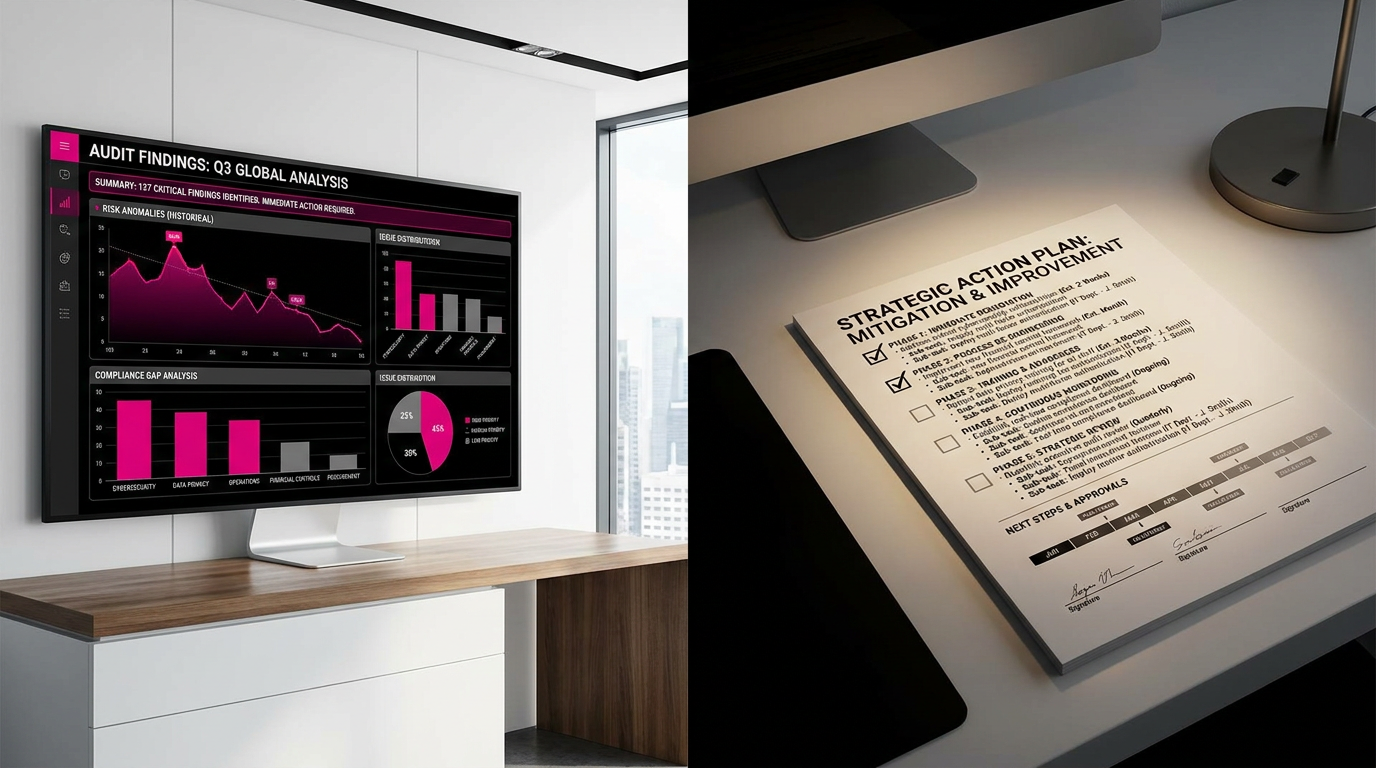
Once you have your key findings, you must translate them into a prioritised action plan. An effective way to do this is using a ‘Gap Analysis’ approach within your employee wellbeing audit template:
- Current State (The Finding): What does the data say? (e.g., “Staff feel disconnected and social interaction is low.”)
- Future State (The Goal): What is the desired outcome? (e.g., “Create a vibrant central hub that encourages cross-departmental collaboration.”)
- The Gap (The Action): What specific, measurable action will bridge this gap? (e.g., “Invest in new modern breakout furniture to redesign the canteen into a multi-purpose social hub by Q3.”)
Your workplace wellbeing checklist of actions should be prioritised based on impact and feasibility. A finding like ‘poor ergonomic setups leading to back pain’ should be a high priority, with a clear action: ‘Procure 50 BSI-compliant ergonomic chairs within the next quarter’.
### Case Study: A Hypothetical Scenario
– Challenge: A mid-sized tech firm in Manchester noticed a 20% increase in short-term sickness absence over six months. Exit interviews frequently mentioned ‘burnout’ and a ‘lack of team connection’ since moving to a hybrid model.
– Solution: The facilities manager conducted a wellbeing audit. The survey revealed high stress scores and low ratings for the physical office environment. Focus groups demonstrated that the office felt ‘sterile’ and wasn’t suited for the collaborative tasks people came in for.
– Results: Based on the audit, the company invested £35,000 in redesigning a section of the office. They replaced rows of desks with collaborative booths, high tables, and comfortable lounge areas. They also upgraded all remaining desk chairs to fully ergonomic models. Within a year, sickness absence fell by 15%, and a follow-up survey showed a 40% improvement in scores related to ‘office environment satisfaction’.
– Key Insight: The audit provided the concrete evidence needed to justify the furniture investment to the board, linking it directly to business metrics like absenteeism.
Step 5: From Plan to Reality – Implementation and Review
Creating a plan is one thing; bringing it to life is another. The implementation phase is where your commitment to wellbeing becomes visible to every employee. The first action should typically be communication. Share a summary of the audit findings (without breaking confidentiality) and the action plan you’ve created. This transparency builds trust and shows that you’ve listened. What does this mean for you? It means your team sees direct results from their feedback.
For larger projects, such as a complete office refurbishment, we recommend a phased rollout. This minimises disruption and allows you to gather feedback as you go. Perhaps you start by upgrading one floor’s furniture or piloting a new quiet zone. This practical approach helps manage budgets and logistics effectively. We offer flexible payment options, including Credit Accounts Or Pay Flexibly, to help manage these project costs.
Finally, a workplace wellbeing audit is not a one-off event. To prove the value of your changes and maintain momentum, you must review their impact. We advise scheduling:
- Quarterly Pulse Surveys: Short, 3-5 question surveys to check in on key metrics you aimed to improve.
- Annual Full Audit: Repeat the comprehensive audit each year to track long-term progress, identify new challenges, and reset your priorities.
This continuous cycle is the foundation of a sustainable wellbeing strategy and is a core part of learning how to conduct a workplace audit effectively.
Your Audit and the Physical Office: Linking Data to Design
One of the most powerful outcomes of a workplace wellbeing audit is the clear, evidence-based case it creates for investing in your physical environment. Too often, furniture and design decisions are based on aesthetics or budget alone. An audit allows you to link procurement directly to employee needs, ensuring every pound spent delivers a tangible return on wellbeing.
This is where our ‘Design To Install We Do It All!’ service adds significant value. We help you translate data into reality. Consider these ‘If This, Then That’ scenarios:
- If your audit reveals… high scores for stress and a lack of quiet space for concentration.
- Then your action should be… to create dedicated ‘focus zones’ using acoustic pods or high-backed privacy sofas. These signal that deep work is valued and protected.
- If your DSE assessments flag… a high percentage of employees with poor posture or discomfort.
- Then your action should be… to invest in high-quality, fully adjustable ergonomic office chairs. This is a direct intervention to prevent costly musculoskeletal issues and demonstrates a duty of care.
- If your survey shows… low scores on social connection and a feeling of isolation.
- Then your action should be… to design a dynamic breakout space with modular furniture, coffee points, and a mix of seating types to encourage spontaneous interaction.
- If your findings point to… a desire for more flexibility and autonomy.
- Then your action should be… to create agile work zones with a variety of settings – high tables for quick touch-downs, booths for small group work, and comfortable lounge chairs for informal meetings.
When making these investments, typically look for UK-compliant and certified furniture. Products that meet British Standards (BSI) have been rigorously tested for safety, durability, and performance, ensuring your investment is sound and long-lasting. Plus, with Bulk Buy Discounts, upgrading your office can be more affordable than you think.
Frequently Asked Questions
What is a workplace wellbeing audit?
A workplace wellbeing audit is a formal and systematic review of how an organisation’s culture, practices, and physical environment impact its employees’ health. It uses data collection methods like surveys and focus groups to identify risks and opportunities. The ultimate goal of a workplace wellbeing audit is to create an evidence-based action plan for building a healthier, more productive, and more supportive place to work.
What are the 4 pillars of workplace wellbeing?
The four most commonly recognised pillars are mental/psychological, physical, social, and financial wellbeing. A comprehensive audit addresses all four to provide a holistic view of employee welfare. This structured approach ensures you consider everything from stress levels and ergonomic comfort to social connections and financial security, leading to more effective and balanced interventions that cater to the whole person, not just the employee.
How do you measure wellbeing in the workplace?
Wellbeing is best measured using a combination of quantitative and qualitative methods for a complete picture. This includes anonymous surveys to gather scalable data on topics like stress and satisfaction, alongside confidential focus groups or interviews to understand the ‘why’ behind the numbers. This should be supplemented with physical assessments of the work environment, including ergonomics, lighting, and noise levels, to provide objective data.
How do you conduct a workplace audit?
A successful audit follows a five-step cycle: define goals, gather data, analyse findings, create an action plan, and review. First, set clear objectives for what you want to achieve. Next, collect information using surveys, interviews, and observations. Then, analyse this data to pinpoint key issues. Based on this, develop a prioritised action plan with specific goals, and finally, implement the changes and regularly review their impact.
What are the 5 C’s of wellbeing?
The ‘5 C’s’ is a personal wellbeing framework, typically including Connect, Care, Challenge, Commit, and Celebrate. While it’s a useful concept for promoting individual resilience and a positive mindset, it isn’t a formal structure for a corporate audit. Workplace audits generally use broader pillars like mental, physical, social, and financial health to assess organisational factors rather than individual behaviours, although the two are complementary.
What are the six pillars of workplace wellbeing?
Some frameworks expand the core four pillars to six to add more detail and granularity. These often separate ‘Career’ wellbeing (covering growth and development) and ‘Community’ wellbeing (addressing belonging and social impact) into their own categories. While the four-pillar model is sufficient for most audits, a six-pillar approach can be useful for larger organisations or those wanting to focus specifically on career progression or corporate social responsibility.
What is the 3-3-3 rule in mental health?
The 3-3-3 rule is an anxiety-grounding technique, not an audit tool, but it’s a useful resource to share with staff. It involves a simple exercise: name three things you can see, identify three sounds you can hear, and then move three parts of your body. This technique helps pull your focus away from anxious thoughts and back to the present moment. It’s a practical coping strategy for individuals, separate from the strategic audit process.
What are the 5 C’s of audit?
The ‘5 C’s of Audit’ is a term from financial and compliance auditing, not wellbeing. It typically stands for Condition (the problem), Criteria (the standard), Cause (why it happened), Consequence (the impact), and Corrective Action (the solution). While the logical process of identifying a cause and proposing a correction is similar to a wellbeing audit, the specific terminology and focus are very different and shouldn’t be confused.
How often should we conduct a wellbeing audit?
We recommend conducting a full, comprehensive workplace wellbeing audit on an annual basis. This allows you to track year-on-year progress and identify emerging trends. To supplement this, you should use more frequent, lighter ‘pulse’ surveys – perhaps quarterly – to monitor the immediate impact of any changes you’ve implemented. This consistent rhythm of feedback and action is crucial for building and maintaining employee trust.
What is the difference between a wellbeing audit and a safety audit?
A safety audit is legally focused on preventing physical harm, whereas a wellbeing audit is much broader. A safety audit ensures compliance with HSE regulations on issues like fire safety, trip hazards, and machinery guards. A wellbeing audit, however, covers psychological, social, and financial health in addition to physical comfort and ergonomics. The two are complementary, but a safety audit is about compliance, while a wellbeing audit is about creating a thriving culture.
Important Considerations and Limitations
An internal audit is a powerful tool, but it’s vital to be aware of its limitations. The data gathered from surveys is self-reported and can be influenced by an employee’s mood on the day or a fear of being identified, even when the survey is anonymous. This is precisely why we advocate for a mixed-method approach. Combining survey data with confidential focus groups and objective physical assessments helps to validate findings and provide a more balanced, accurate picture.
There are, of course, alternative approaches. You could hire an external occupational health or HR consultancy to conduct the audit. This can offer a higher degree of impartiality and access to specialised expertise. However, this option often comes with a significant price tag. For most organisations, especially Small and Medium-sized Enterprises (SMEs), an internal audit following the framework outlined here is a highly effective and cost-efficient first step to taking control of workplace wellbeing.
Finally, you must recognise the limits of your own expertise. If your audit uncovers serious or systemic issues related to mental health crises, harassment, discrimination, or severe burnout, it is your responsibility to escalate these. In such cases, you should consult with HR professionals, occupational health services, or specialist organisations like Mind. They can provide the professional, confidential support that goes beyond the scope of facilities management or general leadership.
Conclusion: Turning Insight into a Thriving Workplace
A successful workplace wellbeing audit provides a clear, actionable roadmap for creating an environment where your team can truly thrive. By systematically gathering and analysing data on everything from psychological safety to physical comfort, your organisation can move beyond guesswork. You can make targeted, evidence-based investments that enhance productivity, reduce absenteeism, and improve employee retention. This process transforms wellbeing from a vague corporate buzzword into a measurable strategic priority.
Translating your audit findings into a physical reality is the most critical step, and it’s where we excel. With over 35 years of experience and a service that is Rated Excellent On Trustpilot, Costcutters UK specialises in helping businesses and schools design and furnish spaces that actively promote wellbeing. If your audit has highlighted a need for better ergonomics, more collaborative zones, or dedicated quiet spaces, our expert team is here to help.
Book a Free Space Planning Consultation today to discuss how we can help you turn your audit data into a workplace that works for everyone.
References
- Health and Safety Executive (HSE) – UK Government Guidance. This source provides the official management standards for tackling work-related stress, forming a legal and practical basis for the mental wellbeing pillar.
- CIPD – Professional Body Hub. The CIPD offers extensive research, factsheets, and practical guides on creating a holistic wellbeing strategy, covering all key pillars discussed.
- Deloitte UK – 2022 Industry Report. This report, based on extensive market analysis, quantifies the Return on Investment (ROI) for employer spending on mental health, finding a £5 return for every £1 invested.
- Mind – Charity Guidance. Mind provides accessible resources and toolkits for creating mentally healthy workplaces, including guides for managers and templates for Wellness Action Plans.
- Champion Health – 2023 Workplace Health Report. This report surveyed over 5,000 UK employees to provide data on stress, anxiety, and other key wellbeing metrics.