School Furniture Budgeting: What £5k, £10k, and £20k Buys in the UK
🎯 Key Takeaway
Effective school furniture budgeting requires a detailed needs analysis followed by strategic allocation to specific budget tiers, with £5k enabling a zone refresh, £10k a full classroom, and £20k larger projects. A £5,000 budget can effectively refresh a specific zone, such as a reading corner or small staff area, with new seating and storage. A £10,000 budget typically allows for a complete refurbishment of a standard 30-pupil classroom, including new desks, chairs, and teacher furniture. A £20,000 budget can furnish larger, more specialised areas like a small library, an IT suite, or multiple classroom zones. This guide provides tangible, itemised examples to help you plan your next procurement project with confidence.
For School Business Managers and Headteachers, stretching a tight budget to create an inspiring and effective learning environment is a constant challenge. For school furniture budgeting, the abstract numbers on a spreadsheet can feel disconnected from the tangible reality of what they can achieve. This guide demystifies the process. As of Q2 2026, we will break down exactly what budget tiers of £5,000, £10,000, and £20,000 can secure for your school in the UK. Smart educational furniture budget planning isn’t just about spending less; it’s about investing wisely in cost-effective school furniture that enhances learning outcomes. We’ll provide concrete examples and shopping lists to empower your decisions, backed by our 35+ years of experience. You can also explore our full range of educational supplies to see the options available.
👤 Written by: Content Team
Reviewed by: Editorial Team, Industry Specialists
Last updated: 25 April 2026
ℹ️ Transparency: This article explores school furniture budgeting based on our 35+ years of industry experience and project data. Some links may connect to our services, such as our free space planning consultation. All information and pricing estimates are verified by our editorial team. Costcutters UK is a leading supplier of school and educational equipment in the UK.
Before You Spend: Core Principles of School Furniture Budgeting
Before allocating a single pound, a thorough needs assessment is essential for effective educational furniture budget planning. In our experience, asking the right questions at the start prevents costly mistakes later. We recommend starting with this checklist:
- Prioritise Your Spaces: Which areas are in most urgent need of an upgrade? Is it a Year 4 classroom with wobbly chairs, an outdated library, or a staff room that offers no real respite? Rank your priorities to focus your school refurbishment budget where it will have the most impact.
- Define Pedagogical Needs: How is the space used for teaching and learning? Does it need to support collaborative group work, individual focused study, or a mix of both? The furniture choices should support your educational goals.
- Assess Durability and Compliance: School furniture must be built to last. We believe that specifying products that are fully compliant with all UK safety and durability standards is non-negotiable. Look for BS EN 1729, which is the UK and European standard for dimensions, strength, and stability of educational furniture. This ensures the furniture is ergonomically sound and safe for daily use.
- Create a Phased Plan: If your total requirements exceed the immediate budget, create a multi-year phased plan. This demonstrates strategic thinking and can make securing future funds easier.
- Explore Funding Streams: Beyond your core allocation, investigate other furniture funding for schools UK options. For eligible academies, the Condition Improvement Fund (CIF), a UK government capital funding programme for academies, can support larger projects. General guidance from bodies like the Resource Centre NZ (2023) highlights the importance of aligning property management with long-term financial planning, a principle that applies directly here.
What a £5,000 Budget Buys: A Targeted Zone Refresh
A £5,000 budget can make a significant, high-impact improvement by focusing on a specific zone within a larger room. This approach allows you to address a pressing need and create a fresh, engaging area without requiring a full-scale overhaul. It’s about being strategic and choosing cost-effective school furniture that delivers maximum impact for a modest investment. Even small changes can make a big difference, a point noted in an article by Envoplan (2024), which suggests targeted updates can dramatically improve school interiors.
Consider these two common scenarios:
- A Vibrant Primary School Reading Corner: Transform a tired corner into an inviting space that encourages reading for pleasure. This involves soft, comfortable seating, accessible book storage, and a splash of colour.
- A Refreshed Staff Breakout Area: Give your staff a more comfortable and professional space to recharge. This could involve replacing worn-out sofas with modern modular seating and functional tables.
Here is an example shopping list for a reading corner project:
- Soft Seating: 2 x Two-Seater Tub Sofas (£700 – £900)
- Floor Cushions: 10 x Large, durable floor cushions (£250 – £350)
- Book Storage: 3 x Low-level, forward-facing bookcases (£600 – £800)
- Feature Rug: 1 x Large, hard-wearing colourful rug (£300 – £400)
- Display: 1 x Wall-mounted noticeboard or display rail (£150 – £250)
- Contingency & Delivery: (£500+)
Total Estimated Cost (ex. VAT): £2,500 – £3,200
This leaves a healthy portion of your £5k budget for other small improvements or to invest in higher-specification items. To see how we can tailor a solution to your exact space and budget, you can get a free, itemised quote for your project.
What a £10,000 Budget Buys: A Complete Classroom Refurbishment
With a budget of £10,000, you can achieve a complete furniture refurbishment for a standard UK classroom of 30 pupils. This level of investment is transformative, allowing you to replace worn, mismatched items with a cohesive, ergonomic, and modern set of furniture that directly supports a positive learning environment. This is often the budget point where schools see the most dramatic ‘before and after’. A guide from Meteor Education (2026) advocates for this kind of holistic, long-term approach to classroom investment, considering both functionality and return on investment.
A typical project of this scale includes new tables and chairs for all pupils, a dedicated teacher’s station, and ample storage. The specific classroom furniture costs UK can vary, but the following breakdown provides a realistic estimate based on contract-quality, compliant furniture.
| Item Category | Example Products | Quantity (for 30 pupils) | Estimated Cost Range (ex. VAT) |
|---|---|---|---|
| Pupil Desks | Fully-welded frame cluster tables (seats 2) | 15 | £2,400 – £3,000 |
| Pupil Chairs | BS EN 1729 compliant polyprop chairs | 30 | £900 – £1,200 |
| Teacher’s Desk | Pedestal desk with locking drawers | 1 | £250 – £400 |
| Teacher’s Chair | Ergonomic operator chair | 1 | £150 – £250 |
| Storage Units | Tall bookcases or Gratnells tray units | 2-3 | £800 – £1,500 |
| Whiteboard | Large magnetic wall-mounted whiteboard | 1 | £200 – £350 |
| Subtotal | £4,700 – £6,700 |
The remaining budget (approx. £3,300 – £5,300) provides crucial flexibility. You could upgrade to height-adjustable tables, invest in more specialised storage solutions, create a dedicated soft-seating zone within the classroom, or cover the costs of installation and removal of old furniture. This comprehensive approach, as highlighted by an article from Witley Jones (undated), saves significant staff time and stress. To plan your classroom project, get a free, itemised quote for your project.
What a £20,000 Budget Buys: Multi-Zone or Specialised Areas
A £20,000 budget empowers you to undertake larger, more ambitious projects that can redefine how learning happens in your school. This level of investment moves beyond replacing like-for-like and allows for the creation of new, purpose-built environments. It’s an opportunity to align your physical space with modern pedagogical approaches, whether that’s creating a central resource hub or upgrading facilities to support a Science, Technology, Engineering, and Mathematics (STEM) curriculum. The focus here is on creating durable, high-value spaces, as firms like Warner Contract Furniture (undated) note that furniture built to last is key to success in the education sector.
With a substantial school refurbishment budget like this, you could consider:
- Furnishing a Small Library or Resource Centre: This involves more than just shelving. You can create distinct zones for quiet study (study carrels), collaborative work (cluster tables), and relaxed reading (soft seating). This budget would cover extensive shelving, a librarian’s desk, and a variety of seating for 20-30 pupils.
- Equipping a New IT Suite or Tech Hub: This requires specialised furniture. The budget could furnish a 30-pupil suite with dedicated IT benching with integrated cable management, ergonomic computer chairs, secure charging trolleys for laptops or tablets, and a teacher’s workstation.
- Refurbishing Two Full Classrooms: Alternatively, this budget could be used to complete two full classroom refurbishments as detailed in the £10,000 scenario, delivering excellent value and consistency across a year group. This is where Bulk Buy Discounts can make a real difference.
An article from Education Business UK (2022) stresses the importance of not sacrificing quality for short-term savings, a principle that is paramount when making a significant investment like this. A £20k project is a statement about a school’s commitment to providing first-class facilities. To discuss a large-scale project, get a free, itemised quote for your project.
Beyond the Price Tag: Calculating Total Cost of Ownership
In any school furniture procurement UK project, it’s tempting to focus solely on the upfront price of items. However, our experience shows this is a shortsighted approach. The true measure of value is the Total Cost of Ownership (TCO). TCO is a financial estimate that includes the initial purchase price plus all direct and indirect costs over the furniture’s entire lifespan.
What are these “hidden” costs of a DIY procurement approach?
- Staff Time: The hours your team spends researching products, vetting multiple suppliers, creating purchase orders, and coordinating deliveries. This is time taken away from their core responsibilities.
- Delivery Logistics: Managing multiple deliveries from different companies, each with its own schedule and potential for delays.
- Installation Labour: The physical work of unboxing, assembling, and positioning dozens or hundreds of items. Is this a good use of your site manager’s time?
- Waste Disposal: The cost and hassle of removing and responsibly disposing of vast amounts of packaging, plus all the old furniture being replaced.
This is where a full-service supplier provides immense value. Our “Design To Install We Do It All!” approach streamlines the entire process. We handle the space planning, product sourcing, a single coordinated delivery, professional installation by our trained team, and complete removal of all waste. This isn’t an extra cost; it’s a way of maximising the value of your budget by Saving Time & Stress. The same principles apply whether you are buying for a classroom or looking at new staff room or sixth form common room furniture. Choosing a partner who manages the entire project delivers a predictable outcome and a higher TCO, ensuring your investment is sound.
Important Considerations and Alternatives
The budget scenarios and prices detailed in this guide are estimates based on data from early 2026 and are exclusive of Value Added Tax (VAT), a consumption tax applied to goods and services in the UK, unless stated. Actual costs will vary depending on the specific products chosen, material finishes, supplier, and the timing of your project. We typically recommend obtaining a formal, itemised quote for accurate planning.
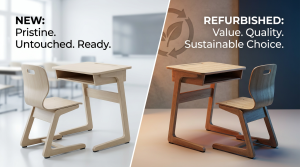
While sourcing second-hand furniture can seem like a cost-saving alternative, it carries risks. It often lacks the necessary BS EN 1729 compliance, may have a short remaining lifespan, and rarely comes with a warranty. For safety, compliance, and long-term value, our advice is that sourcing new from a specialised UK educational supplier is the recommended approach for most schools.
For any project larger than a single classroom, or one that involves reconfiguring a space, we strongly advise a professional space planning consultation. An expert can help you maximise your budget, ensure optimal layouts for teaching and learning, and guarantee full compliance with all relevant UK building and safety regulations. This initial step is crucial for project success.
Frequently Asked Questions About School Furniture Budgeting
What is school furniture budgeting?
School furniture budgeting is the strategic process of planning, allocating, and managing funds for acquiring furniture for educational environments. It involves balancing initial cost against long-term value, quality, durability, and the specific pedagogical needs of pupils and staff. This process is crucial for creating effective and safe learning spaces within financial constraints.
How much should a school budget for furniture per classroom?
For a complete refurbishment of a standard 30-pupil UK classroom, a budget of £8,000 to £12,000 is a realistic starting point. This typically covers new desks, chairs, essential storage units, and a teacher’s desk and chair. Costs can fluctuate based on product specifications, material quality, and whether services like installation are included.
What are the hidden costs in school furniture procurement?
Hidden costs often include separate delivery charges, fees for professional installation, the cost of removing and disposing of old furniture, and valuable staff time spent managing the project. A full-service supplier like us often bundles these into a single project cost, which provides better value, predictability, and is far more efficient.
How can UK schools find funding for furniture?
Beyond the main school budget, eligible academies and sixth-form colleges can apply for the Condition Improvement Fund (CIF) for significant upgrade projects. It’s also worth checking with your Local Authority or Multi-Academy Trust (MAT) for specific grants or centralised furniture funding for schools UK. Parent-teacher association fundraising can also be a great source for smaller projects.
What is the total cost of ownership for school furniture?
Total Cost of Ownership (TCO) includes the initial purchase price plus all costs incurred during the product’s life, such as maintenance, repairs, and eventual replacement. Cheaper furniture that needs replacing every 3-5 years often has a higher TCO than a durable, compliant option with a 10-year guarantee. Investing in quality saves money long-term.
How long should school furniture last?
High-quality, contract-grade school furniture that is compliant with standards like BS EN 1729 should have a lifespan of at least 10 years, even in a demanding school environment. Reputable suppliers who are Rated Excellent On Trustpilot will typically offer may help of 5-10 years on their products, which is a strong indicator of expected durability.
What is BS EN 1729 and why is it important?
BS EN 1729 is the key UK and European standard that specifies the functional dimensions, strength, and stability for chairs and tables in educational institutions. Choosing compliant furniture ensures it is ergonomically appropriate for children’s posture, supports concentration, and is durable enough to withstand the rigours of daily school use, making it crucial for pupil well-being and safety.
What’s the benefit of a bulk buy school furniture discount?
Purchasing furniture for multiple classrooms or a whole-school project at once often unlocks significant Bulk Buy Discounts from suppliers. This reduces the per-unit cost, allowing a school’s budget to stretch much further and achieve more. It is typically worth requesting a project quote for a larger, even if phased, procurement plan.
Can you mix and match furniture from different suppliers?
Whilst it’s possible, mixing suppliers can create logistical headaches with multiple deliveries, varying lead times, inconsistent quality, and mismatched aesthetics. Using a single-source supplier simplifies project management, ensures consistent compliance, and often provides better overall value through a bundled service. This approach is generally more efficient and less stressful for school staff.
How do you create a furniture proposal for a Multi-Academy Trust (MAT)?
A proposal for a MAT, which is a group of schools operating under a single governance structure in the UK, should focus on standardisation, compliance, and long-term value for money. It should clearly outline the educational benefits, the total cost of ownership, and the potential savings from centralised procurement. We recommend including data on product may help and supplier accreditations to build a strong case.
Plan Your Next School Furniture Project with Confidence
Successful school furniture budgeting is achievable with a clear understanding of what your funds can deliver. By establishing your needs and aligning them with realistic budget tiers – from a £5,000 zone refresh to a £20,000 specialised area – you can make informed decisions that enhance your learning environments. Prioritising total cost of ownership over initial price is a strategic move that ensures your investment is durable, compliant, and provides value for years to come in your school furniture procurement UK strategy.
If you are planning a school refurbishment, our team at Costcutters UK is here to help. With over 35 years of experience, we can translate your vision into a practical, budget-friendly reality. We also offer flexible payment options to suit your needs, whether you need to Credit Accounts Or Pay Flexibly. Book a free, no-obligation space planning consultation today to get a detailed plan and itemised quote for your project.
References
- Witley Jones – (Undated) Article. Highlights the benefits of a turnkey service for school furniture projects, saving staff time and resources.
- Warner Contract Furniture – (Undated) Product Page. Emphasises the need for furniture that can withstand the rigours of the education sector, from classrooms to canteens.
- Resource Centre NZ – (2023) Guide. Provides general principles for school budgeting, applicable to finance and property management.
- Envoplan – (2024) Article. Suggests that small, targeted changes can make a big difference in the feel of a school interior on a limited budget.
- Education Business UK – (2022) Article. Stresses the importance of not sacrificing quality for short-term cost savings in school furniture procurement.
- Meteor Education – (2026) Guide. Advocates for a long-term, phased approach to furniture budgeting, considering ROI and instructional fit.
Conclusion
In summary, effective school furniture budgeting is achievable with a clear understanding of what your funds can deliver. By establishing your needs and aligning them with realistic budget tiers—from a £5,000 zone refresh to a £20,000 specialised area—you can make informed decisions that enhance your learning environments. Prioritising total cost of ownership over initial price is a strategic move that ensures your investment is durable, compliant, and provides value for years to come in your school furniture procurement UK strategy.
If you are planning a school refurbishment, our team at Costcutters UK is here to help. With over 35 years of experience, we can translate your vision into a practical, budget-friendly reality. Book a free, no-obligation space planning consultation today to get a detailed plan and itemised quote for your project.