Office Fit-Out Costs: The Ultimate UK Budgeting & ROI Guide (2026)
🎯 Key Takeaway
Understanding office fit-out costs is essential for any UK workspace project, with typical prices ranging from £40 to over £250 per square foot depending on the specification level. These costs are primarily determined by the fit-out category (Cat A or Cat B), location, and the quality of finishes and furniture selected. A key factor influencing the final bill is the estimated office fit out costs per square foot, which varies significantly across regions. For a successful project, it’s vital to grasp the core cost drivers and plan accordingly.
- Cost Categories: A basic Category A Fit-Out (Cat A), the landlord’s finish, is fundamentally different from a tenant’s Category B Fit-Out (Cat B), which includes furniture, branding, and meeting rooms.
- Regional Variation: London has the highest fit-out costs globally, while cities like Manchester and Birmingham offer more moderate pricing due to labour and material costs.
- Furniture as ROI: Furniture is often the largest variable expense and the primary driver of employee well-being and productivity, making it a critical investment for long-term return.
Forecasting office fit-out costs can feel like navigating a maze. For pragmatic project leads and finance directors, the lack of clear benchmarks makes budgeting a significant challenge. As of Q2 2026, with fluctuating material prices and evolving workplace expectations, understanding the typical office fit out costs in the UK is more critical than ever. Whilst construction and mechanical services are fixed costs, we believe the real key to both managing your budget and maximising your Return on Investment (ROI) lies in a furniture-first approach. This guide provides a clear, actionable framework for budgeting corporate, educational, and public sector projects, ensuring you can plan with confidence. As a leading UK supplier of school and office furniture, we’ve seen it all, and we’re here to help you get it right.
Best For: Mid-sized UK Small and Medium-sized Enterprises (SMEs) with 50-500 employees, public sector organisations, and educational institutions planning a refurbishment or relocation.
Not effective For: Large multinational corporations with in-house global procurement teams or individuals undertaking very small-scale home office projects.
Written by: The Cost Cutters UK Content Team
Reviewed by: Editorial Team, 35+ Years Experience; Rated Excellent On Trustpilot
ℹ️ Transparency Disclosure: This article explores UK office fit-out costs based on independent industry analysis and our 35+ years of experience in furniture supply and space planning. We are committed to providing accurate, helpful information. Some links may connect to our services or product pages. All information is verified for accuracy by our editorial team. Cost Cutters UK is a leading UK supplier of school and office furniture.
Understanding Fit-Out Categories: Cat A, Cat B, and Shell & Core
The first step in any fit-out budget is to understand exactly what you’re starting with. The terms ‘Shell and Core’, ‘Category A’, and ‘Category B’ define the different stages of completion for a commercial property, and your lease agreement will specify which applies to you. Misunderstanding this can lead to major, unexpected expenses.
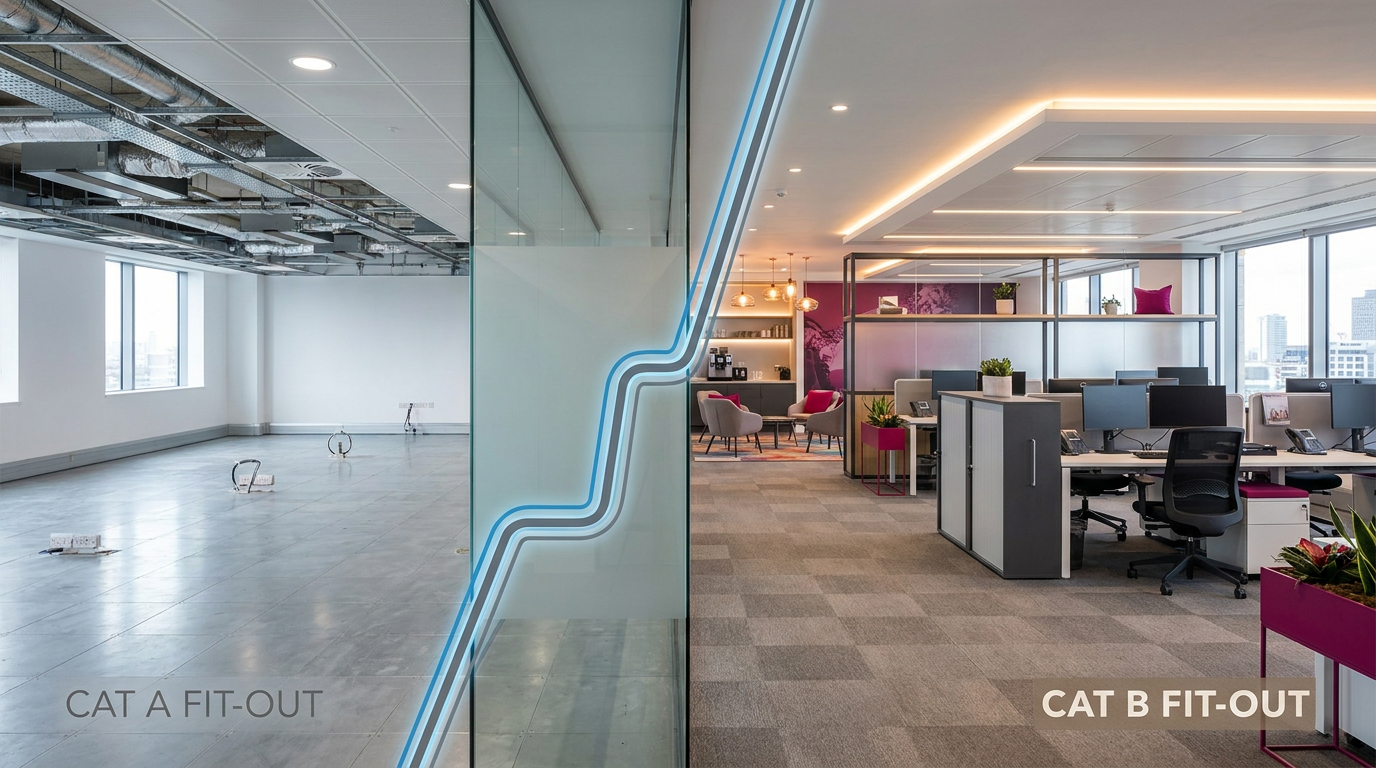
A Shell and Core property is the most basic state. Think of it as just the concrete frame of the building – the structure, cladding, base plant, and common areas like lobbies and lifts are complete, but the office floor itself is an empty shell.
A Category A Fit-Out (Cat A), which is a landlord’s basic finish of a commercial interior space, takes it one step further. It creates a habitable, but plain, white box. This typically includes:
- Raised floors and suspended ceilings
- Basic mechanical and electrical services (M&E)
- Fire detection systems and alarms
- Basic internal finishes on walls and columns
In essence, Cat A is the blank canvas. According to a guide from K2 Space (2026), this is the standard handover condition for most multi-tenancy office buildings. However, some landlords now offer a ‘Cat A+’ fit-out, which includes some enhancements like meeting rooms or kitchenettes, blurring the lines slightly.
A Category B Fit-Out (Cat B), which refers to a tenant’s customised finish of a commercial interior space, is where you make the space your own. This is your responsibility and covers everything needed to operate your business, including:
- Partitions for offices, meeting rooms, and breakout spaces
- Specialist lighting and IT infrastructure
- Kitchens and tea points
- Floor finishes (carpets, vinyl) and decoration
- Branding and signage
- All office furniture
Your lease agreement is the source of truth. Scrutinise it to confirm what the landlord provides versus what you must budget for. Understanding this distinction is the foundation of accurate financial planning.
Average UK Office Fit-Out Costs: A Detailed Breakdown
The most common question we hear is: “What are the average office fit-out costs?” The answer depends heavily on three factors: location, specification, and complexity. As a baseline, you can expect costs to fall into one of three main bands.
Data from leading property consultancies provides a clear picture of the current market. For instance, a global survey by Turner & Townsend (2025) demonstrated London remains the most expensive city in the world for office fit-outs. A detailed UK cost guide from Cushman & Wakefield (2026) reinforces this, showing significant price differences between the capital and other major UK cities like Manchester or Birmingham. This is due to higher labour rates and logistical challenges in London.
The table below outlines the typical office fit out costs per square metre and per square foot for different specification levels across the UK, providing a solid starting point for your budget.
| Fit-Out Level | Typical Cost (per sq m) | Typical Cost (per sq ft) | Key Inclusions |
|---|---|---|---|
| Basic / Light Refurbishment | £450 – £850 | £42 – £79 | Basic decoration, new carpet tiles, standard workstations, and task chairs. Minimal changes to M&E. |
| Mid-Range / Good Quality | £850 – £1,600 | £79 – £148 | New partitions, meeting rooms, a modern kitchen, quality furniture, AV integration, and some M&E upgrades. |
| High-End / Premium | £1,600 – £2,700+ | £148 – £250+ | Bespoke joinery, high-end finishes, significant structural changes, advanced smart technology, and designer furniture. |
Source: Adapted from Cushman & Wakefield (2026) and Imperial Building Solutions (2025) data.
These figures for typical office fit out costs are benchmarks. The final price for your project will depend on the unique requirements, the condition of the building, and the partners you choose. That’s why we typically recommend a detailed consultation to establish a precise quote, which helps in “Saving Time & Stress” later on.
The Furniture-First Approach: How Furnishings Drive Your Office Fit-Out Costs and ROI
When planning a budget, furniture is often treated as a final line item. We believe this is a mistake. In our experience, furniture is the single most important element of a Cat B fit-out, directly impacting both your budget and your long-term ROI. It’s not just an expense; it’s an investment in your people.
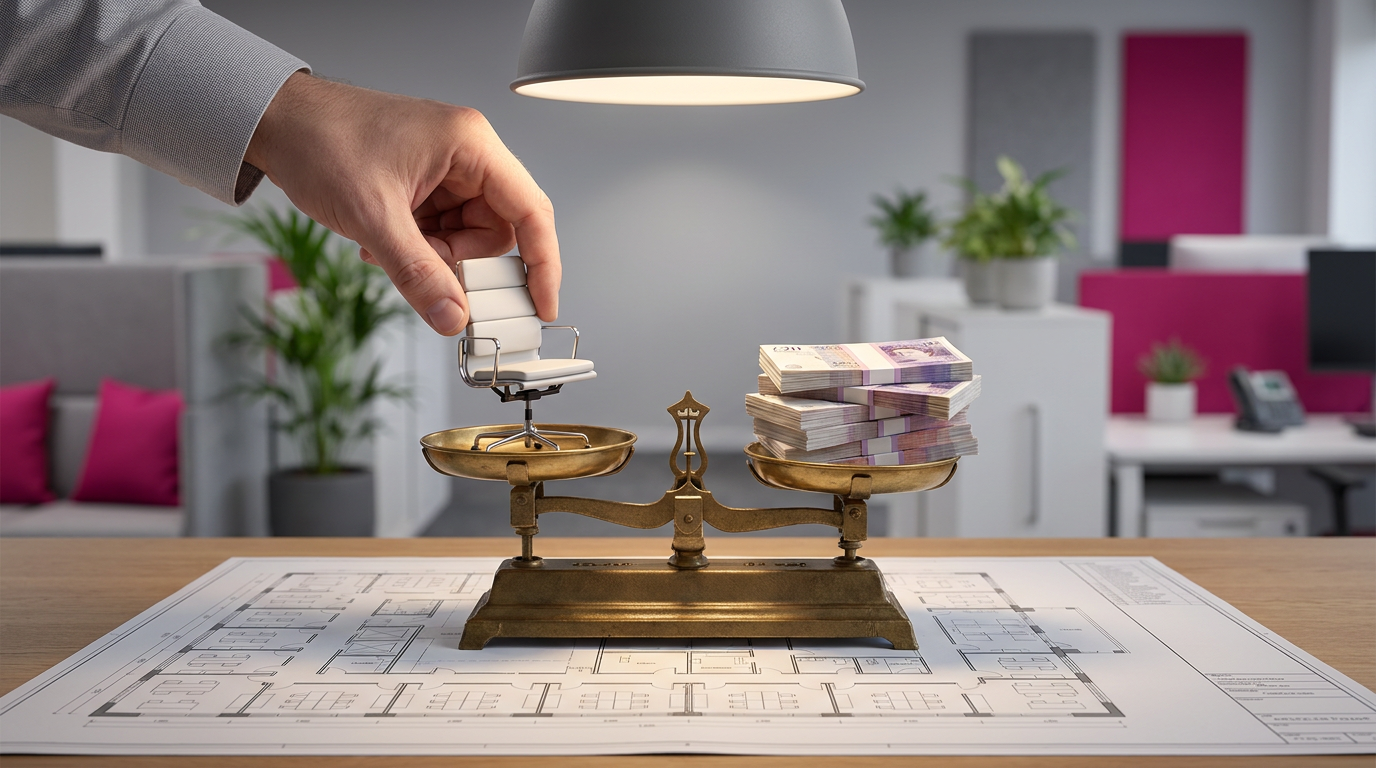
Furniture can easily account for 20-40% of your total Cat B budget. This percentage makes it the largest variable cost, and therefore, the area with the most potential for both savings and strategic investment. While you can’t negotiate the cost of structural steel, you have immense flexibility in your furniture choices.
Here’s why a furniture-first approach makes sense:
- Drives Employee Experience: Walls and ceilings don’t make employees feel valued, but their chair, desk, and collaborative spaces do. Ergonomic seated furniture reduces absenteeism and improves well-being.
- Boosts Productivity: Providing the right tools for the job is crucial. This includes creating a variety of work settings, from quiet focus pods to vibrant areas with modern breakout furniture that encourage spontaneous collaboration.
- Attracts and Retains Talent: In a competitive job market, a well-designed office is a powerful recruitment tool. It sends a clear message about your company culture and how much you value your team.
By considering furniture from day one, you align your spending with what matters most: the people who will use the space every day. It shifts the conversation from “How much does it cost?” to “What value will it deliver?”. This is central to our “Design To Install We Do It All!” philosophy.
### Case Study: A Hypothetical SME Scenario
Challenge: A 70-person tech firm in Manchester was struggling with low morale and high staff turnover. Their outdated, cramped office was cited as a key issue in exit interviews, costing them an estimated £150,000 annually in recruitment and lost productivity.
Solution: Instead of a simple cosmetic refresh, they allocated 35% of their £250,000 fit-out budget to a furniture-first strategy. This included ergonomic workstations for everyone, two bookable project rooms, and a large, multi-functional breakout area with collaborative furniture.
Results: Within 12 months, employee satisfaction scores related to the physical environment increased by 65%. Staff turnover dropped by 40%, representing an annual saving of £60,000. The project’s ROI was achieved in under three years.
Key Insight: Investing strategically in high-impact furniture that supports different work styles delivered a far greater return than spreading the budget thinly across purely aesthetic upgrades.
Specialised Projects: Budgeting Office Fit-Out Costs for Schools & the Public Sector
While corporate office fit-outs focus on branding and collaboration, projects for schools and the public sector have a different set of priorities. Budgeting office fit-out costs in these environments requires a focus on durability, compliance, and demonstrating ‘Best Value’ – it isn’t typically about the lowest initial price.
For a school refurbishment, furniture and equipment must withstand heavy, daily use. Key considerations include:
- Durability and Safety: Materials must be robust, easy to clean, and free from sharp edges. All items must comply with stringent UK safety standards, especially in environments for younger children or those with Special Educational Needs (SEN).
- Flexibility: Classrooms are no longer static. Furniture needs to be easily reconfigurable to support different teaching methods, from group work to individual study.
- Compliance: Suppliers must demonstrate that their products meet all necessary regulations. As a trusted partner, we proudly display our UK certifications and accreditations to provide this assurance.
Public sector procurement follows similar principles. Projects often require suppliers to be on pre-approved government frameworks, which guarantee that they have been vetted for financial stability, quality, and compliance. The goal is to ensure that public money is spent wisely on solutions that are fit for purpose and built to last. We have extensive experience navigating these procurement processes and offer flexible payment options, such as our “Credit Accounts Or Pay Flexibly” programme, to support public sector budget cycles.
Financial Planning: Accounting, Tax, and Managing Your Office Fit-Out Costs
Effectively managing the financial side of your project is just as important as the design. Proper financial planning for office fit-out costs involves understanding how to treat the expenses in your accounts and how to use UK tax relief to your advantage.
From an accounting perspective, most of the costs associated with a fit-out are considered capital expenditure. This means the cost is added to your company’s balance sheet as an asset and depreciated over its useful life, rather than being written off as a day-to-day expense in a single year. This is a crucial aspect of accounting for office fit out costs.
The good news is that UK tax law allows for significant relief on this type of spending. This is primarily through Capital Allowances, a form of UK tax relief on capital expenditure. It allows you to deduct a portion of the value of certain assets from your profits before you pay tax. According to guidance from His Majesty’s Revenue and Customs (HMRC), the UK’s tax authority, many elements of a fit-out qualify as ‘plant and machinery’.
Items that typically qualify for Capital Allowances include:
- Office furniture (desks, chairs, storage)
- IT and telecommunications equipment
- Air conditioning and ventilation systems
- Sanitaryware and kitchen equipment
- Demountable partitions
- Security systems
By working with your contractor and a tax advisor to segregate the costs of qualifying items, you can significantly reduce your corporation tax bill, effectively lowering the net cost of the project. It’s a complex area, but one that offers substantial financial benefits when handled correctly.
Beyond the Basics: 10 Hidden Costs to Factor into Your Budget
A common pitfall in budgeting for an office fit-out is overlooking the “hidden” costs that sit outside the main contractor’s quote. A 2026 guide from Arc Business Interiors highlights the importance of a comprehensive budget. To avoid nasty surprises, we recommend you build these ten items into your financial plan from the very beginning.
- Professional Fees: This includes architects, interior designers, M&E consultants, and project managers. These fees can range from 8% to 15% of the total project cost.
- Dilapidations: If you are moving, you’ll likely have a contractual obligation to return your old office to its original condition. This can be a very significant expense.
- IT & Audio-Visual (AV) Installation: While the fit-out may include cabling, the cost of servers, computers, phones, and AV hardware is almost typically separate.
- Building Control & Planning Fees: Your project will need to be signed off by local authorities to ensure it meets building regulations and fire safety standards.
- Signage & Branding: This includes everything from the vinyl logo on the reception wall to directional signage throughout the space.
- Temporary Relocation Costs: If your team needs to move out during the refurbishment, you’ll need to budget for temporary office space.
- Furniture Storage or Disposal: What will you do with your old furniture? Responsible disposal or short-term storage both come at a cost.
- Contingency Fund: No project goes exactly to plan. We strongly advise setting aside a contingency of 10-15% of the total project cost to cover unforeseen issues.
- Service Charges & Rent-Free Periods: Clarify with your landlord how the fit-out period affects your rent and service charge obligations.
- Post-Completion “Snagging”: After the main work is done, there will be small fixes and adjustments needed. While often covered by the contractor, it’s wise to be prepared for minor associated costs.
Frequently Asked Questions About Office Fit-Out Costs
What are office fit-out costs?
Office fit-out costs are the total expenses incurred to make an interior commercial space suitable for occupation. This covers everything from the initial design and construction to the final installation of furniture, technology, and branding elements. These costs transform an empty shell or a basic finish into a fully functional and customised workspace tailored to a company’s specific needs, and understanding them is crucial for any business relocation or refurbishment project.
What is the difference between Cat A and Cat B fit-out?
Cat A is the landlord’s basic finish, while Cat B is the tenant’s bespoke finish to make the space their own. Think of Cat A as the blank canvas, providing essentials like ceilings, basic lighting, and raised floors. Cat B is the artwork you add on top: partitions for meeting rooms, your kitchen, carpets, decoration, branding, and all the furniture. This distinction is vital for understanding what costs you are responsible for.
How much does a UK office fit-out cost per square metre?
A typical UK office fit-out can cost from £450 per square metre for a basic refurbishment to over £2,700 for a high-specification project. The final office fit out costs per square metre depend heavily on location, with London being the most expensive, and the quality of finishes and technology specified. A mid-range project in a city like Manchester or Birmingham typically falls between £850 and £1,600 per square metre.
What is not included in a typical office fit-out quote?
Quotes often exclude professional fees, IT hardware, furniture, dilapidation costs for a previous office, and a contingency fund. You should get a detailed breakdown of what is and isn’t included. Other common exclusions are planning application fees, costs for moving staff, and any specialist equipment your business might require. Typically clarify the full scope with your contractor before signing any agreements to avoid unexpected expenses.
How can I reduce my office fit-out costs?
You can reduce costs by reusing existing furniture, selecting cost-effective materials, phasing the project, and working with a supplier offering Bulk Buy Discounts. Prioritise spending on high-impact areas that affect staff well-being, like ergonomic chairs and breakout areas. A clear brief from the start also helps prevent expensive changes later in the project. Our team can help you value-engineer a project to meet your budget without compromising on quality.
How are office fit-out costs treated for tax purposes in the UK?
Most office fit-out costs are treated as capital expenditure, but you can claim tax relief through Capital Allowances. This applies to items classified as ‘plant and machinery,’ which includes furniture, IT equipment, air conditioning, and demountable partitions. Correctly accounting for office fit out costs and claiming these allowances can significantly reduce your corporation tax bill. We typically recommend seeking professional advice from a tax specialist for this.
How long does an office fit-out take?
A small office fit-out might take 6-8 weeks, while a larger, more complex project can take 12-24 weeks from design to completion. The initial design and planning phase can take several weeks alone. The construction timeline is then influenced by factors like the complexity of M&E works, lead times for specialist materials, and the availability of labour. Planning ahead is key to meeting your deadline.
Is it cheaper to refurbish or move to a new office?
Refurbishing is often cheaper than moving, as it avoids removal costs, legal fees, and potential dilapidations on your old lease. However, moving to a new Cat A space can provide a well-suited blank canvas to create a purpose-built workspace that perfectly matches your company culture and future needs. A cost-benefit analysis comparing both options is an effective way to make an informed decision for your business.
What is the biggest variable cost in an office fit-out?
Furniture is often the largest and most variable cost in a Cat B fit-out, sometimes accounting for up to 40% of the budget. The choice between basic, mid-range, and high-end designer furniture can dramatically alter the total project cost. However, because it has the biggest impact on employee well-being and productivity, it also offers the greatest potential for a positive return on investment. This makes furniture a strategic, not just a financial, decision.
How do you budget for a school or public sector refurbishment?
Budgeting for a school requires focusing on durability, compliance, and demonstrating ‘Best Value’, not just the lowest initial price. This involves working with accredited suppliers who are often on pre-approved frameworks and ensuring all items meet UK safety and durability standards for educational environments. The goal is long-term performance and safety, so whole-life cost is a more important metric than the upfront ticket price.
Important Considerations
The figures and advice in this guide are intended to provide a strong foundation for your budgetary planning. However, it’s essential to recognise their limitations. The cost estimates are based on market data from Q2 2026 and can fluctuate significantly based on material price volatility, specific project requirements, and regional labour market conditions. This guide is a tool for estimation, not a substitute for a formal, detailed quote from a professional partner.
Alternatives to a full-scale fit-out are worth considering, especially if budgets are tight. A phased refurbishment, tackling one area at a time, can help manage cash flow effectively. Another approach is to focus on a high-impact furniture refresh, which can transform the look and feel of a space for a fraction of the cost of a full structural overall. Comparing the pros and cons of refurbishing your current space versus relocating to a new one is a critical early step in the process.
For any project of significant size or complexity, we highly recommend engaging a professional workspace consultant or project manager. Their expertise can be invaluable in “Saving Time & Stress”, optimising the design, and managing contractors. Also, on the financial side, consulting with a qualified tax advisor on Capital Allowances is crucial. Their specialist knowledge will ensure you are maximising the tax efficiency of your investment, which is a key part of the overall financial picture.
Plan Your Workspace Project with Confidence
Ultimately, planning your office fit-out costs effectively is the foundation of a successful project. By understanding the key differences between fit-out categories, benchmarking your plans against UK averages, and adopting a furniture-first mindset that prioritises ROI, you can transform your workspace without derailing your budget. A well-managed project also involves accounting for all potential hidden costs and considering the specialised requirements for your sector, ensuring a smooth process from concept to completion.
As a leading UK supplier with over 35 years of experience and a service that is “Rated Excellent On Trustpilot”, Cost Cutters UK specialises in helping offices, schools, and public sector organisations create inspiring and functional environments. Our “Design To Install We Do It All!” service is designed to handle every detail for you. If you’re ready to translate your vision into a concrete plan, our team is here to help. Book your free, no-obligation space planning consultation today to get started.
References
- Cushman & Wakefield – 2026 Industry Report. This study provides detailed cost breakdowns for office fit-outs across various UK cities and specification levels.
- K2 Space – 2026 Cost Guide. An article explaining the differences between Cat A and Cat B fit-outs and the elements included in each.
- Turner & Townsend – Global Market Survey (2025). Ranks London as the most expensive city globally for office fit-outs, providing global cost context based on data from multiple international markets.
- Office Insight – Budget Planning Guide. Offers practical advice and tools for budget planning and understanding key cost factors.
- Imperial Building Solutions – UK Pricing Guide (2025). A comprehensive guide detailing UK-specific pricing and cost elements for fit-out projects.
- GOV.UK – Official Guidance. Provides information from HMRC on claiming Capital Allowances on plant and machinery.
- Arc Business Interiors – 2026 Cost Guide. An industry article that highlights potential hidden costs and provides a guide for budgeting in 2026.
Conclusion
Plan Your Workspace Project with Confidence
In summary, understanding your office fit-out costs is the foundation of a successful project. By understanding the differences between fit-out categories, benchmarking against UK averages, and adopting a furniture-first mindset that prioritises ROI, you can transform your workspace without exceeding your budget. Our assessment is that remembering to account for hidden costs and the specialised requirements for your sector is crucial for ensuring a smooth process from start to finish.
As a leading UK supplier with over 35 years of experience, Costcutters UK specialises in helping o