Mobile Phone Bans in Schools: The Complete UK Guide to Policy, Storage & Implementation
🎯 Key Takeaway
Effectively managing mobile phone bans in schools requires a clear policy based on DfE guidance, a robust communication strategy, and investment in appropriate secure storage solutions. While not yet a statutory requirement across the UK, the government strongly encourages schools in England to prohibit mobile phone use throughout the school day.
• The Department for Education (DfE) provides non-statutory guidance supporting headteachers in implementing bans to improve behaviour and reduce distractions.
• Successful implementation hinges on a phased rollout, clear communication with parents and pupils, and a fair, consistently applied sanctions process.
• Practical logistics, especially secure and efficient school mobile phone storage solutions like lockers or cabinets, are critical for the policy’s success and security.This guide provides school leaders with the actionable framework needed to navigate policy, logistics, and procurement for a successful implementation.
The discussion around mobile phone bans in schools has intensified across the UK, especially following new government directives. As of May 2026, the Department for Education (DfE) is strongly backing headteachers in England who choose to prohibit phone use to improve the learning environment. This push, supported by the latest dfe mobile phone guidance, creates significant practical challenges for school leadership teams. You’re not just creating a rule; you’re managing a major change in behaviour and logistics. This guide provides a clear, actionable framework for UK schools, covering policy creation, communication strategies, and the crucial, often-overlooked component of secure phone storage.
👤 Written by: Content Team
Reviewed by: Editorial Team, Industry Specialists with 35+ Years Experience; Rated Excellent On Trustpilot
Last updated: 27 May 2026
ℹ️ Transparency Disclosure: This article explores the implementation of mobile phone bans in schools based on UK government guidance and our 35+ years of experience supplying the education sector. For full transparency, some links may connect to our school furniture services. All information is verified by our editorial team to ensure accuracy and relevance for UK school leaders.
Understanding the DfE Guidance on Mobile Phones in Schools
Yes, the Department for Education (DfE), the UK government department responsible for child services and education in England, has issued strong guidance on this issue. The dfe mobile phone guidance published in February 2024 is ‘non-statutory’, which means it is not a legal command but provides powerful government backing and a clear direction of travel. It empowers headteachers to implement a ban but doesn’t legally obligate them to do so.

The government’s stated rationale is threefold:
- Improve Behaviour: Reducing distractions in class leads to better focus.
- Increase Attainment: Research suggests a link between phone-free schools and better test scores. A paper from the London School of Economics (2015) found that banning mobiles led to a notable increase in student performance.
- Reduce Bullying: A ban limits the potential for in-school cyberbullying via social media and messaging apps.
This aligns with the focus of the Office for Standards in Education (Ofsted) on calm and orderly learning environments. Education is a devolved matter, so schools in Scotland, Wales, and Northern Ireland operate under different national policies, though many are moving in a similar direction.
Developing a Compliant School Mobile Phone Policy (UK)
A clear and comprehensive policy is the foundation of a successful ban. The policy must be unambiguous, fair, and legally sound. Under Section 91 of the Education and Inspections Act 2006, headteachers in the UK have the statutory power to establish school rules and outline disciplinary penalties for pupils who breach them. This provides the legal basis for confiscating phones.
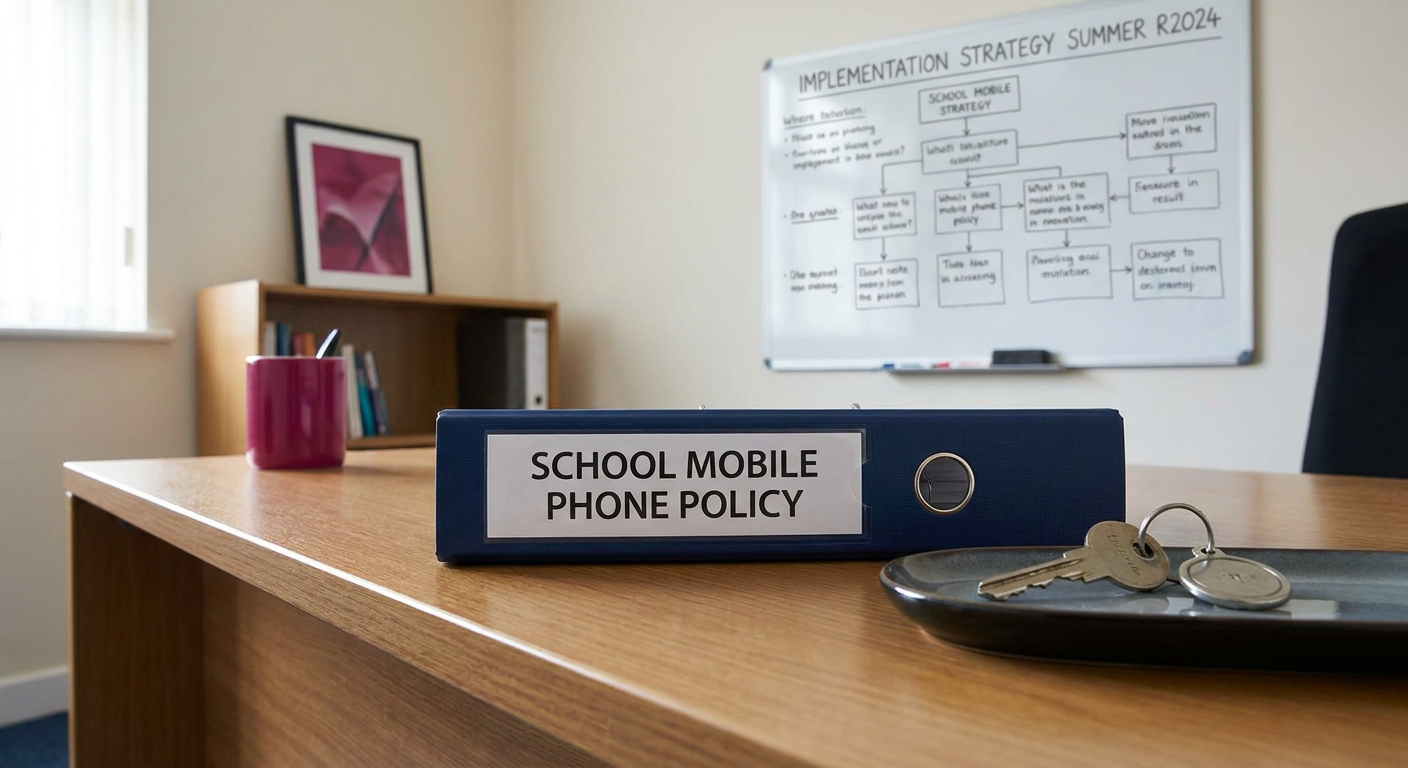
We recommend your school mobile phone policy uk includes these essential elements:
- A Clear Statement: A direct and simple declaration, such as, ‘Mobile phones are not to be used, seen, or heard at any point during the school day, including break and lunch times.’
- Defined Scope: Specify when and where the ban applies. Does it cover the entire school site from the first bell to the last?
- Clear Sanctions: Detail the consequences for non-compliance. This typically involves a tiered system, e.g., first offence is confiscation until the end of the day, a second offence requires parental collection. Consistency is key.
- Exemptions Process: Outline the procedure for pupils who require a phone for medical reasons (e.g., diabetes monitoring apps) or as a reasonable adjustment agreed within an Education, Health and Care Plan (EHCP).
- Staff Protocol: Include rules for staff phone use to ensure they model the expected behaviour. Personal use should be restricted to non-pupil areas like staff rooms.
- Liability Clause: State the school’s position on liability for lost, stolen, or damaged phones, even when confiscated.
Before finalising, consult with governors, staff, parent forums, and the student council. This fosters buy-in and helps identify potential issues early on.
Implementing a Phone Ban in School: A Phased Approach
Suddenly implementing a phone ban in school overnight can cause confusion and resistance. A phased, well-communicated rollout is a far more effective strategy for managing this significant cultural shift. It allows pupils, parents, and staff time to adjust.
We suggest a term-by-term plan for a smooth transition:
- Term 1: Policy & Communication
- Weeks 1-6: Finalise the policy with governors and consult with staff. Prepare all communication materials.
- Weeks 7-12: Announce the upcoming ban to parents and pupils. Use multiple channels: official letters, newsletters, the school website, social media, and dedicated assemblies. Clearly explain the ‘why’ behind the decision, citing improved focus and student wellbeing. Hold parent information evenings to answer questions directly.
- Term 2: Phased Introduction & Storage Rollout
- Begin implementation with specific year groups (e.g., Years 7 and 8). This allows you to test your storage and collection logistics on a smaller scale.
- Use this period to train staff on the new procedures to ensure every teacher applies the rules and sanctions consistently. Inconsistency is the fastest way for a new policy to fail.
- Term 3: Full Implementation
- Roll out the ban to all remaining year groups.
- By this stage, the policy will be embedded in the school culture, and logistical issues will have been resolved. Conduct a review at the end of the term to assess the impact and make any necessary adjustments.
This structured approach helps manage expectations and demonstrates that the school is being thoughtful and supportive, rather than simply punitive.
Choosing the Right School Mobile Phone Storage Solutions
Once you decide on a ban, the immediate practical question is: where will the phones go? For a secondary school with over 1,000 pupils, this is a major logistical challenge. Choosing the right school mobile phone storage solutions is not an afterthought-it is fundamental to the policy’s success. The main options each have distinct advantages and disadvantages.
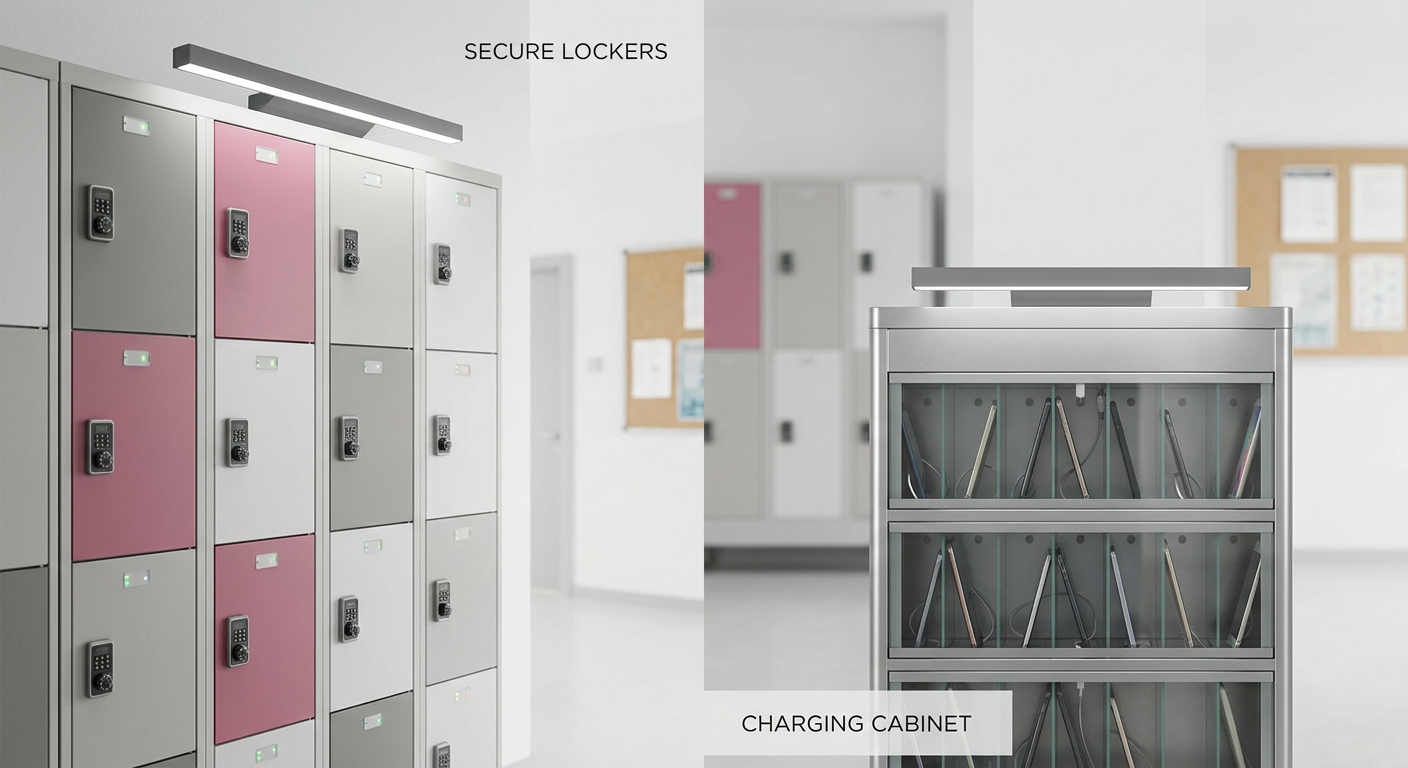
- Personal Pupil Lockers: Assigning each student a locker where they must store their phone for the day. We offer a wide range of secure Industrial Lockers suitable for this purpose.
- Lockable Pouches: Using systems from companies like Yondr. Pupils place their phone in a pouch that locks automatically upon entering a ‘phone-free zone’. They keep the pouch with them, and it’s unlocked at designated stations upon leaving.
- Centralised Storage: Using multi-compartment cabinets or charging trolleys, often managed by form tutors or administrative staff. Phones are collected at the start of the day and returned at the end. An effective choice depends on your school’s specific context, budget, and philosophy on pupil responsibility. Here’s a comparison of the options:
| Feature | Personal Lockers | Lockable Pouches (e.g., Yondr) | Centralised Cabinets/Trolleys |
|---|---|---|---|
| Upfront Cost | Moderate to High (Capital) | Low (Often subscription-based) | High (Capital) |
| Pupil Responsibility | High (Pupil manages their own locker) | Low (Pupil keeps pouch but can’t access phone) | Very Low (Staff manage storage) |
| Daily Logistics | Minimal daily staff input | Moderate (Requires unlocking stations/staff) | High (Staff-intensive collection/return) |
| Security | Good (If quality lockers are used) | Excellent (Prevents use entirely) | Excellent (If stored in a secure room) |
| Potential Bottlenecks | None, if access is staggered | Yes, at unlocking stations end-of-day | Yes, during collection and return |
Ultimately, a poor storage system creates daily friction, security risks, and undermines the entire policy. It’s vital to invest in a solution that is robust and fits your school’s operational capacity.
Budgeting for Phone Storage to Support Mobile Phone Bans in Schools
For the School Business Manager, funding the infrastructure for mobile phone bans in schools is a primary concern. The cost can be significant, so building a strong business case is essential. This isn’t just an expense; it’s an investment in the school’s learning environment and safeguarding procedures.
When budgeting, consider these cost ranges:
- Personal Lockers: A one-off capital cost. Depending on the specification, phone lockers for schools uk can range from £30 to £80 per pupil for a durable, multi-compartment unit.
- Lockable Pouches: An ongoing operational cost, typically a per-pupil annual subscription fee. This can be £12-£20 per pupil per year.
- Centralised Cabinets: A one-off capital cost, often higher per device for charging models. Non-charging secure cabinets offer a more cost-effective option.
To build your business case for governors, focus on long-term value. Highlight durability, security features, and how the investment supports the school’s behaviour and attainment goals. At Cost Cutters UK, we understand school procurement cycles. We offer Bulk Buy Discounts for larger projects and flexible payment options, allowing schools to use Credit Accounts Or Pay Flexibly. We are also proud of our public sector and educational body accreditations, which provide peace of mind.
To get a precise figure for your school, it’s best to request a free, no-obligation quote tailored to your pupil numbers and specific requirements.
Frequently Asked Questions
What are mobile phone bans in schools?
Mobile phone bans in schools are official policies that prohibit pupils from using their personal phones during the school day. The primary goal is to minimise distractions, reduce opportunities for cyberbullying, and improve focus in the learning environment. This approach is strongly supported by the DfE in England to foster better behaviour and academic concentration, though implementation details are decided by individual schools.
Are phones going to be banned in all UK schools?
No, an outright statutory ban is not yet in place for all UK schools, but the direction of travel is clear. In England, the government’s non-statutory guidance strongly encourages headteachers to implement a ban. However, because education is a devolved power, policies in Scotland, Wales, and Northern Ireland are set independently, and the final decision on policy remains with the individual school’s leadership.
Can schools legally take your phone in the UK?
Yes, headteachers and authorised staff have a statutory power to search for and confiscate items banned by school rules. This authority is granted under the Education and Inspections Act 2006. A well-communicated school mobile phone policy uk will clearly state the conditions under which a phone may be confiscated and the procedure for its return, such as collection by a parent.
What is the new DfE mobile phone guidance?
The DfE’s February 2024 guidance is a non-statutory document that empowers and supports headteachers in prohibiting phone use throughout the school day. It is not a law but serves as official government backing. The guidance aims to help schools create a more consistent, focussed, and safer environment by reducing distractions and potential for online bullying, though the final policy is at the school’s discretion.
Can I refuse to put my phone in a Yondr pouch?
Refusing to place a phone in a required pouch would almost generally be treated as a breach of the school’s behaviour policy. This action would likely lead to a sanction as outlined in that policy. Consequences could include immediate confiscation of the phone, detention, or other disciplinary measures determined by the school, as compliance is not optional once the rule is in place.
What are the benefits of no phones in school?
The primary benefits reported by schools include improved pupil concentration, better academic outcomes, and reduced social pressures. A landmark UNESCO (2023) global report highlighted that excessive phone use negatively impacts learning. Also, schools often see a decrease in in-school cyberbullying and an increase in positive, face-to-face social interaction amongst pupils during break times, contributing to a healthier school community.
How should a school communicate a phone ban to parents?
A school should use a multi-channel strategy for clear and early communication with parents. This must include official letters, newsletters, updates on the school website, and ideally, parent information evenings or online webinars. The communication should clearly explain the rationale for the ban, the specific rules, the sanctions for non-compliance, and the official start date to ensure everyone is fully informed.
Are there exemptions to a school phone ban?
Yes, most school policies include clear exemptions for specific, pre-agreed circumstances. These typically cover pupils with medical needs who use apps for monitoring (e.g., glucose levels) or where a phone is a required reasonable adjustment as part of an Education, Health and Care Plan (EHCP). These exemptions must be discussed and formally agreed upon with the school’s leadership team or SENCO in advance.
What is an effective storage option for a phone ban?
The ‘best’ storage option is highly dependent on a school’s budget, physical space, staffing levels, and educational philosophy. Individual lockers promote pupil responsibility but are a high capital cost. Centralised cabinets offer high security but are labour-intensive. Lockable pouches prevent use effectively but often involve an ongoing subscription cost. A thorough assessment of your school’s unique needs is crucial.
Do staff also have to follow the phone ban?
Yes, for a policy to be respected and effective, staff must model the expected behaviour. Most successful policies include clear rules for staff, typically restricting personal phone use to designated staff-only areas like offices or the staff room. Visible use of personal phones by staff in front of pupils can seriously undermine the policy’s authority and create a sense of unfairness.
Important Considerations
You should acknowledge that while early data is promising, the long-term, large-scale impact of total mobile phone bans is still the subject of ongoing educational research. The direct causal link between bans and improved exam results can be complex to isolate from other school improvement factors. Also, this guide focuses on the UK, and policies may differ in other countries.
A complete ban is not the only approach. Some schools opt for alternative policies such as ‘Off and away all day’, ‘Not seen, not heard, not taken’, or allowing phone use only during specific break times in designated zones. These strategies can be less resource-intensive but may require more intensive staff monitoring to ensure compliance.
When developing your policy, particularly regarding pupils with special educational needs (SEN) or complex medical requirements, You should consult with SENCOs, parents, and potentially local authority advisors to ensure all reasonable adjustments are made. For complex legal questions regarding confiscation or liability, seeking advice from a legal service specialised in education law is recommended.
Partnering for a Successful Implementation
Successfully navigating mobile phone bans in schools is a significant undertaking that moves from government policy to daily classroom reality. It requires a robust policy, clear communication, and consistent enforcement. However, the most critical and often underestimated component is the physical infrastructure; without effective school mobile phone storage solutions, even an effective policies can fail due to logistical challenges and security concerns. The process of implementing a phone ban in school must be holistic.
At Cost Cutters UK, we have over 35 years of experience helping schools manage their space and equipment needs. Our “Design To Install We Do It All!” service is designed for Saving Time & Stress for busy school leaders. From secure phone lockers for schools uk to high-capacity storage cabinets, we provide solutions that are durable, compliant, and cost-effective. Being Rated Excellent On Trustpilot, we pride ourselves on being a trusted partner. If you are planning your school’s approach, our specialists can help. Book a free space planning consultation to explore an effective options for your unique environment and budget.
References
- UK Department for Education (2024) – Government Guidance. Provides non-statutory guidance for headteachers to support them in prohibiting the use of mobile phones throughout the school day.
- London School of Economics (2015) – Research Paper. Analysis of schools in four English cities found that banning mobile phones leads to an increase in student test scores, with low-achieving students gaining the most.
- UNESCO (2023) – Global Report. The Global Education Monitoring Report, “Technology in education: A tool on whose terms?”, recommends that mobile phone use in schools should be carefully regulated as it can be a source of distraction and negatively impact learning.
- Education and Inspections Act 2006, Section 91 – UK Legislation. Grants headteachers and authorised staff the power to make rules for pupil discipline, including searching for and confiscating items banned by the school’s behaviour policy.
- Costcutters UK – Product Category. Provides examples of secure, durable locker and cabinet solutions suitable for school environments where device storage is required.
Conclusion
Partnering for a Successful Implementation
In summary, mobile phone bans in schools represent a significant undertaking, and successfully implementing a phone ban in school moves the initiative from government policy to daily classroom reality. It requires a robust policy, clear communication, and consistent enforcement. However, the most critical and often underestimated component is the physical infrastructure; without effective school mobile phone storage solutions, even the best policies can fail due to logistical challenges and security concerns.
At Costcutters UK, we have over 35 years of experience helping schools manage their space and equip