
A Beginner’s Guide to School Facilities Management in the UK
🎯 Key Takeaway
Effective school facilities management is the strategic organisation, operation, and maintenance of a school’s physical assets to ensure a safe, compliant, and productive learning environment. It is a critical function that balances daily operations with long-term strategic planning for the entire school estate. This involves differentiating between ‘hard’ services like building fabric and electrical systems, and ‘soft’ services such as cleaning and security. Adherence to UK-specific regulations from the DfE and HSE is a legal requirement, making strategic procurement and budgeting essential for demonstrating value and maximising limited funds. This guide provides the foundational knowledge for managing your school’s estate effectively.
Managing a school’s physical environment is a monumental task, often falling to already busy school business managers and headteachers. Effective school facilities management introduces a professional discipline that brings order to this complexity. As of June 2026, the demands on school estates, from ageing infrastructure to evolving educational needs, have rarely been greater. This guide breaks down the core components of managing your school’s estate, covering everything from statutory compliance to strategic budgeting, providing a clear roadmap for anyone new to this vital role in the United Kingdom. We’ll explore the key principles of facilities management in schools, ensuring you have the confidence to create a safe and inspiring place for learning.
Written by: Content Team | Reviewed by: Editorial Team, 35+ Years Experience; Rated Excellent On Trustpilot
Last updated: 17 June 2026
ℹ️ Transparency Disclosure: This article explores the fundamentals of school facilities management in the UK based on industry best practices and an analysis of government guidance. Our goal is to provide clear, actionable information. Some links may connect to our school furniture and equipment services, which are part of our comprehensive solutions for the education sector. All information is verified by our editorial team. Cost Cutters UK is a leading supplier with over 35 years of experience, and we’re proud to be Rated Excellent On Trustpilot.
The Core Components of School Facilities Management
Effective school facilities management (School FM) is fundamentally about organising your resources across two distinct categories: Hard Facilities Management (Hard FM) and Soft Facilities Management (Soft FM). Hard FM refers to services related to the physical fabric of the building and its systems. Think of these as the immovable, structural elements. Soft FM, conversely, covers the services that support the people using the building, making it a safe, pleasant, and efficient place to work and learn.
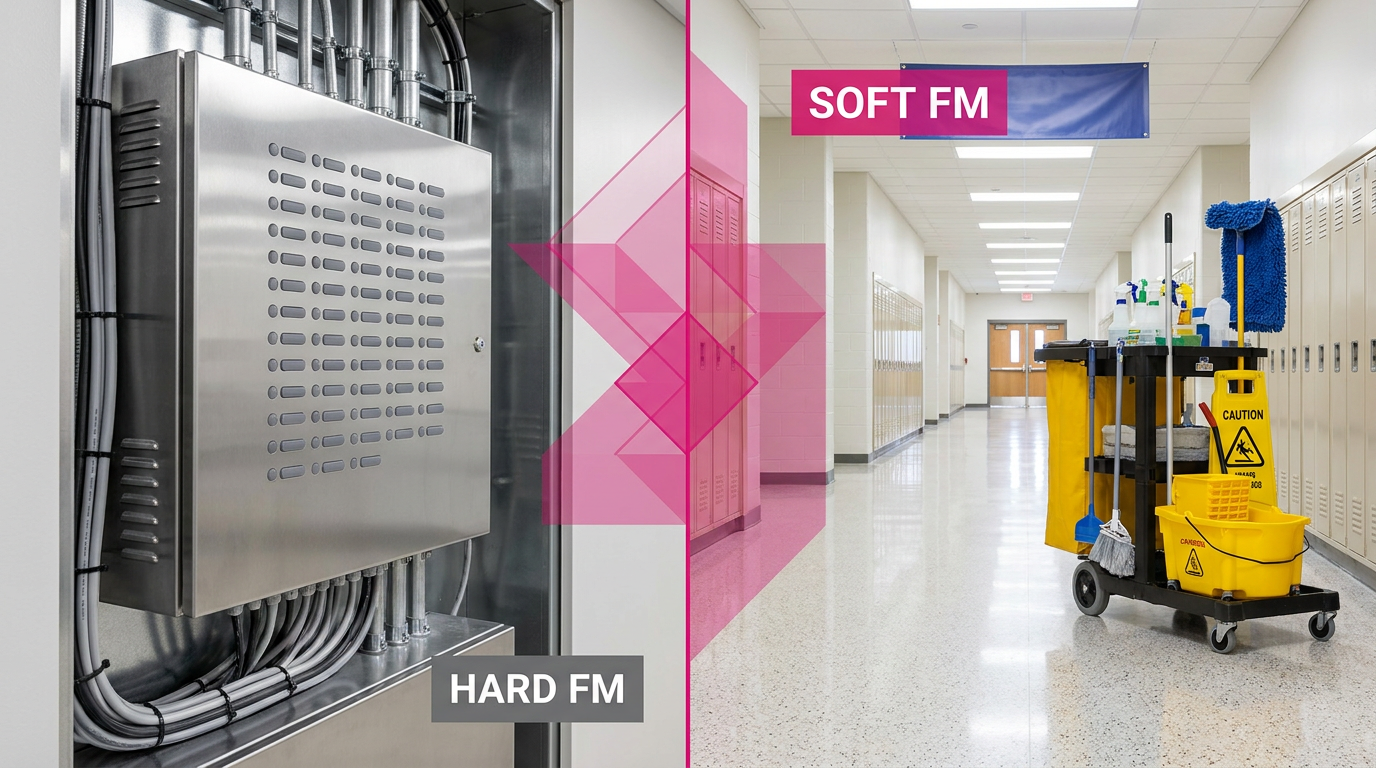
A useful framework for structuring your strategy is the ‘4 Pillars’: People, Place, Process, and Technology. This ensures you consider not just the building (‘Place’) and its maintenance (‘Process’), but also the students and staff (‘People’) and the systems that make management efficient (‘Technology’). The importance of robust Hard FM cannot be overstated; research from the Department for Education (DfE) has consistently highlighted that many UK school buildings are past their intended design life, making proactive maintenance critical. As an industry guide from SFG20 (2023) notes, a structured approach is the only way to manage this complexity effectively.
Hard FM vs Soft FM in a School Setting
Understanding the distinction is the first step in organising your tasks and budgets for facilities management in schools.
Hard FM (The Building Fabric):
- Planned Preventative Maintenance (PPM) schedules
- Boiler and heating, ventilation, and air conditioning (HVAC) systems
- Electrical systems and statutory testing
- Plumbing and water systems (including Legionella testing)
- Fire safety systems and alarms
- Structural and roof repairs
- School building management systems
Soft FM (The People & Services):
- Cleaning and janitorial contracts
- Grounds maintenance and landscaping
- Security services (e.g., patrols, CCTV)
- Waste management and recycling
- Catering services
- Pest control
- Car park management
A foundational overview by Global Facilities (2024) reinforces that while Hard FM is often mandated by law, high-quality Soft FM directly impacts the well-being and perception of the school.
Navigating UK Compliance in School Facilities Management
Maintaining statutory compliance is the most critical and non-negotiable duty of school facilities management. For all UK schools, this legal obligation is extensive and requires meticulous record-keeping. The primary legislation is the Health and Safety at Work etc. Act 1974, which places a duty of care on employers – the governing body or Multi-Academy Trust (MAT) – to protect pupils, staff, and visitors.

Key areas of focus for school health and safety compliance include:
- Asbestos Management: A legal duty to manage asbestos in any school building constructed before the year 2000.
- Fire Safety: Regular fire risk assessments, maintenance of fire-fighting equipment, and clear evacuation procedures are mandatory.
- Electrical Safety: Electrical Installation Condition Reports (EICRs) must be carried out at least every five years.
- Water Safety: Regular risk assessments for Legionella bacteria are required to ensure water systems are safe.
The Department for Education (DfE), the UK government department responsible for education, provides an essential resource called ‘Good Estate Management for Schools’ (GEMS). This guidance is the definitive starting point for understanding your obligations. Following a clear school maintenance checklist uk is not just good practice; it’s a legal necessity. Our own processes are built on these standards, which is reflected in our official certifications and accreditations.
Key Statutory Compliance Checks
This table summarises some of the most critical recurring checks for school building management, based on guidance from the Department for Education (DfE) and the Health and Safety Executive (HSE).
| Check / Inspection | Typical Frequency | Relevant UK Regulation / Guidance | Primary Responsibility |
|---|---|---|---|
| Fire Risk Assessment | Annually (review) | The Regulatory Reform (Fire Safety) Order 2005 | ‘Responsible Person’ (e.g., Headteacher) |
| Asbestos Management Plan Review | Annually | Control of Asbestos Regulations 2012 | Duty Holder (e.g., Governing Body) |
| Electrical Installation Condition Report (EICR) | Every 5 Years | BS 7671 / Electricity at Work Regs 1989 | Employer / Landlord |
| Legionella Risk Assessment | Every 2 Years (or with system changes) | HSE ACOP L8 | ‘Responsible Person’ |
| Gas Safety Check (Boilers, Kitchens) | Annually | Gas Safety (Installation and Use) Regulations 1998 | Employer / Landlord |
Strategic Budgeting & Procurement for School Facilities Management
Effective budgeting for your school’s facilities requires a clear distinction between Capital Expenditure (CapEx) and Operational Expenditure (OpEx). CapEx, the budget for large, long-term projects like a new roof or boiler system, is planned over multiple years. OpEx, on the other hand, covers the day-to-day running costs from your annual budget, such as cleaning contracts and minor repairs.

A core task for strategic school facilities management is creating a 3-to-5-year maintenance plan. This forward-looking document, informed by condition surveys, helps you forecast future CapEx needs and move away from costly, reactive repairs. According to a UK-focused guide from ICH Services (2023), this proactive planning is the hallmark of a mature FM function.
When procuring goods and services, UK schools can use public sector procurement frameworks like ESPO or the Crown Commercial Service (CCS) to ensure compliance and value for money. However, ‘best value’ isn’t just the cheapest price. It’s a balance of cost, quality, and supplier reliability. Partnering with a trusted supplier who offers Bulk Buy Discounts can significantly stretch your OpEx budget. At Cost Cutters UK, we help schools achieve this balance, offering flexible payment options like Credit Accounts Or Pay Flexibly to help manage cash flow while still acquiring high-quality assets. This approach helps in Saving Time & Stress for busy school managers.
Case Study: A Primary School’s Smart Procurement Strategy
- Challenge: A 250-pupil primary school faced escalating repair costs for classroom furniture, with an annual reactive maintenance spend of over £8,000 on broken chairs and desks. Their budget was tight, and they couldn’t afford a full-scale replacement.
- Solution: Instead of piecemeal repairs, the School Business Manager partnered with us to develop a three-year phased replacement plan. They used our Bulk Buy Discounts to purchase durable, BS EN 1729-compliant furniture for two year groups at a time, spreading the cost.
- Results: By year two, reactive repair costs had fallen by 75%. The school fully replaced all classroom furniture within the three-year plan, coming in 15% under the projected cost of continuing with reactive repairs.
- Key Insight: A strategic, phased procurement plan, combined with bulk purchasing, can deliver superior long-term value compared to a purely reactive approach to maintenance.
The Role of Furniture in Effective School Facilities Management
In our experience, furniture is a critical physical asset that directly impacts safety, space utilisation, and the learning environment, yet it’s often overlooked in high-level FM strategy. Choosing the right furniture is a core school facilities management decision that affects both budgets and educational outcomes. It’s not just about filling a room; it’s about investing in the school’s infrastructure.
Key considerations for furniture procurement include:
- Compliance: All educational furniture must comply with British and European standards, primarily BS EN 1729 Parts 1 & 2, which govern strength, stability, and appropriate sizing for pupils. This is a fundamental safety and ergonomic requirement.
- Durability: Investing in robustly constructed items with long may help reduces the total cost of ownership by minimising replacement frequency and repair bills. This is a simple way to make your OpEx budget go further.
- Flexibility: Modern teaching methods require adaptable spaces. We believe that choosing flexible items, such as modular tables, stackable chairs, or modern breakout furniture, is essential for effective school building management. These pieces allow a single room to be reconfigured for multiple purposes, maximising the utility of your estate.
From our “Design To Install We Do It All!” service, we’ve seen first-hand how thoughtful furniture selection transforms a learning space, making it safer, more functional, and more inspiring.
Building a Career in School Facilities Management
A career in school facilities management offers a stable and rewarding path with clear opportunities for progression. The journey can start from a hands-on role like a Caretaker or Site Assistant and advance to a Site Manager, a multi-site Estates Manager for a MAT, or a strategic Head of Estates. It’s a profession that blends practical problem-solving with long-term strategic planning.
To progress, professional qualifications are highly beneficial. The Institute of Workplace and Facilities Management (IWFM), the UK’s primary professional body for the sector, offers qualifications from foundational (Level 2) to postgraduate (Level 7). A report by Q3 Services on the education sector highlights that these credentials, combined with health and safety certificates like IOSH or NEBOSH, are increasingly sought after by employers.
The average facilities manager salary uk varies by responsibility and location. An entry-level Facilities Coordinator might earn around £25,000-£30,000, while an experienced Facilities Manager at a large secondary school could earn £40,000-£55,000. For strategic roles overseeing multiple schools within a large trust, salaries can exceed £60,000. This career path provides tangible results and the satisfaction of creating a better environment for education.
Frequently Asked Questions About School Facilities Management
What is facilities management in schools?
Facilities management in schools is the professional discipline focused on maintaining and developing a school’s buildings and grounds to ensure they are safe, compliant, and fit for purpose. It covers everything from daily cleaning and repairs to long-term strategic estate planning and project management. This function is vital for supporting the educational mission of the school. The scope can vary depending on the school’s size and type.
What are the 4 pillars of facility management?
The four recognised pillars of facility management are People, Place, Process, and Technology. ‘People’ refers to the users of the building; ‘Place’ is the physical environment itself; ‘Process’ covers the operational workflows for maintenance and services; and ‘Technology’ includes the software used to manage the facility. A successful FM strategy integrates all four pillars effectively. This framework applies to schools as much as any other building.
What is a facilities manager salary in the UK?
A facilities manager salary in the UK typically ranges from £30,000 to £55,000 per year. Entry-level or single-site roles may be at the lower end, whilst experienced managers overseeing multiple schools in a Multi-Academy Trust (MAT) can command higher salaries. Location, experience, and the complexity of the estate are all significant factors influencing pay. These figures are based on national averages and can fluctuate.
How to get into facilities management with no experience?
Entry into facilities management without direct experience is often possible through related roles like administration, site maintenance, or a trade. Seeking an apprenticeship is an excellent route, as it combines work with study. You can also start with entry-level qualifications from bodies like the IWFM to demonstrate commitment and build foundational knowledge. Many skills from other sectors, such as project management or customer service, are highly transferable.
Is facilities management a good career?
Yes, facilities management is widely considered a good career due to its stability, varied work, and clear progression paths. It is an essential service in every sector, including education, offering strong job security. The role blends practical problem-solving with strategic planning, which many find engaging. For those who enjoy a dynamic environment and tangible results, it can be very rewarding.
What are the main health and safety responsibilities in a school?
The main health and safety responsibilities in a school include conducting regular risk assessments, ensuring statutory compliance for fire, asbestos, and electricals, and maintaining a safe environment for pupils, staff, and visitors. This also involves managing contractors safely, providing adequate staff training, and having clear procedures for emergencies. These duties fall under the Health and Safety at Work Act 1974. Ultimate responsibility lies with the employer (e.g., the governing body or MAT).
What is the difference between Hard and Soft FM?
The key difference is that Hard FM relates to the physical fabric of the building, while Soft FM relates to the services for the people within it. Hard FM includes things like plumbing, HVAC, and structural maintenance. Soft FM includes services like cleaning, security, and catering. Both are essential for a functional and pleasant school environment. Think of Hard FM as the building’s skeleton and Soft FM as the services that bring it to life.
How do you budget for school maintenance?
Budgeting for school maintenance involves creating a long-term plan (e.g., 3-5 years) that identifies both planned preventative maintenance (PPM) and a contingency for reactive repairs. You should analyse past spending, conduct condition surveys to prioritise needs, and separate your operational budget for daily costs from your capital budget for major projects. This forward-looking approach helps avoid costly emergency repairs. Using procurement frameworks can also help secure better prices.
What qualifications do you need for facilities management?
While a degree is not typically required, professional qualifications from the Institute of Workplace and Facilities Management (IWFM) are highly regarded in the UK. These range from Level 2 (foundational) to Level 7 (postgraduate). Health and safety qualifications like IOSH or NEBOSH are also extremely valuable, especially in a school setting. Practical experience in a related trade or management role can be just as important.
Is it hard to become a facility manager?
Becoming a facility manager is achievable but requires a diverse skill set, including technical knowledge, financial acumen, and people management. The path can be challenging as it involves significant responsibility for safety and budgets. However, with clear career paths, apprenticeships, and professional qualifications available, it is an accessible profession for dedicated individuals. A background in a trade or business administration provides a strong foundation.
Important Considerations and Next Steps
This guide provides a comprehensive overview, but real-world school facilities management involves unique challenges specific to your estate’s age, condition, and usage. The regulations and best practices discussed are subject to change, and You should consult the latest official guidance from sources like the DfE and HSE directly. The information here should be a starting point for developing your own site-specific procedures.
The primary model discussed is an in-house management approach. However, many schools and Multi-Academy Trusts (MATs) opt for alternative models, such as outsourcing all FM services to a single provider (Total Facilities Management) or using a mix of in-house staff and specialised external contractors. An effective approach depends on your school’s size, budget, and in-house expertise. It’s a strategic decision that warrants careful consideration.
For significant projects such as new builds, major refurbishments, or complex compliance issues, we strongly recommend consulting with a chartered surveyor, an accredited FM consultant, or a specialised legal professional. For day-to-day procurement and space planning, partnering with an experienced supplier like us can provide invaluable guidance. Our expertise ensures you achieve best value and compliance, Saving Time & Stress.
From Blueprints to Budgets: Mastering Your School’s Estate
Effective school facilities management is the bedrock of a successful learning institution. It moves beyond reactive repairs to become a strategic function that enhances safety, optimises spending, and creates physical spaces that actively support education. By understanding the core components of hard and soft services, navigating UK compliance, and adopting a strategic approach to procurement, you can transform your school’s estate from a liability into a powerful asset.
Making smart decisions about your school’s physical assets is a key part of this process. As a leading supplier of school and educational equipment with over 35 years of experience partnering with UK schools, Cost Cutters UK understands these challenges. Our “Design To Install We Do It All!” promise means we’re here to support you at every stage. If you are planning a refurbishment or need to optimise your learning spaces, our experts can help. Book a Free Space Planning Consultation today to see how we can help you achieve your goals.
References
- Department for Education (DfE) – Government Guidance. This collection provides official policies, tools, and guidance for managing the school estate, covering health and safety, energy, and strategic planning.
- Health and Safety Executive (HSE) – Regulatory Body Publication. This resource outlines the legal responsibilities of schools to manage health and safety, including specific guidance on asbestos, legionella, and fire safety.
- Institute of Workplace and Facilities Management (IWFM) – Professional Body Website. The IWFM offers professional qualifications, career pathways, and resources for the facilities management profession in the UK.
- SFG20 – Industry Guide. SFG20 defines the industry standard for building maintenance specifications, providing a framework applicable to school environments.
- Global Facilities – Commercial Guide. This guide provides a foundational overview of facilities management concepts, explaining core principles for beginners.
- ICH Services – Commercial Guide. This publication offers a UK-specific perspective on the roles and responsibilities within facilities management.
- Guide to FM – Industry Publication. This resource details the specific challenges and requirements of facilities management within the education sector.
- Q3 Services – Commercial Sector Analysis. This analysis discusses the application of FM services, including both hard and soft FM, within schools and universities.
Conclusion
From Blueprints to Budgets: Mastering Your School’s Estate
In summary, effective school facilities management is the bedrock of a successful learning institution. It moves beyond reactive repairs to become a strategic function that enhances safety, optimises spending, and creates physical spaces that actively support education. By understanding the core components of hard and soft services, navigating UK compliance, and adopting a strategic approach to procurement, you can transform your school’s estate from a liability into a powerful asset.
Making smart decisions about your school’s physical assets, including furniture and equipment, is a key part of this process. With over 35 years of experience partnering with UK schools, Costcutters UK understands these challenges. If you are planning a refurbishment or need to optimise your learning spaces,