7 Costly Space Planning Errors: Maximising Your Layout for Efficiency & Flow
🎯 Key Takeaway
The most common space planning errors involve poor traffic flow, inadequate storage, and neglecting UK compliance, which directly harm efficiency and user well-being. Poor circulation paths are the number one cause of bottlenecks and disruption in offices and schools. Underestimating storage needs leads to clutter, which research suggests can reduce productivity by up to 20%. Failing to adhere to UK regulations like the Equality Act 2010 can result in legal issues and an exclusionary environment. This guide details seven critical errors and provides expert solutions based on our 35+ years of real-world experience.
An inefficient office, a chaotic classroom, a cluttered hallway – sound familiar? As of April 2026, many UK organisations are unknowingly paying a high price for poor design. For space planning errors, the costs aren’t just financial; they manifest in lost productivity, decreased morale, and even safety risks. These common issues can turn a promising workspace into a daily source of friction for staff and students alike.
The good news is that most of these problems are entirely avoidable with the right expertise. As a leading supplier of school and educational equipment for over 35 years, we’ve seen firsthand how strategic planning transforms a physical space from a liability into a powerful asset. In this guide, we’ll walk you through the seven most critical errors we see and provide practical, expert-led solutions to fix them.
👤 Written by: Costcutters UK Content Team
Reviewed by: Costcutters UK Editorial Team, Experts in UK Educational & Commercial Furniture
Last updated: 25 April 2026
ℹ️ Transparency: This article explores common space planning challenges based on over 35 years of industry experience and publicly available design standards. Some links may connect to our specialised furniture services. All information is verified by our editorial team to ensure accuracy and relevance for UK organisations.
Why Effective Space Planning Matters for UK Organisations
Effective space planning directly improves productivity, enhances employee and student well-being, and reduces long-term operational costs. It isn’t just about arranging desks; it’s a strategic investment in your organisation’s performance. For instance, data from the global Leesman Index (2024), which surveys hundreds of thousands of office workers, consistently shows that workplace design is a top driver of employee sentiment and perceived productivity. A layout that supports different work styles can make a tangible difference.

This impact is felt across all sectors. In an office environment, improved office layout efficiency can foster better collaboration and reduce distractions, leading to higher output. In schools, a well-designed classroom supports varied teaching methods and can improve student engagement. Plus, adherence to standards from bodies like the Health and Safety Executive (HSE) isn’t just about compliance; it’s about creating a safe, supportive environment that reduces absenteeism and shows you value your people. Ultimately, a thoughtfully planned space becomes a core asset that boosts your brand and supports your goals.
The 7 Most Common Space Planning Errors (& How to Fix Them)
In our experience, most layout problems stem from a handful of recurring oversights. These common space planning mistakes are often made with an effective intentions but result in spaces that feel cramped, chaotic, and counterproductive. Before purchasing a single chair, it’s vital to audit your plans against these potential pitfalls.
We’ve compiled a checklist of the seven most frequent errors we encounter during our consultations. Use this to analyse your own environment and identify opportunities for improvement. The following table compares common layouts, highlighting how different choices impact space allocation and function.
| Layout Type | Best For | Avg. Space per Person (sq m) | Pros | Cons |
|---|---|---|---|---|
| Open-Plan Benching | High-density, collaborative teams | 6-9 sq m | Maximises headcount; encourages communication. | High noise levels; lacks privacy; high distraction. |
| Traditional Cubicles | Roles requiring individual focus | 9-12 sq m | Good privacy; reduced distractions; personal space. | Can feel isolating; less flexible; uses more floor space. |
| Activity-Based Working | Hybrid teams, dynamic projects | 10-14 sq m (shared) | Highly flexible; promotes movement; efficient use of space. | Requires clear rules; potential for clutter; needs good tech. |
| Cellular Offices | Senior management, confidential work | 12-20+ sq m | Maximum privacy and security; status symbol. | Very inefficient use of space; creates silos. |
Error 1: Ignoring Traffic Flow & Circulation Paths
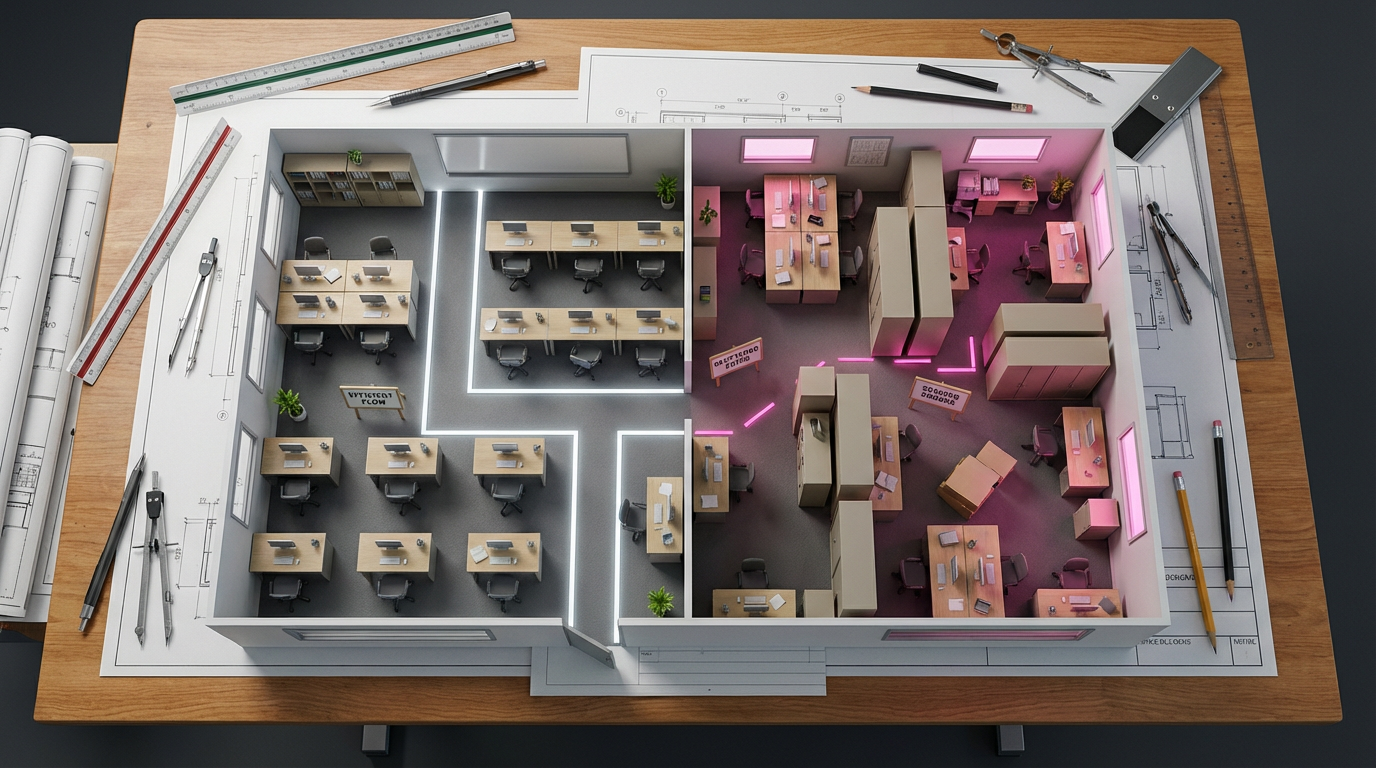
One of the most disruptive yet overlooked errors is poor traffic management. A circulation path is the route people naturally take to move through a space – from the entrance to their desk, to the printer, to the kitchen. When these paths are blocked, too narrow, or illogical, you get bottlenecks. This creates constant, low-level disruption that fragments concentration and is associated with frustration.
In our view, the fix starts with clear analysis. Map out the key journeys within your space. Are there desks blocking a direct route to the fire exit? Do people have to squeeze past a meeting area to get to the toilets? As a general rule of thumb, major walkways should be at least 1200mm wide, while paths between desks should be a minimum of 900mm to allow for comfortable passage. Rearranging just a few key pieces of furniture to create clear, direct routes can dramatically improve the feel and function of a room.
Error 2: Underestimating Storage Needs
Clutter is the enemy of productivity, and its primary cause is inadequate storage solutions. We often see plans that account for desks and chairs but completely forget where coats, bags, documents, and supplies will go. The result is predictable: piles of paper on desks, boxes stacked in corners, and personal items cluttering walkways. This not only looks unprofessional but also creates safety hazards and wastes valuable time as people search for misplaced items.
A robust storage strategy considers three levels: personal, departmental, and archival.
- Personal: Give individuals a place for their belongings with personal lockers or under-desk pedestals.
- Departmental: Use tambour units or shelving for shared resources close to the point of use.
- Archival: For less-frequently accessed items, consider high-density mobile shelving in a dedicated storage room.
Multi-functional furniture is also a great solution; for example, a bench in a reception area can have built-in storage for magazines or equipment.
Error 3: Neglecting UK Compliance & Accessibility
This isn’t just a mistake; it’s a legal and ethical failure. The Equality Act 2010 is a key piece of UK legislation that places a legal duty on employers and service providers to make ‘reasonable adjustments’ for disabled people. Forgetting this during space planning can lead to an exclusionary environment and significant legal risk. This includes everything from providing wheelchair-accessible desk heights to ensuring corridors are wide enough for a turning circle.
Compliance also extends to fire safety. Egress routes must be clearly marked, wide enough for swift evacuation, and kept clear at all times. In our experience, this is non-negotiable. We believe that planning for accessibility from day one is the most cost-effective and responsible approach. It demonstrates a commitment to inclusivity and safety that strengthens your organisation’s reputation. You can review our UK certifications and accreditations to see how seriously we take compliance.
Error 4: Poor Furniture Scaling & Placement
A common error is choosing furniture that is visually appealing in a catalogue but completely wrong for the scale of the room. A massive boardroom table can make a small meeting room unusable, while tiny chairs in a large open-plan area can feel lost and uncomfortable. This is where accurate measurements and a to-scale floor plan are indispensable.
Beyond scale, consider basic furniture placement rules. Start by anchoring the largest piece (like a desk or sofa) first, and then arrange smaller items around it. Create distinct zones for different activities – for example, conversational groupings in a breakout area shouldn’t obstruct a main walkway. Also, balance the visual weight in the room; don’t place all the heavy, dark furniture on one side. Finally, prioritise ergonomics, which is the science of designing the environment to fit the user, not forcing the user to fit the environment. Proper ergonomic chairs and desks are critical for health and productivity.
Error 5: Forgetting Informal & Collaborative Zones
Work doesn’t just happen at a desk. Some of the most valuable interactions – spontaneous problem-solving, team building, and knowledge sharing – occur in informal settings. A major planning error is designing a space that only provides formal workstations. This can stifle creativity and force employees to have impromptu meetings in disruptive locations, like corridors or by the kitchen kettle.
Creating dedicated breakout spaces is essential for a modern, dynamic workplace. These don’t have to be large or elaborate. A small nook with a couple of comfortable armchairs, a high table with stools for quick stand-up meetings, or a quiet pod for focused calls can make a huge difference. Investing in modern breakout furniture signals to your team that you support different ways of working and value their well-being. These zones are often the cultural heart of an office.
Sector-Specific Solutions: Offices vs. Schools
While the core principles of good design are universal, their application varies significantly between sectors. The challenges of optimising an open-plan office are quite different from those of a primary school classroom.
In commercial offices, the focus is increasingly on office layout efficiency to support hybrid working. According to research from firms like McKinsey, the post-pandemic office must be a destination for collaboration. This means reducing rows of identical desks in favour of a diverse ecosystem of spaces: quiet zones for focused tasks, tech-enabled meeting rooms for video conferencing, and comfortable lounges for social interaction. The goal is to give employees the right environment for the task at hand, which boosts both satisfaction and productivity.
In contrast, a school classroom layout must prioritise flexibility and durability. Guidelines from the Department for Education (DfE), the UK government body for education, provide standards for space per pupil, but the real challenge is creating a room that can shift from lecture-style teaching to group work to individual learning in minutes. This requires lightweight, movable, and robust furniture. Safety is also paramount, with a need for rounded corners, anti-tilt storage, and clear floor space to prevent trips and falls.
Hypothetical Case Study: A Growing UK Tech Firm
- Challenge: A 70-person software company was struggling with a cramped, noisy open-plan office. Productivity was dipping due to constant interruptions, and there was no space for private client calls or focused coding.
- Solution: We implemented a “zoning” strategy. We used acoustic panels and high-backed seating to create a quiet “deep work” zone. Two small, underused corners were converted into bookable pods for calls. We also introduced a central collaborative hub with a high table and whiteboards to contain spontaneous meetings.
- Results: In a post-project survey, employees reported a 40% reduction in unwanted distractions. The firm was able to retain its existing office space while improving functionality, Saving Time & Stress associated with a full relocation.
- Key Insight: A full redesign isn’t typically necessary. Strategic interventions to create different types of zones within an existing layout can deliver significant improvements to workflow and morale.
From Floor Plan to Furniture: The Costcutters UK Process
Navigating the complexities of space planning can feel overwhelming. That’s why we’ve refined a comprehensive process over 35 years to guide our clients from initial idea to finished reality. Our mantra is “Design To Install We Do It All!” because we manage every step, ensuring a smooth and successful outcome.
Our approach is built on partnership and expertise:
- Consultation & Needs Analysis: It starts with listening. We meet with you to understand your goals, workflows, budget, and challenges. We survey the users to ensure the final design meets their practical needs.
- 2D/3D Space Planning & Design: Our design team takes your requirements and translates them into detailed 2D floor plans and immersive 3D visuals. This allows you to see exactly how the space will look and function, enabling you to make informed decisions and prevent costly errors before any furniture is ordered.
- Furniture Selection & Quotation: With a plan in place, we help you select the well-suited furniture from our extensive catalogue. We focus on finding items that offer an effective combination of style, durability, and value. We also provide clear quotations, with options for Bulk Buy Discounts and flexible payment terms.
- Delivery & Installation: Our professional installation team handles everything. They deliver the furniture, build it on-site, and place it according to the approved plan, ensuring every detail is well-suited. We manage the entire project, leaving you with a ready-to-use space.
Frequently Asked Questions About Space Planning
What are the most common space planning errors?
The most common space planning errors include creating poor circulation paths, under-providing storage, using incorrectly scaled furniture, and ignoring accessibility regulations. These mistakes lead to inefficient, cluttered, and often non-compliant environments that hinder productivity and well-being. A successful layout must balance aesthetics with practical functionality, requiring careful consideration of user needs.
What is the 3-5-7 rule in interior design?
The 3-5-7 rule is a guideline for arranging decorative items, suggesting they look best grouped in odd numbers. For example, you might place three cushions on a sofa or five items on a mantelpiece. While useful for styling, it is a decorative principle, not a core rule for structural space planning. Functional layout planning should typically take precedence over purely aesthetic guidelines.
What is not to be considered in space planning?
In professional space planning, you should not consider personal taste over functional requirements or ignore budget and compliance constraints. It is also a mistake to plan a space without consulting the actual users – the staff or students who will use it daily. Finally, rarely assume current needs will be static; good planning typically considers future flexibility and growth to ensure long-term value.
What are common planner mistakes?
Common planner mistakes often stem from a lack of detailed analysis before the design begins. These include failing to measure the space accurately, overlooking the locations of power sockets and data ports, and choosing aesthetics over ergonomics and comfort. Another frequent error is not creating a detailed floor plan to scale before purchasing any furniture, which can lead to costly returns and delays.
What are the three F’s of interior design?
The three F’s of interior design are typically cited as ‘Form, Function, and Feeling’. ‘Form’ refers to the shape and visual aesthetics of the space and its objects. ‘Function’ relates to how the space will be used and its practicality. ‘Feeling’ is the mood or atmosphere the space evokes. A successful design achieves a harmonious balance between all three, ensuring the space is both beautiful and usable.
What colour is replacing gray in 2026?
Design experts predict that warm, earthy tones are replacing the cool greys popular in the last decade. As of 2026, expect to see more beige, terracotta, warm whites, and nature-inspired greens in commercial and educational interiors. These colours create a more welcoming and less clinical atmosphere. However, brand colours and environmental psychology should typically guide your final choice for the space.
What are the first steps in planning a new office layout?
The first step is a thorough needs analysis: survey employees, analyse workflows, and define the goals for the new space. Next, establish a realistic budget and timeline. Only after these foundational steps should you proceed to measure the space accurately and begin creating initial floor plan drafts. This initial research is strongly critical for the project’s ultimate success.
How does space planning impact employee well-being?
Space planning profoundly impacts well-being by influencing comfort, stress levels, and interaction. Good ergonomic furniture reduces physical strain, while proper lighting can improve mood and reduce eye fatigue. Providing a variety of spaces – for quiet focus and social interaction – gives employees control over their environment, which has been shown to boost job satisfaction and reduce stress.
How do you plan a space for traffic flow?
To plan for traffic flow, first identify the main circulation paths: from the entrance to desks, to meeting rooms, and to facilities. Ensure these paths are wide, direct, and unobstructed. A general rule is to allow at least 900mm for minor walkways and 1200mm for main corridors. Avoid placing furniture where it creates awkward detours or bottlenecks, as this is essential for a smooth-functioning environment.
What are the UK regulations for office space?
Key UK regulations include the Health and Safety at Work etc. Act 1974 and the Equality Act 2010, which mandates accessibility. The Workplace (Health, Safety and Welfare) Regulations 1992 specify requirements for ventilation, temperature, lighting, and space per person (typically 11 cubic metres). Adhering to these is a legal necessity, and professional planners are well-versed in these critical standards.
Important Considerations & Professional Guidance
This guide provides general principles and highlights common errors based on extensive industry experience. However, every space is unique, with its own architectural quirks, budget constraints, and organisational culture. The solutions presented are starting points and may require adaptation for your specific context, particularly in listed buildings or highly specialised environments like Special Educational Needs (SEN) classrooms or clinical settings.
The ‘rules’ of design, such as the 3-5-7 rule or standard walkway widths, are valuable guidelines, not rigid laws. Alternatives to traditional layouts, like fully activity-based working or dynamic classroom designs, can be highly effective but require careful change management and user training. You should evaluate these alternatives against your organisation’s readiness for change and operational needs rather than adopting a trend for its own sake.
While this article empowers you to identify problems, implementing a full-scale redesign is a complex project. For any significant refurbishment or new fit-out, we strongly recommend consulting with a professional space planning service. An expert can ensure compliance with all UK regulations, create optimised 3D plans, and help you source furniture that delivers an effective long-term value, preventing costly mistakes before they happen.
Transform Your Space from a Liability to an Asset
Avoiding common space planning errors is fundamental to creating a space that works for your organisation, not against it. By prioritising clear circulation, adequate storage, user well-being, and legal compliance, you can directly enhance productivity and satisfaction. A well-planned layout is one of the most powerful investments you can make in your people and your operational success, helping you to maximise office flow and efficiency. We’re proud to be Rated Excellent On Trustpilot for helping clients achieve exactly that.
With over 35 years of experience helping UK schools, offices, and public sector organisations, the team at Costcutters UK understands these challenges intimately. We move beyond simply selling furniture to provide a comprehensive, end-to-end service, with options to Credit Accounts Or Pay Flexibly. If you’re ready to fix your layout issues and unlock your space’s true potential, our experts are here to help.
Book a Free Space Planning Consultation today.
References
- Health and Safety Executive (HSE) – UK Government Guidance. This source specifies legal requirements for workplace environments, including space, ventilation, and lighting under UK law.
- Leesman Index – Global Workplace Study. This ongoing global research provides data from hundreds of thousands of employees on how workplace design impacts sentiment and productivity.
- Department for Education (DfE) – UK Government Standards. The DfE provides building bulletins and area guidelines for school premises in the UK, including standards for space per pupil.
- The Equality Act 2010 – UK Legislation. This act outlines the legal duty to make reasonable adjustments for disabled people, which has significant implications for physical space planning in all UK organisations.
Conclusion
Transform Your Space from a Liability to an Asset
In summary, avoiding common space planning errors is fundamental to creating a space that works for your organisation, not against it. By prioritising clear circulation, adequate storage, user well-being, and legal compliance, you can directly enhance productivity and satisfaction. A well-planned layout is one of the most powerful investments you can make in your people and your operational success, helping you to maximise office flow and efficiency.
With over 35 years of experience helping UK schools, offices, and public sector organisations, the team at Costcutters UK understands these challenges intimately. We move beyond simply selling furniture to provide a comprehensive, end-to-end service. If you’re ready to fix your layout