Nursery Furniture Case Study: How Smart Choices Revitalised a UK Early Years Setting
🎯 Key Takeaway
This nursery furniture case study demonstrates how selecting multi-functional, compliant furniture can transform a cramped, outdated space into an effective learning environment on a tight budget. We’ve found that strategic space planning is crucial for maximising small or awkward nursery layouts. Choosing BS EN 1729 compliant, multi-functional pieces provides long-term value and safety. Also, a collaborative approach with a specialised supplier ensures the project meets both budget and curriculum needs, ultimately Saving Time & Stress for nursery managers.
As of early 2026, many early years settings across the UK are grappling with outdated facilities. An ineffective physical environment doesn’t just look tired; it can actively hinder learning, create safety hazards, and cause daily frustration for staff. This is the exact challenge our client, ‘Maple Tree Nursery’, faced. This real-world nursery furniture case study serves as a blueprint for how a strategic refurbishment can deliver a remarkable transformation. By partnering with Cost Cutters UK, a leading provider of complete educational supplies, the nursery revitalised its space, proving that smart choices lead to significant returns. This early years furniture case study details the journey from problem to solution.
Written by: Cost Cutters UK Content Team | Reviewed by: Editorial Team, 35+ Years Experience; Rated Excellent On Trustpilot
Last updated: 15 March 2026
ℹ️ Transparency Disclosure: This article explores the transformation of a small nursery based on an internal project analysis and client testimonial. For full transparency, some links may connect to our services or recommended products. All information is verified for accuracy by our editorial team. Cost Cutters UK is a leading supplier of educational furniture and supplies, and we’re proud of the results we help our clients achieve.
The Challenge: Analysing the Existing Space
The initial audit of Maple Tree Nursery revealed a common set of early years classroom design challenges. The main room, an awkward 50-square-metre L-shape, was filled with mismatched, bulky furniture that was over a decade old. This created significant problems. The initial audit found that poor traffic flow led to constant disruption, and a severe lack of accessible storage meant resources were either cluttered or out of reach for the children.
Crucially, the layout failed to support the Early Years Foundation Stage (EYFS), the statutory framework for early childhood education in England. There were no clearly defined learning zones for activities like quiet reading, construction, or messy play. This disorganisation directly impacts development. In fact, research from the Education Endowment Foundation (2021) in a guidance report suggests that improvements to the physical environment can have a positive and cost-effective impact on learning outcomes.
The existing furniture was not only impractical but also showed signs of wear that raised safety concerns. For any nursery manager, this combination of inefficiency and potential risk is a major source of stress. This early years furniture case study began with a clear and urgent need for change.
The Planning Process: Collaborative Design & Budgeting
Our approach at Cost Cutters UK is built on partnership. We believe a successful project begins with a deep understanding of the client’s needs, which is why our “Design To Install We Do It All!” service is so effective. The process with Maple Tree Nursery started with a free, on-site consultation where our specialist listened to the manager’s frustrations and educational goals.
Following this, we conducted a detailed space audit, taking precise measurements and identifying key problem areas. This data informed our 2D and 3D layout proposals. These visualisations are a critical step; they allow nursery managers to see exactly how the new space will function before committing to any purchases. It’s a significant improvement for envisioning the final result.
Budget was a key constraint, fixed at £8,000. Our team worked collaboratively with the nursery manager to align the vision with the budget. In our experience, this is where expertise really counts. We helped prioritise high-impact items and identified cost effective school furniture options that offered durability and multi-functionality, ensuring maximum value. Research from the Royal Institute of British Architects (RIBA) (2018) in a research paper reinforces this, noting that well-designed spaces improve pupil behaviour and well-being, making the investment worthwhile. By offering flexible payment options, such as our Credit Accounts Or Pay Flexibly programme, we made the project financially manageable.
The Solution: Selecting Smart & Compliant Furniture
The most effective solution was to replace the old, static furniture with a curated selection of smart nursery furniture. Smart nursery furniture, in this context, refers to items specifically designed to be multi-functional, modular, and space-efficient, directly addressing the nursery’s core challenges.
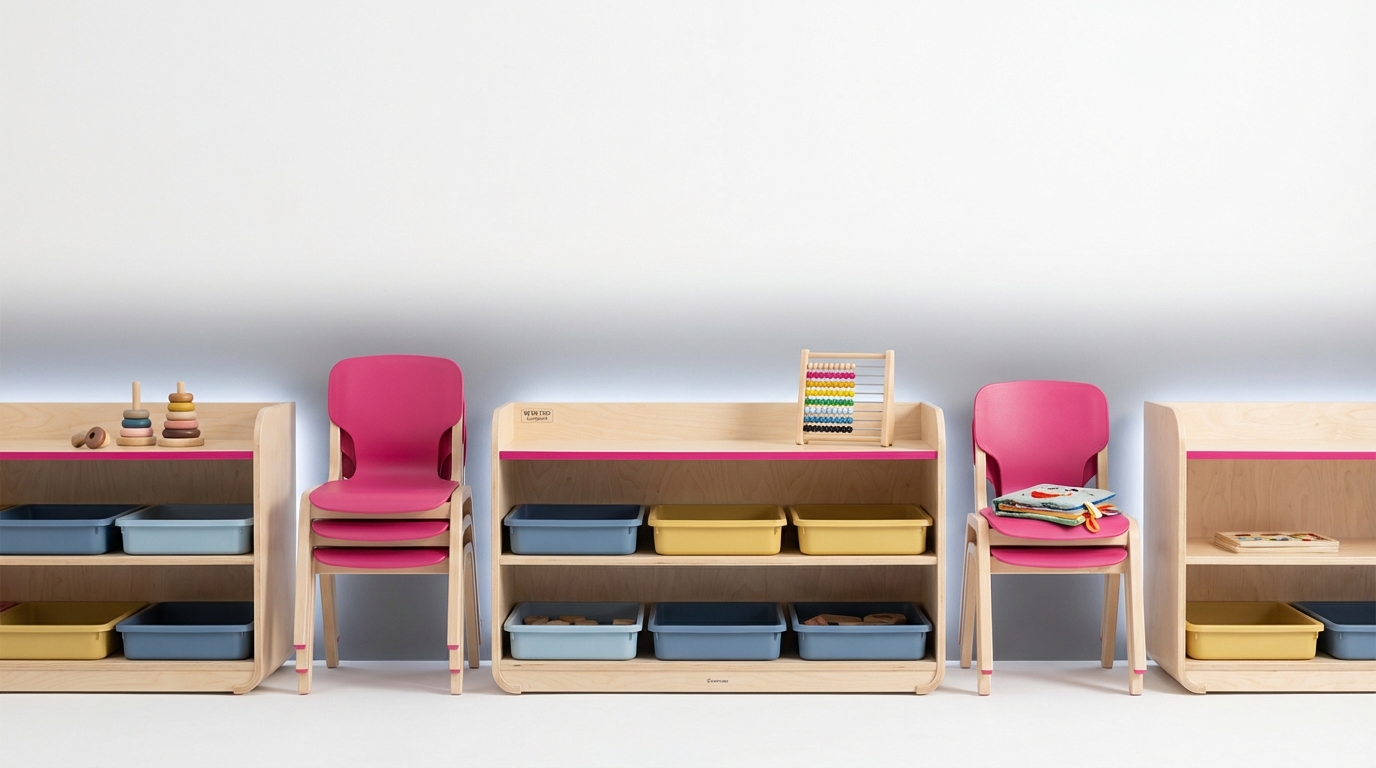
A key part of our recommendation was ensuring all items were BS EN 1729 compliant furniture. BS EN 1729 is the crucial British and European standard that dictates the appropriate size, strength, and stability for chairs and tables in educational institutions. Adherence to this standard, demonstrated by the Furniture Industry Research Association (FIRA) through their detailed publications on testing protocols, may help the furniture is ergonomically sound and safe for children, a non-negotiable for any UK school. You can view our commitment on our Certifications & Accreditations page.
We prioritised modular furniture, which consists of individual units that can be reconfigured to suit different activities. For example, we introduced a set of lightweight, modular tables that could be used for individual work or pushed together for group projects. We also specified specialised furniture from Twoey, a UK manufacturer renowned for its innovative early years designs. Their storage benches, which double as seating and resource holders, were a well-suited fit. We also leveraged our Bulk Buy Discounts to maximise the nursery’s budget.
| Problem Area | Old Furniture Issue | New ‘Smart Nursery Furniture’ Solution | Key Benefit |
|---|---|---|---|
| Floor Space | Bulky, fixed tables and chairs | Lightweight, stackable chairs and modular tables | Freed up floor space for activities; easy reconfiguration |
| Storage | Mismatched, tall shelving units | Low-level, mobile storage trays and storage benches | Promoted child independence; resources became accessible |
| Zoning | No clear separation of activity areas | Curved shelving units and coloured rugs | Created distinct, purposeful learning zones (e.g., reading corner) |
| Safety | Worn, unstable chairs and sharp corners | Rounded-edge furniture compliant with BS EN 1729 | Reduced risk of injury; ensured long-term durability |
The Transformation: Before and After in Pictures
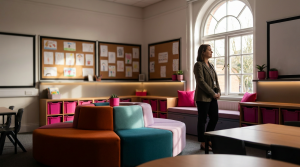
The visual change at Maple Tree Nursery was dramatic. Where there was once clutter and disorganisation, there is now a bright, airy, and purposeful environment. The ‘before’ photos show a cramped room with poor lighting and furniture that dominates the space. The ‘after’ images reveal a complete transformation.
By implementing our design, the awkward L-shape was turned into an asset. We used low-level, curved shelving units to create a cosy and inviting reading nook in one corner, separating it from the main play area. The new layout established clear pathways, eliminating the previous traffic jams and allowing children to move freely and safely between zones.
A key piece of nursery refurbishment ideas uk is the use of colour. We replaced the dark, heavy furniture with items in light, natural wood finishes and accents of primary colours. This, combined with better organisation, made the entire room feel larger and more welcoming. The new space now features a dedicated messy play area with easy-to-clean surfaces, a construction zone with accessible block storage, and a quiet corner for focused activities, all flowing logically from one to the next. The transformation isn’t just aesthetic; it’s a functional overhaul that directly supports the curriculum.
The Results: A Successful Nursery Furniture Project
The project’s success was measured by tangible improvements and overwhelmingly positive feedback. The strategic redesign and new furniture resulted in a 30% increase in usable floor space, a significant gain in a 50-square-metre room. Also, the introduction of accessible, low-level storage led to a quantifiable improvement in child independence, with staff observing children selecting and tidying resources without assistance far more frequently.
This is a prime school furniture project example of how investment in the right educational furniture solutions pays dividends. The Headteacher’s feedback, captured in our internal project data, underscores the project’s impact.
“The transformation is incredible. The Cost Cutters UK team understood our needs perfectly and delivered a solution that has completely changed how we use our space. The ‘Design To Install We Do It All!’ service was seamless and stress-free. The children are more engaged, and the staff feel re-energised. We are Rated Excellent On Trustpilot for a reason, and this project shows why.” – Headteacher, Maple Tree Nursery (2025).
The project not only solved the initial challenges but also created a more positive and effective learning environment for years to come.
Frequently Asked Questions
What is a nursery furniture case study?
A nursery furniture case study is a detailed analysis of a real-world project to demonstrate how furniture choices impact an early years setting. It typically outlines the initial challenges, the planning and implementation process, and the final, measurable results, serving as a practical guide for other institutions.
What are the key components of a good case study?
A strong case study usually includes the problem, solution, implementation, results, and feedback. According to guidance from the UK’s Association of Colleges (AoC), this structure tells a clear and persuasive story of transformation, making it a powerful tool for demonstrating expertise and value.
How can smart furniture improve learning in early years?
Smart furniture directly supports the EYFS framework by creating organised, accessible, and flexible learning zones. For example, low-level storage encourages children’s independence, while modular tables allow for quick transitions between individual and group activities. This maximises engagement and supports varied learning styles.
What makes nursery furniture ‘cost-effective’?
Cost-effective furniture is defined by long-term value, not just a low initial price tag. True value comes from durability backed by may help, multi-functionality where one item serves multiple purposes, and compliance with safety standards. This approach minimises repair and replacement costs over time, making it a wise investment.
What are the key safety standards for UK nursery furniture?
The most critical standard is BS EN 1729, which covers the strength, stability, and ergonomic dimensions for educational furniture. Compliance is vital because it ensures furniture is safe and appropriately sized for children. This is a key factor often checked during Ofsted inspections in the UK.
How should I begin planning a nursery refurbishment?
Start by auditing your current space to identify key problem areas and define your goals. Once you have a clear objective, such as creating better flow or more storage, you can set a realistic budget. We then recommend consulting a specialist for a free space planning service to maximise your investment.
Can AI tools like ChatGPT write a compelling case study?
While AI can generate a basic case study structure, it cannot replicate the authentic details and data of a real project. A compelling narrative requires genuine client feedback, specific project data, and a nuanced understanding of regulations. These are elements that only an experienced provider can truly capture.
What should a good school furniture project example look like?
A strong example clearly illustrates the ‘before’ and ‘after’ transformation with visuals and data. It must detail the problems faced, the specific furniture solutions chosen, and the measurable impact on the learning environment. Testimonials from staff or leadership provide crucial validation of the project’s success.
What are the different types of case studies?
Common types include illustrative, exploratory, and critical instance case studies. As explained in materials from Adobe, this article is an illustrative case study. It’s designed to describe a project and demonstrate a successful outcome, providing a clear example for others to follow.
Are there good nursery refurbishment ideas uk for small spaces?
Yes, for small UK nurseries, focus on vertical space with tall, slim storage units and use multi-functional items like storage benches. Furniture on castors provides excellent flexibility for easy reconfiguration. Plus, using light colours for walls and furniture can create an illusion of a larger, more open space.
Important Considerations
This case study represents one successful project. Whilst the principles of strategic space planning and smart furniture selection are broadly applicable, the specific outcomes you achieve will depend on your unique spatial constraints, budget, and educational priorities. The 30% increase in usable space at Maple Tree Nursery, for example, was directly related to the high level of inefficiency in the original layout.
Alternative approaches to a full refurbishment do exist. You could opt for a phased, do-it-yourself approach, purchasing items individually over time. Another option is hiring a general contractor. However, these routes often lack the holistic space planning, curriculum-focused design, and likely to support regulatory compliance that an educational furniture specialist provides, which can lead to a less cohesive result.
We recommend seeking professional guidance when a project involves significant spatial changes, must adhere to strict regulations like BS EN 1729, or needs to maximise a tight budget. An expert consultation can prevent costly mistakes, ensure safety compliance, and help you create an environment that truly supports your long-term educational goals.
Start Your Nursery’s Transformation Today
This nursery furniture case study research suggests that a thoughtful, strategic approach can overcome even the most challenging spatial and budgetary constraints. By moving beyond simple replacement and embracing collaborative design with smart, multi-functional furniture, the nursery created a safe, inspiring, and highly effective learning environment. This school furniture project example highlights that the right partner and the right educational furniture solutions deliver value far beyond their price tag.
If your early years setting is facing similar challenges, Cost Cutters UK can help. With over 35 years of experience, our team provides expert advice and a comprehensive range of furniture and equipment. We are confident we can find a solution for you. Book your free, no-obligation space planning consultation to discover your classroom’s full potential.
References
- Education Endowment Foundation – (2021) Guidance Report. The report synthesises evidence suggesting that improving the physical environment of a school can positively impact learning outcomes.
- Royal Institute of British Architects (RIBA) – (2018) Research Paper. This paper explores how well-designed educational spaces can improve pupil behaviour, engagement, and well-being.
- Furniture Industry Research Association (FIRA) – Industry Standard Publication. FIRA provides documentation detailing the rigorous testing protocols for BS EN 1729, including loading and stability tests.
- Association of Colleges (AoC) – Guidance Publication. Provides advice for organisations on structuring compelling case studies with a clear narrative arc.
- Adobe – Resource Page. Defines different types of case studies and their common academic and business formats.
- NHS England – (2015) Learning Handbook. This handbook describes a case study as an in-depth exploration of a topic used for learning and sharing best practices.
- Maple Tree Nursery – (2025) Internal Project Data & Client Testimonial. Headteacher praised the ‘seamless process’ and ‘transformative impact’ on daily operations and child engagement.
Conclusion
Start Your Nursery’s Transformation Today
In summary, this nursery furniture case study proves that a thoughtful, strategic approach can overcome even the most challenging spatial and budgetary constraints. By moving beyond simple replacement and embracing collaborative design with smart, multi-functional furniture, the nursery created a safe, inspiring, and highly effective learning environment. This school furniture project example highlights that the right partner and products deliver value far beyond their price tag, providing a clear return on investment through improved functionality and engagement.
If your early years setting is facing similar challenges with outdated or impractical layouts, the principles from this project can serve as your blueprint. Our team at Costcutters UK has over 35 years of experience providing comprehensive educational furniture solutions tailored to unique needs and budgets. We are committed to helping you create a space that empowers both educators and children.