Outdoor Classroom Design: A Practical Guide for UK Schools
🎯 Key Takeaway
Effective outdoor classroom design for UK schools requires a strategic approach to planning, zoning, and selecting all-weather, compliant furniture to create a safe and engaging learning environment. A successful project enhances pupil well-being and academic attainment by extending learning beyond the traditional classroom. We believe this investment delivers significant returns, not just in educational outcomes but also in making your school more attractive to prospective parents. Our guide is designed to make this process straightforward, “Saving Time & Stress” for busy school managers.
The value of outdoor learning is increasingly recognised by educational bodies across the United Kingdom. However, for school business managers and headteachers, the path from a muddy field to a functional learning space can seem complex. Concerns over budget, safety compliance, and the famously unpredictable British weather often create barriers. This is where a structured approach to outdoor classroom design becomes essential. It’s not just about placing a few benches outside; it’s about creating a durable, engaging, and curriculum-aligned extension of your school. This guide provides a practical, step-by-step framework to help you deliver a high-impact project, supported by our 35+ years of experience providing a complete range of school equipment and educational supplies.
👤 Written by: The Cost Cutters UK Content Team | Reviewed by: Our In-House Experts, 35+ Years in Educational & Commercial Furnishing; Rated Excellent On Trustpilot
Last updated: 15 March 2026
ℹ️ Transparency Disclosure: This article explores outdoor classroom design based on our 35 years of experience supplying UK educational institutions. This transparency is important to us. Some links connect to our products and services, such as our free space planning consultation. All information is verified by our editorial team to ensure accuracy and practicality. Cost Cutters UK is a leading supplier of school and educational equipment in the UK, trusted by thousands of schools.
Best For: School Business Managers, Headteachers, and Governors in UK primary schools and academies planning to develop or upgrade their outdoor learning facilities.
Not effective For: Individuals seeking DIY home garden play area ideas or international schools operating under different compliance standards.
How Should You Begin Planning Your Outdoor Classroom Design?
The most effective outdoor classroom design plans begin not with a catalogue, but with a thorough site assessment and clear educational objectives. This initial planning phase is the single most important factor in ensuring the project’s success and long-term value. Our experience suggests that a rushed start often leads to costly revisions later.
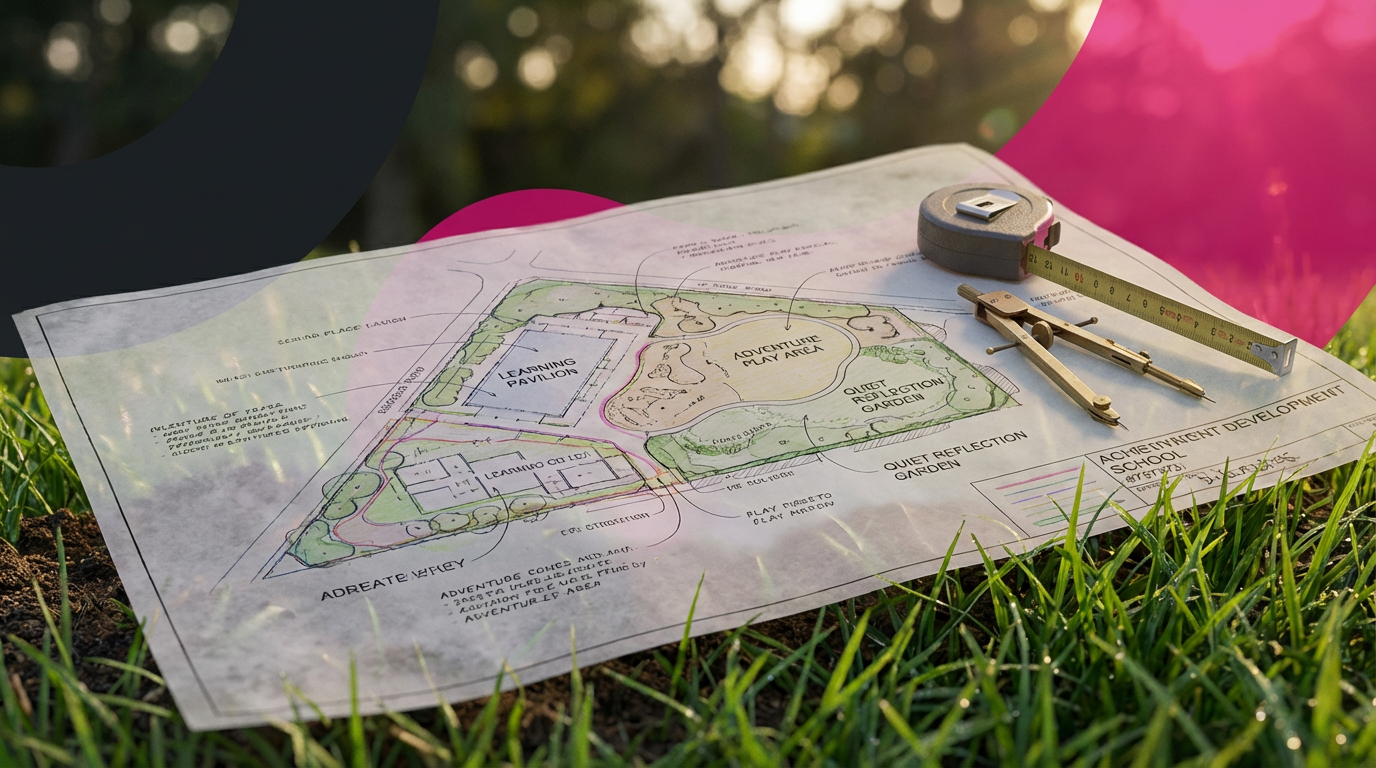
First, you must define your educational goals. What do you want pupils to achieve in this space? For the Early Years Foundation Stage (EYFS), the statutory educational framework for children aged 0-5 in England, the focus will be on sensory exploration and play-based learning. For Key Stage 1 (KS1) and KS2, the space might need to support science experiments, outdoor reading, or even small drama performances. Aligning the design with specific curriculum needs ensures the space is used effectively.
Next, conduct a detailed site audit. Analyse sun and shade patterns throughout the day, identify areas exposed to wind, check for drainage issues, and map out access routes for pupils of all abilities. This audit informs where to place different zones. For instance, a quiet reading nook should be in a sheltered, shaded spot, while a planting area needs good sunlight.
Finally, establish a realistic budget and a safety framework. Your budget should account for groundwork, surfaces, furniture, installation, and ongoing maintenance. Considering our “Bulk Buy Discounts” can make a significant difference to the overall cost. From the very beginning, safety must be paramount. Creating an outdoor classroom safety checklist that considers supervision, equipment safety, and accessibility is non-negotiable. We recommend referencing our full range of UK safety accreditations to understand the standards your project must meet.
How Can You Design an All-Weather Outdoor Classroom?
To maximise the return on your investment, you must design a space that can be used for more than just a few sunny weeks a year. The key is to address the British weather head-on through intelligent zoning, shelter, and surfacing. We believe a well-designed space can be usable for over 200 days of the school year, significantly increasing learning opportunities.
Zoning is a technique that divides your outdoor area into distinct sections for different activities. This prevents conflicts (like a quiet reading group being disturbed by a messy play session) and allows for a wider range of outdoor learning space ideas. Common zones include:
- A Covered Teaching Hub: The anchor of your outdoor classroom, featuring a permanent canopy or large sail shades, a whiteboard, and seating for a full class.
- A Messy Play Zone: Sited away from the main hub, with surfaces like bark chippings or sand, containing mud kitchens or water tables.
- A Quiet/Sensory Zone: A sheltered corner with comfortable seating, planters, and sensory elements like wind chimes or textured panels.
- A Natural Discovery Area: A space left partially wild to encourage biodiversity, well-suited for bug hotels and observing nature.
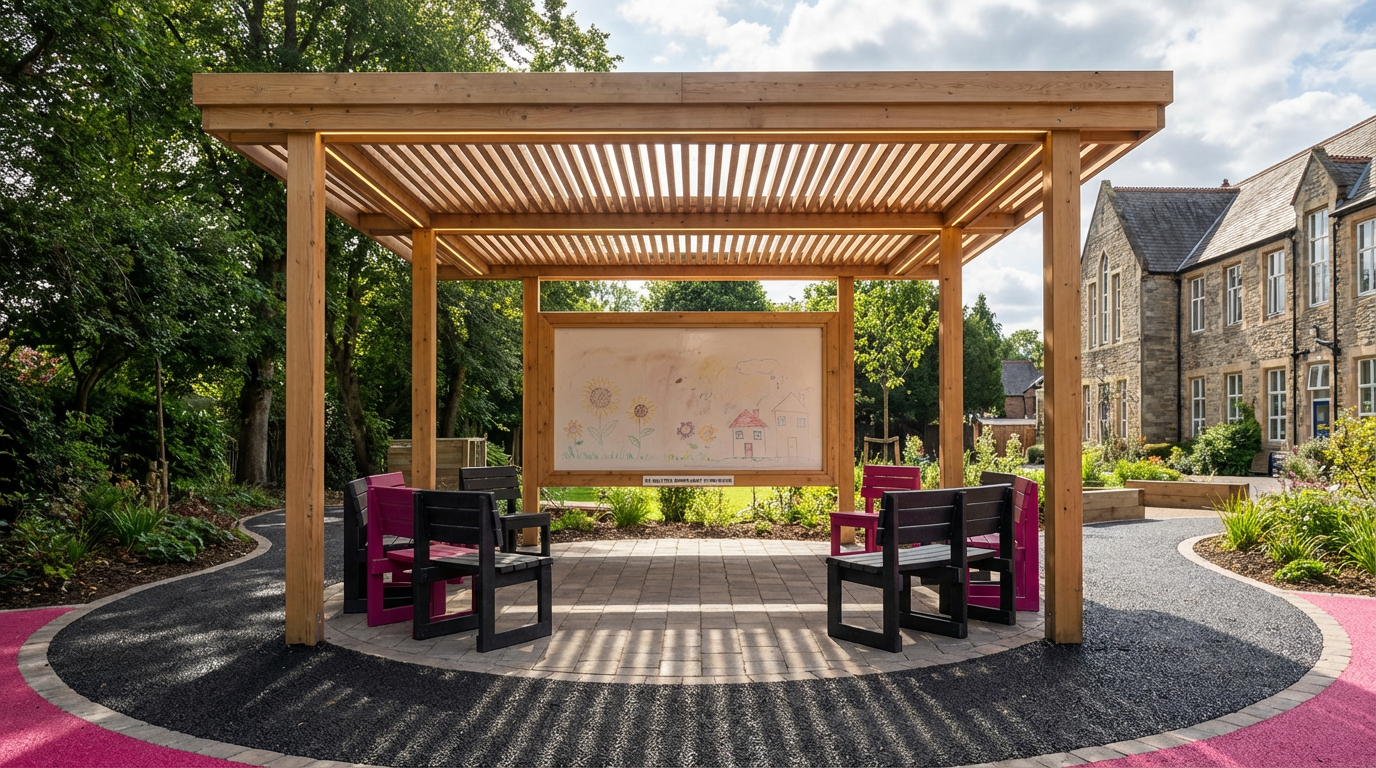
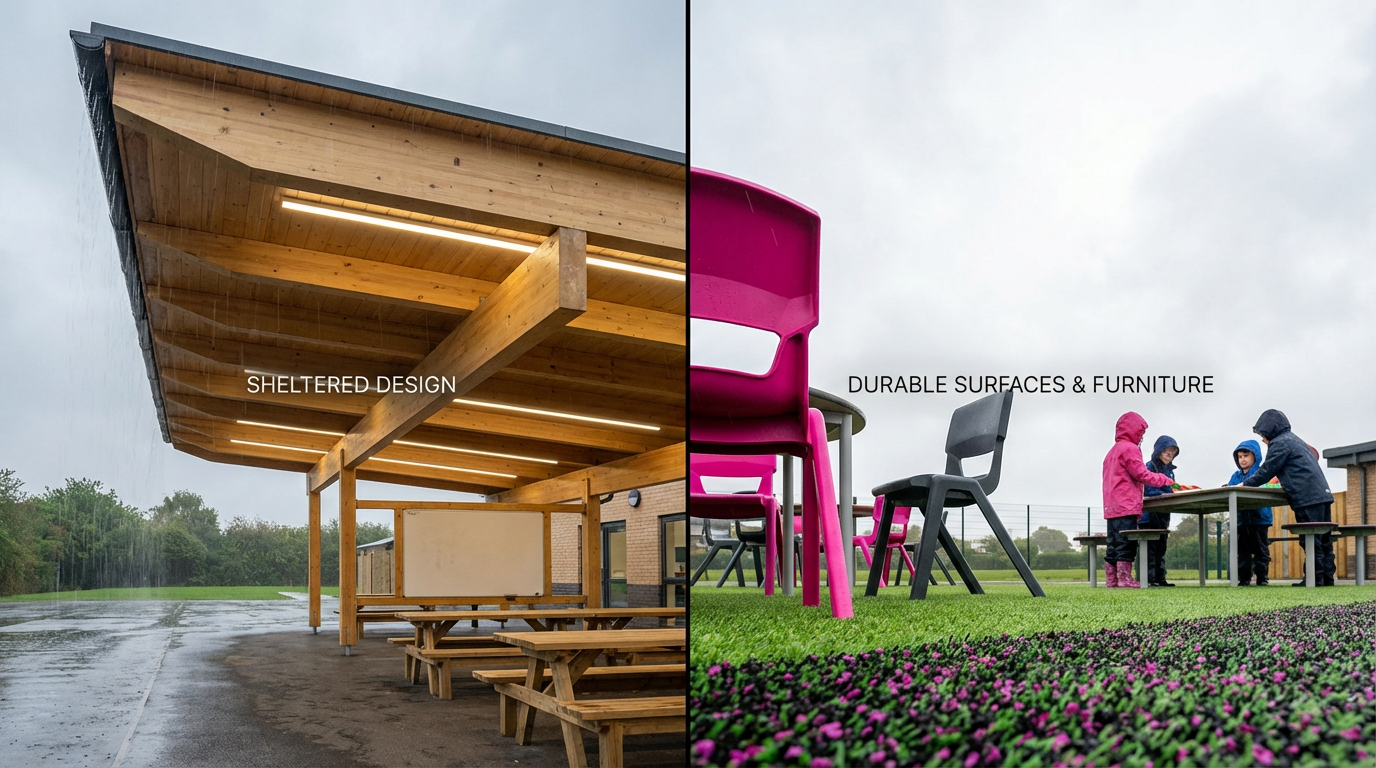
Shelter is the most critical element for year-round use. A permanent timber-framed canopy is a fantastic long-term investment, providing protection from both rain and UV rays. For tighter budgets, large, high-quality shade sails or even heavy-duty commercial umbrellas can create effective sheltered spots for small group work.
Equally important are the surfaces. Non-slip decking, rubber mulch under play equipment, and artificial grass provide safe, usable surfaces even after a downpour. Proper ground preparation and drainage are essential to prevent the space from becoming a mud pit. It’s this attention to practical detail that transforms a simple garden into a true outdoor classroom.
### Case Study: A Primary School Transformation
Challenge: A South London primary school had a large, underused grassy area that became waterlogged and unusable for half the year, limiting their Ofsted-praised outdoor learning programme.
Solution: We worked with them on a phased “Design To Install We Do It All!” project. Phase one involved installing a 6m x 4m timber canopy and creating a zoned area with artificial grass for the teaching hub and bark chippings for a new messy play zone.
Results: The school reported a 150% increase in the use of the outdoor space during the autumn and spring terms. Pupil engagement in science lessons, now often held outdoors, rose measurably according to teacher feedback.
Key Insight: A phased approach, starting with the essential shelter and core zones, allowed the school to make an immediate impact while planning for future additions like planters and a performance stage.
What Furniture is Essential for Your Outdoor Classroom Design?
Choosing the right furniture is a critical decision that directly impacts pupil safety, budget longevity, and the overall functionality of your outdoor classroom design. This isn’t the place for domestic garden furniture; you need commercial-grade, compliant, and durable items designed for the rigours of a school environment.
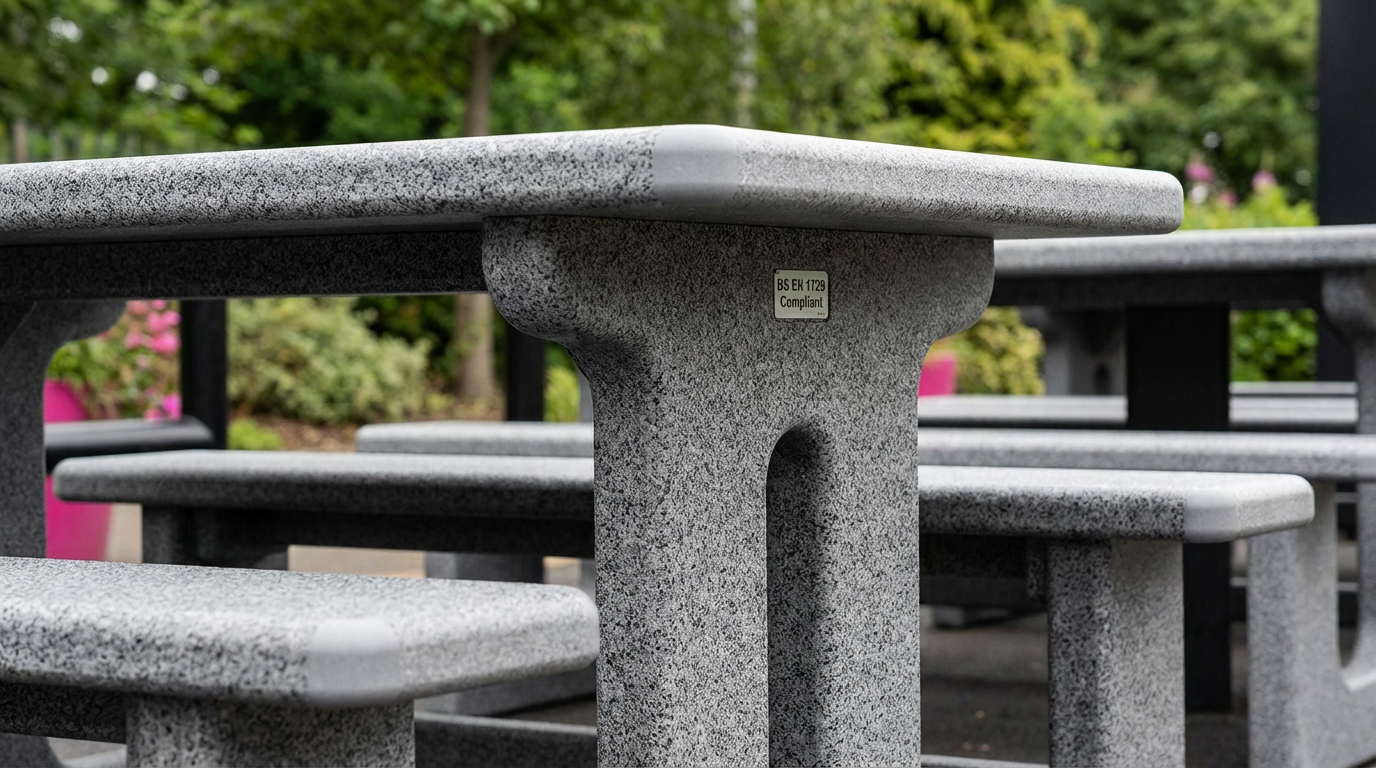
The most important factor is compliance. All furniture should conform to British Standard EN 1729 (BS EN 1729). This is the European safety and ergonomic standard for educational furniture, which dictates correct heights, depths, and angles for chairs and tables to support good posture and prevent strain in growing children. Specifying BS EN 1729-compliant furniture is a mark of due diligence and ensures pupil well-being.
Material choice is the next consideration. Given the UK climate, you need materials that can withstand damp, frost, and sun without degrading. Our experience shows that recycled plastic and high-quality, pressure-treated timber offer an effective long-term value. While the initial outlay may be higher than for cheaper alternatives, their lifespan is significantly longer, leading to a lower total cost of ownership.
Comparison of Outdoor Furniture Materials
| Material | UK Weather Resistance | Typical Lifespan | Maintenance Required | Best For |
|---|---|---|---|---|
| Recycled Plastic | Excellent | 25+ years | Very Low (Wipe clean) | Benches, picnic tables, planters |
| Pressure-Treated Timber | Very Good | 15-20 years | Low (Annual check/clean) | Natural aesthetics, canopies, stages |
| Powder-Coated Steel | Good | 10-15 years | Low (Check for chips/rust) | Secure storage, table frames |
| Untreated Softwood | Poor | 2-5 years | High (Annual sealing/staining) | Low-budget, temporary solutions only |
Finally, consider the range of furniture you’ll need. This typically includes picnic tables for group work, benches for seating, mark-making boards or outdoor easels, and planters for gardening activities. A crucial, often overlooked item, is storage. Leaving resources outside will lead to damage and loss. Investing in secure outdoor storage units from Asgard ensures that equipment is kept safe, dry, and ready for the next lesson.
Inspiring Outdoor Classroom Design Ideas for All Ages
an effective outdoor classroom design ideas are those that directly support curriculum objectives while sparking curiosity and engagement. A well-designed space provides a flexible backdrop for a huge variety of lessons, from science to art. The key is to tailor the features to the age and developmental stage of the pupils who will be using it most.
EYFS: Sensory and Play-Based Spaces
For the youngest learners, preschool outdoor classroom design should be a sensory wonderland. The focus is on learning through doing, touching, and exploring. Simple, robust features have the biggest impact. Consider installing a mud kitchen, where children can engage in imaginative play while learning about measurements and textures. Water tables offer endless opportunities for scientific discovery, exploring concepts like floating and sinking. We also recommend low-level, accessible planters and tactile pathways made from different materials like smooth pebbles, wood rounds, and textured paving slabs. It’s vital that all furniture and equipment is at an appropriate height and designed with safety as the priority, which is why we partner with brands offering specialised outdoor learning furniture for this age group.
KS1 & KS2: Curriculum-Linked Learning Zones
As children progress to KS1 and KS2, outdoor learning space ideas can become more directly linked to specific subjects. A small, raised wooden stage can become a performance area for drama and English, a speaker’s corner for debating, or simply an elevated spot for storytelling. A dedicated ‘minibeast-mansion’ or bug hotel becomes a living science lab for studying habitats. A school weather station with a rain gauge and anemometer provides real-world data for maths and geography lessons. Large, wall-mounted outdoor whiteboards or chalkboards are well-suited for collaborative maths problems or creative writing prompts. The goal is to create zones that teachers can easily adapt for a multitude of lessons, making the outdoors a truly integrated part of the school day.
Important Considerations
This guide provides a robust framework, however, every school site presents unique conditions. Factors such as significant ground slope, the presence of protected trees, local planning permission requirements, and specific accessibility needs for pupils with physical disabilities can introduce complexities not covered in detail here. The budget ranges discussed are for guidance and will inevitably vary based on your UK location, chosen materials, and groundwork requirements.
Whilst a community-led, DIY approach can be effective for smaller elements like building planters, alternative approaches exist for larger projects. You might consider a phased implementation over several financial years to manage cash flow. Another alternative is to focus on significantly upgrading a small, existing courtyard or patio area rather than developing a large new space from scratch, which can deliver a high impact for a lower initial investment.
For a project of this scale, our professional advice is to seek expert guidance to avoid costly mistakes and ensure full compliance. We recommend a consultation to analyse your specific needs. An experienced partner can help you maximise your budget, navigate safety standards like BS EN 1729, and create a durable, inspiring space that will serve your pupils effectively for many years. It’s an investment in your school’s future.
Frequently Asked Questions
What is outdoor classroom design?
Outdoor classroom design is the professional planning and creation of an external school space that functions as a safe, durable, and curriculum-rich extension of the indoor learning environment. It moves beyond simple play equipment to incorporate specific zones, all-weather solutions, and compliant furniture. The ultimate goal is to create a versatile educational asset that supports teaching and learning throughout the year, something we have helped hundreds of UK schools achieve.
How do you create an outdoor classroom on a budget?
You can create an effective outdoor classroom on a budget by prioritising multi-purpose items and adopting a phased development plan. Start with essentials like a few durable recycled plastic picnic tables and a weatherproof whiteboard. You can then use low-cost, high-impact materials like bark chippings for surfaces. Involving the school community in creating features like planters or a bug hotel is a great way to stretch funds, but typically prioritise spending on safety-compliant items.
What furniture is best for an outdoor classroom in the UK?
an effective furniture is durable, low-maintenance, and compliant with UK safety standards. We strongly recommend durable outdoor school furniture made from recycled plastic or pressure-treated timber, as these materials are well-supported by research to resist the UK’s damp and frost. You should ensure all items, particularly chairs and tables, meet the BS EN 1729 standard for ergonomics and safety. This ensures longevity and protects both pupils and your investment.
How do you make an outdoor classroom safe?
Making an outdoor classroom safe begins with a formal risk assessment before any work starts. Key actions include creating clear zones to separate quiet and active areas, using certified non-slip and impact-absorbing surfaces where needed, and checking for site hazards like poisonous plants or unstable walls. All furniture and equipment must be professionally installed and conform to the latest British safety standards to ensure the well-being of all users.
What are the key zones in an outdoor learning space?
Effective outdoor learning spaces typically feature several distinct zones to support a variety of activities. These often include a covered teaching area for group instruction, a messy play zone with sand or mud, a quiet zone with comfortable seating for reading, a natural area for observing wildlife, and an open space for physical activity. Zoning helps to manage the class effectively and maximises the educational potential of the area.
How do you design a preschool outdoor classroom for EYFS?
An effective preschool outdoor classroom design must prioritise sensory and play-based learning opportunities. Key elements to incorporate include mud kitchens, water tables, sensory pathways with varied textures, and low-level planters that children can easily access. It’s also important to ensure there is a seamless, free-flow movement between the indoor and outdoor spaces, allowing children to choose where they learn and play.
What is an effective flooring for an outdoor classroom?
an effective flooring depends entirely on the specific zone and its intended use; there is no single solution. We recommend using certified impact-absorbing surfaces like rubber mulch under any climbing equipment. Artificial grass provides a durable, low-maintenance green look for group areas, while bark chippings are effective for natural or messy play zones. Hard-paved areas are best for access paths and positioning tables and chairs securely.
How can I provide shelter from rain and sun?
Shelter is non-negotiable for an outdoor classroom in the UK, and several excellent options are available. Permanent timber-framed canopies and gazebos offer the most robust, all-weather protection. For more flexible or budget-conscious solutions, large, commercial-grade shade sails provide excellent UV protection, and high-quality cantilevered umbrellas can create effective, sheltered spots for small group work. Even a simple solution is better than none.
What are the benefits of an outdoor classroom?
The educational benefits are extensive and well-documented, covering academic, personal, and health outcomes. Research indicates that regular outdoor learning improves pupil engagement, boosts mental well-being, and increases physical activity levels. Also, it provides invaluable opportunities for hands-on, practical learning that can deepen understanding of abstract concepts in subjects like science, technology, engineering, and maths (STEM).
Where can I get help with my outdoor classroom design plans?
For expert guidance tailored to your school’s specific site, budget, and educational aims, consulting with specialists is the most efficient path forward. Professional suppliers like Cost Cutters UK offer services to help you develop compliant and effective outdoor classroom design plans. This ensures your vision is realised correctly the first time, “Saving Time & Stress” and guaranteeing a space that is both safe and inspiring.
Bringing Your Outdoor Classroom to Life
a successful outdoor classroom design project does more than just improve the look of your school grounds; it transforms an underused space into a dynamic, engaging, and valuable educational asset. By focusing on detailed planning, all-weather durability, and unwavering safety compliance, UK schools can create an environment that measurably enhances learning and pupil well-being. The key is to expertly balance creative outdoor learning space ideas with the practical realities of your site, budget, and curriculum.
At Cost Cutters UK, we have over 35 years of experience helping schools like yours bring their visions to life. From initial design to the supply of durable, compliant furniture – “Design To Install We Do It All!” To take the next step towards creating your well-suited outdoor learning environment, book a free, no-obligation space planning consultation with our expert team today.
References
- Cost Cutters UK – Brand Homepage. Offers a comprehensive range of indoor and outdoor furniture and supplies with design-to-installation services for UK schools.
- Cost Cutters UK – Certifications & Accreditations – Company Information Page. Details the company’s adherence to UK safety and quality standards, crucial for public sector procurement.
- Cost Cutters UK – Asgard Secure Storage – Product Category Page. Showcases a range of secure, weatherproof metal storage units suitable for protecting outdoor equipment.
- Cost Cutters UK – Twoey Toys & Furniture – Product Category Page. Features specialised furniture and equipment designed for Early Years (EYFS) outdoor and indoor learning environments.
- Cost Cutters UK – Space Planning Service – Service Page. Provides a mechanism for schools to request a free consultation and bulk quotes for furniture and equipment projects.
Conclusion
Bringing Your Outdoor Classroom to Life
In summary, outdoor classroom design transforms an underused space into a dynamic, engaging, and valuable educational asset. By focusing on careful planning, all-weather durability, and safety compliance, UK schools can create an environment that enhances learning and well-being. The key is to balance creative outdoor learning space ideas with the practical realities of your site and budget.
At Costcutters UK, we have over 35 years of experience helping schools like yours bring their visions to life. From initial design to the supply of durable, compliant furniture, we are your trusted partner. To take the next step, [book a free, no-obligation space planning consultation](https://www.costcuttersuk.com/request_quote/cart