Navigating UK Education Trends & Policy: A Comprehensive Guide for 2026
🎯 Key Takeaway
The most significant UK education trends for 2026 centre on integrating technology, prioritising student wellbeing, and adopting flexible pedagogical models driven by evolving Department for Education (DfE) policy and Ofsted frameworks. These shifts require school leaders to think critically about how their physical environments support modern learning. Key challenges include managing the school funding crisis and improving teacher retention, which directly impact resource allocation. Emerging teaching models like the 70/30 rule and the ‘4 Cs’ necessitate a move from traditional classrooms to dynamic, collaborative learning environments. Strategic procurement is crucial for translating these trends into physical spaces.
The pace of change within the UK education sector is accelerating. As of early 2026, school leaders are not only managing day-to-day operations but also navigating a complex landscape of evolving government policies, new pedagogical theories, and significant societal shifts. Understanding the latest UK education trends is no longer just an academic exercise; it’s a critical component of strategic school management, directly influencing everything from curriculum design to capital expenditure. Grasping the details of education policy UK has become essential for making informed decisions about a school’s budget, infrastructure, and, ultimately, its ability to provide an outstanding learning experience. This guide decodes these trends and offers practical advice for school leaders looking to create future-ready environments. As a leading supplier of school and educational equipment, we’ve seen firsthand how proactive planning can turn challenges into opportunities.
👤 Written by: Costcutters UK Content Team
Reviewed by: Costcutters UK Editorial Team, Education Environment Specialists
Last updated: 15 April 2026
ℹ️ Transparency Disclosure: This article explores UK education trends based on an analysis of government policy, educational research, and our 35+ years of experience in the sector. We are a leading supplier of educational furniture and supplies, rated Excellent on Trustpilot, and some links may connect to our services. All information is verified by our editorial team to ensure accuracy and impartiality.
The Current Landscape: Key Issues Shaping UK Education Today
The most pressing challenges facing UK schools are persistent funding pressures and difficulties with teacher retention, which together create a complex operational environment. These current issues in education uk are not abstract; they have a direct and tangible impact on school life. Data from the Institute for Fiscal Studies (IFS) (2025) in their annual school spending analysis highlights that despite nominal increases, real-terms funding per pupil remains a significant concern for many schools, impacting their ability to invest in necessary resources and building maintenance.

This financial strain is compounded by a workforce crisis. Research from the National Foundation for Educational Research (NFER) (2025), based on teacher workforce data, indicates that teacher retention rates, particularly in key subjects, continue to be a major challenge for school leaders. High staff turnover can disrupt educational consistency and makes long-term strategic planning difficult.
Also, evolving education policy UK from the Department for Education (DfE), the UK government department responsible for education, often requires schools, whether standalone or part of a Multi-Academy Trust (MAT), to adapt quickly. A MAT is a legal entity that runs a group of academy schools under a single governance structure. These pressures mean that any investment in infrastructure or furniture must be highly strategic, delivering maximum value and aligning with both educational goals and budgetary realities. It’s a tough balancing act, but one that successful schools are mastering.
Key UK Education Trends Shaping Learning Spaces for the Future
The definitive UK education trends transforming learning spaces are the deep integration of technology, a robust focus on student and staff wellbeing, and the widespread adoption of flexible, collaborative learning models. These are not passing fads but foundational shifts in how education is delivered and experienced. They represent the future of education uk and demand a corresponding evolution in the physical school environment. Schools that successfully adapt their spaces to these trends are better positioned to improve engagement, support mental health, and deliver a curriculum fit for the 21st century.
Trend 1: Holistic Technology Integration
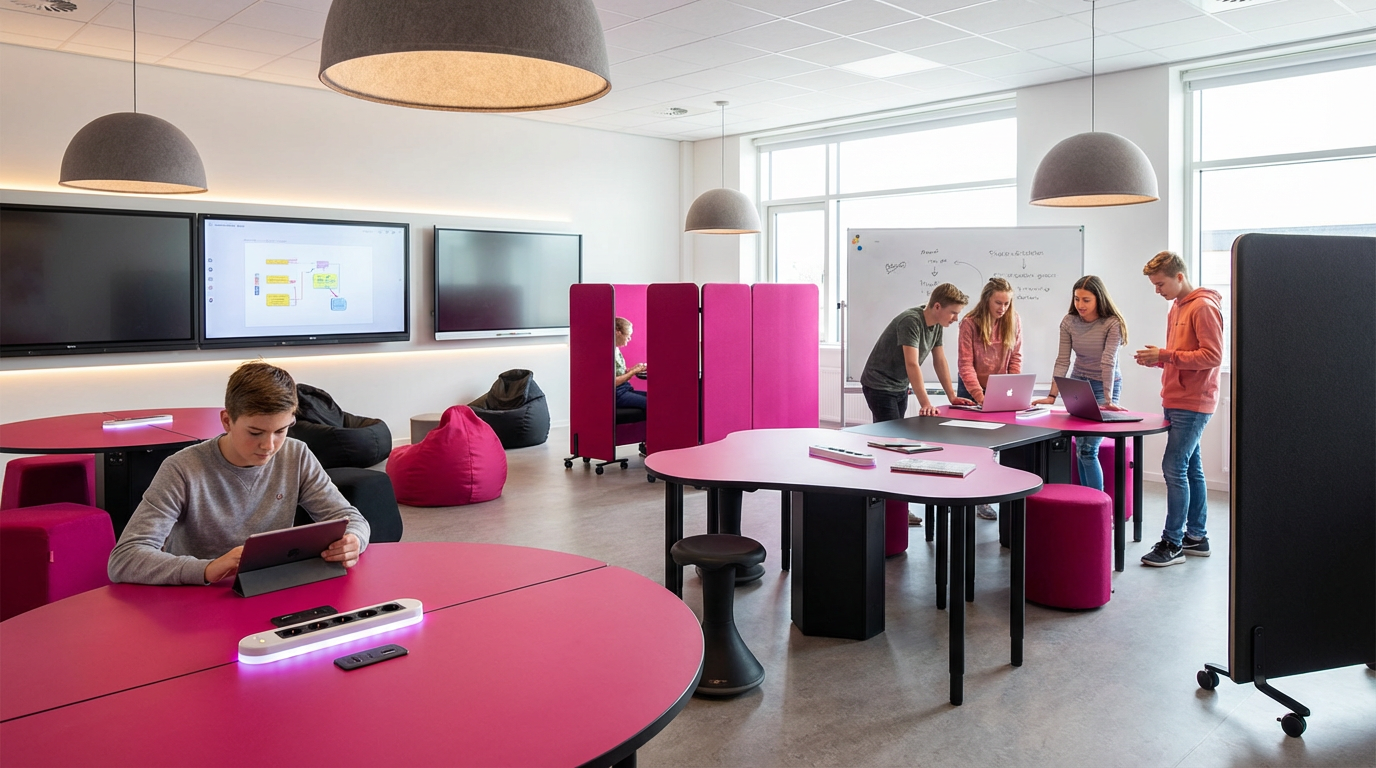
Technology in UK classrooms has moved far beyond the isolated IT suite. The trend is now towards holistic integration, with many schools implementing 1:1 device programmes and leveraging AI-powered learning platforms. This shift means technology is pervasive, not peripheral.
What This Means for Your School’s Environment: Your infrastructure must support this. This includes providing ample charging stations (like charging trolleys or secure lockers), robust Wi-Fi coverage everywhere, and furniture that accommodates device use seamlessly. Think tables with integrated power supplies and presentation screens in collaborative zones.
Trend 2: Prioritising Student and Staff Wellbeing
Student wellbeing in schools UK is now a central focus, reinforced by its inclusion in the Ofsted inspection framework. Ofsted, the UK’s Office for Standards in Education, now assesses how schools create a positive and supportive atmosphere. This has direct implications for space design.
What This Means for Your School’s Environment: Schools are actively creating ‘calm-down corners’, sensory rooms, and quiet zones. Incorporating biophilic design principles, such as natural light, plants, and nature-inspired colours, is also gaining traction. Furniture choices play a key role, with a move towards soft seating, acoustic pods for quiet reflection, and ergonomic chairs that support posture.
Trend 3: The Rise of Flexible Learning Environments
Rigid classrooms with desks in rows are becoming less common as pedagogy shifts towards collaboration and student-led inquiry. A flexible learning environment is a space designed to support multiple teaching and learning styles simultaneously, often within a single classroom.
What This Means for Your School’s Environment: This requires adaptable furniture. Modular tables on castors, lightweight stackable chairs, tiered seating for presentations, and a variety of writable surfaces (walls, tables) allow a space to be reconfigured in minutes. Investing in flexible breakout furniture for common areas also extends learning beyond the traditional classroom walls.
Decoding Modern Pedagogy: From the ’70/30 Rule’ to the ‘4 Cs’
Modern pedagogical models are the engine driving changes in classroom design, with the ’70/30 rule teaching’ model and the ‘4 Cs’ framework being particularly influential. The 70 30 rule teaching approach is a model where approximately 70% of learning time is student-led (involving discovery, group work, and independent research) and 30% is for traditional, teacher-led instruction. This model empowers students to take ownership of their learning.

Simultaneously, the ‘4 Cs’ framework – Critical thinking, Communication, Collaboration, and Creativity – is widely recognised as a cornerstone of 21st-century skills. An effective learning environment must be intentionally designed to foster these competencies.
What does this mean in practice? These abstract ideas have very concrete physical requirements. A classroom designed for the 70/30 rule and the 4 Cs cannot be static. It needs distinct zones that cater to different activities: a zone for direct instruction with a focal point, areas with large tables for collaboration, quiet nooks with comfortable seating for independent research, and open space for creative projects or presentations. According to a report by Jisc (2025) on digital learning spaces, furniture that is mobile, modular, and multi-purpose is essential to support these dynamic teaching methods.
| Pedagogical Approach | Classroom Layout Focus | Required Furniture Types | Supports ‘4 Cs’ Element |
|---|---|---|---|
| Traditional (Teacher-Led) | Front-facing, individual focus | Static individual desks, teacher’s desk at front | Communication (one-to-many) |
| 70/30 Rule (Student-Led) | Zoned for varied activities | Modular tables, study carrels, soft seating, writable surfaces | Collaboration, Critical Thinking |
| Project-Based Learning | Open, reconfigurable space | Large work tables, mobile storage, presentation screens | Creativity, Collaboration |
| Flipped Classroom | Collaborative group work | Cluster tables, interactive whiteboards, breakout pods | Communication, Critical Thinking |
From Policy to Procurement: A School Leader’s Guide
For a School Business Manager, translating educational vision into a compliant and cost-effective reality is the ultimate challenge. A strategic approach to procurement is essential. This begins with aligning refurbishment projects with available funding streams, such as the Condition Improvement Fund (CIF) for academies and sixth-form colleges, and ensuring any bids are supported by a clear educational rationale.
Your brief should explicitly connect the proposed works to key education policy UK priorities and the UK education trends discussed earlier. For instance, a bid to refurbish a library can be strengthened by framing it as the creation of a modern ‘learning resource centre’ that supports independent study, digital literacy, and student wellbeing – all key objectives for Ofsted. We find that a well-defined brief is the cornerstone of a successful project.
For purchasing, using compliant procurement frameworks like those from ESPO or CPC is not just good practice; it’s often a requirement. These frameworks ensure you achieve value for money and adhere to public procurement regulations, Saving Time & Stress. At Cost Cutters UK, we are listed on numerous national frameworks, simplifying the process for schools. Our advice is simple: engage with suppliers who understand the education sector and can provide a ‘Design To Install We Do It All!’ service, from initial space planning to final installation.
Hypothetical Case Study: A Primary School’s Library Transformation
– Challenge: A North London primary school had an outdated, underused library with static shelving and poor lighting. It didn’t support their new focus on collaborative, project-based learning and was seen as an unwelcoming space.
– Solution: Working with our design team, the school developed a plan to create a multi-zone learning hub. We installed mobile, low-level shelving to open up the space, created a ‘storytelling corner’ with tiered seating, added collaborative tables with writable surfaces, and integrated a quiet zone with acoustic seating pods.
– Results: Within six months, library usage increased by over 60%. The space is now used for group projects, independent reading, and after-school clubs. Teacher feedback noted a marked improvement in student engagement during literacy sessions.
– Key Insight: A successful refurbishment isn’t just about new furniture; it’s about redesigning the space to align with specific pedagogical goals.
Important Considerations
This guide analyses broad UK-wide trends and policies. The specific challenges and opportunities in your school will depend on local factors, including your Local Authority or MAT’s priorities, student demographics, and existing infrastructure. While the trends discussed are widely recognised, their pace of adoption varies significantly across the country.
The pedagogical models discussed, such as the 70 30 rule teaching model, are frameworks, not rigid prescriptions. Alternative approaches like Direct Instruction or Project-Based Learning have their own distinct merits and space requirements. The most effective strategy often involves a blended approach tailored to your school’s unique educational philosophy and student needs.
Translating educational trends into a physical environment is a complex task. For significant refurbishment or new build projects, we recommend consulting with education space planning specialists. They can help conduct a needs analysis, develop compliant designs, and ensure the final space truly supports your pedagogical goals and budget. Our “Design To Install We Do It All!” service is built for this purpose.
Future-Proofing Your School with Smart Planning
To conclude, staying ahead of UK education trends is fundamental to creating effective, engaging, and supportive learning environments. By understanding the interplay between education policy UK, emerging pedagogies, and key issues like funding and wellbeing, school leaders can make strategic decisions that benefit both students and staff. The move towards flexible, technology-rich, and collaborative spaces is not just a trend but a necessary evolution for the future of education uk. These changes empower schools to deliver a more dynamic and personalised education.
At Cost Cutters UK, we have over 35 years of experience helping schools navigate these changes, and we’re Rated Excellent On Trustpilot for a reason. Our specialists can help you translate your vision into a practical, budget-conscious reality, with options for Bulk Buy Discounts and flexible payments. Whether you need to update a single classroom or redesign an entire block, we’re here to help. To discuss how your school can adapt to these trends, book a free space planning consultation with our expert team today.
Frequently Asked Questions About UK Education Trends and Policies
What are the key UK education trends?
The main UK education trends involve greater technology integration in classrooms, a stronger focus on student and staff wellbeing, and the adoption of flexible teaching models that encourage collaboration. This shift is driving changes in both curriculum delivery and the physical design of learning spaces across the country. These trends are influenced by government policy and Ofsted inspection criteria, making them a priority for school leaders.
What are the current issues in education in the UK?
The most significant current issues in UK education are the ongoing school funding crisis, challenges with teacher recruitment and retention, and a widening attainment gap. These pressures directly affect schools’ ability to provide resources, maintain building standards, and invest in modern educational tools. Addressing these systemic problems is a key focus of current education policy UK debates and directly impacts long-term school planning.
What is the 70 30 rule in teaching?
The 70/30 rule is a pedagogical model where 70% of class time is dedicated to student-led activities, discovery, and group work, with the remaining 30% for teacher-led instruction. This approach aims to foster student autonomy, critical thinking, and problem-solving skills. It requires a flexible classroom environment that can support both independent and direct instruction modes effectively, moving away from traditional layouts.
What are the 4 C’s of teaching and learning?
The 4 C’s are Critical Thinking, Communication, Collaboration, and Creativity. These are recognised as essential skills for 21st-century learners. Modern pedagogy and classroom design aim to create environments that actively nurture these four competencies. This often involves moving away from passive listening to active, project-based learning in adaptable spaces that encourage interaction and innovation.
What are educational trends in 2026?
Educational trends for 2026 are expected to heavily feature AI-assisted learning, personalised education paths, and an even greater emphasis on mental health and wellbeing infrastructure within schools. The concept of the ‘smart classroom’ will become more widespread, integrating technology seamlessly into the physical environment. The future of education uk points towards more adaptive and student-centric models that use data to improve outcomes.
What are the 4 pillars of education?
The four pillars of education, as defined by UNESCO, are: Learning to Know, Learning to Do, Learning to Live Together, and Learning to Be. This framework provides a holistic vision for education, encompassing knowledge acquisition, practical skills, social development, and personal growth. These pillars guide comprehensive curriculum development around the world and underpin many modern educational philosophies.
Is the 70/30 rule real?
Yes, the 70/30 rule is a real and increasingly popular pedagogical concept, though its application is flexible rather than a rigid mandate. It represents a philosophical shift towards more student-centred learning. Many schools adopt its principles to balance direct instruction with inquiry-based activities, adapting the ratio to suit the subject and students’ needs, making it a practical framework.
How does education policy affect school furniture?
Education policy directly influences furniture choices by shaping teaching methods and priorities. For instance, a policy promoting collaborative learning necessitates modular tables and breakout seating over individual desks. A focus on wellbeing might lead to investment in soft seating and acoustic pods. Procurement policies also dictate how schools can purchase these items compliantly, linking policy to practical purchasing.
What is a flexible learning environment?
A flexible learning environment is a space designed to support multiple teaching and learning styles simultaneously. It replaces fixed rows of desks with a variety of furniture and zones, such as collaborative pods, quiet study areas, and presentation spaces. This adaptability allows teachers and students to easily transition between different activities throughout the day, maximising the use of space.
Why is student wellbeing important in school design?
Student wellbeing is crucial because a positive physical environment is directly linked to better learning outcomes, attendance, and behaviour. School design that incorporates natural light, good acoustics, comfortable furniture, and quiet zones helps reduce stress and anxiety. Ofsted now actively considers how schools support wellbeing, making it a key design and compliance factor for all UK schools.
References
- Department for Education (DfE) – Policy Paper (2025). Official government policies and funding announcements related to UK schools.
- Institute for Fiscal Studies (IFS) – Economic Analysis (2025). Independent research on real-terms school funding in the UK based on government spending data.
- Ofsted – Education Inspection Framework (2024). Guidelines on how wellbeing and the quality of education are assessed during school inspections.
- National Foundation for Educational Research (NFER) – Research Report (2025). Data and analysis on teacher retention and workforce trends from surveys of thousands of UK teachers.
- Jisc – Technology Report (2025). Insights into the use of digital technology and EdTech in UK education, compiled from sector-wide data.
- UNESCO – International Report (1996). Original framework for the ‘Four Pillars of Education’ from the International Commission on Education for the Twenty-first Century.
Conclusion
Future-Proofing Your School with Smart Planning
In summary, the key UK education trends are fundamental to creating effective, engaging, and supportive learning environments. By understanding the interplay between education policy, emerging pedagogies, and key issues like funding and wellbeing, school leaders can make strategic decisions that benefit both students and staff. The move towards flexible, technology-rich, and collaborative spaces is not just a trend, but a necessary evolution for the future of education UK.
At Costcutters UK, we have over 35 years of experience helping schools navigate these changes. Our specialists can help you translate your vision into a practical, budget-conscious reality. To discuss how your school can adapt to these trends, book a free space planning consultation with our expert team today.