Top 5 Office Layout Mistakes: How to Boost Productivity & Employee Well-being
🎯 Key Takeaway
The most common office layout mistakes involve neglecting ergonomics, creating poor traffic flow, ignoring noise levels, and failing to provide diverse zones for different work styles, which collectively damage productivity and employee well-being. These common office design flaws are more than minor annoyances; they represent significant hidden costs to your organisation. A layout that ignores the legal requirements for ergonomics in the UK, for instance, creates both a health and a compliance risk. Meanwhile, inefficient layouts produce physical and digital ‘traffic jams’, wasting valuable time and causing frustration. A one-size-fits-all approach, especially in open-plan offices, often leads to high distraction levels and reduced focus. This guide provides actionable solutions to turn these flaws into strategic advantages for your organisation.
An ineffective workspace can quietly drain resources through lost productivity, increased absenteeism, and higher staff turnover. Many businesses overlook subtle but significant office layout mistakes that directly impact their bottom line and team morale. This is because a a bad office layout isn’t just about aesthetics; it’s a fundamental business tool that can either support or hinder your daily operations. As of Q2 2026, with the rising importance of employee well-being office design, getting the layout right has become a critical competitive advantage. This guide analyses the five most damaging errors we’ve seen in our 35+ years of experience and provides a clear, cost-effective framework for creating a workspace that actively supports your organisation’s goals.
Written by: Content Team | Reviewed by: Editorial Team, 35+ Years Experience; Rated Excellent On Trustpilot
Last updated: 15 April 2026
ℹ️ Transparency Disclosure: This article explores common office layout issues based on over 35 years of industry experience and analysis of workplace studies. Our recommendations are grounded in our ‘Design To Install We Do It All!’ philosophy. Some links may connect to our specialised services and products, which we believe offer excellent value. All information is verified by our editorial team to ensure accuracy and relevance for UK businesses.
Mistake #1: Ignoring Ergonomics & UK Health & Safety Compliance
One of the most critical ergonomic office layout mistakes is failing to comply with UK health and safety law, which can lead to significant legal and financial consequences. Ergonomics, the science of designing the workplace to fit the worker, is not just about providing a comfortable chair; it is a legal duty. The Health and Safety Executive (HSE), the UK government agency for workplace safety, enforces the Display Screen Equipment (DSE) Regulations. These regulations mandate that employers must perform workstation assessments, reduce risks like poor posture or eye strain, and provide adjustable equipment for employees who use screens for a significant part of their day.
Ignoring these rules is a costly error. According to the HSE, musculoskeletal disorders accounted for millions of lost working days in the UK. A poor ergonomic office setup directly contributes to this, causing issues from back pain to repetitive strain injury (RSI). These health problems result in tangible business costs: increased absenteeism, reduced efficiency from staff in discomfort, and the risk of personal injury claims.
The fix is straightforward and demonstrates a commitment to staff well-being.
- Conduct DSE Assessments: Regularly assess each workstation to ensure it meets DSE standards.
- Invest in Adjustable Furniture: Provide chairs with adjustable height, back support, and armrests. Sit-stand desks are an excellent option to encourage movement.
- Ensure Correct Positioning: Educate staff on how to position monitors at eye level and keyboards to allow for neutral wrist posture.
By prioritising ergonomics, you’re not just buying furniture; you’re investing in a healthier, more productive workforce and ensuring your business is fully compliant with UK safety standards.
Mistake #2: Creating ‘Traffic Jams’ with Poor Workflow & Space Utilisation
A second major error is designing a layout that obstructs natural workflow, creating physical and digital bottlenecks that waste time and cause daily frustration. A bad office layout functions like a poorly designed road network, with constant congestion around key destinations like printers, meeting rooms, kitchens, and departmental hubs. When staff have to take long, convoluted routes or navigate crowded corridors to collaborate with a colleague or access a shared resource, you’re losing valuable minutes every single hour. This is one of the office layout mistakes related to workflow that directly impacts efficiency.
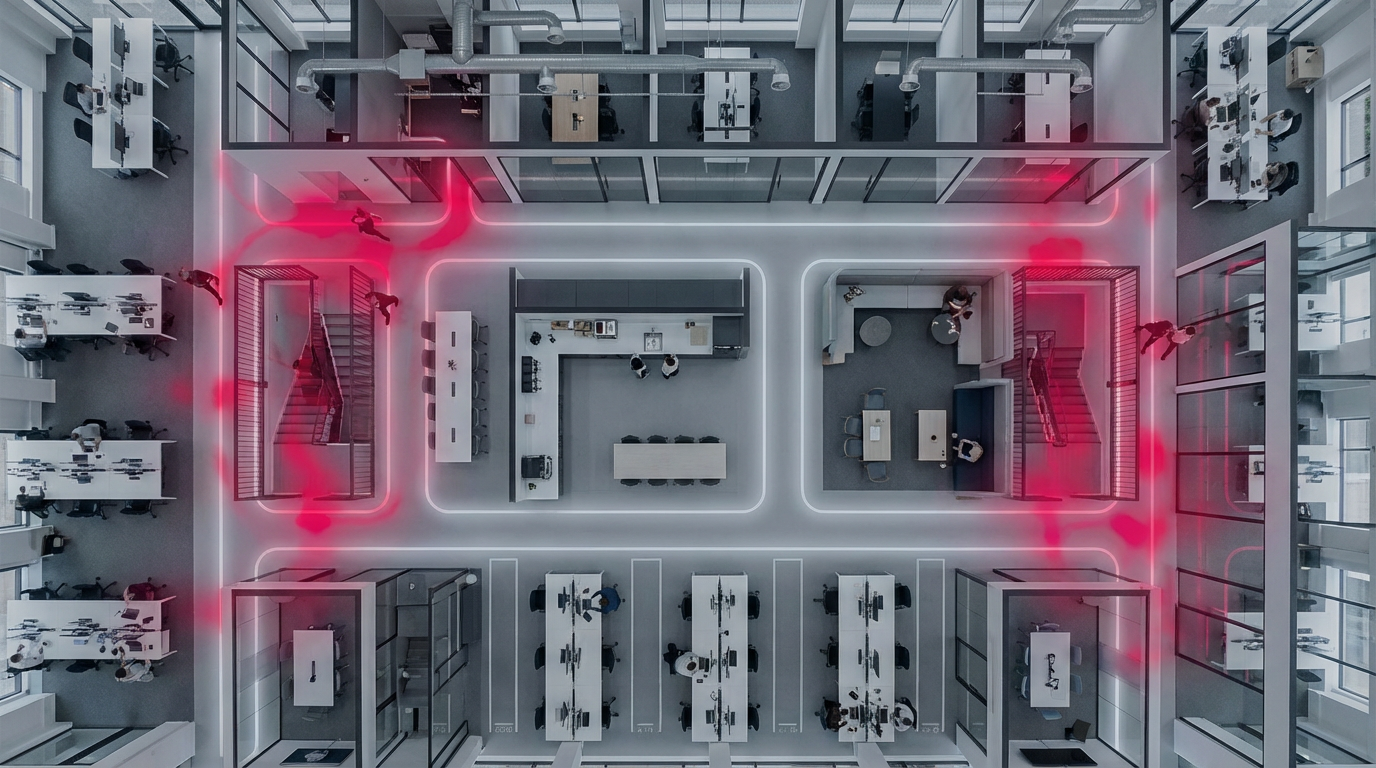
Workflow analysis is the process of mapping how people, information, and resources move through the office. A layout that ignores this logic separates teams that need to communicate frequently or places high-traffic equipment in cramped, out-of-the-way corners. This not only slows down processes but also adds to employee stress, a clear indicator of a poor office productivity layout. Our experience suggests that thoughtful zoning is the solution. Good office space planning tips involve grouping departments logically, ensuring main walkways are wide and clear, and using furniture to subtly guide movement.
Comparison of Common Office Layouts
| Layout Type | Best For | Pros | Cons (If Not Managed) |
|---|---|---|---|
| Open-Plan | High-collaboration teams, dynamic projects | Promotes communication, flexible, cost-effective per person. | High noise levels, constant distractions, lack of privacy. |
| Cubicle Farm | Roles requiring individual focus (e.g., finance, data entry) | Provides personal space, reduces visual distractions. | Can feel isolating, hinders spontaneous collaboration. |
| Zoned Office | Most modern businesses with diverse roles | Balances collaboration and focus with dedicated zones. | Requires more space and careful planning to execute well. |
| Activity-Based Working (ABW) | Agile, project-based organisations | Empowers employees, maximises space usage, supports diverse tasks. | Needs strong management and a culture of trust to succeed. |
By analysing and planning for traffic flow, you can create an environment that feels intuitive and efficient, Saving Time & Stress for your entire team.
### Hypothetical Case Study: A Growing Tech Start-Up
Challenge: A 70-person software company was experiencing communication breakdowns and project delays. Their office was a simple open-plan layout, but the development team, requiring deep focus, was seated next to the high-energy sales team. The single printer was located at the far end of the office, causing frequent, time-wasting journeys.
Solution: We conducted a workflow analysis and proposed a zoned layout. The developers were moved to a quieter corner, shielded by acoustic screens. A collaboration hub with whiteboards was created near the sales and marketing teams. A smaller, secondary printer was installed in the developers’ zone.
Results: Within three months, the company reported a 15% reduction in cross-departmental noise complaints and a self-reported 10% increase in developer productivity. Project managers noted faster turnaround times on key tasks.
Key Insight: Simply rearranging teams and resources based on workflow, without major structural changes, can yield significant productivity gains.
Mistake #3: Underestimating Noise & Distractions in Open-Plan Designs
One of the most frequent common office layout mistakes in open-plan designs is the failure to manage acoustics, leading to an environment where noise and distractions cripple concentration. While open-plan offices are intended to foster collaboration, they often create acoustic chaos. Research from the Leesman Index, which analyses global workplace data, consistently shows that noise levels are a top complaint among office workers. Constant chatter, ringing phones, and foot traffic create an barrage of interruptions that shatter deep focus, increase stress, and ultimately reduce productivity.
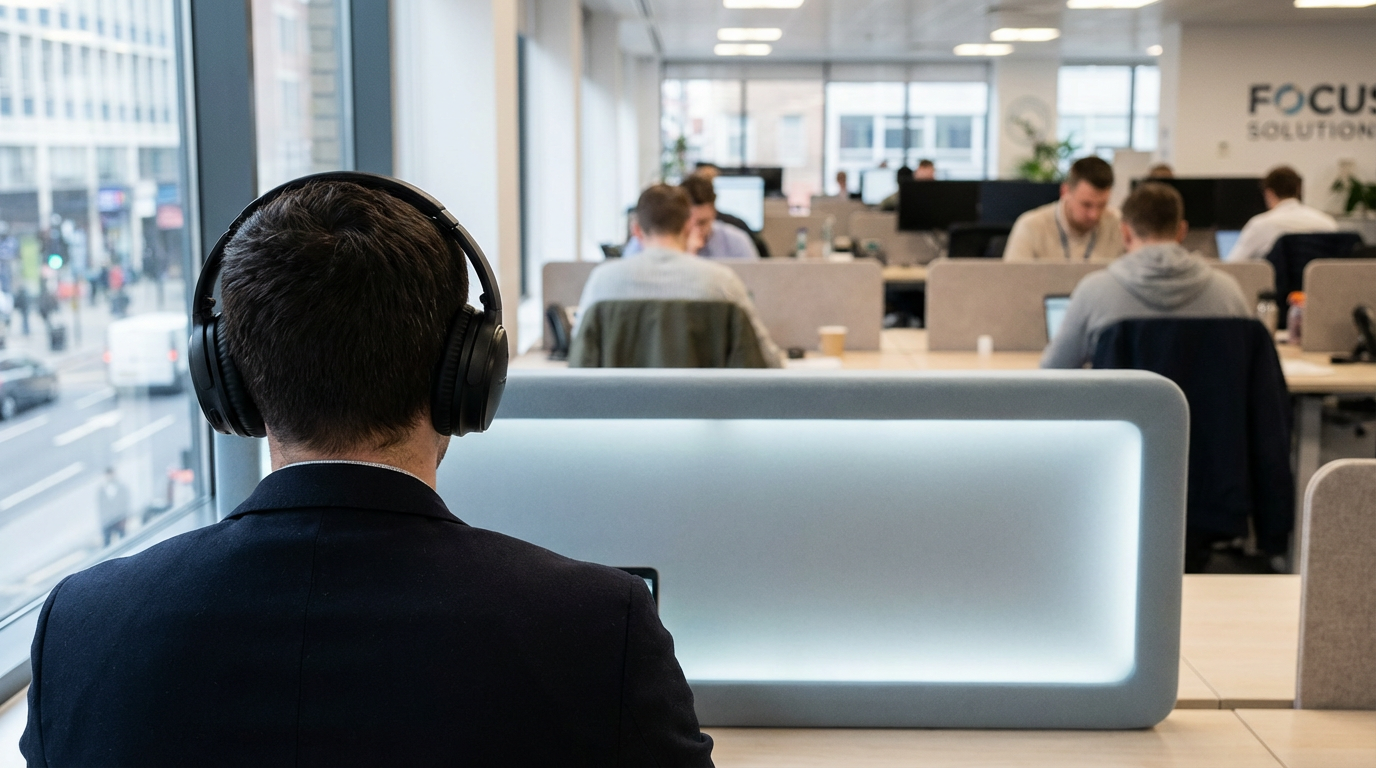
Many organisations fall into the trap of thinking open plan office problems are an unavoidable trade-off for collaboration. This isn’t true. The issue isn’t the open concept itself, but the lack of a layered acoustic strategy. Telling people to simply ‘be quieter’ is not a solution. Effective acoustic management involves absorbing, blocking, and containing sound. In our view, a multi-faceted approach is essential.
We recommend a combination of solutions:
- Sound Absorption: Install acoustic panels on walls and ceilings, use high-backed sofas made of sound-dampening fabric, and lay carpet tiles to absorb ambient noise.
- Sound Blocking: Use strategically placed shelving units or screens to break up long lines of sight and sound travel.
- Dedicated Quiet Zones: Designate a specific area of the office for focused work where conversation is not permitted.
- Private Spaces: Provide enclosed office pods or small rooms for confidential calls and tasks requiring intense concentration. These are a highly effective way to combat the primary flaw of open-plan designs.
By proactively managing sound, you can retain the collaborative benefits of an open layout while giving employees the peace they need to focus.
Mistake #4: The One-Size-Fits-All Approach & Lack of Diverse Work Zones
A surprisingly common error is designing a uniform layout of identical desks, which fails to recognise that different tasks require different environments. This “one-size-fits-all” approach is one of the most subtle but damaging layout mistakes impacting employee well-being and productivity. An employee trying to do deep, focused work has very different needs from a team brainstorming a new project or a manager holding an informal one-to-one. Forcing everyone into the same setting is inefficient and can be a source of frustration.
The solution is to adopt a more flexible model, such as Activity-Based Working (ABW). ABW is a work style where employees can choose from a variety of settings according to the task they are performing. This empowers your team and acknowledges that a modern office productivity layout must be agile. To learn how to improve office layout with this principle, you don’t necessarily need a complete redesign.
You can start by creating a variety of work zones:
- Focus Booths: Small, single-person pods or shielded desks for concentration-intensive tasks.
- Collaboration Hubs: Open areas with whiteboards, large screens, and flexible seating to encourage teamwork.
- Breakout Areas: Comfortable lounge seating for informal catch-ups, relaxation, or alternative work postures. These inspiring, comfortable spaces are vital for company culture.
- Private Rooms: Small, enclosed rooms for confidential meetings or video calls.
By providing this diversity, you empower employees to choose an effective space for their work at any given moment, boosting both autonomy and efficiency. That’s a smarter way to work.
Mistake #5: Overlooking Lighting, Air Quality & Biophilic Design
Finally, a significant bad office layout mistake is overlooking the sensory environment, particularly lighting, air quality, and the human need for a connection to nature. Poor environmental quality is directly linked to lower morale and productivity. Many older offices rely on harsh, uniform fluorescent lighting, which can cause headaches, eye strain, and fatigue. Similarly, poor ventilation and a lack of natural elements can make a space feel sterile and draining. This directly undermines efforts to create a positive employee well-being office design.
The solution lies in prioritising the sensory experience. First, maximise natural light wherever possible by arranging desks to benefit from windows and using glass partitions instead of solid walls. Supplement this with layered, human-centric lighting that can be adjusted for different tasks and times of day.
Second, embrace Biophilic Design. Biophilic Design is an approach that seeks to connect building occupants more closely to nature by incorporating natural elements. Studies published in outlets like the Journal of Environmental Psychology show that this has measurable benefits.
- Introduce Plants: Live plants improve air quality, absorb sound, and have been shown to reduce stress.
- Use Natural Materials: Incorporate wood, stone, and natural textiles to create a warmer, more calming atmosphere.
- Maximise Views: Arrange the layout so that as many employees as possible have a view of the outside.
These elements are not luxuries; they are low-cost, high-impact strategies that can improve creativity, reduce stress, and make your office a place where people genuinely want to be.
Frequently Asked Questions About Improving Office Layouts
What are the most common office layout mistakes?
The most common office layout mistakes include poor ergonomics, inefficient traffic flow, high noise levels, a lack of varied workspaces, and inadequate lighting. These flaws can significantly reduce productivity and negatively impact staff morale and well-being. A successful layout addresses all these factors holistically to create a supportive work environment.
How does office layout affect productivity?
An office layout directly affects productivity by influencing concentration, communication, and movement. A distracting, noisy environment hinders focus, while a poorly planned space wastes time as staff navigate bottlenecks or search for resources. An optimised office productivity layout provides the right environment for each task, boosting efficiency.
What is an effective layout for a small office?
For a small office, a flexible or zoned layout is often best, maximising every square metre. Use multi-functional furniture, create vertical storage, and use glass partitions to maintain an open feel while defining zones. The key is smart space planning to avoid a cramped and chaotic environment, which is a common issue.
Are open-plan offices bad for employees?
Not inherently, but they become problematic when implemented as a one-size-fits-all solution. Unmanaged open plan office problems include high distraction rates and a lack of privacy. A successful open-plan design must incorporate acoustic controls, quiet zones, and private pods to be effective for all employees.
How can I reduce noise in my office?
You can reduce office noise by installing acoustic panels, using high-backed furniture, laying carpet tiles, and adding plants. For focused work, introducing dedicated quiet zones or installing soundproof office pods are highly effective solutions. A multi-layered approach typically yields an effective acoustic results for your team.
What are DSE regulations and how do they affect office layout?
The Display Screen Equipment (DSE) regulations are UK laws requiring employers to protect workers from the health risks of using screens. This affects layout by mandating sufficient desk space, adjustable chairs and monitors, and adequate lighting to prevent musculoskeletal issues. Compliance is a legal requirement for UK businesses and a core part of a responsible layout.
How much does it cost to redesign an office layout?
The cost varies dramatically based on scale, from a few hundred pounds for minor furniture rearrangement to many thousands for a full refurbishment. Factors include furniture costs (where Bulk Buy Discounts can help), structural changes, and technology integration. We recommend a free space planning consultation to get a detailed, no-obligation quote.
What is an ergonomic office setup?
An ergonomic office setup is one where the workstation is fully adapted to the user to maximise comfort and efficiency while minimising injury risk. This includes an adjustable chair, a monitor at eye level, and a keyboard position that allows for neutral wrists. It is a cornerstone of modern, responsible office design and is essential for employee well-being.
What are the benefits of breakout areas?
Breakout areas provide a space for informal collaboration, creative thinking, and relaxation away from the desk. They improve team cohesion, reduce stress, and can boost innovation by fostering spontaneous conversations. These zones are crucial for a positive and dynamic company culture and overall employee well-being office design.
How do I start planning to improve my office layout?
Start by observing how your team currently uses the space and asking for their feedback on pain points. Analyse workflow and identify bottlenecks. For a professional, data-driven approach on how to improve office layout, consider our free space planning consultation to get expert advice tailored to your specific needs and budget.
Important Considerations & Professional Guidance
This guide offers well-supported by research principles for identifying and correcting common layout flaws. However, every office is unique, with its own building constraints, budget, and company culture. The effectiveness of these solutions depends on a detailed assessment of your specific environment, which is beyond the scope of a general article. Your team’s specific work patterns and needs must be the primary driver of any change.
While a full redesign delivers the most significant impact, alternative approaches can offer incremental improvements. These include investing in better task lighting, introducing a ‘quiet hours’ policy in certain areas, or upgrading to ergonomic chairs without changing the entire desk layout. These can be effective first steps for organisations with limited budgets or those wishing to test changes before a full commitment. You don’t have to do everything at once.
For comprehensive projects, compliance checks, or to ensure the maximum return on your investment, we recommend consulting with a space planning professional. An expert can conduct a thorough needs analysis, create 2D and 3D plans to visualise the changes, and manage the entire process from procurement to installation. This ‘Design To Install We Do It All!’ approach ensures a seamless and effective transformation, letting you focus on your business.
From Mistakes to Masterplan: Your Next Step
Correcting common office layout mistakes is not an expense; it is a strategic investment in your organisation’s most valuable asset – its people. By creating an environment that prioritises ergonomics, workflow, focus, and well-being, you build a foundation for higher productivity, improved staff retention, and a stronger company culture. The right layout works for you, not against you, and our expert office space planning tips can help you achieve that.
Transforming your workspace can feel like a daunting task, but it doesn’t have to be. With over 35 years of experience helping UK businesses, schools, and public sector organisations, and being Rated Excellent On Trustpilot, Cost Cutters UK offers a completely free, no-obligation space planning service. We also offer flexible payment options to suit your budget, whether you need to Credit Accounts Or Pay Flexibly. Let our experts help you design a productive and inspiring environment tailored to your goals. Book a Free Space Planning Consultation today.
References
- Health and Safety Executive (HSE) – Governmental Guidance. Provides the official legal framework and guidance for Display Screen Equipment (DSE) workstation assessments in the UK.
- Leesman Index – Global Workplace Survey Data. Collects and analyses data from millions of employees on how workplace design impacts their experience and productivity, often highlighting the negative impact of noise.
- Journal of Environmental Psychology – Academic Journal. Publishes peer-reviewed studies on topics like biophilic design and the psychological impact of office lighting on employee mood and performance.
- Gensler – Design & Architecture Firm Research (2023). Their regular workplace surveys of thousands of office workers provide insights into the demand for more diverse and flexible work environments.
- Forbes – Business Publication Analysis. Often publishes articles synthesising research on workplace productivity, including the financial impact of employee distractions and poor ergonomics.
CONCLUSION
From Mistakes to Masterplan: Your Next Step
In summary, office layout mistakes are more than just an inconvenience; they are a strategic liability that can drain resources and morale. Correcting them is a vital investment in your organisation’s most valuable asset—its people. By creating an environment that prioritises ergonomics, workflow, focus, and well-being, you build a foundation for higher productivity, improved staff retention, and a stronger company culture. The right layout works for you, not against you, and our expert office space planning tips can help you achieve that.
Transforming your workspace can feel like a daunting task, but it doesn’t have to be. With over 35 years of experience helping UK businesses, schools, and public