Maximising Space: The Ultimate Guide to Storage, Organisation & Efficiency
🎯 Key Takeaway
Maximising space in a professional setting involves the strategic use of multi-functional furniture and intelligent layouts to enhance productivity, ensure regulatory compliance, and improve user experience within a set budget. For schools, it means creating ‘enabling environments’ that meet Ofsted criteria and support varied learning styles. For offices, it involves designing flexible, hybrid-ready workspaces that boost collaboration and adhere to HSE guidelines. For the public sector, it is about delivering ‘Best Value’ for taxpayers by improving facility usage and durability. This guide provides actionable strategies for procurement managers, facilities managers, and school business managers to optimise their premises effectively.
As of April 2026, UK organisations are under increasing pressure to do more with the space they have. For maximising space, the conversation often defaults to residential tips like maximising space in a small house. However, for schools, offices, and public buildings, this is a far more strategic challenge. Inefficient layouts and cluttered environments don’t just look untidy; they can hinder productivity, impact well-being, and represent a significant waste of resources.
Effective professional space planning is a strategic investment that transforms a physical footprint into a high-performing asset. With over 35 years of experience, Costcutters UK has seen first-hand how intelligent design can solve these deep-rooted operational issues. This guide provides practical, role-specific advice to help you unlock the full potential of your premises.
👤 Written by: Content Team
Reviewed by: Editorial Team, Industry Specialists with 35+ Years Experience; Rated Excellent On Trustpilot
Last updated: 15 April 2026
ℹ️ Transparency Disclosure: This article explores professional space optimisation based on our 35+ years of industry experience and analysis of UK case studies. Some links may connect to our services or product pages. All information is verified by our editorial team to ensure accuracy and relevance for UK organisations.
The Core Principles of Maximising Space in UK Organisations
The core principles for maximising space professionally are multi-functionality, verticality, and zoning. Mastering these three concepts allows any organisation to dramatically improve the efficiency and feel of its environment. We believe a well-planned space is the foundation of an effective organisation.
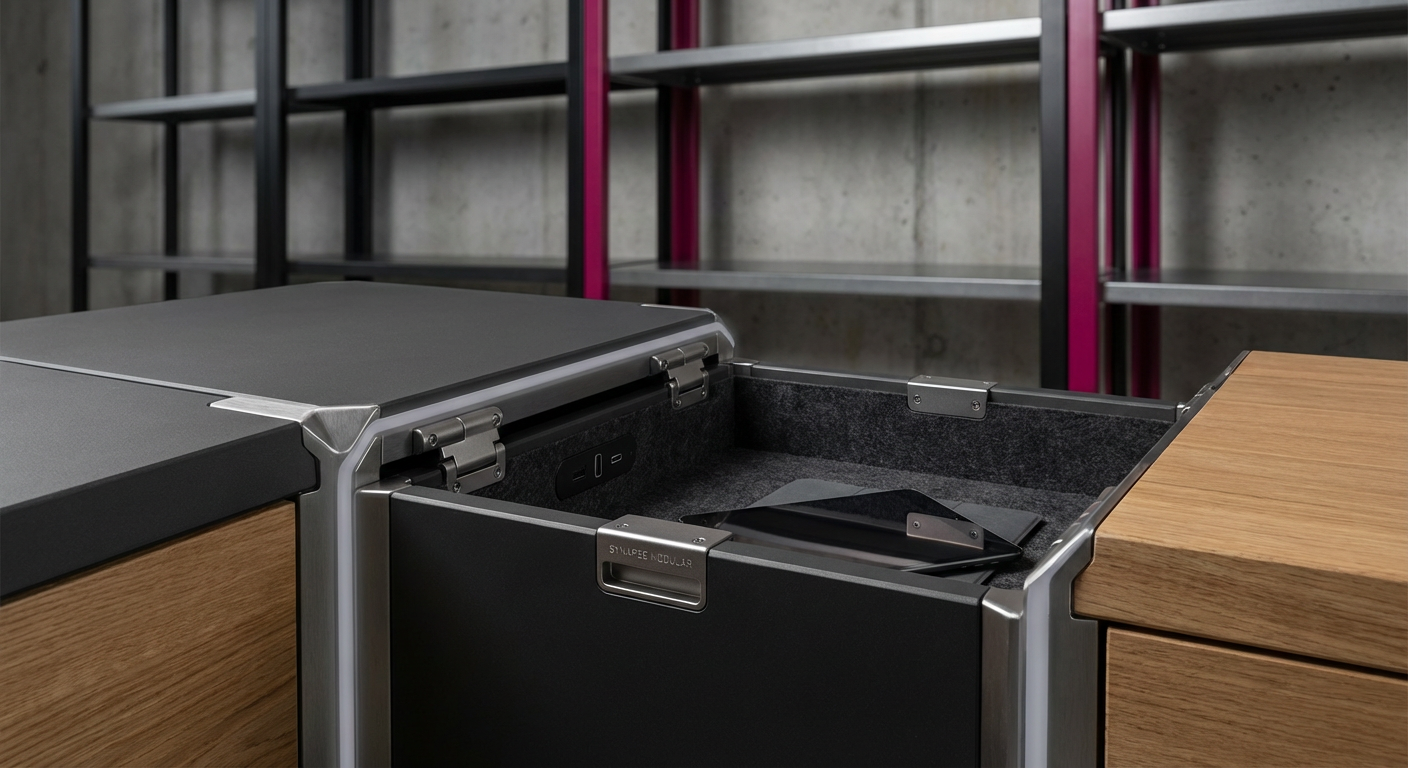
- Multi-functionality: This is the practice of using furniture and equipment that can serve multiple purposes. Think of a staff room with modular sofas that can be reconfigured for presentations, benches with built-in storage, or tables that can be folded and stored away to open up a room for events. This principle ensures every piece of furniture works harder for you.
- Verticality: Floor space is a finite resource, but wall space is often underused. Verticality involves using the full height of a room with tall shelving units, wall-mounted cabinets, and high-density storage systems. This approach draws the eye upward, creating a sense of spaciousness whilst maximising storage space and keeping floors clear.
- Zoning: This involves creating distinct areas for different activities within a single, often open-plan, space. You can use furniture like screens, different flooring, or even colour to delineate zones for quiet focus, collaboration, or relaxation. This brings order and purpose to large spaces, guiding user behaviour and improving workflow without building walls.
Applying these principles can have a measurable impact. Research from Gensler (2022), based on surveys of office workers, suggests that the most innovative companies are five times more likely to have well-designed, flexible workspaces that empower employees.
For School Business Managers: Optimising Educational Environments
Optimising a school’s physical space directly contributes to creating an ‘Enabling Environment’, a key concept for The Office for Standards in Education, Children’s Services and Skills (Ofsted). An enabling environment is one that supports learning, development, and well-being. For School Business Managers, this means navigating the challenges of often-older buildings and tight budgets to meet the standards set by the Department for Education (DfE).

The DfE’s Building Bulletin 103 (2014) provides non-statutory area guidelines, and achieving them requires smart thinking. Our experience shows that focusing on furniture is the key.
Here are some actionable strategies:
- Classrooms: Use modular, trapezoidal tables that can be quickly rearranged from individual workstations to group pods. Opt for stackable chairs to free up floor space for activities. Utilise wall-mounted “Gratnells” tray storage to keep resources organised and accessible, a core part of maximising storage space in a learning setting.
- Libraries & Common Areas: Mobile shelving units allow layouts to be adapted for different class sizes or events. Soft, durable seating can create comfortable reading nooks.
- Staff Rooms: A well-designed staff room is crucial for well-being. Modular seating and stackable furniture allow the space to be used for meetings, lunches, and quiet work.
Durability and safety are non-negotiable. All furniture must be robust enough for daily school life and comply with UK standards. You can view our full list of UK certifications and accreditations to see how we guarantee this. The physical environment’s impact is significant; a University of Salford study found that classroom design can affect a child’s learning progress by up to 16% in a single year.
Hypothetical Case Study: A Primary School’s Canteen Transformation
Challenge: A primary school’s 100 sq. Metre canteen felt cramped and chaotic during lunch service, with fixed, bulky furniture making cleaning difficult and preventing the room from being used for other activities.
Solution: We implemented a “Design To Install We Do It All!” project. We replaced the old furniture with lightweight, foldable bench dining units and stackable stools. This allowed the room to be cleared in under 15 minutes.
Results: The school reclaimed over 20 hours of usable space per week, now using the hall for breakfast clubs and after-school activities. The change also reduced cleaning time by 40%, Saving Time & Stress for the caretaking staff.
Key Insight: Choosing multi-functional, mobile furniture over fixed items can dramatically increase the utility of a space, turning a single-purpose room into a multi-use asset.
For Office & Facilities Managers: Designing Productive Workspaces
Designing a productive office today means embracing flexibility to support a hybrid workforce. The key is creating a space that employees want to come to. This involves moving beyond rows of identical desks towards a more dynamic and varied environment.
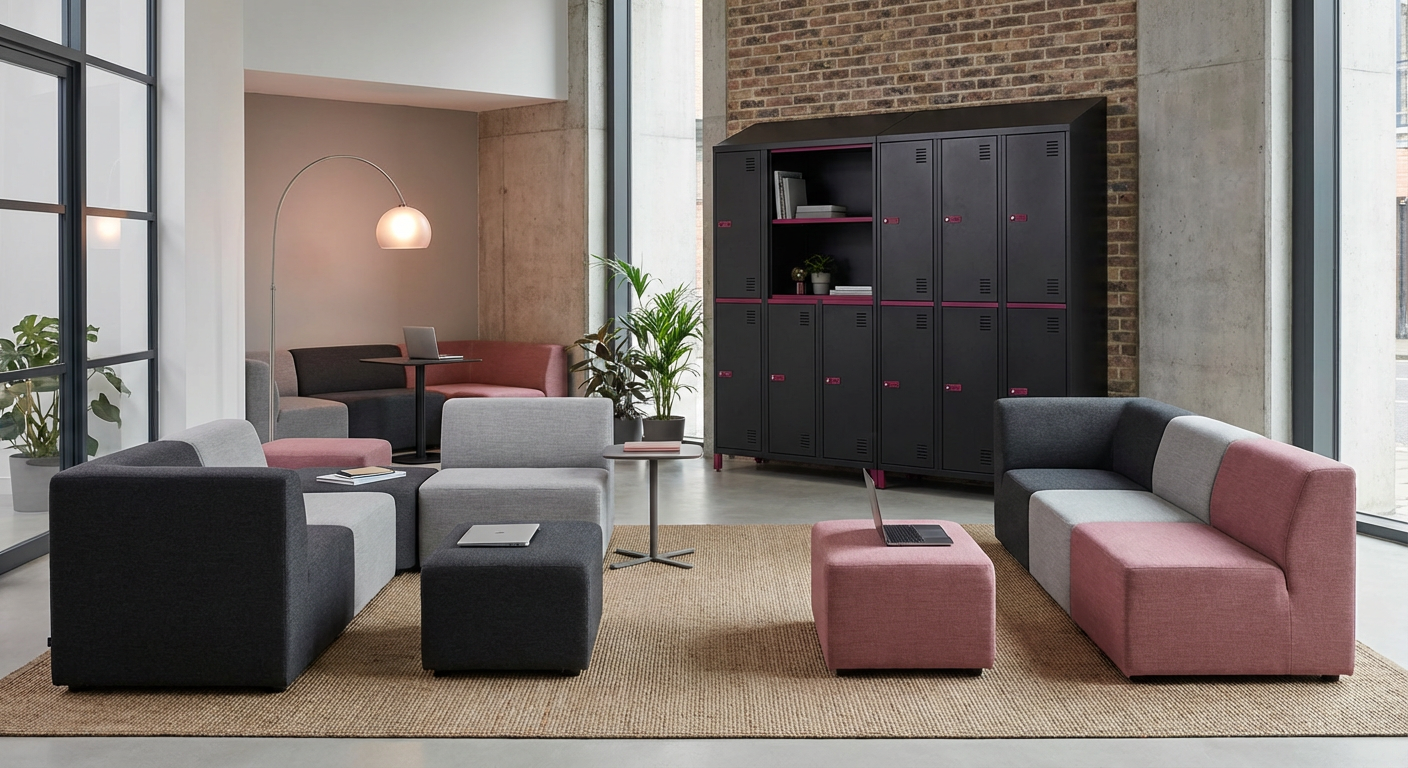
A popular strategy is ‘Hot-Desking’, where employees don’t have an assigned desk but choose one for the day. To make this work, you need excellent supporting infrastructure. We recommend banks of personal heavy-duty industrial lockers for staff to store their belongings securely. This declutters the workspace and gives employees a personal anchor point.
Breakout areas are no longer just a luxury; they are essential. These multi-functional zones, equipped with modern and flexible breakout furniture, can serve as informal meeting spots, collaborative hubs, and places for staff to decompress. Good design here is vital for well-being and fostering a positive company culture. Even the staff kitchen requires attention. Strategies for maximising kitchen space include using high-density shelving, wall-mounted storage, and durable, easy-to-clean cafe furniture that can be moved or stacked.
All workplace design must comply with regulations from Britain’s national regulator for workplace health and safety, the Health and Safety Executive (HSE). This includes providing ergonomic seated furniture and ensuring safe traffic routes, as detailed in their workplace welfare guidance. The demand for this kind of adaptable space is clear; a survey by McKinsey & Company (2022) involving over 25,000 American workers found that 87% of those offered flexible work take it.
For Public Sector Officers: Delivering Value Through Smart Space Utilisation
In the public sector, maximising space is directly linked to accountability and delivering ‘Best Value’ for the taxpayer. With budgets under constant scrutiny, every square metre of a public building must be justified and used efficiently. The challenge is the sheer diversity of needs, from hard-wearing seated furniture in an NHS waiting room to configurable meeting rooms in a local council office.
Smart procurement is the solution. Using established frameworks like ESPO (a UK public sector owned professional purchasing organisation) ensures that acquisitions are compliant, cost-effective, and meet quality standards. You can explore these options through ESPO’s furniture frameworks. We are a proud supplier on many of these frameworks, offering options for Bulk Buy Discounts to deliver even greater value.
The key is investing in versatility. For example:
- Community Centres: Using lightweight, stackable chairs and foldable tables allows a single hall to host a daytime parent-toddler group, an afternoon training session, and an evening community meeting.
- Council Offices: Implementing bench desking systems can increase headcount capacity in open-plan areas, while acoustic pods provide quiet spaces for focused work or private calls without the cost of construction.
- Healthcare Waiting Areas: Beam seating maximises capacity and is easy to clean, while careful layout planning ensures clear, accessible routes for all users, including those with mobility aids.
This drive for efficiency is a government-wide priority. Analysis by the National Audit Office (2023) consistently highlights the need for the public sector to make better use of its assets, including its extensive estate. Smart space utilisation is a direct and effective response to this imperative.
The Buyer’s Guide: Choosing Furniture for Maximum Efficiency
Procuring the right furniture is the most critical step in executing a space maximisation strategy. When evaluating options, our advice is to prioritise modularity, durability, and multi-functionality over simple aesthetics or initial low cost. Here’s a practical guide to key categories.
Seated Furniture
Look for chairs that are stackable or nesting to allow rooms to be cleared easily. In high-traffic areas like canteens or waiting rooms, choose materials like polypropylene or vinyl that are easy to clean and exceptionally durable. For office environments, ergonomic features are essential for compliance and user well-being. Don’t overlook seated furniture that includes storage, like ottomans with lift-up lids.
Tables & Desks
Bench desking systems are a superb solution for maximising headcount in an office, sharing leg frames to reduce footprint. Height-adjustable desks support employee well-being and cater to different preferences. For multi-purpose rooms, foldable or flip-top tables are indispensable, allowing for rapid transformation of the space.
Storage Solutions
Think vertically. Tall shelving units and cupboards make use of the full room height. For securing equipment and personal items, explore options from simple lockable cabinets to specialised units like secure outdoor Asgard storage units. Under-desk pedestals provide personal storage without consuming additional floor space, making them well-suited for hot-desking environments. The goal is to find the right solution for maximising storage space for your specific needs.
| Furniture Type | effective Environment | Key Space-Saving Feature | Example Product Category |
|---|---|---|---|
| Modular Soft Seating | Office Breakout, Library, Staff Room | Reconfigurable into multiple layouts | Modern and flexible breakout furniture |
| Stacking Chairs | School Hall, Conference Room, Canteen | High-density vertical storage when not in use | Polypropylene & Metal Chairs |
| Bench Desking | Open-Plan Office, Call Centre | Shared leg components reduce overall footprint | Adapt Four-Seater Back to Back Bench Desk |
| Folding Dining Units | School Canteen, Community Hall | Folds away to completely free up floor space | Mobile Folding Dining Furniture |
Frequently Asked Questions
What is maximising space?
Maximising space is the process of arranging a room or building to make it feel as large as possible and function at its highest potential. In a professional context, this involves strategic furniture selection and layout planning to improve workflow, accommodate more users, or create multi-functional areas, all while adhering to safety and accessibility standards. This is a core part of effective facilities management and organisational efficiency.
What is the 2/3 rule for a living room?
The 2/3 rule is a design guideline suggesting a coffee table should be about two-thirds the length of the sofa. It also suggests a rug should leave about one-third of the floor bare around its edges. In a commercial setting like an office breakout area or staff room, this principle can be adapted to ensure furniture is proportionally scaled to the space, preventing it from feeling either cluttered or empty and ensuring good circulation.
How can I maximise my space?
You can maximise your space by using three key strategies: choosing multi-functional furniture, utilising vertical height with tall storage, and zoning areas for specific tasks. Decluttering regularly and opting for a light colour palette can also create a sense of spaciousness. For organisations, we find that a professional space plan is the most effective first step, as it ensures the most efficient use of your entire premises.
What is the 70/30 rule in decorating?
The 70/30 rule suggests that 70% of a room should be a dominant colour, 30% a secondary colour, with a smaller 10% as an accent. This is often cited as the 70/20/10 rule. In a school or office, this can be used to apply brand colours or create distinct zones without physical walls, aiding navigation and improving atmosphere. It’s a simple but powerful design principle for creating a cohesive look.
How do you maximize space?
To maximise space effectively, start with a clear objective for the area, whether it’s for learning, working, or collaborating. Measure the space accurately, then select furniture that is appropriately scaled and, where possible, serves more than one purpose. Look for opportunities to use wall space for storage and keep pathways clear to ensure good flow. Professional planning can identify opportunities you may have missed.
What color is replacing gray in 2026?
As of early 2026, trends are moving away from cool greys towards warmer, earthier tones like beige, terracotta, and deep greens. These colours create a more inviting and natural-feeling environment. For commercial interiors, these tones can be combined with a neutral base to create a calming yet professional atmosphere that feels modern and welcoming. This reflects a broader shift towards biophilic design principles in the workplace.
What does it mean to maximize something?
To maximise something means to make it as large or great as possible, or to make an effective use of it. For business or public services, it means achieving the highest possible level of efficiency, output, or value from a given resource, such as a budget, a team, or a physical space. This is a key objective in operational management and strategic planning.
What is a better word for maximize?
Synonyms for ‘maximise’ include ‘optimise’, ‘enhance’, ‘expand’, or ‘amplify’. For space planning, ‘optimise’ is often a more precise term, as it implies finding an effective possible balance between competing needs (e.g., space, cost, function), not just making something bigger. ‘Enhance’ is also useful as it focuses on improving the quality of the space. An effective choice depends on the specific context.
Does maximize mean increase?
Yes, to maximise often means to increase a quantity to its fullest potential, but it can also mean making the ‘best use of’ something without increasing its size. For example, maximising a small office space means increasing its efficiency and functionality, not physically enlarging the room itself. It’s about increasing the potential and value derived from the existing asset.
Is maximise or maximize?
In British English, the correct spelling is ‘maximise’ with an ‘s’, whereas ‘maximize’ with a ‘z’ is standard in American English. As a UK-based supplier rated Excellent on Trustpilot, we consistently use British English spellings such as ‘maximise’, ‘organisation’, and ‘colour’ in all of our communications. This is an important distinction for our UK-based clients and partners.
Important Considerations
This guide provides general principles and strategies for space optimisation applicable to many UK organisations. However, every building is unique, with its own structural constraints, safety regulations (e.g., fire exits, accessibility), and user needs. The recommendations here should be adapted to your specific context, and this article is not a substitute for a professional site survey or architectural plan.
An alternative to a comprehensive refurbishment is a phased approach, focussing on one area at a time, or simply procuring new, multi-functional furniture to replace outdated items. Whilst a DIY approach to rearranging space is possible, it often misses opportunities for major efficiency gains that a professional space planner can identify, particularly regarding workflow, acoustics, and long-term value. We’ll be honest – this part can be tedious, but getting it right pays off.
Our recommendation is to consult a professional space planning expert when undertaking a significant refurbishment, moving premises, or looking to make substantial improvements to your operational efficiency. An expert can provide 2D and 3D plans, ensure compliance with all relevant UK regulations, and help you procure the most cost-effective and durable solutions, Saving Time & Stress in the long run.
Conclusion: Your Partner in Professional Space Planning
Ultimately, maximising space within your organisation is a strategic move that pays dividends in productivity, user satisfaction, and financial efficiency. By applying the core principles of multi-functionality, vertical storage, and intelligent zoning, and selecting furniture tailored to the unique demands of educational, corporate, or public sector environments, you can transform your premises into a valuable, high-performing asset.
For over 35 years, Costcutters UK has specialised in helping organisations across the country achieve these goals. Our experienced team understands the challenges you face, offering flexible payment options with Credit Accounts Or Pay Flexibly, and can provide a complete “Design To Install We Do It All!” service. To see how we can transform your space, request a free, no-obligation space planning consultation with our experts today.
References
- Health and Safety Executive (HSE) (2013) – UK Government Guidance. Provides regulations on room dimensions, workstations, seating, and traffic routes in UK workplaces.
- Department for Education (DfE) (2014) – UK Government Publication (Building Bulletin 103). Details non-statutory area guidelines for teaching and non-teaching spaces in schools.
- ESPO (Eastern Shires Purchasing Organisation) – Public Sector Procurement Framework. Offers a compliant route for public bodies to procure furniture that has been vetted for quality and value.
- Gensler Research Institute (2022) – U.S. Workplace Survey based on responses from over 2,000 office workers. Found that innovative companies are more likely to have well-designed workspaces.
- University of Salford (2015) – Clever Classrooms Report based on a study of 153 classrooms in the UK. Found that classroom design can impact learning by 16%.
- McKinsey & Company (2022) – American Opportunity Survey of over 25,000 workers. Revealed high uptake of flexible work options.
- Barratt Homes – Home Design Guide. Provides tips on using mirrors and light colours to create a sense of space.
- LOVESPACE – Storage Service Blog. Suggests using multi-functional furniture like ottoman beds for storage.


You Might Also Like
School Furniture Regulations UK: A School Business Manager’s Guide
School furniture regulations UK: Ensure compliance with BS EN 1729 & fire safety for pupil well-being. A guide for School Business Managers. Contact us …

School Furniture Replacement: A Step-by-Step UK Guide
Planning school furniture replacement? Discover our six-step UK guide for audit, budgeting, compliance, & logistics. Ensure safe, modern learning spaces.

Ergonomic School Furniture: A UK School’s Guide to Durability & Value
Discover everything about ergonomic school furniture. Expert insights, practical tips, and proven strategies for success.