Mastering Facilities and Maintenance: A UK Guide for Education & Commerce
🎯 Key Takeaway
Effective facilities and maintenance involves the strategic management of a building’s assets and infrastructure to ensure safety, functionality, and compliance, with a focus on optimising long-term costs. This approach moves beyond simple repairs to encompass the entire lifecycle of an asset, from procurement to disposal. For UK organisations, mastering this discipline is crucial for budget control and operational excellence. This guide provides actionable strategies for UK educational and commercial managers to develop a robust maintenance programme that starts with smarter purchasing decisions.
For many school business managers and office administrators, the battle against spiralling repair costs and operational disruption feels constant. As of April 2026, the pressure to maintain functional, safe, and compliant environments within tight budgets has rarely been greater. The common approach to facilities and maintenance often defaults to a reactive cycle of fixing what’s broken. However, we believe this misses the fundamental point: effective maintenance doesn’t start with a repair ticket; it begins with the initial procurement decision. This guide provides a strategic framework for UK managers to connect purchasing choices with long-term operational efficiency. As a provider of complete furniture solutions for educational and commercial spaces, we’ve seen first-hand how investing in the right assets from day one is the most effective way of Saving Time & Stress down the line.
👤 Written by: Content Team
Reviewed by: Editorial Team, Industry Specialists with 35+ Years Experience; Rated Excellent On Trustpilot
Last updated: 20 April 2026
ℹ️ Transparency Disclosure: This article explores facilities and maintenance strategies based on over 35 years of industry experience and analysis of public standards. Some links may connect to our services. All information is verified by our editorial team. Costcutters UK is a leading supplier of educational and commercial furniture in the United Kingdom.
What Are the Pillars of Modern Facilities Management in the UK?
Modern facilities management rests on four interconnected pillars: People, Place, Process, and Technology. A successful strategy harmonises these elements to support an organisation’s core mission. ‘People’ refers to everyone who uses the space, from students and employees to visitors. ‘Place’ is the physical building and its assets. ‘Process’ covers the operational workflows, like cleaning schedules and safety drills. Finally, ‘Technology’ includes the software and tools used to manage the facility, from Building Management Systems (BMS) to simple asset tracking apps.

In the United Kingdom, these pillars are underpinned by a robust regulatory framework. Facilities Management (FM), the professional discipline that encompasses these pillars, is typically divided into two categories.
- Hard FM relates to the physical fabric of the building. Think of services that cannot be removed, such as electrical systems, plumbing, heating, ventilation, and air conditioning (HVAC).
- Soft FM refers to services that make the workspace more pleasant, productive, and secure. This includes cleaning, waste management, security, and the management of furniture and other movable assets.
The Health and Safety Executive (HSE), which is the UK’s national regulator for workplace health and safety, provides extensive guidance that governs both Hard and Soft FM. According to the Health and Safety Executive (HSE), employers have a legal duty to provide a safe and healthy environment, which directly impacts all public sector building maintenance and commercial property management. Effective facilities management strategies uk therefore aren’t just about efficiency; they are a matter of legal compliance.
Proactive vs. Reactive: A Strategic Approach to Facilities and Maintenance
A strategic approach to facilities and maintenance requires a conscious choice between two core philosophies: reactive and proactive. Reactive maintenance, also known as the ‘run-to-fail’ method, involves fixing assets only after they break down. While it requires minimal upfront planning, it leads to unpredictable costs, operational downtime, and potential safety hazards. In contrast, proactive (or preventative) maintenance involves scheduled servicing and inspections to prevent failures before they happen – much like servicing your car to avoid a breakdown on the motorway.
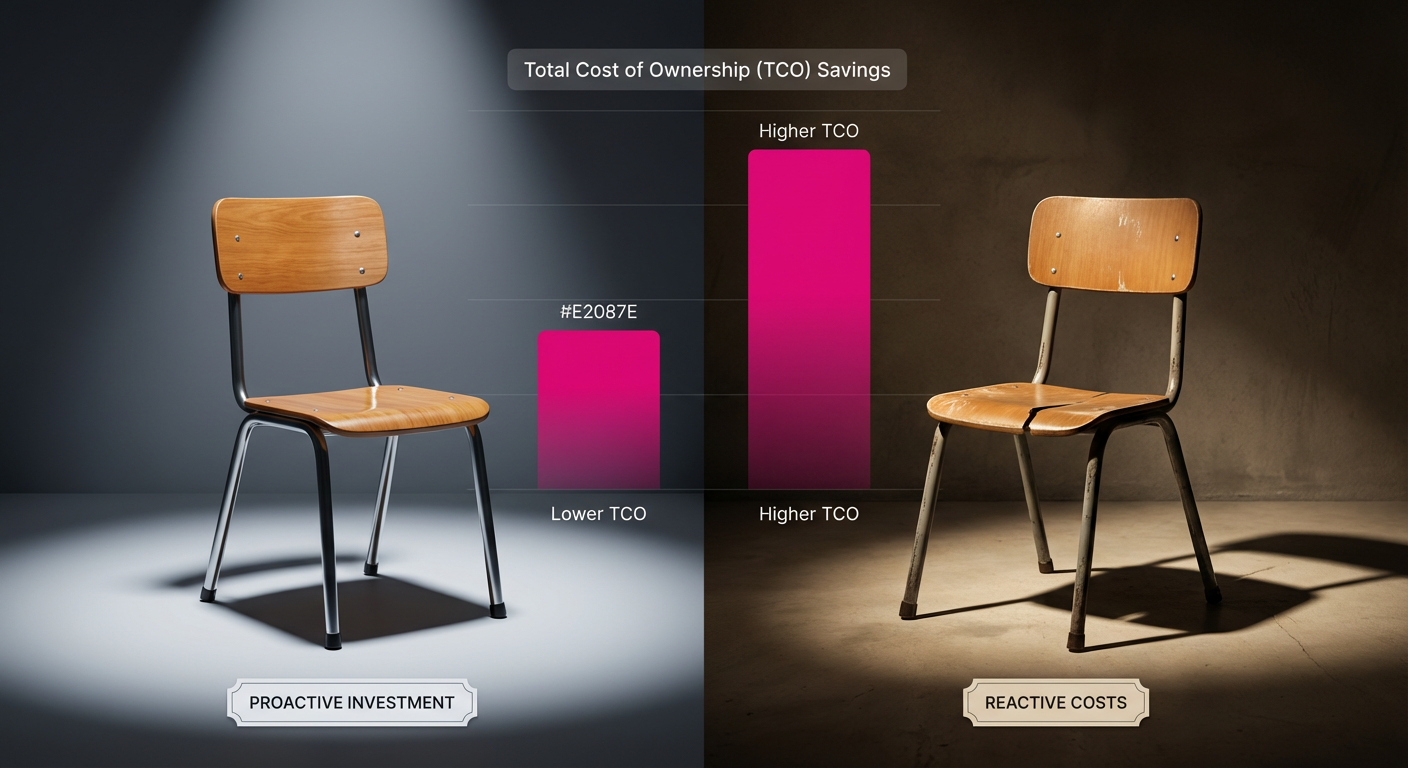
The key to implementing a proactive strategy is understanding an asset’s Total Cost of Ownership (TCO). TCO is a financial estimate that includes the initial purchase price plus all direct and indirect costs of operating and maintaining that asset over its entire lifespan, including disposal. Our experience shows that a slightly higher initial investment in durable, well-designed assets almost typically results in a significantly lower TCO. This is because the costs of repair, replacement, and associated disruption from lower-quality items quickly outweigh the initial savings. For instance, preventative maintenance for furniture starts by choosing items built for the rigours of a commercial or school environment.
This data table illustrates how TCO plays out with a common asset like a classroom chair.
| Cost Factor | Low-Quality Asset (Non-Compliant Chair) | High-Quality Asset (BS EN 1729 Compliant Chair) | Commentary |
|---|---|---|---|
| Initial Purchase Price | £25 | £40 | The high-quality chair costs 60% more upfront. |
| Annual Repair Costs | £8 (tightening fixings, replacing parts) | £1 (minimal checks, occasional wipe-down) | Lower quality requires frequent labour and parts. |
| Expected Lifespan | 3-4 Years | 10-15 Years | The compliant chair lasts at least 3x longer. |
| Total Cost Over 10 Years | £105 – £130 (incl. 2-3 replacements) | £50 | The “cheaper” chair costs more than double over a decade. |
| Source | Internal analysis based on BSI/HSE guidance | Internal analysis based on BSI/HSE guidance | Figures are illustrative |
As the table demonstrates, the proactive approach of investing in quality delivers substantial savings and predictability, forming the basis of sound facilities management strategies uk.
How Does Procurement Link to Maintenance?
Procurement choices are the single most influential factor in determining future maintenance workloads and costs. Every purchasing decision is, in effect, a maintenance decision. Opting for the cheapest available asset without considering its design, materials, and durability is a common mistake we see that directly leads to higher long-term expenditure and operational headaches. A smart procurement strategy is an effective form of preventative maintenance for furniture and other assets.
Consider these practical examples:
- Canteen & Dining: Choosing tables with seamless, moulded polyurethane edges instead of cheaper glued-on T-bar edging prevents peeling, chipping, and dirt traps, dramatically cutting down cleaning time and eliminating a common point of failure.
- Classrooms & Offices: Selecting chairs with fully-welded steel frames instead of screw-together components removes the need for staff to constantly tighten loose fixings – a frequent and time-consuming task.
- Breakout Areas: Opting for modular soft seating with replaceable covers and components allows for easy repair of localised damage (like a stain or tear) without replacing the entire unit.
For UK schools, this link is formalised through compliance standards. BS EN 1729 is the British and European standard covering furniture for educational institutions. It specifies dimensions for correct posture and ergonomics, but also sets rigorous requirements for strength, stability, and durability. Choosing furniture that meets this standard is not just about ticking a box; it’s a strategic decision. Compliant items are tested to withstand the unique demands of a school environment, ensuring they last longer and pose fewer safety risks. Adherence to uk educational furniture compliance is a critical part of our “Design To Install We Do It All!” philosophy, ensuring we provide solutions that are safe, ergonomic, and built to minimise your maintenance burden from day one. You can view our UK-recognised certifications and accreditations to see our commitment to quality.
### Case Study: A Hypothetical Primary School Upgrade
Challenge: A 300-pupil primary school was spending over 15 staff hours per month on furniture repairs (wobbly chairs, peeling desks) and faced a budget overrun of £5,000 annually on reactive replacements. Their existing furniture was a mix of non-compliant, low-cost items.
Solution: During a summer refurbishment, the school invested in BS EN 1729 compliant classroom chairs and tables from Cost Cutters UK. The new furniture featured fully welded frames and high-pressure laminate tops.
Results: In the first year, reactive repair hours dropped by 90% to less than 2 hours per month. The annual replacement budget was eliminated, and the initial higher investment was projected to deliver a net saving within three years based on the previous TCO.
Key Insight: By shifting budget from a recurring operational expense (repairs) to a capital investment (compliant furniture), the school gained long-term financial predictability and a safer learning environment.
What Are the Sector-Specific Maintenance Checklists for UK Spaces?
A robust maintenance plan is not one-size-fits-all; it must be tailored to the unique demands of the environment. The usage patterns, user demographics, and regulatory pressures in a primary school are vastly different from those in a corporate office. Therefore, creating sector-specific checklists is essential for effective public sector building maintenance and commercial property care.
For schools, the academic calendar provides a natural rhythm for maintenance activities, with deep cleans and major repairs scheduled for holiday periods. The focus is on durability, safety, and compliance with standards from bodies like Ofsted. For offices, the emphasis is often on flexibility, employee wellbeing (ergonomics), and maintaining a professional appearance in client-facing areas. Here, maintenance must be agile to support evolving workspace configurations.
Maintenance Checklist for UK Schools
This school maintenance checklist is designed around the typical academic year to minimise disruption to learning.
- End of Each Term (Christmas, Easter, Summer):
- Wobble Test: Systematically check all classroom chairs and desks for stability. Tighten any fixings on non-welded frames.
- Surface Inspection: Examine tabletops and chair surfaces for deep scratches, peeling laminates, or graffiti. Schedule repairs or deep cleaning.
- Inventory Audit: Log any items that are broken beyond repair and flag for replacement, taking advantage of Bulk Buy Discounts for larger orders.
- Storage Check: Inspect shelving units for signs of stress or overloading. Ensure they are securely fixed to walls where required.
- Summer Holidays (Deep Maintenance):
- Full Classroom Reset: Empty classrooms to deep clean floors and furniture thoroughly.
- Outdoor Furniture: Inspect benches and play equipment for weather damage, splinters, or rust. Treat or repair as needed.
- Canteen Deep Clean: Sanitise all dining furniture and check for structural integrity, paying close attention to chair and table legs.
Maintenance Checklist for Modern UK Offices
This office facilities maintenance checklist focuses on high-use areas and adaptable workspaces.
- Quarterly Checks:
- Ergonomic Audits: Inspect task chairs in all workstations. Check that gas lifts, back tilts, and armrest adjustments are functioning correctly. Provide guidance to staff on proper setup.
- Cable Management: Review all desking and meeting rooms to ensure cable trays and ports are intact and not overloaded, reducing trip hazards and fire risk.
- Breakout & Collaborative Zones: Check durable and easy-to-maintain breakout furniture for stains, wear, and stability. Clean upholstery as per manufacturer guidelines.
- Bi-Annual Checks:
- Modular Furniture Inspection: If using modular systems, check that all connection points are secure and components are aligned correctly.
- Meeting Room Tech: Test integrated AV equipment and ensure all associated furniture (e.g., media units) is in good condition.
- Reception Area Review: First impressions count. Deep clean reception seating and check tables for scuffs or damage. This is a key part of maintaining a professional image.
Frequently Asked Questions About Facilities and Maintenance
What is facilities and maintenance?
Facilities and maintenance is the comprehensive process of managing and servicing an organisation’s buildings, assets, and infrastructure to ensure a safe, functional, and efficient environment. This includes everything from structural repairs and HVAC servicing to furniture upkeep and grounds management, all governed by compliance and budgetary planning.
What are the 4 pillars of facility management?
The four pillars of facility management are generally recognised as People, Place, Process, and Technology. ‘People’ represents the users of the space, ‘Place’ is the physical environment, ‘Process’ covers the operational workflows, and ‘Technology’ includes the tools used for management. A successful strategy integrates all four pillars to support the organisation’s core mission.
What are the main maintenance strategies in facilities management?
The primary maintenance strategies are reactive, preventative, predictive, and reliability-centred maintenance. Reactive is fixing things when they break, while preventative involves scheduled servicing to avoid failures. Predictive uses data to forecast issues, and reliability-centred is a highly strategic approach that industry guides from sources like SFG20 (2024) highlight as effective for business-critical assets.
How would you approach facility maintenance?
A strategic approach to facility maintenance begins with a comprehensive audit of all assets and their condition. From there, you should prioritise assets based on their importance, develop a preventative maintenance schedule, and allocate a budget that balances proactive work with a contingency for reactive repairs. This approach minimises disruption and controls long-term costs effectively.
What is the difference between hard and soft facilities management?
Hard FM refers to services integrated into the building’s structure, which cannot be removed, while Soft FM refers to services that make the workplace more pleasant and secure. Hard FM includes plumbing, electrical systems, and HVAC. Soft FM includes cleaning, security, catering, and managing furniture. Both are essential for a well-run facility.
What are the core competencies of a facility manager?
Core competencies for a facility manager include financial planning, project management, risk assessment, and strong communication skills. As outlined in professional development guides like those seen on YouTube (2023), a deep understanding of health and safety regulations (HSE) and procurement processes is also vital in the UK. They must manage both people and assets effectively.
What is the 80/20 rule in maintenance?
The 80/20 rule, or Pareto Principle, in maintenance suggests that 80% of your breakdowns and repair costs come from 20% of your assets. By identifying and focusing preventative efforts on that critical 20% of equipment or furniture, you can achieve the greatest impact on reliability and budget control. This is a cornerstone of prioritising maintenance tasks.
How does furniture choice impact a school maintenance checklist?
Choosing durable, compliant furniture significantly simplifies a school maintenance checklist. For example, chairs with fully welded frames remove the need to check for loose screws, while stain-resistant tabletops reduce deep cleaning time. Smart procurement builds a lower-maintenance environment from day one, freeing up resources for other educational priorities.
Why is UK educational furniture compliance important?
Compliance with standards like BS EN 1729 is critical for safety, ergonomics, and financial prudence. It ensures furniture is appropriately sized for children, strong enough for school use, and reduces the risk of accidents and liability. Compliant furniture, as required by the British Standards Institution (BSI) (2024), also has a longer lifespan, offering a better long-term return on investment.
Can I mix reactive and preventative maintenance strategies?
Yes, a hybrid approach is the most common and practical strategy for most organisations. A purely preventative plan can be prohibitively expensive, while a purely reactive one is chaotic and costly. The optimal balance involves using preventative maintenance for critical assets and accepting reactive repairs for low-cost, non-essential items.
Important Considerations and Alternative Approaches
This guide provides a strategic framework, but specific maintenance schedules and costs will vary based on your building’s age, usage levels, and geographical location. The data presented is illustrative and should be adapted to your organisation’s unique asset inventory. We recommend conducting a full site audit to establish a precise baseline for your maintenance programme. For example, uk educational furniture compliance rules are strict, but their application depends on the specific age groups you serve.
While this article focuses on an in-house, procurement-led maintenance strategy, other models exist. Many organisations choose to outsource their facilities management to a specialised third-party provider. This can offer access to expert knowledge and technology but may involve higher costs and less direct control over day-to-day operations. An effective approach depends on your organisation’s scale, internal expertise, and budget.
For large-scale refurbishments, new builds, or if you are managing facilities with complex compliance needs (e.g., listed buildings, specialised laboratories), we strongly advise consulting with a chartered surveyor or a certified facilities management professional. Their expertise can prevent costly errors in planning and ensure full compliance with all relevant UK building codes and regulations.
Building a Low-Maintenance, High-Performance Environment
Ultimately, a successful facilities and maintenance strategy is one that shifts the focus from reactive firefighting to proactive, strategic asset management. By understanding the core pillars of FM, calculating the Total Cost of Ownership, and making procurement the first line of defence, UK managers in education and commerce can create safer, more efficient, and more cost-effective environments. This creates a positive cycle of value, where well-maintained spaces improve user experience and reduce financial strain.
This proactive approach begins with choosing the right partners and products. With over 35 years of experience and being Rated Excellent On Trustpilot, Cost Cutters UK provides durable, compliant, and cost-effective furniture solutions designed to minimise your long-term maintenance burden. We offer flexible payment options, whether you need to set up Credit Accounts Or Pay Flexibly. If you’re planning a project, our team can help you design a space that’s built to last. Book a free space planning consultation today to get started.
References
- LSIB – Course Information (2024). Details on Level 7 Facilities Management Practice courses, covering sustainable practices and strategic management.
- SFG20 – Industry Guide (2024). Defines the two main approaches to facility maintenance as preventative and corrective (reactive) for industry professionals.
- Oxford Home Study – Course Information (2024). Outlines fundamentals of facilities management, including incorporating sustainable practices and lifecycle costing.
- Anabas – Industry Blog (2023). An article that groups facilities maintenance into four types: preventative, corrective, risk-based, and condition-based.
- Health and Safety Executive (HSE) – Regulatory Body (2024). The official UK government body providing guidance on workplace health, safety, and welfare, including building maintenance regulations.
- British Standards Institution (BSI) – Standards Organisation (2024). Publishes standards such as BS EN 1729 for educational furniture, which dictate requirements for strength, durability, and safety.
- Institute of Workplace and Facilities Management (IWFM) – Professional Body (2024). Offers research and good practice guides on facilities management, including cost management and strategic planning for UK professionals.
- YouTube – Mastering Facilities Management – Video Guide (2023). A video presentation discussing career paths and key skills required for facilities management professionals in the modern workplace.
Conclusion
Building a Low-Maintenance, High-Performance Environment
In summary, facilities and maintenance is most effective when it shifts the focus from reactive firefighting to proactive, strategic asset management. By understanding the core pillars of FM, calculating the Total Cost of Ownership, and making procurement the first line of defence, UK managers in education and commerce can create safer, more efficient, and more cost-effective environments.
This proactive approach begins with choosing the right partners and products. With over 35 years of experience, Costcutters UK provides durable, compliant, and cost-effective furniture solutions designed to minimise your long-term maintenance burden. If you’re planning a project, our team can help you design a space that’s built to last. Book a free space planning consultation today to get started.