Designing an EYFS Learning Environment: A Step-by-Step Guide
🎯 Key Takeaway
A successful EYFS learning environment is a thoughtfully organised space that supports child development by blending the statutory framework’s principles with safe, stimulating, and flexible resources. It acts as the ‘third teacher’, encouraging exploration and learning through purposeful design. An ‘enabling environment’ is a core Early Years Foundation Stage (EYFS) principle, requiring spaces to be challenging yet safe. Effective design involves zoning for different activities, such as creative play, quiet reading, and construction. Also, procurement must balance pedagogical goals with budget reality, prioritising long-term value, durability, and UK safety compliance like BS EN 1729.
Creating an outstanding setting while managing tight budgets is a significant challenge for school leaders. The pressure from Ofsted inspections, coupled with the practicalities of procurement, can feel overwhelming. This guide bridges that gap. We’ll move beyond pedagogical theory to provide a practical, step-by-step framework for designing an exceptional EYFS learning environment that works within real-world financial constraints. A well-designed space isn’t just a room full of furniture; it’s a critical investment in child development. As of May 2026, the principles outlined here align directly with current expectations. At Cost Cutters UK, our 35+ years of experience have shown us that a successful design is achievable for every school, and we’re here to show you how. We provide a comprehensive ‘Design To Install We Do It All!’ service, ensuring you get an effective value from our complete range of educational supplies.
👤 Written by: Costcutters UK Content Team
Reviewed by: Costcutters UK Editorial Team, Specialists in Educational Furniture & Space Planning
Last updated: 21 May 2026
ℹ️ Transparency Disclosure: This article explores designing an EYFS learning environment based on the official UK government framework, Ofsted guidance, and our 35+ years of industry experience. For transparency, some links may connect to our services or product pages. All information is verified by our editorial team to ensure accuracy and relevance for UK educational settings.
Foundations of a High-Quality EYFS Learning Environment
A high-quality EYFS learning environment is fundamentally one that enables learning. The concept of enabling environments EYFS is a cornerstone of the UK’s statutory framework for early childhood education. The Early Years Foundation Stage (EYFS), the official framework from the Department for Education, defines an enabling environment as one rich with opportunities and experiences that respond to children’s individual needs. This environment is often called the ‘third teacher’ because it actively supports and guides children’s development alongside practitioners and peers.
This concept has three core components:
- The Emotional Environment: This refers to the atmosphere. It should be a place where children feel safe, secure, and valued, fostering positive relationships and a strong sense of belonging.
- The Indoor Environment: The physical classroom space. It must be well-organised, accessible, and equipped with resources that invite children to explore the seven areas of learning.
- The Outdoor Environment: An equally important space that offers unique opportunities for large-scale play, risk-taking, and connecting with the natural world.
Ofsted inspectors pay close attention to how the environment supports learning. They look for evidence that the space is thoughtfully planned to be both challenging and safe, allowing children to develop independence and curiosity. A report from HFL Education highlights the importance of seeing the setting through a child’s eyes to truly gauge its effectiveness. Therefore, creating effective enabling environments EYFS isn’t just good practice; it’s essential for meeting regulatory standards.
Zoning Your Space: A Practical Guide to EYFS Classroom Layout
Effective zoning is the most practical way to translate pedagogical goals into a functional early years classroom layout. A well-zoned space provides clarity for children, reduces conflict over resources, and ensures all seven areas of learning are accessible. The core principle of good EYFS classroom design is to create distinct but flexible areas for different types of activity, with clear pathways for children and adults to move around safely.
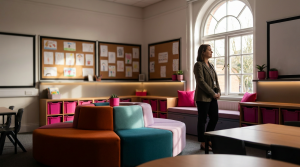
We recommend creating several key zones. A welcoming area at the entrance helps settle children and provides a space for communication with parents. Creative and messy play zones should have durable, easy-to-clean surfaces and storage. A construction and small world area benefits from open floor space and low-level shelving. For quiet time, a cosy reading corner with soft furnishings is essential. Each zone should be equipped with appropriate furniture that supports its purpose, such as the durable and child-friendly units in our specialised EYFS furniture from Twoey range. As noted by industry experts at KI Europe, the layout should be fluid enough to adapt to children’s changing interests.
| EYFS Zone | Learning Objective | Recommended Furniture | Key Consideration |
|---|---|---|---|
| Creative & Messy Play | Develops fine motor skills, self-expression, and exploration of materials. | Easels, sand & water trays, art tables with integrated storage, drying racks. | Proximity to a sink; durable, water-resistant surfaces are a must. |
| Construction & Small World | Encourages problem-solving, collaboration, and imaginative storytelling. | Low, open-access shelving for blocks; durable play mats; large, sturdy tables. | Ample floor space away from main traffic paths to protect creations. |
| Quiet/Reading Corner | Promotes literacy, relaxation, and emotional self-regulation. | Soft seating (beanbags, cushions), low-level bookcases, a small ‘den’ or canopy. | Position in a quieter part of the room with soft lighting. |
| Role Play Area | Supports social skills, language development, and understanding the world. | Child-sized kitchen units, shop counters, dress-up trolleys, flexible wooden frames. | Furniture should be adaptable to different themes (e.g., a shop, a clinic). |
Smart Procurement for Your EYFS Project: Budgeting and Sourcing
The first step in any school furniture procurement process is to create a realistic budget that prioritises long-term value. It’s tempting to choose the cheapest options, but this often leads to higher replacement costs and potential safety issues down the line. We advise clients to consider the Total Cost of Ownership (TCO), which includes not just the purchase price but also maintenance, repairs, and the expected lifespan of the furniture. High-quality, durable items may cost more initially but save significant money over a five-to-ten-year period.
Navigating the school furniture procurement process in the UK requires an understanding of public sector purchasing rules. Many schools and academies use purchasing frameworks designed to ensure value and compliance. Working with an experienced supplier like Cost Cutters UK simplifies this process immensely. We understand the procurement landscape and offer flexible solutions to meet your needs, including instant Credit Accounts Or Pay Flexibly options and Bulk Buy Discounts that help your budget stretch further. When vetting a supplier, we recommend you check for their experience in the education sector, their understanding of EYFS furniture requirements, and their ability to provide a complete service from planning to installation.
Case Study: A Typical Primary School Scenario
Challenge: A two-form entry primary school needed to refurbish its outdated EYFS classrooms. The existing furniture was worn, non-compliant, and created a cluttered, over-stimulating environment. The school had a fixed budget of £25,000 and a tight six-week summer holiday deadline.
Solution: The school partnered with us for our ‘Design To Install We Do It All!’ service. We conducted a site survey, created a 3D plan that optimised space with clear zones, and sourced compliant, durable furniture. Using our Bulk Buy Discounts, we procured everything within budget.
Results: The new classrooms were delivered and installed two days ahead of schedule. The headteacher reported a calmer atmosphere, improved child engagement, and positive feedback from both staff and Ofsted. The school saved an estimated 15% compared to sourcing from multiple suppliers.
Key Insight: A single-source procurement and design partner can significantly streamline a project, reducing administrative burden and maximising budget efficiency.
Beyond the Catalogue: Ensuring Safety, Durability, and Compliance
Meeting EYFS furniture requirements goes far beyond choosing items from a catalogue; it’s about ensuring the physical safety of children and the long-term viability of your investment. In the UK, the key standard to look for is BS EN 1729. This is the British and European standard specifically for chairs and tables in educational institutions. It has two parts: Part 1 specifies the appropriate sizes and dimensions for different age groups, while Part 2 tests for strength, stability, and durability. Insisting on furniture that meets both parts of this standard is non-negotiable for any school.
Material choice is equally critical. In a high-traffic EYFS setting, furniture must withstand constant use. Solid wood is extremely durable, while high-quality Melamine Faced Chipboard (MFC) with protective, rounded ABS edging offers a robust and cost-effective alternative. All surfaces should have non-toxic finishes, and design features like anti-finger-trap hinges are vital. We’ll be honest – verifying these details can be tedious. That’s why working with a reputable supplier who can provide documentation for all their products is so important for Saving Time & Stress. At Cost Cutters UK, we take this seriously, and you can review our full list of certifications for peace of mind. Investing in certified, durable furniture isn’t an expense; it’s a fundamental part of your duty of care.
Important Considerations
This guide provides a comprehensive framework based on established principles and best practices. However, every school and cohort of children is unique. The effective layout and resource selection will typically depend on your specific physical space, the number of children, their developmental stages, and their current interests. We recommend using this guide as a starting point for your own professional observations and planning.
Whilst a fully managed design and installation provides the most efficient and compliant solution, alternative approaches exist. Some settings may choose a phased approach, upgrading one zone at a time, or utilise DIY elements. While potentially cost-saving initially, it’s vital to ensure any approach still meets rigorous UK safety standards (like BS EN 1729) and that materials are sufficiently durable for a demanding educational environment.
For complex projects, new builds, or if you lack the in-house time and expertise for space planning and procurement, seeking professional guidance is the most effective path. An educational furniture specialist can conduct a site survey, create 2D/3D plans to optimise your space, ensure full compliance, and manage the entire project from design to installation, saving you valuable time and preventing costly mistakes.
Conclusion
Creating a high-quality EYFS learning environment is one of the most impactful investments a school can make in its youngest pupils’ development. By thoughtfully blending the principles of an ‘enabling environment’ with practical zoning, smart school furniture procurement, and an unwavering focus on safety and durability, you can create a space that inspires learning, meets Ofsted expectations, and stands the test of time. This approach ensures you build a foundation for success that children will benefit from for years to come.
Navigating the complexities of space planning and procurement can be daunting. At Cost Cutters UK, our team has over 35 years of experience helping schools, nurseries, and academies across the UK do just that. We’ve been Rated Excellent On Trustpilot because we deliver results. If you’re ready to transform your space, we invite you to book a free, no-obligation space planning consultation with one of our experts today.
Frequently Asked Questions
What makes a good EYFS learning environment?
A good EYFS learning environment is a safe, stimulating, and responsive space that acts as a ‘third teacher’. It carefully balances opportunities for child-led exploration with adult-guided activities and is organised into clear zones that support all seven areas of learning. Ultimately, it should be a welcoming place where every child feels secure and eager to learn.
What are the 5 key principles for organizing the learning environment?
The five key principles are creating a welcoming space, ensuring accessible resources, designing flexible zones, balancing stimulation, and reflecting children’s interests. This means the environment must be safe, resources should be easy for children to use independently, and the layout must support various activities. It should be calm yet engaging and evolve based on the children’s needs.
What are the 4 types of learning environment in teaching?
The four main types are often described as learner-centred, knowledge-centred, assessment-centred, and community-centred. An effective EYFS setting integrates all four. It creates a space where children’s needs are primary, knowledge is co-constructed, progress is observed and supported, and a strong sense of belonging is fostered amongst children and practitioners.
How do you create a good learning environment?
You create a good learning environment by starting with the children’s needs and observing how they use the space. From there, plan clear zones for different activities using high-quality, safe furniture. We recommend using neutral colours for walls and large items to create a calm backdrop, adding vibrancy with resources and children’s own artwork.
What are the six elements of a positive learning environment?
The six key elements are safety, positive relationships, a sense of belonging, accessible resources, a well-organised space, and respect for diversity. Physical and emotional safety is the foundation. When children feel secure and connected to others in a well-planned space, they are empowered to take risks in their learning and thrive.
What are the 3 main learning environments in EYFS?
The EYFS framework highlights the emotional, indoor, and outdoor environments. The emotional environment refers to the positive relationships and atmosphere that make children feel safe. The indoor and outdoor environments refer to the physical spaces and resources that are thoughtfully planned to support learning and development across all areas.
What does the EYFS say about environment?
The EYFS statutory framework states that practitioners must provide an ‘enabling environment’ rich with opportunities and experiences. It emphasises that the environment plays a key role in supporting children’s learning and development. The space must be a place where children feel secure and where their development is supported through challenging, playful activities.
How can you make an EYFS classroom feel homely?
You can make a classroom feel homely by using soft furnishings like rugs, cushions, and curtains. Incorporate natural elements such as plants and wooden furniture. Display children’s artwork in frames and create cosy, enclosed spaces like a reading den. Using soft lighting with lamps instead of relying solely on harsh overhead lights also creates a warmer atmosphere.
Why are neutral colours recommended for an EYFS learning environment?
Neutral colours for walls and furniture create a calm, uncluttered background that reduces over-stimulation. This approach, often linked to the Reggio Emilia philosophy, allows the colourful resources and children’s own creations to become the main focus. This helps children concentrate better and makes the learning materials themselves more appealing and engaging.
How important is the outdoor learning environment in EYFS?
The outdoor learning environment is critically important and holds equal weight to the indoor space in the EYFS framework. It offers unique opportunities for large-scale physical activity, appropriate risk-taking, and connecting with nature that cannot be replicated indoors. A well-planned outdoor area should be accessible in all weathers and support all seven areas of learning.
References
- Department for Education – Statutory Framework. Defines the requirements for an ‘Enabling Environment’ and the seven areas of learning.
- KI Europe – Industry Guide. Provides practical ideas for classroom layout and zoning to engage early learners.
- Teach Early Years – Practitioner Magazine. Offers actionable tips for improving specific rooms and areas within an early years setting.
- HFL Education – Educational Blog. Emphasises the importance of viewing the environment from a child’s perspective to assess its effectiveness.
- BSI Group – Standards Body. Publishes BS EN 1729, the standard for furniture dimensions, strength, and stability in educational settings.
- Early Excellence – Practitioner Resource. Offers practical tips for classroom setup ahead of a new school year, reinforcing zoning principles.
- Trent Schools – Educational Trust Guidance. Outlines strategies for creating effective learning environments, aligning with Ofsted expectations.