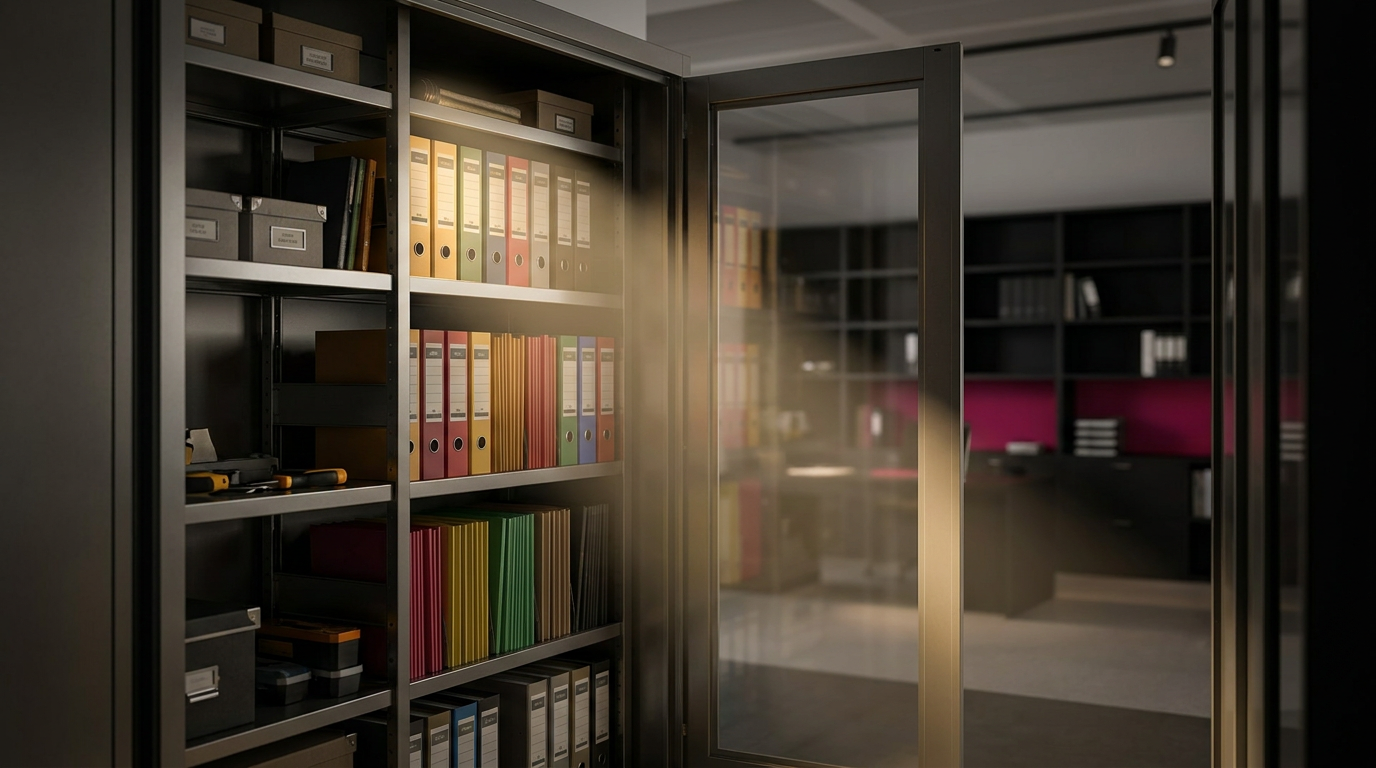
5 Common Workplace Storage Mistakes & How to Avoid Them
🎯 Key Takeaway
The most common workplace storage mistakes involve poor space planning, neglecting UK compliance and security, and choosing low-cost, non-durable solutions that fail over time. Inefficient use of vertical space and cluttered floorplans reduce usable area and create hazards. Ignoring the Data Protection Act 2018 and Health and Safety Executive (HSE) regulations can lead to significant fines and safety incidents. Also, opting for cheap, unsuitable furniture results in higher long-term replacement costs and disruption. This guide provides actionable strategies for UK facility managers and business leaders to create a compliant, efficient, and cost-effective storage system.
An untidy office or classroom is more than just an eyesore; it’s a drain on resources. Disorganisation directly contributes to wasted staff time, low morale, and significant safety risks. In fact, a study by the British Chambers of Commerce (2024) suggests that the average UK employee loses up to 30 minutes per day searching for misplaced items or navigating cluttered spaces, impacting overall productivity. Many organisations make common, costly workplace storage mistakes because they view storage as a passive container rather than a strategic asset. Thinking strategically about how to organise office storage is the first step towards a more efficient workplace.
This authoritative guide details the five most frequent errors we’ve seen in our 35+ years of experience and provides practical solutions for UK offices, schools, and public sector bodies.
Written by: The Cost Cutters UK Content Team
Reviewed by: The Editorial Team, with insights from our In-House Space Planning Specialists with 35+ Years Experience; Rated Excellent On Trustpilot
Last updated: 15 June 2026
ℹ️ Transparency Disclosure: This article explores common workplace storage issues based on our extensive industry experience and analysis of UK regulations. Our goal is to provide reliable, practical advice. For full transparency, some links may connect to our relevant services or product pages. All information is verified by our editorial team to ensure accuracy as of the publication date.
Mistake 1: Inefficient Space Planning & Poor Organisation
Yes, poor space planning is the most frequent and fundamental storage error. It often manifests as a failure to use the full volume of a room, especially vertical space. Many workplaces have shelving that stops at eye level, leaving vast, unused areas above. Another common issue is ‘storage creep’, a phenomenon where items accumulate without a logical system, leading to cluttered floorplans and hazardous walkways. This disorganisation directly impacts efficiency, with research indicating that a cluttered physical environment can increase cognitive load and reduce focus.
The key to overcoming this is a strategic approach to space utilisation. We believe the most effective solutions involve:
- Going Vertical: High-density shelving is a system designed to maximise storage capacity by using the full height of a room. This frees up valuable floor space for other functions.
- Introducing Mobility: Mobile shelving units and under-desk pedestals provide flexible, high-capacity storage that can be moved or reconfigured as needs change. They are excellent office storage solutions UK businesses can use to adapt to agile working models.
- Using Wall Space: Wall-mounted cabinets and shelving keep essential items accessible without consuming any floor area, which is effective for smaller offices or narrow corridors.
Learning how to organise office storage properly transforms a space from a liability into an asset, boosting both safety and productivity.
What Are the Risks of Ignoring UK Security & Compliance Requirements?
Yes, neglecting security and compliance is one of the most serious workplace storage mistakes, carrying major financial and legal risks. In the UK, two key pieces of legislation govern this area. The Data Protection Act 2018, which enacts the principles of the General Data Protection Regulation (GDPR), mandates that any organisation holding personal data must take appropriate technical and organisational measures to prevent unauthorised access or loss. This applies to physical documents just as it does to digital files. Separately, the Health and Safety at Work etc. Act 1974, enforced by the Health and Safety Executive (HSE), requires employers to provide a safe working environment, which includes ensuring storage units are stable and do not obstruct emergency exits or create trip hazards.
The consequences of non-compliance are severe. According to the Information Commissioner’s Office (ICO) (2025) in its Data Security Incident Trends report, failure to use a lockable cabinet for physical documents containing personal data remains a common cause of security breaches, which can result in fines of up to £17.5 million or 4% of global turnover. For physical safety, the HSE can issue improvement notices or even prosecute in cases of serious negligence.
Our recommendation is to categorise your storage needs:
- Sensitive Data: For HR records, client information, or student files, you must implement secure document storage solutions. This means using lockable, robust filing cabinets or cupboards. For ultimate protection, consider fire-resistant units.
- Hazardous Materials: In environments like science labs or workshops, chemicals and equipment must be stored in appropriate COSHH (Control of Substances Hazardous to Health) cabinets.
- General Items: Even for general supplies, storage must not block walkways, fire exits, or access to first-aid points.
Checking that your furniture is fit for purpose is simple; you can explore our accredited and compliant furniture ranges to ensure you meet all necessary standards. For outdoor equipment, using secure, weather-resistant metal storage units is essential.
Why is Prioritising Low Cost Over Value a Major Storage Mistake?
Yes, focusing solely on the upfront price is a false economy that almost typically leads to higher costs over time. The key is to evaluate the Total Cost of Ownership (TCO), which is a financial estimate that includes the initial purchase price plus all direct and indirect costs of a product over its entire lifespan. For storage furniture, this includes maintenance, repairs, and eventual replacement. A cheap, flat-pack cabinet might seem like a bargain, but if it needs replacing every two years, its TCO will far exceed that of a durable, commercial-grade unit that lasts for a decade or more.
This is especially true in demanding environments. We frequently encounter school storage problems where domestic-grade furniture has failed under the strain of heavy daily use. This not only costs money to replace but also is associated with significant disruption to the learning environment. Investing in commercial-grade furniture built from materials like fully welded steel instead of particleboard is a smarter financial decision. These products are designed and tested to withstand the rigours of a busy workplace or school, as demonstrated by certifications from bodies like the Furniture Industry Research Association (FIRA) (2025).
Storage Solution Cost vs. Lifespan Comparison
| Storage Type | Typical Initial Cost (per unit) | Estimated Lifespan (Heavy Use) | Best For |
|---|---|---|---|
| Domestic Flat-Pack (Particleboard) | £50 – £150 | 1-3 Years | Very light, infrequent use; temporary needs. |
| Standard Contract Steel (Self-Assembly) | £150 – £300 | 5-7 Years | General office use; moderate traffic areas. |
| Fully Welded Steel (Commercial Grade) | £250 – £500+ | 10-15+ Years | Schools, busy offices, high-traffic areas. |
| High-Density Mobile Shelving | £2,000+ (per bay) | 15-20+ Years | Archiving, medical records, maximising capacity. |
### Hypothetical Case Study: A Primary School’s Storage Transformation
Challenge: A multi-form entry primary school in Manchester was facing cluttered classrooms and corridors. Teachers were losing valuable teaching time tidying up, and several minor trip incidents had been reported due to items stored on the floor. Their existing wooden cupboards were damaged and unsuitable.
Solution: We implemented our “Design To Install We Do It All!” service. After a site survey, we designed a solution using a combination of durable, fully welded Gratnells tray storage units in classrooms and tall, lockable metal cupboards in the corridors for bulk supplies.
Results: The school reclaimed an estimated 15% of its classroom floor space. Reported trip incidents fell to zero in the following term. Teachers reported saving an average of 10-15 minutes per day, time they could now dedicate to lesson preparation.
Key Insight: A professional space plan delivered a solution that addressed safety, efficiency, and durability simultaneously, providing far greater value than simply replacing old cupboards like-for-like.
How Do Workplace Storage Mistakes Create Workflow Bottlenecks?
Yes, poorly placed storage is a direct and often underestimated barrier to productivity. When storage location isn’t mapped to actual workflows, it forces employees to take unnecessary steps, wasting valuable time. For example, if the main printer paper supply is kept in a basement stockroom far from the print area, every trip to restock it is a moment of lost productivity. A study from the Association of Professional Declutterers and Organisers (APDO) (2024) found that inefficient workflows linked to disorganisation can cost a business up to 15% of its payroll in wasted time.
In our experience, the solution lies in analysing how your team works and placing storage at the point of need. This involves:
- Point-of-Use Storage: Keep frequently used items within arm’s reach of where the task is performed. This could be small stationery caddies on desks or team-specific supply cupboards located within that department’s zone.
- Centralised Hubs: For items shared by everyone (like printer supplies or kitchen consumables), create a single, clearly organised, and easily accessible central hub.
- Visual Management: Use clear labels and even colour-coding to help staff identify contents quickly without having to open every cupboard. This simple step is vital for office storage solutions UK businesses can implement to reduce search time.
A modern approach also integrates storage into the workspace fabric. Utilising clever storage in breakout furniture or collaborative zones keeps spaces tidy and functional without appearing cluttered.
Mistake 5: Failing to Plan for Future Growth and Flexibility
Yes, installing a static, inflexible storage system is a short-sighted decision that quickly becomes obsolete. Businesses and schools are dynamic; teams expand, departments merge, and processes evolve. A storage system designed for today’s needs may be completely inadequate in two years. If you’ve invested heavily in fixed, built-in joinery, adapting to these changes can be incredibly expensive and disruptive. This is a classic error that locks an organisation into an inefficient layout.
The most effective strategy we advise clients to adopt is to invest in modularity and reconfigurability.
- Modular Systems: These are storage solutions built from standardised components that can be added to, taken away, or reconfigured with ease. You can start with a small system and expand it as your headcount or storage needs grow, protecting your initial investment.
- Reconfigurable Furniture: Look for shelving with adjustable heights and internal fittings that can be changed to accommodate different-sized items. Mobile units on castors offer the ultimate flexibility, allowing you to completely repurpose a space in minutes.
Thinking about future needs from the outset is crucial. It allows you to select a system that can evolve with your organisation, preventing the recurring cycle of outgrowing your storage and facing another costly overhaul. It’s about “Saving Time & Stress” not just for today, but for the years to come.
Frequently Asked Questions About Workplace Storage
What are the most common workplace storage mistakes?
The most common workplace storage mistakes include poor space planning, ignoring safety and data compliance, choosing cheap over durable solutions, creating access bottlenecks, and failing to plan for the future. These errors lead to inefficiency, unnecessary costs, and potential legal risks for UK organisations. Addressing them is a strategic priority.
How can I maximise storage in a small office?
You should think vertically and choose multifunctional furniture to maximise space. Use tall, narrow shelving units to draw the eye upwards and free up the floor. Consider over-desk storage, mobile pedestals that fit under desks, and breakout furniture with integrated storage. Wall-mounted solutions are also excellent for keeping items accessible without cluttering surfaces.
What are the UK compliance rules for document storage?
Key regulations are the Data Protection Act 2018 and HSE rules. For personal data, you must ensure storage is secure to prevent unauthorised access, for example, by using lockable cabinets. The Health and Safety Executive (HSE) requires that storage does not create hazards like blocked fire exits or trip risks. Proper compliance protects both data and people.
How do I choose durable storage for a school environment?
Prioritise robust construction, well-supported by research materials, and relevant safety certifications. Look for fully welded steel frames, scratch-resistant surfaces, and heavy-duty hinges and locks. Check for relevant British Standards (BS EN) for safety and strength. For schools, durability is a much better long-term investment than low initial cost due to high-intensity use.
Is investing in more expensive storage worth it?
Yes, it is almost typically worth it when you consider the total cost of ownership. While the upfront price may be higher, commercial-grade storage lasts significantly longer and withstands heavy use. It often comes with better warranties, too. This reduces replacement costs, disruption, and long-term expenditure, delivering better value for your budget.
What’s an effective way to organise a shared storage area?
Implement a clear, visual system that everyone can understand and follow. Use large, easy-to-read labels on all shelves, drawers, and containers. A colour-coding system can also work well, assigning different colours to departments or item categories. Finally, schedule regular audits to declutter and ensure the system is being maintained.
How does poor storage affect employee safety?
It creates direct and serious physical hazards in the workplace. Cluttered walkways are a primary cause of slips, trips, and falls, which The Royal Society for the Prevention of Accidents (RoSPA) identifies as the most common cause of major workplace injuries. Overloaded or unstable shelving can collapse, and blocked fire exits present a critical risk in an emergency.
What is the difference between archiving and active storage?
The key difference is access frequency, which dictates location and type. Active storage holds items needed for daily operations and must be highly accessible. Archival storage is for documents and items that must be retained for legal or operational reasons but are rarely needed. It can be located in less prime space and often uses high-density systems.
Can office furniture double as storage?
strongly, and it’s a fantastic space-saving and aesthetic strategy. Modern office furniture is often designed with this in mind. Look for breakout seating with storage underneath, desks with integrated pedestals, and media units that have built-in cupboards. This approach helps maintain a clean, professional look while maximising functionality in a limited space.
When should I call a professional for space planning?
Consult a professional when you are moving, refurbishing, or consistently struggling with space. If you lack the time or in-house expertise to design a layout that meets safety, compliance, and workflow needs, an expert provides significant value. Their input helps you avoid costly mistakes and maximises the return on your investment.
Important Considerations & Professional Guidance
The advice in this article provides a general framework for improving workplace storage. However, every organisation has unique spatial constraints, workflows, and regulatory requirements. The solutions presented here should be adapted to your specific context, and for any significant project, a full site survey may be necessary to develop a truly optimised plan that addresses your specific challenges.
While a DIY approach to reorganisation can yield small improvements, a comprehensive storage strategy often involves more than just buying new cabinets. Alternative approaches include engaging an interior architect or a specialised project manager. However, a dedicated furniture supplier with in-house space planning expertise, like us at Cost Cutters UK, often provides the most integrated and cost-effective solution, combining design, procurement, and installation into a single, seamless service.
For complex projects, or if you need to ensure full workplace storage compliance UK with Health and Safety and Data Protection regulations, we recommend seeking professional guidance. A specialist can conduct a needs analysis, produce CAD drawings, and ensure your investment meets all legal and operational requirements. This proactive step is crucial for “Saving Time & Stress” and preventing costly errors down the line.
Transform Your Space with a Strategic Storage Plan
Avoiding common workplace storage mistakes is crucial for any efficient, safe, and compliant organisation. By shifting your focus from reactive tidying to proactive, strategic planning, you can reclaim valuable space, protect sensitive data, and ensure your investment delivers long-term value. A well-designed storage system is not an expense; it is a strategic asset that supports productivity, safeguards your staff, and protects your budget. We know that many businesses can benefit from our flexible payment options, with choices to set up Credit Accounts Or Pay Flexibly.
If you’re ready to develop a lasting solution, our team at Cost Cutters UK can help. With over 35 years of experience serving schools, offices, and public sector organisations, and being Rated Excellent On Trustpilot, we offer expert advice and end-to-end project support. Our “Design To Install We Do It All!” promise means we handle every detail. We also offer Bulk Buy Discounts to ensure you get an effective possible value.
Book a Free Space Planning Consultation today to discover how we can transform your workspace.
References
- The Royal Society for the Prevention of Accidents (RoSPA) – Workplace Safety Report (2024). Analysis of UK workplace injury data shows slips, trips, and falls, often linked to poor housekeeping and obstructions, remain the single most common cause of non-fatal injuries.
- Information Commissioner’s Office (ICO) – Data Security Incident Trends Report (2025). This annual review of reported incidents consistently highlights failure to use a lockable cabinet or secure area for physical documents containing personal data as a common cause of security breaches.
- Health and Safety Executive (HSE) – Annual Workplace Injury Statistics (2024). Data from UK employers shows incorrect manual handling, including lifting items from poorly designed or inaccessible storage, is a leading cause of musculoskeletal disorders and lost workdays.
- Furniture Industry Research Association (FIRA) – Product Certification Standards (2025). This body provides standards and testing to certify that contract furniture demonstrates a higher level of strength, stability, and durability suitable for non-domestic environments (e.g., BS EN standards).
- British Chambers of Commerce – UK Workplace Productivity Survey (2024). A survey of 1,500 UK Small and Medium-sized Enterprises (SMEs) found that employees in disorganised environments lose an average of 30 minutes per day to non-productive tasks like searching for items.
Conclusion
Transform Your Space with a Strategic Storage Plan
Avoiding common workplace storage mistakes is crucial for any efficient, safe, and compliant organisation. By shifting focus from reactive tidying to proactive planning, you can reclaim valuable space, protect sensitive data, and ensure your investment in furniture delivers long-term value. A well-designed storage system is not an expense; it is a strategic asset that supports productivity and protects your budget.
If you’re ready to move beyond temporary fixes and develop a lasting solution, the team at Costcutters UK can help. With over 35 years of experience serving schools, offices, and public sector organisations across the UK, we offer expert advice and end-to-end project support. Book a Free Space Planning Consultation today to discover how we can transform your workspace.