Traditional vs. Flexible Classrooms: A Practical Guide for UK Schools
🎯 Key Takeaway
The debate over traditional vs flexible classrooms reveals that an effective choice depends on a school’s pedagogical goals, budget, and space; flexible layouts promote collaboration and student agency, while traditional setups excel at direct instruction and classroom management. Traditional classrooms offer structure and are often more cost-effective upfront, suiting teacher-led instruction. In contrast, flexible classrooms enhance engagement and support varied learning styles, potentially leading to better student outcomes. The decision must weigh pedagogical benefits against the practical realities of budget, procurement, and UK-specific safety standards (BS EN 1729).
School leaders across the United Kingdom face constant pressure to modernise learning spaces while managing ever-tighter budgets. The discussion around traditional vs flexible classrooms is not just theoretical; it’s a practical decision with significant financial and operational consequences for headteachers and school business managers. As of May 2026, finding the right balance between fostering 21st-century skills and ensuring value for money is paramount. This guide provides a clear, balanced comparison to help you make an informed choice, covering pedagogy, long-term costs, and crucial compliance standards. At Costcutters UK, we’ve spent over 35 years as a trusted partner to schools, and we understand that the right environment is key to success. We offer a complete range of school equipment and educational supplies to bring any vision to life.
👤 Written by: Costcutters UK Content Team
Reviewed by: Costcutters UK Editorial Team, 35+ Years Supplying UK Educational Institutions
Last updated: 24 May 2026
ℹ️ Transparency Disclosure: This article explores classroom design based on educational research and our 35+ years of experience in school outfitting. For full transparency, some links may connect to our services or products. Our editorial team has verified all information to ensure accuracy and relevance for UK schools. Costcutters UK is a leading national supplier of educational furniture, recognised for our commitment to quality and service.
What is a Traditional Classroom? The Established Model
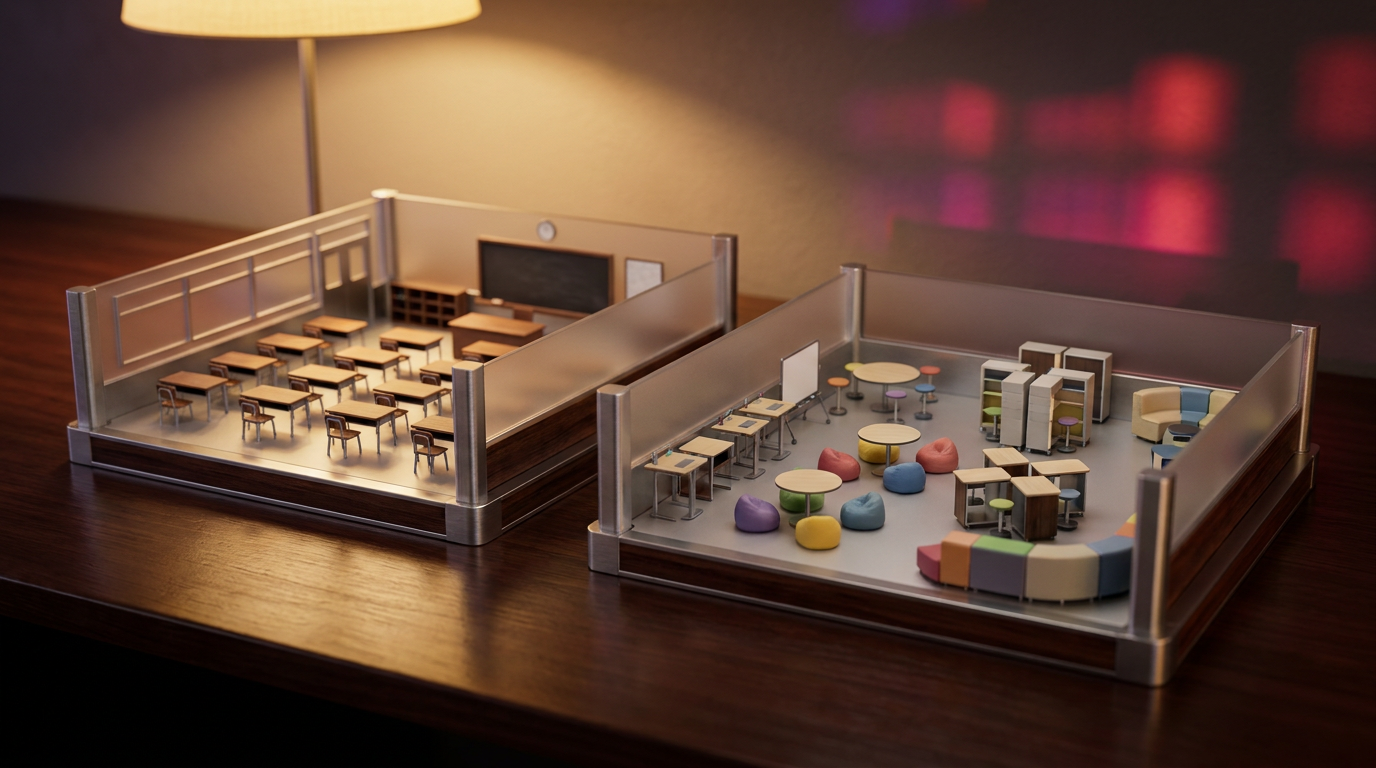
A traditional classroom is a teacher-centred learning environment characterised by a structured and uniform layout. Typically, this involves rows of individual desks and chairs facing a single focal point at the front of the room, such as a whiteboard or teacher’s desk. This traditional classroom layout has been the standard in British schools for generations because it directly supports a specific pedagogical approach: direct, whole-class instruction where the teacher is the primary dispenser of knowledge.
The established model offers several distinct advantages. Classroom management can be more straightforward, as sightlines are clear and students have defined personal spaces, which may reduce distractions. This structure aligns well with certain parts of the National Curriculum, the framework of subjects and standards used by schools in England, especially for subjects that rely on rote learning or explicit instruction. According to an article from Teacher Magazine, this model excels at creating a quiet, orderly environment conducive to individual, focused work.
However, a potential drawback is that this rigid setup can limit opportunities for collaborative work and student-led inquiry. Whilst often more affordable For initial furniture outlay, the one-size-fits-all approach may not cater effectively to the diverse learning needs within a single classroom.
What is a Flexible Classroom? The Modern Approach
A flexible classroom is a student-centred learning space intentionally designed with varied, movable furniture to support a wide range of learning activities. This goes far beyond simply adding beanbags; it’s a fundamental shift in philosophy. The core principle is providing students with choice and agency over where and how they learn. A survey featured in The Educator Online found that both students and teachers perceived flexible classroom designs as more effective than both traditional and open-plan layouts for supporting learning.
These innovative learning environments often feature distinct zones:
- Collaboration Zones: Group tables or clustered seating for project-based work.
- Quiet Study Zones: Individual carrels or soft seating for focused reading and independent tasks.
- Instructional Zones: A space for teacher-led mini-lessons, often with tiered seating or stools.
- Standing Zones: High-top tables that allow students to work while standing, which can improve focus.
The pedagogical goal is to create a physical space that facilitates differentiation and the ‘5 C’s’ of modern education: collaboration, communication, creativity, critical thinking, and choice. Research from KI Europe, a furniture manufacturer, highlights that the benefits of flexible seating include improved student engagement and comfort. By allowing students to select a learning space that suits their needs for a particular task, teachers can more easily support diverse learning styles and foster greater independence. It’s a dynamic environment built for active, not passive, learning.
Head-to-Head: A Feature-by-Feature Comparison of Traditional vs Flexible Classrooms
Comparing traditional vs flexible classrooms reveals distinct trade-offs in pedagogy, management, and student experience. A traditional classroom layout prioritises order and direct instruction, whereas a flexible model champions student agency and collaborative learning. The choice between flexible learning vs traditional methods isn’t about right or wrong; it’s about aligning your physical space with your school’s educational philosophy and the needs of your students.
An analysis from Finland Way Schools highlights that the teacher’s role shifts dramatically between the two models – from a “sage on the stage” in a traditional setting to a “guide on the side” in a flexible one. This has implications for lesson planning and classroom management. Also, Ofsted, the government body that inspects schools in England, increasingly focuses on active learning and student engagement, which flexible spaces are well-suited to demonstrate. However, as one opinion piece on LinkedIn argues, the pedagogy must lead the design; simply changing furniture without adjusting teaching practice yields limited results.
The table below breaks down the key differences to aid your decision-making.
| Feature | Traditional Classroom | Flexible Classroom | Relevance for UK Schools |
|---|---|---|---|
| Pedagogical Focus | Teacher-led, direct instruction. Focus on individual work and knowledge transmission. | Student-centred, collaborative, and project-based learning. Focus on skill development. | Aligns with the shift towards developing 21st-century skills (the ‘5 Cs’) and Ofsted’s focus on active learning. |
| Student Role | Passive receiver of information. Limited movement and choice. | Active participant. High degree of choice in seating and learning style. | Fosters student agency and independence, which are key goals in modern education. |
| Teacher Role | “Sage on the stage.” Primary source of knowledge and director of activities. | “Guide on the side.” Facilitator of learning, providing support as needed. | Requires a shift in teacher training and professional development but supports greater differentiation. |
| Classroom Management | Simpler due to clear sightlines and assigned seating. Easier to manage behaviour. | More complex initially. Requires clear routines and expectations for using different zones. | A key consideration for teacher workload and school culture. Success depends on strong implementation. |
| Space Utilisation | Often inefficient, with static rows leaving unused space. | Highly efficient and multi-functional. The same space can be used for multiple activities. | Important for schools with limited physical space, allowing one room to serve many purposes. |
The Budget Reality: Costing Your Classroom Transformation
When comparing flexible learning vs traditional setups, it’s crucial to look beyond the initial price tag and consider the total cost of ownership. While a traditional classroom with 30 identical desks and chairs may have a lower upfront cost, flexible furniture can represent a better long-term investment.
The initial outlay for a flexible classroom is typically higher. This is because you are purchasing a wider variety of items – soft seating, wobble stools, standing desks, collaborative tables, and storage units. However, many of the benefits of flexible seating come from its durability and adaptability. High-quality, multi-purpose furniture can be reconfigured for different year groups and teaching styles, reducing the need for future replacements as educational trends evolve. A single durable table might outlast several cheaper desks.
For schools managing tight budgets, we recommend a phased rollout. You don’t have to transform every classroom overnight.
- Start Small: Begin by creating a single flexible zone within an existing traditional classroom.
- Prioritise Durability: Invest in a few high-quality, versatile pieces that can serve multiple functions.
- Plan Across Budget Cycles: Develop a three-to-five-year plan to gradually introduce more flexible elements across the school.
This approach makes the transition manageable and financially sustainable. Plus, with options for Bulk Buy Discounts and flexible payment terms like Credit Accounts Or Pay Flexibly, we can help make your budget go further.
Procurement & Compliance: Choosing Safe, Durable Furniture
Choosing the right furniture for any classroom requires careful attention to safety and durability, especially when creating flexible classroom designs. All furniture intended for educational use in the UK must comply with specific standards to ensure it is safe and ergonomically sound for children. The most important of these is BS EN 1729.
BS EN 1729, the UK and European standard for educational furniture, is split into two parts:
- Part 1: Functional Dimensions. This specifies the appropriate size, height, and ergonomic dimensions of chairs and tables for different age groups, ensuring good posture and preventing discomfort.
- Part 2: Safety Requirements and Test Methods. This outlines strength and durability standards, ensuring furniture can withstand the rigours of a school environment without breaking or becoming a hazard.
When procuring furniture, it is your school’s responsibility to ensure suppliers meet these standards. Sourcing through reputable frameworks like ESPO, a public sector owned professional buying organisation, can provide peace of mind. At Costcutters UK, we guarantee that our educational furniture meets or exceeds these critical benchmarks. You can view our UK safety and quality accreditations for complete confidence. Our “Design To Install We Do It All!” service ensures that every piece is not only compliant but also perfectly suited to your space, Saving Time & Stress for your facilities team.
Frequently Asked Questions About Classroom Design
What is the difference between traditional vs flexible classrooms?
The core difference is that traditional classrooms prioritise structure, while flexible classrooms prioritise student choice. A traditional setting uses a uniform, static layout (desks in rows) to support teacher-led instruction. In contrast, the debate over traditional vs flexible classrooms highlights that a flexible space uses varied, movable furniture to support multiple learning styles and activities simultaneously, empowering student agency.
Why might a traditional classroom be better in some cases?
A traditional classroom can be more effective for subjects requiring sustained direct instruction or for students who thrive on routine. Its structured layout simplifies classroom management, minimises distractions, and ensures every student is focused on the teacher. For certain learning objectives, such as mastering foundational knowledge or for younger children needing clear boundaries, this predictable environment can be more conducive to learning.
What are the 4 types of learning environments?
The four main types are teacher-centred, student-centred, technology-rich, and collaborative environments. A teacher-centred space is the traditional model. A student-centred one, like a flexible classroom, prioritises choice. A technology-rich environment integrates digital tools seamlessly, while a collaborative space is designed for group work. Modern flexible classrooms often aim to blend student-centred, collaborative, and tech-rich elements into one adaptable space.
How is flexible grouping different from traditional group work?
Flexible grouping is fluid and task-based, whereas traditional group work often involves static, long-term groups. In a traditional setup, a teacher might assign students to a table group for a whole term. With flexible grouping, groups form and reform dynamically for different activities based on skill level, interest, or social needs. This fluidity is a key benefit enabled by an adaptable classroom design.
What is another term for flexible learning?
Common synonyms for flexible learning include ‘agile learning environments’, ‘modern learning spaces’, or ‘student-centred learning environments’. These terms all refer to the same pedagogical philosophy that values student choice, movement, and collaboration. While the specific terminology may vary, the underlying principles of creating an adaptable space that caters to diverse needs remain consistent across all these descriptions.
Does flexible seating cost more?
Yes, the initial investment for flexible seating is often higher than for traditional furniture. This is because you are purchasing a greater variety of specialised items like wobble stools, soft seating, and standing desks. However, the long-term value can be greater. High-quality, adaptable furniture can outlast cheaper options and be reconfigured for different needs, potentially offering a better total cost of ownership over time.
Is flexible seating suitable for all age groups?
Yes, the principles of flexible seating can be adapted for all age groups, from Early Years to Further Education. While it’s most visibly popular in primary schools with floor cushions and low tables, the concept evolves for older students. In secondary schools and colleges, it manifests as university-style breakout zones, collaborative hubs with integrated technology, and standing-height desks for project work, supporting more mature learning styles.
How do I start implementing a flexible classroom on a budget?
The most effective strategy is a phased approach, starting with one or two ‘flexible zones’ within your current classroom. You don’t need a complete overhaul at once. Begin by investing in a few multi-purpose, durable items like a standing-height table or some floor cushions. You can then gradually add more pieces over several budget cycles, making the transition financially manageable.
What are the ‘5 C’s’ of modern teaching?
The ‘5 C’s’ are Communication, Collaboration, Critical Thinking, Creativity, and Choice. These are widely regarded as the essential 21st-century skills that students need to succeed in the future workforce. Flexible learning environments are specifically designed to nurture these competencies by creating opportunities for group work, problem-solving, and independent inquiry, moving beyond simple knowledge recall.
How does classroom design affect Ofsted inspections?
Ofsted does not mandate a specific classroom layout, but an effective environment provides positive evidence for inspectors. An environment that visibly supports active learning, differentiation for varying student needs, and high levels of student engagement directly aligns with the criteria in the inspection framework. A well-designed flexible classroom can be a powerful, non-verbal demonstration of outstanding teaching and learning practices in action.
Important Considerations and Alternatives
You should acknowledge that much of the research comparing classroom types is qualitative, and success stories often depend heavily on teacher training and a supportive school culture, not just the furniture. The “best” environment is one that authentically aligns with your school’s unique pedagogical vision and the specific needs of your students. A change in furniture without a corresponding shift in teaching practice is unlikely to yield the desired results.
For many schools, a hybrid model offers a practical and effective alternative. You can gain many of the benefits of flexible learning without the cost and disruption of a complete redesign. This could involve introducing specific flexible elements into a traditional classroom, such as creating a comfortable reading corner with soft seating, adding a few standing-height desks for students who need to move, or placing a large collaborative work table for group projects. This approach allows you to test the principles on a smaller scale. We offer a wide range of flexible breakout furniture well-suited for this purpose.
For any significant investment, such as a classroom or whole-school refurbishment, we strongly advise seeking professional guidance. A specialist supplier can provide expert space planning to maximise your room’s potential, ensure every item is compliant with UK safety standards, and develop a solution that perfectly fits your budget and educational goals. This expert partnership is crucial for avoiding costly mistakes and achieving an effective possible outcome.
Making the Right Choice for Your School
Ultimately, the decision between traditional vs flexible classrooms is a strategic one that balances pedagogy with practicality. While traditional layouts offer well-supported by research structure and straightforward management, the growing movement towards flexible, innovative learning environments reflects a deeper shift in education – one that aims to foster collaboration, creativity, and student agency. The right choice is not universal; it depends on a careful analysis of your school’s unique student needs, overarching teaching philosophy, and, crucially, your budget. Many schools find a hybrid approach to be the most effective solution.
With over 35 years of experience helping UK schools design and furnish their learning spaces, Costcutters UK understands these complex challenges. Our team, Rated Excellent On Trustpilot, is here to help you explore the options, from initial design concepts to compliant installation. We are confident we can help you create an effective and affordable learning environment that inspires both students and teachers. To get started, book a free, no-obligation space planning consultation with our experts today.
References
- Finland Way Schools – Article. This resource compares the teacher-centric model of traditional classrooms with the student-centric approach of modern learning environments.
- KI Europe – Industry Guide. This guide outlines the practical benefits of flexible seating, including improved collaboration, physical comfort, and student choice.
- The Educator Online – Survey Report. A survey of students and teachers found that flexible learning spaces were perceived as more effective than both traditional and open-plan layouts.
- Teacher Magazine – Article. This piece discusses the critical relationship between the physical learning space and student outcomes in both traditional and innovative settings.
- LinkedIn / Lesley Murrihy – Opinion Piece. This article argues for moving beyond a simplistic ‘traditional vs. Modern’ debate to focus on ensuring pedagogy drives classroom design.
- Cotaplan – Guide. This resource provides practical guidance on designing flexible classrooms specifically to enhance collaborative learning amongst students.
- Edutopia – Video Explainer. This video defines the concept of flexible classrooms and showcases real-world examples of how they function in schools.
Frequently Asked Questions About Classroom Design
Q1: What is the difference between traditional vs flexible classrooms?
The core difference between traditional vs flexible classrooms lies in their philosophy. A traditional classroom prioritises structure, uniformity, and teacher-led instruction, reflected in static furniture arrangements like rows of desks. A flexible classroom prioritises student choice, movement, and varied learning activities, using adaptable furniture to create different zones. The furniture is the most visible differentiator, but the underlying pedagogy is the key distinction.
Q2: Why might a traditional classroom be better in some cases?
A traditional classroom can be more effective for subjects requiring sustained direct instruction or for specific student cohorts. For learners who thrive on clear routines and minimal distractions, the predictable structure of a traditional layout can enhance focus and simplify classroom management. It is particularly well-suited for exam preparation or when a teacher needs to deliver information to the entire class simultaneously and efficiently.
Q3: What are the 4 types of learning environments?
The four main types of learning environments are teacher-centred, student-centred, technology-rich, and collaborative. A traditional classroom is primarily teacher-centred. A modern flexible classroom is student-centred by design and aims to integrate the other types, using varied furniture to create collaborative zones and seamlessly incorporating digital tools to create a technology-rich space. The goal is to blend these environments to support diverse pedagogical needs.
Q4: How is flexible grouping different from traditional group work?
Flexible grouping is dynamic and task-based, whereas traditional group work often uses static, teacher-assigned groups. In a traditional setup, students might stay in the same groups for an entire term. Flexible grouping allows a teacher to form and reform groups fluidly—sometimes based on skill level, other times by interest or for a specific project—which is physically enabled by an adaptable classroom space.
Q5: What is another term for flexible learning?
Terms like ‘agile learning environments’, ‘modern learning spaces’, or ‘student-centred learning environments’ are often used interchangeably with flexible learning. While subtle differences may exist in academic literature, in the context of school outfitting, they all refer to the same core principles: prioritising student agency, movement, and choice through adaptable physical spaces and furniture to support a variety of teaching and learning styles.
Q6: Does flexible seating cost more?
The initial investment for a complete flexible seating classroom is often higher than a traditional one. This is due to the need for a greater variety of specialised furniture types (e.g., soft seating, standing desks, collaborative tables). However, many schools argue for a better total cost of ownership, as high-quality, adaptable furniture is more durable and can be repurposed for years, reducing future replacement costs.
Q7: Is flexible seating suitable for all age groups?
Yes, the principles of flexible seating can be adapted for all age groups, though the execution differs. While highly popular in Early Years and primary settings with floor cushions and wobble stools, the concept evolves for secondary and further education. In these contexts, it focuses more on creating distinct zones for independent study, collaborative project work, and formal instruction using a mix of cafe-style seating, high benches, and modular desks.
Q8: How do I start implementing a flexible classroom on a budget?
The most effective way to start on a budget is with a phased approach. Begin by introducing one or two ‘flexible zones’ within your existing traditional classroom, such as a quiet reading corner with soft seating or a standing-height table for collaborative work. Focus on purchasing a few multi-purpose, highly durable items first and then gradually build your collection over subsequent budget cycles.
Q9: What are the ‘5 C’s’ of modern teaching?
The ‘5 C’s’ are Communication, Collaboration, Critical Thinking, Creativity, and Choice. These are widely considered the key 21st-century skills that modern educational approaches aim to develop in students. Flexible learning environments are specifically designed to foster these skills by providing physical spaces that naturally encourage interaction, problem-solving, and student agency over how and where they learn.
Q10: How does classroom design affect Ofsted inspections?
Ofsted does not mandate a specific classroom layout, but the environment can provide powerful evidence of effective teaching and learning. An inspector will look for signs of a well-planned curriculum and high engagement. A flexible classroom that visibly supports differentiation, active learning, and student collaboration can serve as strong, positive evidence that the school is fostering an ambitious and effective learning culture.
Important Considerations and Alternatives
It is important to acknowledge that much of the research comparing classroom types is qualitative, and success is not guaranteed by furniture alone. The effective implementation of a flexible classroom depends heavily on consistent teacher training, a supportive school culture, and a clear pedagogical vision. The ‘best’ environment is always the one that is thoughtfully designed to align with and actively support the school’s specific educational goals and the needs of its students.
For schools facing budget constraints or wanting to transition gradually, a hybrid model offers a practical and effective alternative. You can gain many of the benefits of a flexible space without a complete overhaul. This can be achieved by introducing specific flexible elements into a traditional classroom, such as creating a breakout corner with flexible breakout furniture, adding a few standing-height desks, or replacing a block of individual desks with a large collaborative work table.
For any significant investment, from a single classroom to a whole-school refurbishment, it is crucial to seek professional guidance. A specialist educational furniture supplier can provide essential space planning services to help you maximise the potential of your area, ensure every item meets UK safety standards, and develop a solution that fits your school’s unique budget and pedagogical aims.
Conclusion
Making the Right Choice for Your School
In summary, the choice between traditional vs flexible classrooms is a strategic one that requires balancing pedagogy with practicality. While traditional layouts offer proven structure and cost-effectiveness, the growing adoption of flexible, innovative learning environments reflects a fundamental shift in education towards fostering collaboration, critical thinking, and student agency. The right decision ultimately rests on a careful analysis of your school’s unique student needs, its core teaching philosophy, and the realities of your budget.
With over 35 years of experience helping UK schools design and furnish their learning spaces, Costcutters UK understands these challenges intimately. Our team can help you navigate the options, from initial design concepts to compliant installation, ensuring you get the most value from your investment. To explore how you can create an effective and affordable learning environment tailored to your school, [book a free, no-obligation space planning consultation](