School Furniture UK: The Complete 2026 Procurement Guide
🎯 Key Takeaway
Procuring the right school furniture UK requires a strategic approach focused on compliance with BS EN 1729 standards, long-term durability, and ergonomic suitability for each Key Stage. This standard is not just a recommendation; it’s a critical benchmark for student health and safety. Selecting furniture based on the specific UK Key Stage supports student posture, improves concentration, and contributes to better learning outcomes. We believe that developing a whole-school procurement strategy that balances upfront cost with long-term value and sustainability is the most effective approach for modern educational institutions.
As of February 2026, the landscape for educational procurement demands a sharp focus on value and compliance. For school business managers and headteachers, balancing tight budgets with the need for high-quality, durable assets is a constant challenge. Choosing the right school furniture in the UK is a strategic investment in student wellbeing and educational outcomes, not just an operational expense. This guide provides a clear framework for understanding critical standards like BS EN 1729, selecting appropriate classroom furniture UK for different age groups, and navigating the procurement process to secure an effective possible value for your institution.
👤 Written by: Costcutter Content Team
Reviewed by: Costcutter Editorial Team, Experts in Value-Driven Procurement
Last updated: 25 February 2026
ℹ️ Transparency & Disclosure: This article explores school furniture procurement based on an impartial analysis of UK government standards, educational body guidelines, and supplier best practices. Our editorial team has verified all information to help schools make confident, well-informed purchasing decisions.
What are the UK Furniture Standards for Schools?
The primary standard governing educational furniture in the UK and Europe is BS EN 1729. This is a crucial piece of regulation designed to ensure that chairs and tables in schools are fit for purpose, promoting good posture and withstanding the rigours of a school environment. The standard is split into two distinct parts:
- BS EN 1729 Part 1: Functional Dimensions. This part focuses on ergonomics. It specifies the appropriate chair and table heights, depths, and widths for students of different age groups. Following these dimensions helps prevent musculoskeletal issues and ensures children are comfortable and able to concentrate.
- BS EN 1729 Part 2: Safety Requirements and Test Methods. This part covers strength, stability, and durability. Furniture must pass a series of rigorous tests for tipping, weight loading, and structural integrity to prove it is safe and robust enough for daily use in a demanding educational setting.
Compliance with both parts of the bs en 1729 furniture standard is the most important factor to verify during procurement. It’s a non-negotiable benchmark for safety and student wellbeing. Reputable suppliers will typically clearly state if their products are compliant.
How Does Sizing Work for School Furniture?
To simplify the selection process, BS EN 1729 introduced a ‘Size Mark’ system. This system uses a numerical and colour-coded scale to link furniture dimensions directly to the stature (height) of the students who will be using it.
For example, a Size Mark 3 chair is designed for children with a stature of 1190-1420mm, typically found in Key Stage 1. This system, detailed in guides like the one from Office Monster, removes the guesswork from procurement and ensures you are purchasing ergonomically correct educational furniture UK.
Why is Furniture Choice Important for Different Key Stages?
Selecting furniture appropriate for each UK Key Stage is vital because learning activities and physical needs change dramatically as children grow. What works for a play-based Early Years classroom is entirely unsuitable for a Sixth Form study area.
- Early Years Foundation Stage (EYFS): For children aged 3-5, learning is hands-on and active. Early years furniture must be low-level, extremely durable, and have safety features like rounded corners. Tables should have easy-to-clean, scratch-resistant surfaces. The focus is on facilitating group play and exploration, typically using Size Marks 1 and 2.
- Primary (Key Stages 1 & 2): As students (aged 5-11) move to more structured learning, furniture needs to be more versatile. According to a guide from Edu-Quip, stackable chairs and height-adjustable or modular tables are effective for creating flexible layouts that support both individual tasks and collaborative group work. Size Marks 2, 3, and 4 are common here.
- Secondary & Sixth Form (Key Stages 3, 4 & 5): For older students (aged 11-18), durability and ergonomics are paramount. Secondary school furniture must withstand heavy use and potential tampering. Desks are often designed for focused, individual study, particularly in examination years and for IT suites. Size Marks 5 and 6 are standard.
Matching the Size Mark to the Key Stage is a fundamental step in creating an effective learning environment.
| Size Mark | Recommended Age (Years) | Stature Range (mm) | Associated Key Stage |
|---|---|---|---|
| 1 | 3-4 | 800-950 | EYFS |
| 2 | 4-6 | 950-1100 | EYFS / KS1 |
| 3 | 6-8 | 1100-1250 | KS1 / KS2 |
| 4 | 8-11 | 1250-1400 | KS2 |
| 5 | 11-14 | 1400-1550 | KS3 |
| 6 | 14+ | 1550-1800 | KS4 / Sixth Form |
Data collated from BSI and supplier guidance such as Office Monster (2024).
What About Furniture for Other School Areas?
A school’s furniture needs extend well beyond the standard classroom. Creating a cohesive and functional environment requires considering ancillary spaces, each with its own specific requirements.
Libraries and Common Rooms
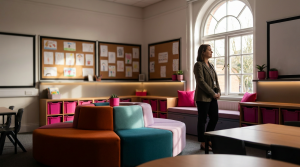
These spaces are no longer silent, formal rooms. Modern school libraries and common areas are flexible hubs for independent study, group projects, and relaxation. Furniture choices should reflect this, incorporating a mix of traditional study carrels, large collaborative tables, and comfortable soft seating to create a welcoming, multi-purpose environment.
Dining Halls and Canteens
Durability and hygiene are the top priorities for canteen furniture. Surfaces must be non-porous, scratch-resistant, and easy to clean thoroughly. Folding or stacking tables and benches are excellent for maximising space and allowing the hall to be used for other activities, like assemblies or exams. Fully-welded frames offer far greater longevity than self-assembly options in this high-traffic area.
SEN and Inclusive Environments
Creating an inclusive school requires specialised furniture. The Department for Education (DfE) provides guidance on meeting the needs of pupils with Special Educational Needs (SEN). This can include height-adjustable desks for wheelchair users, postural support chairs to aid concentration, or specific furniture for sensory rooms. Working with specialist suppliers is often essential to source items that meet specific therapeutic and physical requirements. Plus, effective school storage solutions are vital in all these areas to maintain a safe, tidy, and accessible space.
The Smart Procurement Process for School Furniture in the UK
A structured procurement process for school furniture in the UK is an effective way to avoid costly mistakes and ensure you achieve excellent long-term value. We recommend a five-step approach.
- Needs Analysis: Begin by auditing your current furniture stock. Identify items that are broken, non-compliant, or no longer fit for purpose. Crucially, consult with teaching staff and even students to understand what works well and what doesn’t in their learning spaces.
- Budgeting: Develop a comprehensive budget that goes beyond the ticket price of the items. Factor in costs for delivery, installation, and the disposal or recycling of old furniture. Good budgeting tips for schools typically account for this Total Cost of Ownership (TCO), which is the initial price plus ongoing maintenance.
- Specification: Create a detailed tender document. This must specify that all items must comply with both parts of BS EN 1729. Include the required Size Marks, quantities, materials, and desired guarantee periods. A clear specification prevents suppliers from quoting for inferior products.
- Sourcing Suppliers: Look for accredited providers. The British Educational Suppliers Association (BESA) is an excellent starting point, as its members are vetted. You can also use local authority procurement frameworks. Typically ask for references from other schools.
- Evaluation: When bids are returned, evaluate them based on overall value, not just the lowest price. As noted by experts like Castles UK Education, factors like guarantee length, material quality, and after-sales service are critical components of value. A cheaper chair that breaks in two years is far more expensive than a compliant one that lasts for ten.
Frequently Asked Questions About UK School Furniture
What is school furniture in the UK?
School furniture in the UK refers to specialised tables, chairs, and storage units designed specifically for educational environments. It must meet strict safety and ergonomic standards, principally BS EN 1729, to ensure it is safe, durable, and appropriately sized for students at different Key Stages. This distinguishes it from standard domestic or office furniture, which is not built to withstand the demands of a school setting.
Why is BS EN 1729 so important for schools?
This standard is critical because it directly impacts student health, safety, and ability to learn effectively. BS EN 1729 ensures furniture is ergonomically sized to promote good posture and prevent long-term health issues. Its rigorous strength and stability tests also guarantee that the furniture is safe for use in a busy school, minimising the risk of accidents and ensuring the school meets its duty of care.
How much does classroom furniture cost in the UK?
The cost of classroom furniture varies significantly, but you can expect to pay £20-£40 for a basic compliant chair and £60-£120 for a standard classroom table. Prices depend heavily on materials, supplier, and order volume, with Bulk Buy Discounts often available. However, our advice is typically to focus on the total cost of ownership, including the product’s lifespan and guarantee, rather than just the initial price tag.
How do I find reputable school furniture suppliers in the UK?
an effective way to find reputable school furniture suppliers in the UK is to start with the British Educational Suppliers Association (BESA). Its members are vetted for quality, financial stability, and adherence to a code of practice. Plus, check your local authority’s approved supplier lists or procurement frameworks. Typically ask potential suppliers for references from other schools to verify their service and product quality.
What is the most durable material for school tables and chairs?
For table tops, the most durable option is typically a solid Medium-Density Fibreboard (MDF) core with a high-pressure laminate (HPL) finish. This combination is highly resistant to scratches, heat, and impact. For chair frames, a fully-welded, powder-coated steel frame offers maximum strength and longevity compared to bolt-together alternatives. Polypropylene is a very robust and easy-to-clean material for the chair shells themselves.
Can I mix and match furniture from different suppliers?
Yes, it is possible to mix and match furniture, but you must ensure every piece is fully compliant with BS EN 1729. Pay close attention to the Size Marks to ensure ergonomic consistency across your classrooms. While possible, sourcing from a single supplier can often simplify logistics, guarantee a consistent aesthetic, and may offer better value through volume discounts, Saving Time & Stress during installation.
What’s the difference between early years and primary school furniture?
Early years furniture is smaller, safer, and designed for play, while primary furniture supports more structured learning. Specifically, early years furniture uses smaller Size Marks (1-2), often features enhanced safety like rounded corners, and is built for hands-on, activity-based learning. Primary furniture (Size Marks 2-4) is larger and more often designed for both individual desk work and flexible collaborative group settings.
How long should school furniture last?
Good quality, compliant school furniture should be expected to last for at least 10-15 years with proper care. Most reputable suppliers will offer may help of between 5 and 10 years on their products. This durability is a key factor in calculating the furniture’s long-term value and should be a major consideration during procurement, as replacing cheap furniture frequently is a false economy.
Are there sustainable options for school furniture?
Yes, many suppliers now offer excellent sustainable school furniture options. You should look for products made from recycled materials, such as recycled polypropylene for chair shells, or from wood certified by the Forest Stewardship Council (FSC), which may help it comes from responsibly managed forests. Also, ask suppliers about their end-of-life recycling programmes to support a circular economy.
What are the common mistakes to avoid when buying school furniture?
The most common mistakes are buying on price alone, failing to verify BS EN 1729 compliance, and not involving end-users. Choosing the cheapest option often leads to higher long-term costs due to breakages and replacements. Not checking for compliance is a major safety and liability risk. Finally, failing to consult with teachers means you may purchase furniture that doesn’t actually suit their teaching methods or classroom needs.
Important Considerations and Next Steps
This guide provides a comprehensive overview of school furniture procurement in the UK. However, market prices, specific supplier offerings, and local authority regulations can change. It should be used as a strategic framework, not a substitute for direct communication with accredited suppliers who can provide detailed quotes and samples.
While purchasing new furniture is often necessary, schools on very tight budgets may consider alternatives. Refurbishment of existing high-quality frames can be a cost-effective option. Plus, exploring grant opportunities for capital projects or leasing agreements can provide alternative funding routes to acquiring new assets. Consider suppliers offering flexible payment options like Credit Accounts Or Pay Flexibly.
For large-scale projects, such as a new build or a complete school refurbishment, we recommend engaging an independent educational furniture consultant. These specialists can manage the entire procurement process, from space planning and needs analysis to tender management, ensuring optimal value and a cohesive learning environment. Their expertise can be invaluable in Saving Time & Stress.
A Strategic Investment in Your School’s Future
Ultimately, selecting the right school furniture UK is a critical decision that extends far beyond simple purchasing. By prioritising compliance with BS EN 1729, focusing on long-term durability over short-term cost, and matching furniture to the specific needs of each Key Stage, you create learning environments that actively support student wellbeing and academic achievement. A well-managed procurement process ensures every pound spent is a defensible and valuable investment in your school’s infrastructure, from school storage solutions to classroom furniture UK.
At Costcutters UK, we have over 35 years of experience helping organisations make smart procurement decisions. We are Rated Excellent On Trustpilot because we focus on providing value and reliable service. While we don’t sell furniture, our expertise in procurement can help guide your process.
References
- British Standards Institution (BSI) – Standards Body. Provides the official documentation and framework for the BS EN 1729 standard, which is the cornerstone of safe and ergonomic educational furniture.
- Department for Education (DfE) – Government Body. Publishes guidance on all aspects of school management, including procurement, capital expenditure, and standards for creating effective and inclusive learning environments.
- British Educational Suppliers Association (BESA) – Professional Organisation. Maintains a directory of accredited UK educational suppliers who adhere to a strict code of practice, ensuring quality and reliability.
- Office Monster (https://www.officemonster.co.uk/school-furniture-sizing-guide) – Supplier Guide. Published online, this guide provides a clear, user-friendly summary of the BS EN 1729 sizing and colour-coding system.
- Edu-Quip (https://www.edu-quip.co.uk/blog/buying-guide-for-school-tables-and-chairs) – Supplier Guide. Their online buying guide offers practical advice on selecting tables and chairs for different school settings.
- Castles UK Education (https://www.castlesukeducation.com/post/5-essential-factors-to-consider-when-purchasing-educational-furniture-for-schools) – Supplier Insight. This article outlines key factors for purchasing educational furniture, emphasising long-term value and user needs.
Conclusion
A Strategic Investment in Your School’s Future
Ultimately, selecting the right school furniture UK is a critical decision that extends far beyond simple purchasing. By prioritising compliance with BS EN 1729, focusing on long-term durability over short-term cost, and matching furniture to the specific needs of each Key Stage, you create learning environments that actively support student wellbeing and academic achievement. A well-managed procurement process ensures every pound spent on educational furniture UK is a defensible and valuable investment in your school’s infrastructure, from classroom desks to school storage solutions.
Use the principles and checklists in this guide to build confidence in your next furniture project. By taking an informed and strategic approach, you can ensure your school is equipped for success for years to come.