
Debunking School Funding Myths: A Practical Guide for UK Educators
🎯 Key Takeaway
The most significant school funding myths cause UK educators to overlook major budget opportunities, but that funding streams are more flexible and accessible than commonly believed. Capital funding like Devolved Formula Capital (DFC) is specifically for long-term assets, not daily costs. Both academy and maintained schools are funded via the same National Funding Formula (NFF), with differences being primarily administrative. Also, Pupil Premium can be used for resources and environmental improvements, not just tutoring. This guide provides the factual clarity needed to maximise your budget and invest strategically.
For School Business Managers and Headteachers, navigating school finance can feel like a constant battle against constraints. Amidst headlines about a potential uk school funding crisis, it’s easy to feel that budgets are perpetually squeezed. However, some of the biggest barriers aren’t just financial; they’re informational. Widespread school funding myths often prevent schools from accessing or using funds effectively. For the 2024-2025 financial year, understanding the facts behind the funding is more critical than ever. As a leading supplier of school and educational equipment, we’ve seen how this knowledge gap can hinder progress. This guide is designed to debunk those myths with official data and provide practical guidance on turning policy into smart procurement.
👤 Written by: Costcutters UK Content Team
Reviewed by: Costcutters UK Editorial Team, Public Sector Procurement Specialists
Last updated: 15 April 2026
ℹ️ Transparency Disclosure: This article explores UK school funding based on official government guidance and our 35+ years of industry experience. Some links may connect to our services, such as our free space planning consultation. All information is verified by our editorial team to ensure accuracy and relevance for UK school leaders.
Myth 1: Capital Funding is Unattainable for Large Projects
A common belief is that there’s simply ‘no money’ for big-ticket items like a new IT suite or a complete library overhaul. This myth stems from confusing two distinct types of funding. Your revenue budget, which covers salaries and utilities, is indeed tight. However, Capital funding is an entirely separate pot of money designated for long-term assets.

One of the most important streams is Devolved Formula Capital (DFC), which is a type of capital funding for schools uk that is allocated directly to schools and local authorities to invest in their buildings and facilities. DFC is specifically for expenditure that has a lasting benefit, making it effective for a classroom refurbishment or new library furniture. According to the Department for Education (DfE) (2024) guidance, this funding can be used for buildings, Information and Communication Technology (ICT), and other capital assets. For the 2024-2025 financial year, the DfE allocated over £450 million in DFC.
The key is to align the purchase with the funding source. Instead of trying to squeeze a major furniture project out of your daily revenue budget, you can strategically plan it using your DFC allocation. This is a well-suited example of overcoming the policy-to-procurement gap by understanding what funds are available and using them for their intended purpose, which is exactly what our “Design To Install We Do It All!” service helps schools achieve.
Hypothetical Case Study: A Primary School’s Library Transformation
Challenge: A primary school in the North West had an outdated and uninspiring library. Their revenue budget was fully committed to staffing and resources, leaving no funds for the £25,000 refurbishment needed.
Solution: After a consultation, we helped the School Business Manager identify that their annual DFC allocation, which they had been accumulating, was the correct funding stream. We developed a phased plan to use the funds for new shelving, soft seating, and collaborative tables.
Results: The project was completed over two financial years without impacting the school’s revenue budget. The new library led to a 40% increase in book borrowing and created a vibrant hub for learning.
Key Insight: Understanding the distinction between revenue and capital funding unlocked a significant project that the school previously thought was impossible, “Saving Time & Stress” in the budgeting process.
Myth 2: Academy vs Maintained School Funding is Wildly Different
This is one of the most persistent myths, but the core funding mechanism is the same for both school types. The answer to how are uk schools funded in England is the National Funding Formula (NFF), a system designed by the DfE to distribute core school funding. The Department for Education (DfE) (2024) policy paper indicates that both maintained schools and academies are funded through the NFF.
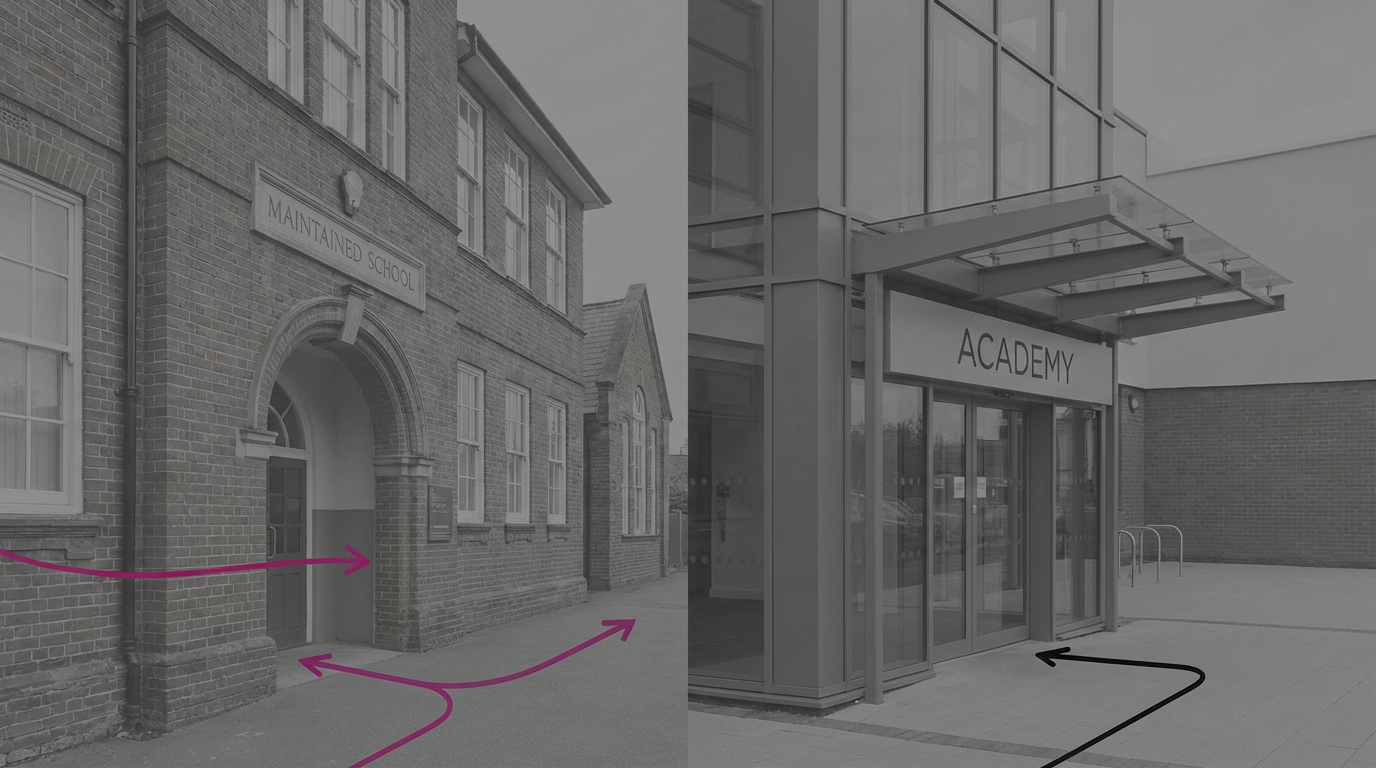
The crucial difference is the route the money takes.
- Maintained Schools: Receive their budget from their Local Authority (LA), which gets its funding allocation from the government. The LA may ‘top-slice’ funds to provide central services.
- Academies: Receive their funding, known as the General Annual Grant (GAG), directly from the Education and Skills Funding Agency (ESFA), an executive agency of the DfE. This gives them more autonomy over their budget.
Because academies receive their full budget directly, they also become responsible for services that an LA might have provided, such as HR, payroll, or building maintenance. So, whilst an academy’s initial GAG may look larger than a maintained school’s budget, it has to cover more services. The academy vs maintained school funding debate is therefore less about the total amount and more about control and responsibility. Good school budget allocation guidance applies to both: understand your income streams and plan expenditure accordingly.
Comparing Funding Streams: Maintained vs. Academy
| Funding Stream | Received by Maintained School | Received by Academy Trust | Key Consideration |
|---|---|---|---|
| Core Funding (NFF) | Via the Local Authority (LA) as part of the schools budget share. | Directly from the ESFA as the General Annual Grant (GAG). | The base NFF amount is calculated the same way for both school types before routing. |
| Pupil Premium | Directly from the ESFA. | Directly from the ESFA. | Both school types receive this in addition to core funding and must follow the same grant conditions. |
| Devolved Formula Capital (DFC) | Directly from the ESFA. | Directly from the ESFA. | Both school types receive this for capital investments, though LAs also get a larger pot for their schools. |
| Central Services Funding | Services are often provided by the LA, paid for via a ‘top-slice’. | Academies receive funding for these services but must procure them independently. | This is a key factor in the academy vs maintained school funding comparison. |
Myth 3: Pupil Premium is Just for Tutoring and Interventions
The belief that Pupil Premium funding can only be spent on small-group tuition is a myth that severely limits its potential impact. While academic support is a core component, the official pupil premium funding rules are far more flexible.

The Education and Skills Funding Agency (ESFA) (2024) sets out the conditions of the grant. It promotes a ‘menu of approaches’ recommended by the Education Endowment Foundation (EEF). This framework is organised into three tiers:
- High-Quality Teaching: Professional development for staff, effective curriculum planning.
- Targeted Academic Support: Tutoring, structured interventions.
- Wider Strategies: Addressing non-academic barriers to success, such as attendance, behaviour, and social-emotional support.
For the 2023-2024 academic year, funding was set at £1,455 per eligible primary pupil and £1,035 per secondary pupil. This funding can be used creatively. For example, a school could use it to resource a breakfast club to improve attendance and readiness to learn. It could also be used to purchase sensory equipment for a nurture room that supports the emotional regulation of disadvantaged pupils, or to invest in laptops that close the digital divide for homework and revision. The key is being able to evidence how the expenditure is helping to close the attainment gap for eligible pupils.
Myth 4: Grant Bids (Like CIF) Are Too Competitive to Bother With
It’s true that securing grant funding is a competitive process, but writing it off as impossible is a missed opportunity. The Condition Improvement Fund (CIF) is a prime example of capital funding for schools uk that can transform a school’s estate if approached strategically.
The Condition Improvement Fund (CIF), which is an annual bidding round for eligible academies and sixth-form colleges, is designed to keep school buildings safe and in good working order. According to the Department for Education (DfE) (2024), the 2023-2024 round awarded £456 million for 1,033 projects at 859 institutions. While competitive, this shows that a significant number of projects are successfully funded each year.
The key to a strong condition improvement fund (cif) for schools bid is not luck; it’s preparation. Successful bids typically demonstrate:
- Clear Evidence of Need: Professional condition surveys, photos, and reports that prove the urgency of the project (e.g., a failing boiler or a leaking roof).
- Robust Costings: Detailed, accurate quotes from reputable suppliers. This is where our expertise in providing detailed quotes for
Bulk Buy Discountscan be invaluable. - Strategic Alignment: Showing how the project aligns with DfE priorities, such as energy efficiency or school expansion.
For Local Authorities and large Multi-Academy Trusts (MATs) that are ineligible for CIF, they receive a different stream called the School Condition Allocation (SCA) to invest across their estate. The principle remains the same: this is dedicated funding for building improvements that must be used strategically.
Important Considerations and Strategic Planning
You should recognise that school funding is a dynamic landscape. The data and figures presented, such as NFF weightings and grant allocations, are based on the current financial year. These are subject to change annually based on government policy. This guide provides a framework for understanding, but you should typically consult the latest DfE and ESFA documentation for the most current figures and rules to avoid issues related to the uk school funding crisis.
Whilst this article focuses on maximising official funding streams, schools have typically supplemented their budgets through other means. Alternative approaches include Parent-Teacher Association (PTA) fundraising, seeking local business sponsorship, and exploring charitable grants from educational trusts. As noted in guidance from organisations like the Institute for Public Education (2022) in their analysis of funding myths, these external funds can be valuable for specific projects that fall outside the scope of core or capital funding, but they require significant time and effort to secure.
For large-scale projects, especially those involving CIF bids or significant capital expenditure on building works and refurbishment, seeking professional guidance is advisable. A specialist consultant or an experienced supplier can assist with space planning, bid writing, and ensuring procurement is fully compliant with public contract regulations. We’ll be honest – this part can be tedious, but this expertise can be the difference between a successful project and a costly administrative error. It’s an investment in getting your project over the line.
From Myth to Mandate: Investing in Your School’s Success
By moving beyond common school funding myths, school leaders can unlock the true potential of their budgets. The key is to understand the distinct purposes of revenue and capital funding, the real similarities in how all schools are funded, and the flexibility within targeted grants like Pupil Premium. This clarity transforms budget management from a restrictive exercise into a strategic one, empowering you to make impactful investments that improve the learning environment. Effective school budget allocation guidance starts with these foundational facts.
Navigating this complex environment requires a partner who understands both the funding rules and the practicalities of procurement. With over 35 years of experience serving UK schools and being “Rated Excellent On Trustpilot”, Cost Cutters UK helps translate your budget into a vibrant, effective learning environment. If you’re planning a refurbishment or need to procure compliant, high-value furniture with flexible payment options like Credit Accounts Or Pay Flexibly, book a free space planning consultation with our public sector specialists today.
Frequently Asked Questions About UK School Funding
What are the most common school funding myths?
The most pervasive school funding myths are that there is no money for capital projects, that academies typically get more funding, and that Pupil Premium has overly restrictive rules. In reality, dedicated capital funds exist, all schools are funded via the NFF, and Pupil Premium can be used flexibly. Understanding these facts is key to effective budget management and strategic financial planning for your school.
How is school funding calculated in the UK?
In England, core school funding is primarily calculated using the National Funding Formula (NFF). This formula allocates a base amount per pupil, with additional weightings for factors like deprivation (which informs Pupil Premium), low prior attainment, and geographic area costs. Local Authorities then use this to set their local formulas, which determine the final budget for their maintained schools, while academies receive their allocation directly based on the NFF.
Can schools use capital funding to buy furniture?
Yes, strongly; capital funding is specifically intended for acquiring long-term assets like school furniture. Devolved Formula Capital (DFC) is a well-suited example of a funding stream that can be used for classroom, library, or office refurbishments. This is entirely separate from the revenue budget used for day-to-day costs like salaries and utilities, making it effective for significant furnishing projects. Typically check your specific funding agreement for details.
What is the difference between GAG and DFC funding?
General Annual Grant (GAG) is the main revenue funding for academies, whereas Devolved Formula Capital (DFC) is capital funding for assets. GAG covers day-to-day operational costs such as staff salaries, utility bills, and educational supplies. DFC, on the other hand, is a separate, smaller fund allocated specifically for long-term investments like building improvements, ICT infrastructure, and major furniture purchases.
Are pupil premium funding rules strict?
Whilst schools must show how spending benefits eligible pupils, the official pupil premium funding rules are designed to be flexible. The Department for Education endorses a ‘menu of approaches’ that extends beyond academic tuition to include wider strategies that support attendance, well-being, and access to enrichment. As long as you can evidence the positive impact on disadvantaged pupils, your spending strategy can be quite broad and creative.
Who can apply for the Condition Improvement Fund (CIF)?
The Condition Improvement Fund (CIF) is a competitive grant available to smaller single academy trusts, small multi-academy trusts (MATs), and sixth-form colleges. Larger MATs (typically with over 3,000 pupils) and local authority maintained schools are generally not eligible. Instead, they receive a direct capital allocation known as the School Condition Allocation (SCA) to manage building maintenance and improvements across their estate.
How can I make my school’s budget stretch further?
To maximise your budget, start by using the correct funding streams for each purchase (e.g., capital for furniture, revenue for supplies). Explore public sector buying frameworks and suppliers who offer Bulk Buy Discounts to secure compliant, pre-negotiated prices. For large projects, consider leasing options to spread costs over time. We also recommend getting several quotes from approved suppliers to ensure you achieve best value.
Does funding differ between England, Scotland, Wales, and NI?
Yes, education is a devolved matter, meaning funding systems are entirely different across the four nations of the UK. The National Funding Formula (NFF), Pupil Premium, and condition improvement fund (cif) for schools are specific to England. Scotland, Wales, and Northern Ireland each have their own distinct funding mechanisms, allocation formulas, and targeted grants managed by their respective governments and local authorities.
What is a ‘top-slice’ from a Local Authority?
A ‘top-slice’ is the portion of funding a Local Authority (LA) retains from the total schools’ budget before distributing it to its maintained schools. This money is used to fund central services that the LA provides to all its schools, which can include things like HR support, school improvement partners, or Special Educational Needs and Disabilities (SEND) administration. The amount retained and services offered vary between different LAs.
Where can I find official school budget allocation guidance?
The most reliable sources are the official UK government websites for education. For schools in England, you should consult the Department for Education (DfE) and the Education and Skills Funding Agency (ESFA) portals. These sites publish the annual guidance on the National Funding Formula, the conditions of grant for Pupil Premium, and capital funding allocations, providing the definitive rules for your school’s budget.
References
- Department for Education (DfE) (2024) – Official Government Guidance. Outlines the different streams of capital funding available to schools in England, including DFC, SCA, and CIF.
- Department for Education (DfE) (2024) – Policy Paper. Details the factors and weightings used to calculate core school funding allocations for every school in England.
- Education and Skills Funding Agency (ESFA) (2024) – Grant Conditions Document. Specifies the rules and permissible uses of Pupil Premium funding, including the ‘menu of approaches’ for schools.
- Institute for Fiscal Studies (IFS) (2024) – Independent Research Report. Provides independent analysis of trends in UK school funding per pupil in real terms over the last decade.
- National Audit Office (NAO) (2018) – Government Audit Report. An analysis of the financial processes and implications of school academisation, including funding flows.
- Education Endowment Foundation (EEF) (2023) – Evidence-Based Guidance. Offers evidence-based recommendations for how schools can spend their Pupil Premium funding to achieve the greatest impact.
- Department for Education (DfE) (2024) – Official Government Announcement. Lists the successful applicants and projects for the CIF round, providing insight into total funding and success rates.
- AEU News Victoria (2023) – News Analysis. Explores common international myths about public versus private school funding.
- Institute for Public Education (2022) – PDF Report. A breakdown of five common myths surrounding public school funding in the US, with relevance to UK discussions on accountability.
- Independent Schools Australia (ISA) (2024) – Web Resource. Dispels common myths about the funding of independent schools in the Australian context.
Conclusion
From Myth to Mandate: Investing in Your School’s Success
By moving beyond common school funding myths, school leaders can unlock the true potential of their budgets. The key is to understand the distinct purposes of revenue and capital funding, the real similarities in how all schools are funded, and the flexibility within targeted grants like Pupil Premium. This clarity transforms budget management from a restrictive exercise into a strategic one, empowering you to make impactful investments in your school’s future.
Navigating this complex environment requires a partner who understands both the funding rules and the practicalities of procurement. With over 35 years of experience serving UK schools, Costcutters UK helps translate your budget into a vibrant, effective learning environment. If you’re planning a refurbishment or need to procure compliant, high-value furniture, book a free space planning consultation with our public sector specialists today.