Office vs Home Furniture: Why Commercial Grade Matters for UK Organisations
🎯 Key Takeaway
The core difference in the office vs home furniture debate is that commercial-grade furniture is engineered and certified to meet stringent UK legal standards for durability, fire safety, and ergonomics required for high-traffic, public environments, whereas domestic furniture is not. Commercial items undergo rigorous testing to withstand continuous daily use, ensuring a longer lifespan and lower total cost of ownership. Crucially, they must comply with UK fire safety laws like The Furniture and Furnishings (Fire) (Safety) Regulations 1988, which is vital for insurance and legal compliance.
Thinking of furnishing a new office, school, or reception area? The temptation to choose stylish, readily available, and seemingly cheaper domestic furniture is understandable. However, For the office vs home furniture decision, this is a critical error that can expose your organisation to significant legal, financial, and safety risks. As of March 2026, the distinction isn’t merely about aesthetics; it’s a fundamental issue of professional responsibility and strategic procurement. At Cost Cutters UK, a leading UK supplier of educational and commercial furniture, we’ve guided thousands of clients through this process. This article provides a definitive guide, exploring the crucial differences in durability, safety compliance, ergonomics, and the true financial implications for your business. We offer complete furniture solutions for schools and offices and understand that the right choice protects both your people and your budget.
Written by: Cost Cutters UK Content Team | Reviewed by: Cost Cutters UK Editorial Team, 35+ Years Experience; Rated Excellent On Trustpilot
Last updated: 15 March 2026
ℹ️ Transparency Disclosure: This article explores the differences between commercial and domestic furniture based on UK industry standards, safety regulations, and our 35+ years of procurement experience. Our goal is to provide clear, actionable information. For transparency, some links may connect to our specialised services that directly address the topics discussed. All information is verified for accuracy.
At a Glance: Key Differences in Office vs Home Furniture
While a chair designed for a home living room and one for an office reception may look similar, they are engineered for vastly different environments and levels of use. The primary distinction in the office vs home furniture comparison lies in certified performance and safety. Commercial furniture is built to serve dozens of users daily for years, while domestic furniture is designed for a few users for a couple of hours a day.
This table provides a clear, side-by-side summary of the critical distinctions. For any procurement manager or business owner, features like warranty length and fire retardancy standards are not minor details; they are central to compliance and long-term value. For example, a one-year domestic warranty is insignificant compared to the 5, 10, or even 15-year warranties common with commercial grade furniture UK suppliers provide.
| Feature | Home Furniture (Domestic Grade) | Office Furniture (Commercial Grade) |
|---|---|---|
| Intended Use | 2-3 hours per day by a few individuals | 8+ hours per day by multiple users |
| Fire Safety Standard | BS 7176 Low Hazard (Domestic) | BS 7176 Medium Hazard (Crib 5) for public areas |
| Durability Testing | Minimal or no formal testing | Rigorous testing (e.g., FIRA, SATRA) for structural integrity |
| Fabric Wear Rating | Typically 10,000-20,000 Martindale rubs | 40,000+ Martindale rubs (Contract Use) |
| Warranty | Typically 1-2 years | 5-15 years, covering structural components |
| Ergonomic Adjustability | Limited or fixed | Multi-point adjustment (seat, back, arms) to meet HSE standards |
| Tax Treatment (UK) | Not a business expense (unless sole trader home office) | Capital asset eligible for Capital Allowances |
| Compliance | Not suitable for commercial/public spaces | Meets legal requirements for UK workplaces and public buildings |
What are the Durability and Construction Differences?
Commercial-grade furniture is significantly more durable than its domestic counterpart because it is purpose-built to withstand the rigours of a high-traffic environment. The construction of office furniture is fundamentally different; it anticipates constant use, movement, and interaction from multiple people, day in and day out. This contrasts with home furniture, which is designed for lighter, more sporadic use.
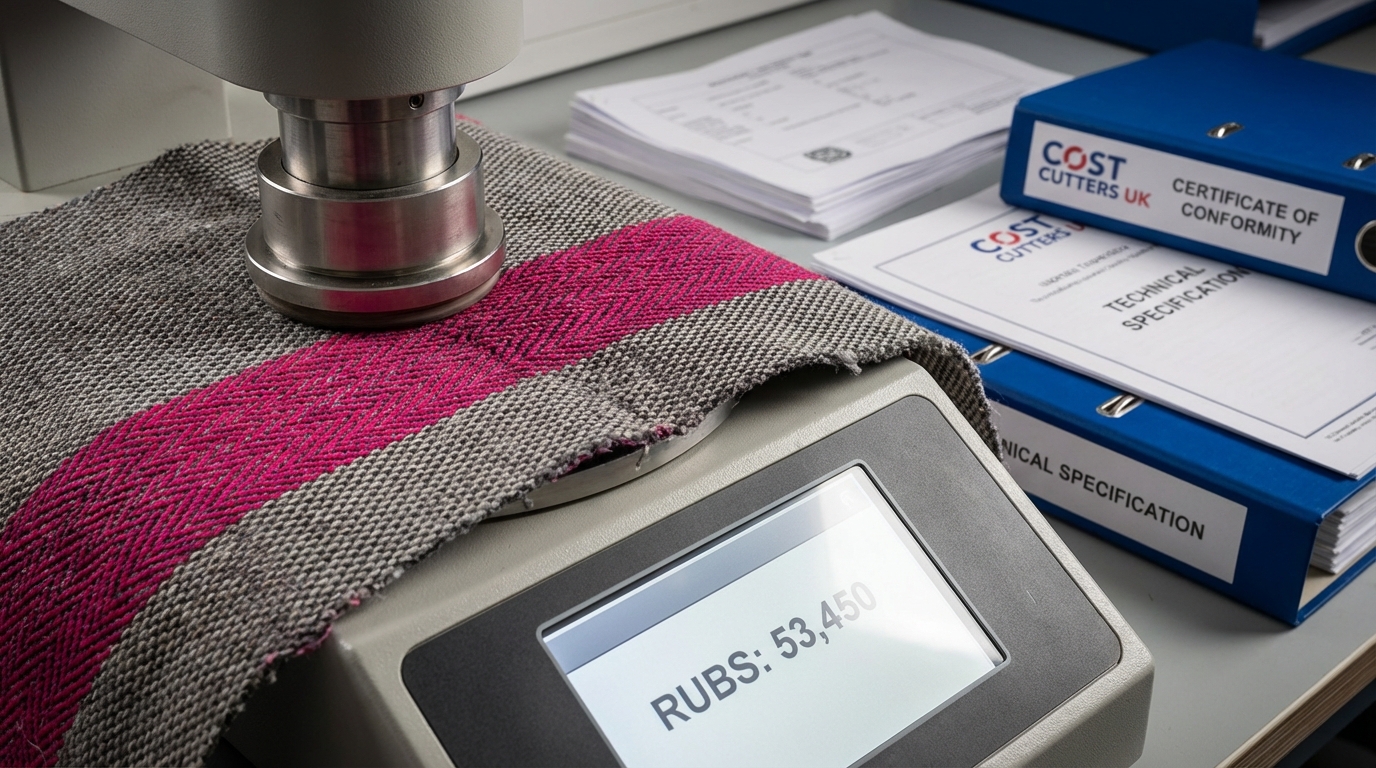
The material choices reflect this. Commercial seating often uses high-density, combustion-modified foam that retains its shape and support for years, whereas domestic sofas may use softer, lower-density foam that can sag and lose form quickly. The fabrics are also in a different league. According to industry resource LOF Office Furniture (2023), a key differentiator is the Martindale test, which measures fabric abrasion resistance. Domestic fabrics might pass at 15,000 rubs, but commercial ‘contract’ fabrics often exceed 40,000, with some reaching over 100,000 for severe-use areas. This is a clear indicator of office furniture durability standards.
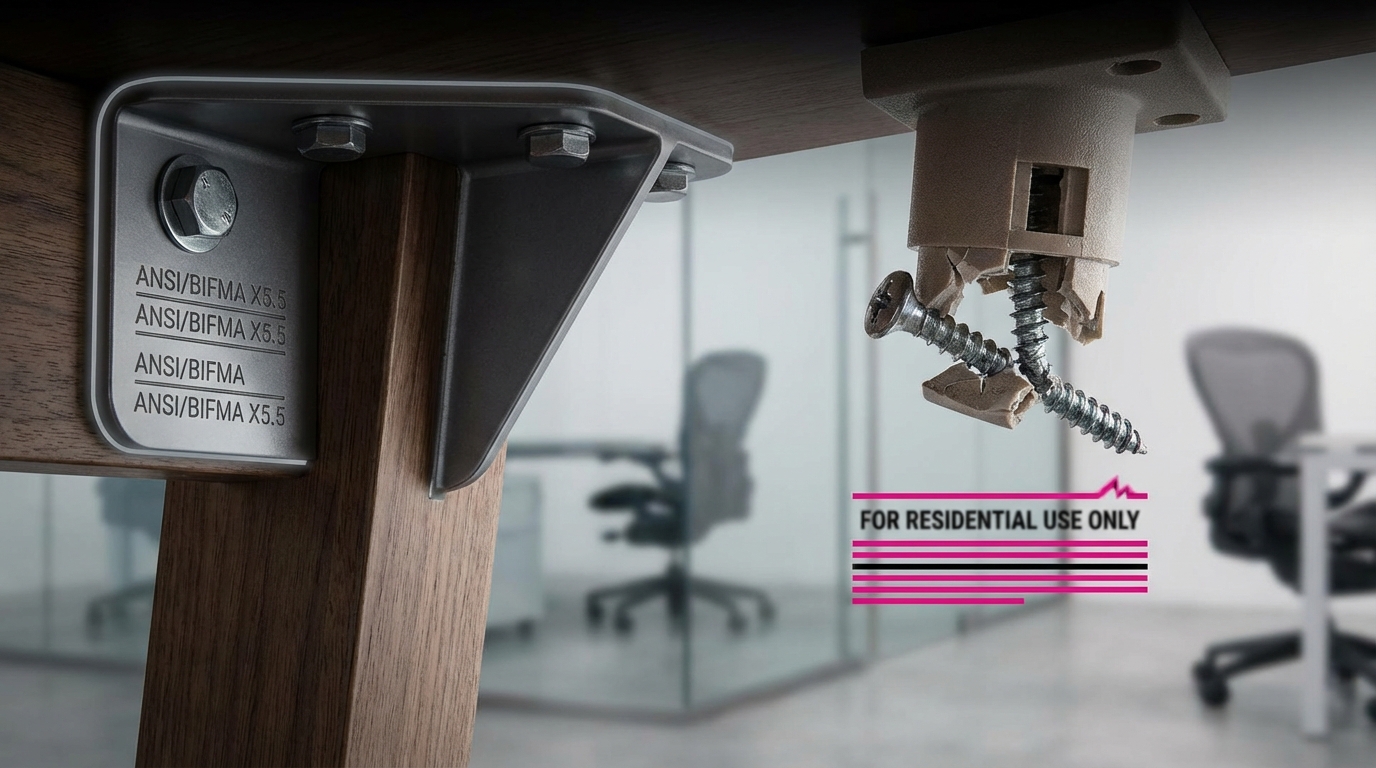
The difference between an office sofa and a home sofa is a well-suited example. A commercial sofa will likely feature a robust frame of solid wood or steel, with reinforced joints designed to handle heavy and repeated use. A domestic sofa, however, may rely on particleboard and simpler construction methods. This superior build quality is why we typically discuss Total Cost of Ownership (TCO). TCO is a financial estimate intended to help buyers determine the direct and indirect costs of a product. A cheaper home chair might need replacing three times in the same period a single, more robust commercial chair would last, making the commercial option far more cost-effective in the long run.
Why is UK Safety & Compliance a Non-Negotiable?
No, home furniture does not typically meet the legal safety requirements for UK office or public use, and this is the most critical factor in the office vs home furniture debate. For any space used by employees, clients, or the public, fire safety is a legal obligation for the business owner or premises manager. Using non-compliant furniture is a serious breach of duty that can invalidate your insurance and lead to prosecution in the event of a fire.

The key legislation is The Furniture and Furnishings (Fire) (Safety) Regulations 1988. This law mandates that all upholstered furniture in commercial and public settings must meet higher flammability resistance standards than domestic furniture. Specifically, items must pass the British Standard 5852 (BS 5852) Ignition Source 5 test, commonly known as ‘Crib 5’. This test involves applying a small wooden crib (the ‘source’) to the furniture to see if it ignites and, if so, whether it self-extinguishes. Domestic furniture only needs to pass a lower-level test (smouldering cigarette and match), making it unsuitable and illegal for office use. Data from the UK Government on fire safety responsibilities underscores the employer’s duty to manage these risks.
To ensure compliance, look for FIRA certification furniture. The Furniture Industry Research Association (FIRA) is the UK’s recognised authority on furniture standards. A FIRA certificate provides independent verification that a product has been tested for safety, structural integrity, and ergonomic suitability. We’re proud to hold numerous our UK safety certifications and accreditations, as it gives our clients absolute confidence that they are purchasing compliant, safe, and reliable products. It’s a benchmark for quality that simply doesn’t exist in the domestic market.
How Does Ergonomics Impact Productivity and Wellbeing?
Yes, commercial furniture almost typically offers superior ergonomic support, which is a direct investment in your team’s health, wellbeing, and productivity. In the United Kingdom, employers have a legal duty of care under the Health and Safety Executive (HSE) guidelines for Display Screen Equipment (DSE). The HSE is Great Britain’s national regulator for workplace health and safety. The DSE regulations state that workstations must be assessed and that equipment, including chairs, must meet minimum requirements to prevent work-related health issues.

A typical domestic chair offers minimal, if any, adjustability. In contrast, a commercial-grade ergonomic office chair is a highly engineered tool. It provides multiple adjustment points, including seat height, seat depth, back-angle tilt, and adjustable armrests, allowing the user to tailor the chair to their specific body shape and task. This is essential for preventing musculoskeletal disorders (MSDs), which according to the HSE, are a leading cause of lost work days in the UK. A study by workspace specialists Zentura (2024) highlights that ergonomic design is a primary reason for the price difference between commercial and domestic furniture.
Beyond chairs, commercial furniture design incorporates functionality that supports a productive work environment. This includes desks with built-in cable management to create tidy and safe workspaces, and modular systems that allow for the creation of flexible breakout furniture. These spaces encourage collaboration and provide alternative postures throughout the day, further enhancing employee wellbeing. Investing in proper ergonomics isn’t a luxury; it’s a strategic decision that pays dividends through reduced absenteeism and higher performance.
What is The Financial Case for Commercial Furniture?
Yes, office furniture is a business expense in the UK, but how you account for it is crucial for financial planning. The higher upfront cost of commercial furniture often deters businesses, but this overlooks the far more important metric: Total Cost of Ownership (TCO). The financial case for commercial office vs home furniture becomes clear when you analyse value over time, not just the initial price tag.
Let’s illustrate TCO with a simple example. A domestic-grade task chair might cost £80 but comes with a 1-year warranty and needs replacing every 2 years under office conditions. Over a 10-year period, you would buy 5 chairs, costing £400, plus the administrative time and disruption of frequent replacement. A comparable commercial-grade chair might cost £250 upfront but comes with a 10-year warranty. The TCO for the commercial chair is £250, saving you £150 and significant hassle. This is the core of smart procurement.
So, is office furniture a business expense UK businesses can claim? According to guidance from HM Revenue and Customs (HMRC), the UK’s tax authority, office furniture is not treated as a simple day-to-day ‘allowable expense’ like stationery. Instead, it is classified as a capital asset. This means businesses can claim ‘capital allowances’ on the cost. As detailed on the GOV.UK website, this allows you to deduct a percentage of the item’s value from your pre-tax profits each year, effectively reducing your corporation tax bill. This tax benefit is a significant financial advantage that applies to commercial-grade assets, not personal home items used in a business context.
### Case Study: A Hypothetical School Scenario
– Challenge: A multi-academy trust needed to furnish 15 new classrooms. Their initial budget, based on quotes using near-domestic grade furniture, was tight and didn’t account for long-term wear and tear in a demanding school environment. They were facing a choice between low initial cost and long-term durability.
– Solution: We conducted a TCO analysis comparing the cheap option with our recommended mid-range, commercial-grade classroom furniture. We demonstrated that while the initial outlay was 20% higher, our solution offered a 10-year warranty versus the competitor’s 2-year warranty and met all required UK educational and fire safety standards.
– Results: The trust opted for the commercial-grade solution. Over the first five years, they have had a 0% replacement rate due to defects, compared to an estimated 30% replacement rate with the cheaper option. This has already saved them an estimated £18,000 in replacement costs and administrative time, justifying the initial investment. Our Bulk Buy Discounts also helped them stay within their revised budget.
– Key Insight: Presenting a clear TCO calculation is the most effective way to shift the conversation from initial price to long-term value and risk management.
Important Considerations
This guidance primarily applies to organisations furnishing commercial or public premises, such as offices, schools, healthcare facilities, and hospitality venues. The legal and insurance implications are most stringent in these environments where a duty of care extends to employees, customers, and the public. Research into the long-term durability of specific domestic furniture pieces used in intensive home-office settings is still developing, as this trend has accelerated significantly in recent years.
An alternative approach might be considered for a sole trader operating exclusively from a private home office that is rarely visited by employees or the public. In this specific scenario, the legal requirement for Crib 5 fire retardancy may not apply, and domestic furniture could be used. However, the principles of ergonomics for preventing MSDs remain just as important. The answer to “can I use home furniture in an office?” is almost typically no for a registered business premise, but the lines can blur in a purely private dwelling.
Ultimately, we strongly advise that for any space that will be used by employees, clients, students, or members of the public, you must consult a professional commercial supplier. This is the only way to guarantee you are meeting all legal, safety, and insurance obligations. Also, to benefit from UK tax advantages like capital allowances, the furniture must be a verifiable business asset. Relying on domestic furniture introduces risks that are simply not worth taking. Our “Design To Install We Do It All!” service ensures every aspect, from compliance to layout, is handled professionally, Saving Time & Stress.
Frequently Asked Questions About Office and Home Furniture
What is the difference between office furniture vs home furniture?
The key difference is that commercial-grade items are built and certified for safety, durability, and heavy use in public environments, while home furniture is not. This means office furniture meets stricter fire safety laws (Crib 5), uses more robust materials, and is tested to withstand 8+ hours of daily use. Home furniture is designed for occasional use by a few people.
Can I claim office furniture on my taxes in the UK?
Yes, you can typically claim the cost of office furniture as a capital allowance against your UK business’s pre-tax profits. This reduces your overall tax bill over several years. It is not usually treated as a simple day-to-day allowable expense but rather as a long-term asset investment for the business.
What is the difference between an office sofa and a home sofa?
An office sofa uses high-density foam and durable contract fabric that withstands constant use and meets UK commercial fire safety regulations (Crib 5). In contrast, a home sofa uses softer materials designed for occasional use and only needs to meet less stringent domestic fire codes. The frame of an office sofa is also engineered for much greater structural integrity.
Is office furniture a 5 or 7 year asset?
For UK tax purposes, office furniture is typically categorised under the main rate pool for capital allowances, allowing for an 18% writing down allowance per year. The ‘5 or 7 year’ asset classification is a concept more commonly associated with United States tax law (MACRS) and does not directly apply in the same way under HMRC rules in the UK.
Can I use home furniture in a business office?
Using home furniture in a UK business office is strongly discouraged as it typically does not meet the legal fire safety regulations (Crib 5) for commercial spaces. This can invalidate your business insurance, breach health and safety law, and create a significant legal liability for the company directors or premises manager in the event of an incident.
What is FIRA certification for furniture?
FIRA certification is a quality mark from the UK’s Furniture Industry Research Association, indicating a product has passed stringent independent tests. These tests cover safety, structural integrity, and overall fitness for purpose in a demanding commercial or public setting. It is a key indicator of high-quality, reliable commercial furniture.
Are there legal requirements for office chairs in the UK?
Yes, under the Health and Safety (Display Screen Equipment) Regulations 1992, chairs for DSE users must be stable, allow easy movement, and have an adjustable seat height and back. They must also comply with the same commercial office furniture fire regulations UK law requires for all other upholstered items in the workplace, meaning they must be Crib 5 compliant.
Is office furniture an allowable expense?
No, office furniture is generally not considered a day-to-day ‘allowable expense’ in the same way as items like stationery or utility bills. Instead, it is treated as a ‘capital asset’ for the business. The cost is claimed back over several years through the capital allowances system, which reduces your taxable profit.
Can I deduct home office furniture if I’m an employee?
Deducting home office furniture costs as a UK employee working from home is exceptionally difficult. You must prove to HMRC that the equipment is ‘wholly, exclusively, and necessarily’ for your job and that your employer does not provide it. The rules are much more straightforward for a limited company or a registered sole trader buying assets for their business.
What are the three main types of furniture?
Furniture can be broadly categorised by its function into three main types: seating (e.g., chairs, sofas), surfaces (e.g., desks, tables), and storage (e.g., cabinets, shelving). Each of these types is then further classified as either domestic or commercial grade, depending on the materials, construction, and safety standards used for its intended environment.
Making the Smart, Strategic Choice for Your Organisation
The debate over office vs home furniture ultimately centres on risk, compliance, and long-term value. While domestic furniture may offer a lower initial price, it introduces significant legal, safety, and financial risks when used in a commercial setting. Choosing commercial grade furniture UK suppliers provide is an investment in your organisation’s safety, your employees’ wellbeing, and your long-term financial health. It is a strategic decision, not a stylistic one.
With over 35 years of experience and being Rated Excellent On Trustpilot, we at Cost Cutters UK have helped countless schools, offices, and public sector organisations make the right choice. Our experts can help you navigate compliance, maximise your budget with Bulk Buy Discounts, and design a space that’s both functional and cost-effective, with options to open Credit Accounts Or Pay Flexibly. Book your free space planning consultation today to ensure your next project is a compliant, durable, and successful investment.
References
- GOV.UK – Government Guidance. This source outlines the legal responsibilities of employers and premises managers regarding fire safety, which includes furnishings and equipment.
- Health and Safety Executive (HSE) – Regulatory Body Guidance. This details the duties employers have for workers who use Display Screen Equipment (DSE), including specific requirements for workstations and chairs.
- The Furniture and Furnishings (Fire) (Safety) Regulations 1988 – UK Statutory Instrument. This is the primary UK legislation governing the flammability standards for furniture used in domestic and commercial environments.
- FIRA International – Industry Body Website. This resource details the various testing standards, including for flammability and structural integrity, that furniture must pass to achieve FIRA certification.
- GOV.UK – Capital Allowances – Government Tax Guidance. This explains how UK businesses can claim tax relief on qualifying assets, known as plant and machinery, which includes office furniture.
- LOF Office Furniture – Industry Analysis (2023). This article provides a detailed comparison of commercial and domestic furniture, highlighting key differences in testing and materials for UK buyers.
- Zentura Workspace – Specialist Insight (2024). This post explores the reasons behind the cost difference, focusing on ergonomics, durability, and compliance as key value drivers in commercial furniture.
- Add Office – Supplier Comparison. This resource contrasts ordinary and office furniture, emphasizing the need for commercial-grade products to withstand constant use in a professional environment.
Conclusion
Making the Smart, Strategic Choice for Your Organisation
In summary, the debate over office vs home furniture ultimately centres on risk, compliance, and long-term value. While domestic furniture offers an appealingly low initial price, it presents significant legal, safety, and financial risks when used in a commercial or public setting. Our assessment is that choosing commercial grade furniture UK suppliers provide is not merely a purchase, but a strategic investment in your organisation’s safety, your employees’ wellbeing, and your long-term financial health.
At Costcutters UK, we have over 35 years of experience helping schools, offices, and public sector organisations make the right choice. Our experts can help you navigate the complexities of compliance and design a functional, durable, and cost-effective space that meets all legal requirements. Book your free space planning consultation today to ensure your next project is a compliant, safe, and successful one.